

There is no single best AI coding agent in 2026, and anyone telling you otherwise is confusing benchmark scores with developer workflow. Claude Code is the strongest choice for deep, multi-step engineering; Codex is the strongest hand-off-and-review option; Cursor is the best daily IDE experience; and Meta's new Muse Code is the aggressive value challenger. The right choice depends on whether you want maximum engineering depth, cloud delegation, editor productivity, or the lowest token bill.
The short version: use Claude Code for complex codebase work, Codex for asynchronous delegated tasks, Cursor for an editor-first workflow, and Muse Code when cost and parallel agent execution matter most. For the wider landscape, the Best AI Coding Tools 2026 collection is the place to track the category as new agents ship.
In 2026, Claude Code is the best default for serious software engineering, Cursor is the best choice for developers who want AI embedded directly in the IDE, Codex is the best fit for teams that want to delegate work to cloud agents and review the result later, and Muse Code is the most interesting new value play. That ranking is deliberately not based on one benchmark: an empirical study of 7,156 pull requests found that task type mattered more than typical inter-agent differences, with Claude Code leading documentation and feature tasks while Cursor led fix tasks and Codex showed consistently strong acceptance across categories.
The 2026 AI Coding Agent Rankings
Best Overall: Claude Code
If you only want one coding agent for serious engineering, Claude Code is the safest default. It is terminal-native, understands repositories deeply, can edit multiple files, run commands, execute tests, and keep working through a task instead of stopping after generating a code snippet. Its biggest advantage is not a flashy benchmark. It is the combination of model quality and workflow depth.
Claude Code also benefits from a mature project-context system. CLAUDE.md files let teams persist architecture rules, coding conventions, commands, and project-specific constraints across sessions. That matters more than it sounds: an agent that knows how your repository works from the beginning wastes fewer turns rediscovering the same context.
Build Fast with AI's Claude Code vs Codex comparison goes deeper on the terminal-first workflow, benchmarks, pricing, and why Claude Code remains the stronger choice for difficult multi-file refactors.
My take: Claude Code is the best agent here if your definition of 'best' is 'I trust this thing with an ugly production problem.' It is not necessarily the cheapest and it is not the prettiest interface, but engineering depth is where it earns its position.
Best for Delegated Work: OpenAI Codex
Codex takes a different approach. Instead of making the terminal the center of the experience, OpenAI has built Codex across the CLI, IDE extensions, desktop app, and cloud execution. You can give it a task, let it work in an isolated environment, and review the resulting branch rather than supervising every command.
That makes Codex particularly useful for teams that want asynchronous development: fix this issue, update these tests, investigate this regression, or implement this scoped feature while the developer works on something else. OpenAI says Codex is included with eligible ChatGPT plans, while usage is now measured through token-based credits; its current rate card explicitly moved away from per-message pricing to token-based accounting.
OpenAI's Codex documentation and rate card are worth checking before budgeting because actual consumption depends on model, input, cached input, output, task complexity, and fast-mode usage.
The strongest argument for Codex is ecosystem fit. If your team already lives in ChatGPT, GitHub, VS Code, and OpenAI's APIs, adding another vendor just for coding may create unnecessary friction. Codex turns that existing ecosystem into an agentic development workflow.
Best Value Challenger: Muse Code
Muse Code is the new entrant that makes the old pricing of coding agents look uncomfortable. Meta launched it in beta in August 2026 as a terminal-based coding agent powered by Muse Spark 1.2. It can plan changes, write and debug code, handle long software-engineering tasks, and run multiple sub-agents concurrently.
The headline is price. Reuters reported Muse Code at $1.25 per million input tokens and $4.25 per million output tokens. That is a pay-as-you-go model rather than the simple $20/month subscription approach used by several competitors. Meta also introduced a much cheaper contributor tier in exchange for allowing coding activity to be used to improve its products, which is a trade-off businesses with proprietary code should examine carefully.
The important caveat is that Muse Code is still a beta product. Unlike Claude Code and Codex, it does not yet have the same depth of independent evaluation or long production track record. For context on how agent architecture matters beyond model scores, compare it with Grok Build's parallel-agent design rather than looking only at token prices.
My hot take: Muse Code is more important as a pricing weapon than as a proven Claude killer. If the quality is close enough, $1.25/$4.25 changes what teams consider acceptable coding-agent economics. But 'cheap' is not the same as 'cheap per successful PR,' and that second number is the one worth measuring.
Best Daily Driver: Cursor
Cursor wins a different contest. It is an editor-first environment, built around a VS Code-style workflow where the agent sits beside the code instead of making the terminal the primary interface. For developers who constantly jump between inline edits, completions, Agent tasks, debugging, and manual changes, that integration can be more productive than a pure CLI.
Cursor's current plans include a free Hobby tier, Pro at $20/month, Pro+ and Ultra tiers with higher usage, and team plans. The product also supports frontier models, MCPs, skills, hooks, cloud agents, and Bugbot. That breadth is the real reason Cursor remains competitive even as standalone agents become stronger.
Cursor's current pricing page shows the subscription structure and included Agent, cloud-agent, MCP, skills, and hooks features.
Cursor's weakness is the same thing that makes it powerful: abstraction. You are buying a platform that can route across models and tools, not just a single coding model. That can be excellent for productivity, but it makes usage economics harder to reason about than a simple API bill.
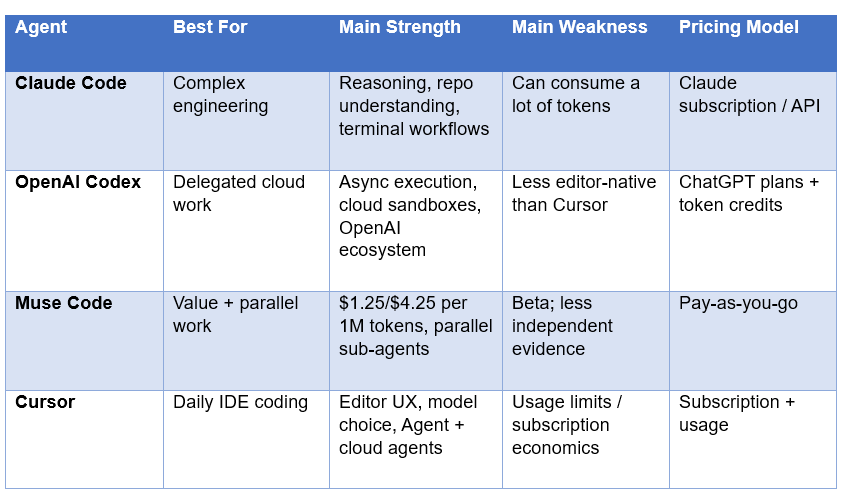
Claude Code vs Codex vs Muse Code vs Cursor
Here is the practical comparison. Don't read it as a permanent leaderboard; these products are moving too quickly. Read it as a workflow map.
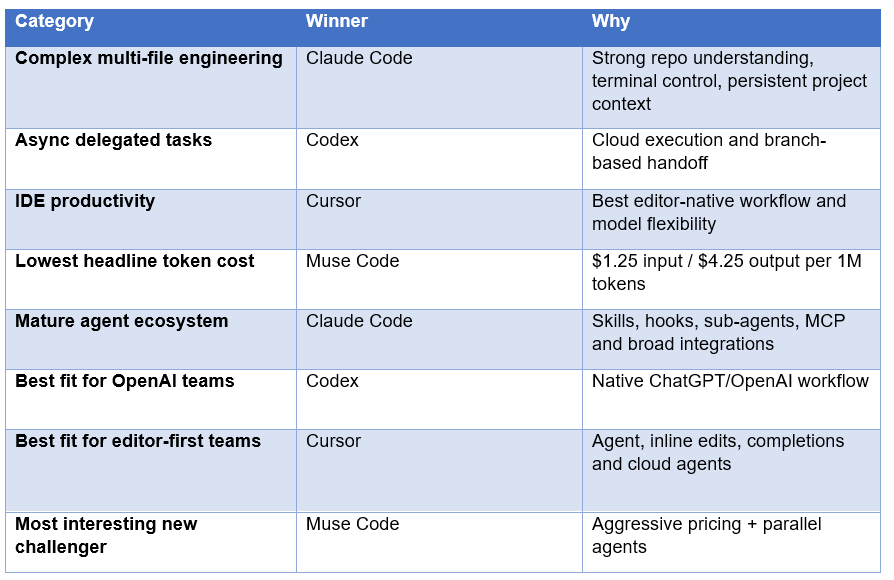
What the Benchmarks Actually Tell You
The biggest mistake in coding-agent comparisons is treating one benchmark as the answer. Software engineering is not one task. A 2026 empirical study using 7,156 pull requests found acceptance rates varied substantially by task type: documentation reached 82.1% acceptance while new-feature tasks were only 66.1%. That task difference was larger than the typical gap between agents, which means a model can be 'best' for one class of work and mediocre for another.
The same study found Claude Code led documentation at 92.3% and feature tasks at 72.6%, Cursor led fix tasks at 80.4%, and Codex maintained consistently high acceptance across all nine task categories. That is a much more useful way to think about coding agents than asking which logo is #1.
Security is another blind spot. A July 2026 IssueTrojanBench study found 66.5% of malicious issues penetrated all tested guardrails across modern coding-agent deployments. The practical lesson is brutal: giving an agent access to your repository, shell, CI, credentials, or issue tracker changes your threat model. The best coding agent is not automatically the safest coding environment.
For a deeper look at the wider developer-tool landscape, the AI Coding Tools collection tracks agent, IDE, CLI, and model changes together.
Which Agent Should You Actually Buy?
The answer depends on the work, not the benchmark screenshot.
- Building a large production feature: Claude Code.
- Delegating tickets while you work elsewhere: Codex.
- Living inside VS Code and wanting AI everywhere: Cursor.
- Running high-volume coding tasks where token economics dominate: Muse Code.
- Managing a complex repository with persistent conventions: Claude Code.
- Working in an OpenAI-heavy team: Codex.
- Wanting to switch models without changing your editor: Cursor.
- Experimenting with a new agent at aggressive token prices: Muse Code.
My preferred setup for a serious team is not actually one agent. Use Cursor as the daily editor, Claude Code for hard engineering tasks, and Codex or Muse Code for delegated work depending on the workload and data policy. That sounds more expensive, but routing every task to the most expensive agent is usually the bigger waste.
The Contrarian Take: Stop Asking Which Agent Is Best
The more useful question in 2026 is: which agent gives us the lowest cost per accepted change? A developer does not get paid for tokens generated, benchmark points, or lines of code. The business gets value when a correct change is merged without creating another problem.
That changes how you should evaluate these tools. Give each agent the same 30 to 50 real tickets from your own repository. Measure first-pass acceptance, review time, rollback rate, token spend, wall-clock time, and security incidents. Then pick the winner for your workload. A public benchmark can tell you where to start. Your repository tells you what to buy.
What Changed in 2026
AI coding agents have stopped being autocomplete products. Claude Code, Codex, Cursor, and Muse Code can now operate across files, execute commands, run tests, delegate work, and in some cases continue working without the developer sitting in front of the terminal.
The competitive battle has therefore moved up one level. It is no longer just model quality. It is model + agent loop + tools + context + sandboxing + developer experience + price. That is why Cursor can remain relevant even when the underlying models are available elsewhere, and why Muse Code can matter even before it has a huge benchmark record: the product architecture changes the economics.
For another example of how terminal agents are evolving, see Kimi Code K2.6 and Kimi K2.7 Code to see how open and specialized coding models are pushing the category from another direction.
How to Build Your Own Coding-Agent Evaluation
Do not start with SWE-bench. Start with your repository. Pick real bugs, feature tickets, refactors, test failures, documentation tasks, and dependency upgrades that your team has already completed.
- Freeze the issue description so every agent receives the same task.
- Give every agent the same repository state and relevant permissions.
- Measure whether the final tests pass, not whether the agent says they pass.
- Track token usage and wall-clock time.
- Record how many manual interventions were required.
- Have a human reviewer score correctness and maintainability.
- Run security tests against untrusted issue text and repository content.
- Calculate cost per accepted change, not cost per token.
For hands-on experiments, you can adapt the Build Fast with AI Gen-AI-Experiments cookbook to create a repeatable evaluation harness rather than relying on one-off demos.
Frequently Asked Questions
What is the best AI coding agent in 2026?
Claude Code is the strongest overall choice for serious engineering and complex multi-step work. Cursor is the best editor-first choice, Codex is strong for delegated cloud work, and Muse Code is the most interesting value challenger.
Is Claude Code better than Codex?
For complex multi-file engineering, Claude Code is the safer default. Codex is stronger when you want to delegate work to cloud agents and review branches later. A 2026 pull-request study found Claude Code led some task categories while Codex was consistently strong across all nine.
Is Cursor better than Claude Code?
Not universally. Cursor is better if your productivity depends on an integrated editor with inline changes, completions, Agent mode, and model choice. Claude Code is better when you want a terminal-native agent to own a larger engineering task.
What is Muse Code?
Muse Code is Meta's beta terminal coding agent powered by Muse Spark 1.2. It is designed for complex software-engineering tasks and can execute multiple sub-agents concurrently. Reuters reported pricing of $1.25 per million input tokens and $4.25 per million output tokens.
How much does Claude Code cost?
Claude Code is available through Anthropic's paid Claude plans, with Claude Pro listed at $20/month in the US. API usage is separately metered by model and token consumption. Heavy agent usage can require higher-tier plans.
How much does Codex cost?
Codex is included with eligible ChatGPT plans, with usage limits varying by plan. OpenAI moved Codex to token-based credit pricing in 2026, so actual consumption depends on input, cached input, output, model, and task complexity.
How much does Cursor cost?
Cursor has a free Hobby plan, Pro at $20/month, higher Pro+ and Ultra tiers, and team plans. Its current product includes Agent, cloud agents, MCPs, skills, hooks, and access to frontier models.
Which coding agent is cheapest?
Muse Code has the lowest headline token pricing among these four at $1.25 per million input tokens and $4.25 per million output tokens. But cheapest tokens do not automatically mean cheapest completed software task; reliability and retry rates can change the economics.
Which AI coding agent is best for large codebases?
Claude Code is the strongest default for large, complex repositories because of its terminal-native workflow, persistent project instructions, context handling, and agentic tooling. Cursor can be equally compelling for teams that want the same work inside an IDE.
Recommended Blogs
- Claude Code vs Codex: Which Terminal AI Tool Wins in 2026?
- Grok Build: xAI's Agent CLI Reviewed (2026)
- Kimi Code K2.6 Preview: What Developers Need to Know
- Kimi K2.7 Code Review 2026: 1T Coding Model Tested
- Claude Code Desktop Redesign: Multi-Sessions + Routines
- OpenAI Codex Is Now on Mobile: What Developers Need to Know
Resources & Community
Join our community of 70,000+ AI enthusiasts and learn to build powerful AI applications! Whether you're a beginner or an experienced developer, Build Fast with AI helps you understand and implement AI in your projects.
- Website — buildfastwithai.com
- LinkedIn — Build Fast with AI
- Instagram — @buildfastwithai
- Founder Twitter — @satvikps
- Twitter — @BuildFastWithAI
Agentic AI Launchpad 2026
A structured 6-week cohort program that takes you from AI basics to building and deploying real-world agentic AI systems. Includes live sessions, expert mentorship, project reviews, and a builder community network.
Ready to go from learning to building? Join the next cohort → Agentic AI Launchpad 2026
Free AI Resources
Access free tools, workshops, and micro-learning to keep building:
- AI Workshops — Free resources, upcoming events & past recordings
- Unrot — Learn AI in 5 minutes a day (free micro-learning app)
The coding-agent race is no longer about one winner. Build your evaluation set, measure cost per accepted change, and let your own repository decide.
References
- Reuters — Meta launches Muse Code AI coding tool powered by Muse Spark 1.2
- OpenAI Help Center — Codex rate card
- OpenAI Help Center — Using Codex with your ChatGPT plan
- Cursor — Pricing
- Anthropic Help Center — How much does Claude Pro cost?
- ArXiv — Comparing AI Coding Agents: A Task-Stratified Analysis of Pull Request Acceptance
- ArXiv — IssueTrojanBench: Benchmarking AI Coding Agents Against Malicious Issue Requests
- Build Fast with AI — Best AI Coding Tools 2026

