



Kimi Code K2.6 Preview: What Every Developer Needs to Know (2026)
Beta testers spent a week inside K2.6-code-preview and kept noticing something odd: the console still said K2.5, but the model was clearly better. Deeper reasoning traces, cleaner agent planning, faster multi-step tool calls. On April 13, 2026, Moonshot AI confirmed everything with a single email and rolled K2.6 out to all Kimi Code subscribers.
This is not a minor patch. The jump from K2.5 to K2.6 mirrors what happened between K2 and K2 Thinking in late 2025 — enough of a leap that early testers on Reddit called it "Opus-flavored." Now the question is: does the broader rollout hold up to that hype?
I've been tracking Kimi Code since it launched alongside K2.5 in January 2026. Here's a no-spin breakdown of what K2.6 actually changes, how it stacks up against Claude Code and Cursor, and whether it's worth your subscription dollars right now.
What is Kimi Code K2.6?
Kimi Code K2.6 is Moonshot AI's latest iteration of its terminal-based AI coding agent, built on the K2.6-code-preview model and officially made available to all Kimi Code subscribers on April 13, 2026. It is a coding-specialized upgrade of the K2.5 foundation model, tuned specifically for writing, debugging, refactoring, and orchestrating multi-step software development tasks from the command line.
Kimi Code itself launched in January 2026 alongside Kimi K2.5. Think of it as Moonshot's answer to Claude Code — a terminal-first AI developer tool that plugs into existing workflows. The K2.6 preview had been running in closed beta for about a week before the full rollout. Beta testers noticed performance gains but couldn't pin down a model name because the console consistently displayed "kimi-for-coding" as the unified model identifier.
If you want to see how Kimi Code compares in the broader landscape of developer tools, the top 11 AI-powered developer tools for 2026 gives context on where tools like this sit in a developer's stack.
The K2.6 model is described by Moonshot as featuring improved reasoning depth and better agent planning over K2.5 — two areas that directly affect how well a coding assistant handles complex, multi-file refactors and agentic task decomposition.
What Actually Changed from K2.5 to K2.6
K2.6-code-preview improves on K2.5 in three specific areas confirmed by beta testers and the Moonshot email rollout announcement: reasoning depth, agent planning quality, and reliability during multi-step tool calls.
On reasoning depth: testers reported that K2.6 produces longer, more structured thinking traces — one community member described the style as "very Opus," noting it frequently produced "Let me..." prefixes during internal reasoning, similar to Claude Opus 4.6's verbose chain-of-thought. Whether you find that useful or annoying depends on how much you care about auditability versus speed.
On agent planning: the model gets better at breaking down large tasks into parallelizable sub-tasks without collapsing into serial execution. This builds on the Agent Swarm infrastructure introduced in K2.5, which allows up to 100 coordinated sub-agents. K2.6 reportedly improves the orchestrator's ability to route tasks without the orchestrator defaulting back to a single-agent loop — a known weakness in earlier Kimi models.
What Moonshot has NOT confirmed: exact benchmark numbers for K2.6 vs K2.5. The company says the team is making final adjustments based on beta feedback before publishing official evals. I'll update this post the moment those numbers drop.
Key K2.5 baseline for context (what K2.6 builds from):
- SWE-Bench Verified: 76.8% (K2.5 baseline)
- LiveCodeBench: 85% (K2.5 baseline)
- 256K context window, 100 tokens/second output speed
- 1 trillion total parameters, 32B active per forward pass (MoE architecture)
- Agent Swarm: up to 100 sub-agents, 4.5x faster on parallelizable tasks
Kimi Code K2.6 vs Claude Code vs Cursor: Real Benchmarks
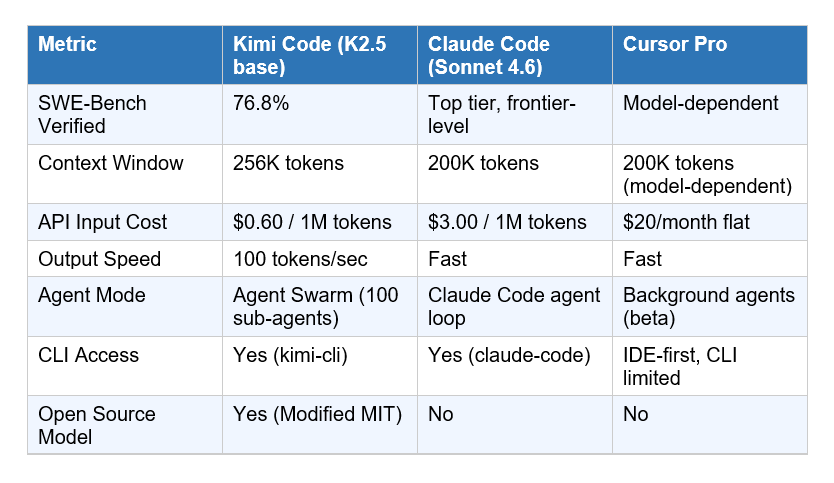
Kimi Code K2.6 competes most directly with Claude Code (backed by Claude Sonnet 4.6) and Cursor Pro on coding agent tasks. Here's a direct comparison based on the K2.5 baseline — K2.6 should push those numbers higher once official evals land.
The Claude Code side of this comparison is evolving fast. For a fuller picture of what Claude's managed agents actually do in production, see this Claude Managed Agents review from April 2026.
My honest read: on raw coding benchmarks, Kimi K2.5 (and by extension K2.6) is genuinely competitive with Claude Sonnet 4.6. Where Claude still wins is in complex English-language instruction following and reliability on multi-constraint agent loops. Kimi wins hard on cost and on Chinese-bilingual tasks.
How to Access Kimi Code K2.6 Right Now
Kimi Code K2.6-code-preview is now available to all Kimi Code subscribers through the subscription dashboard at kimi.com/code. The model appears in the console under the "Kimi for Code" unified label — the naming switch happened alongside the April 13 CLI update (version 1.33.0), which dropped hardcoded K2.5 references from the welcome screen.
CLI access is slightly behind the dashboard rollout as of April 14, 2026. The kimi-cli 1.33.0 update unified model display under "Kimi for Code" but backend routing to K2.6 may still be propagating for some users. If you're seeing K2.5-level outputs after updating, give it 24 hours.
Quick setup for new users:
- Visit kimi.com/code and subscribe (paid tier required for K2.6)
- Install the CLI: curl -L code.kimi.com/install.sh | bash
- Alternatively, plug Kimi K2.5 into Claude Code by setting ANTHROPIC_BASE_URL to the Moonshot endpoint
- Check the console model display — "K2.6-code-preview" confirms you're on the new model
For remote development workflows, Cursor just launched something worth comparing: Cursor Remote Agents for controlling dev from any device. Worth knowing about if you're deciding between the two ecosystems.
Pricing Breakdown: Is It Actually Cheaper?
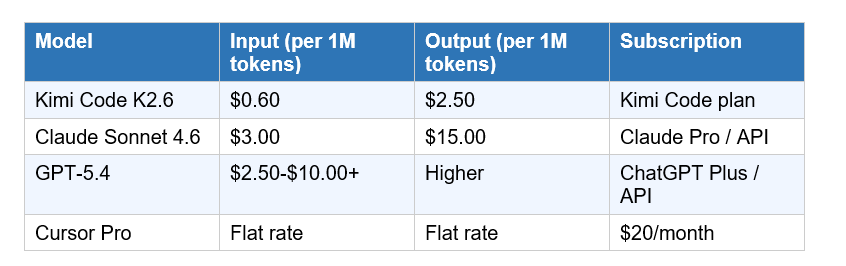
Kimi Code K2.6 costs $0.60 per million input tokens and $2.50 per million output tokens via API, making it 5x cheaper on input and 6x cheaper on output than Claude Sonnet 4.6 at $3.00/$15.00 per million tokens. For teams running high-volume coding agents, that gap is real money.
Here's a concrete example: a startup processing 100 million input tokens and 10 million output tokens monthly pays roughly $85 with Kimi K2.6 versus $450 with Claude Sonnet 4.6. That's a $4,380 annual difference — enough to fund another seat or a meaningful infrastructure upgrade.
One caveat on the Kimi Code subscription: the token quota system allocates 300 to 1,200 API calls per 5-hour window with a max concurrency of 30. For sustained heavy coding sessions, you need to be quota-aware. This is less of an issue for most developers but matters a lot for automated pipelines running overnight.
Where Kimi Code K2.6 Falls Short (Honest Take)
K2.6 is a real improvement over K2.5 on agent planning and reasoning depth — beta feedback confirms that consistently. But I'd be doing you a disservice if I painted it as a drop-in Claude Code replacement for every workflow.
The CLI access lag at launch is annoying. If you upgraded expecting immediate K2.6 access through the terminal on day one, the backend routing delay is a friction point Moonshot should fix faster. Rolling out the dashboard before the CLI creates a confusing user experience.
The unified "kimi-for-coding" model name is also a minor trust issue. When the API always returns "kimi-for-coding" regardless of which underlying model is active, you lose the ability to pin a specific model version in production. That's fine for consumer use but creates headaches for teams running reproducible CI/CD workflows.
On the broader question of open-source model reliability in production, the GLM-5.1 Code Arena breakdown from April 11 is a useful parallel — open-weight models are legitimately competitive now, but the ecosystem gaps (versioning, reproducibility) are real.
The Chinese-first interface and support infrastructure is also worth flagging for international teams. Documentation is improving but still lags OpenAI and Anthropic in English. If your team does not have someone comfortable navigating Moonshot's platform, expect occasional friction.
Who Should Switch to Kimi Code K2.6?
Kimi Code K2.6 is the right call if you fit one of three profiles. First: cost-sensitive teams running coding agents at scale. The 5-6x price advantage over Claude Sonnet 4.6 is not marginal — it's a budget-level decision. Second: developers building bilingual (Chinese and English) products who need a model that handles Chinese output naturally, not awkwardly. Third: developers who want an open-weight model they can self-host — Kimi K2.5 weights are on Hugging Face under a Modified MIT license, and K2.6 will likely follow the same pattern.
If you're evaluating the full spectrum of where AI agent strategy is heading in 2026, the Anthropic Advisor Strategy breakdown on smarter AI agents is worth reading alongside this — it covers the multi-agent orchestration principles that both Claude and Kimi are racing to improve.
Who should stay with Claude Code or Cursor: developers who need maximum reliability on complex English-language multi-constraint agent tasks, teams that need pinnable model versions for reproducible pipelines, and anyone whose workflow depends on tight IDE integration (Cursor still wins here).
The practical answer for most people: benchmark Kimi Code K2.6 on your actual codebase for two weeks. If the outputs match Claude Sonnet 4.6 quality on your tasks, the 5x cost savings alone justify the switch.
Frequently Asked Questions
What is Kimi Code K2.6?
Kimi Code K2.6-code-preview is the latest coding-specialized model from Moonshot AI, powering the Kimi Code terminal-based coding agent. Moonshot rolled it out to all subscribers on April 13, 2026, after a closed beta that ran for approximately one week. It improves on K2.5 with better reasoning depth and stronger agent planning.
How is K2.6 different from K2.5?
Beta testers confirmed that K2.6 produces deeper reasoning traces, cleaner multi-step agent plans, and more reliable tool call execution compared to K2.5. The K2.5 baseline scored 76.8% on SWE-Bench Verified and 85% on LiveCodeBench — official K2.6 benchmark numbers have not been published as of April 14, 2026, but should land shortly.
Is Kimi Code K2.6 free to use?
Kimi Code K2.6 requires a paid Kimi Code subscription. The Kimi chatbot at kimi.com has a free tier, but the coding-specific tool with K2.6 access is subscription-gated. API access is priced at $0.60 per million input tokens and $2.50 per million output tokens as of April 2026.
How does Kimi Code compare to Claude Code?
Kimi Code K2.6 is 5x cheaper on input tokens ($0.60 vs $3.00 per million) and 6x cheaper on output tokens ($2.50 vs $15.00 per million) compared to Claude Sonnet 4.6, which powers Claude Code. On coding benchmarks, K2.5 scores 76.8% on SWE-Bench Verified, competitive with Sonnet-class models. Claude Code holds an edge on complex English-language instruction following and reliable multi-constraint agent loops.
How do I install Kimi Code CLI?
Run curl -L code.kimi.com/install.sh | bash in your terminal. Update to version 1.33.0 or later to get the unified "Kimi for Code" model display that reflects the K2.6 rollout. You can also plug Kimi K2.5/K2.6 into Claude Code by configuring the Moonshot API endpoint as an alternative base URL.
What is Agent Swarm in Kimi Code?
Agent Swarm is Kimi's multi-agent execution mode that coordinates up to 100 specialized sub-agents running in parallel. On tasks like large-scale codebase refactoring or batch code generation, Agent Swarm cuts execution time by up to 4.5x compared to single-agent execution. The K2.6 update improves the orchestrator's ability to maintain parallel execution rather than collapsing into sequential processing.
Can I use Kimi K2.6 weights on my own infrastructure?
Kimi K2.5 model weights are available on Hugging Face under a Modified MIT license and can be deployed via vLLM, SGLang, or KTransformers. K2.6 weights have not been released as of April 14, 2026. The Modified MIT license requires companies with over 100 million monthly users or $20 million monthly revenue to display "Kimi" branding in their products.
Recommended Blogs
These are real posts that exist on buildfastwithai.com right now:
- GLM-5.1: First Open-Weight Model in Top 3 of Code Arena (April 2026)
- Cursor Remote Agents: Control Dev From Any Device (2026)
- Claude Managed Agents Review: Is It Worth It? (2026)
- Anthropic Advisor Strategy: Smarter AI Agents (2026)
- Top 11 AI-Powered Developer Tools Transforming Workflow
Related Cookbooks
References
- 1. Kimi Code Official Page — kimi.com/code (Moonshot AI, April 2026)
- 2. Kimi K2.5 Model Card — Hugging Face (moonshotai/Kimi-K2.5)
- 3. Kimi K2.5 Official Page — kimi.com/ai-models/kimi-k2-5
- 4. Moonshot AI API Platform — platform.moonshot.ai
- 5. Kimi K2.5 Developer Guide — Moonshot API Docs
- 6. Kimi Code K2.6 Community Discussion — Reddit r/kimi

