



The Best AI Coding Models Under $5 per Million Tokens (2026)
AI coding has entered a different cost era. Strong models are no longer limited to premium price bands. Several current systems can handle serious software engineering, coding agents, tool use and long-context work while staying under $5 per million tokens on both input and output.
The lowest prices are striking. DeepSeek V4 Flash is currently priced at $0.22 per million input tokens and $0.66 output during off-peak periods, while GLM-5.3-Flash lists at $0.15 input and $0.50 output. GPT-5.6 Luna costs $0.20 input and $1.20 output, MiniMax M3 costs $0.30 and $1.20, Gemini 3.8 Flash costs $0.75 and $3.75 through the end of 2026, and GPT-5.4 mini costs $0.75 and $4.50.
But a cheap token is not necessarily a cheap coding task. Agents spend money on repository context, reasoning, tool calls, test output and retries. The useful question is therefore not just 'What is the price per million tokens?' It is 'How much working software can the model deliver for each dollar?'
QUICK ANSWER
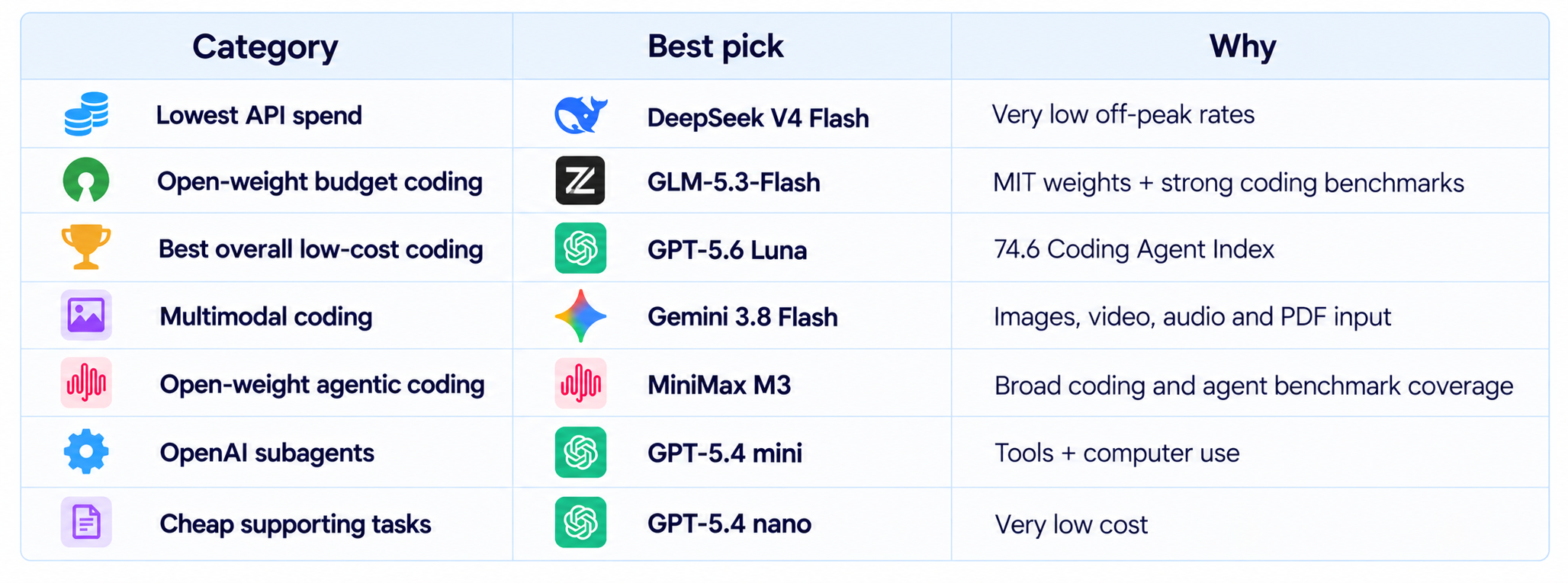
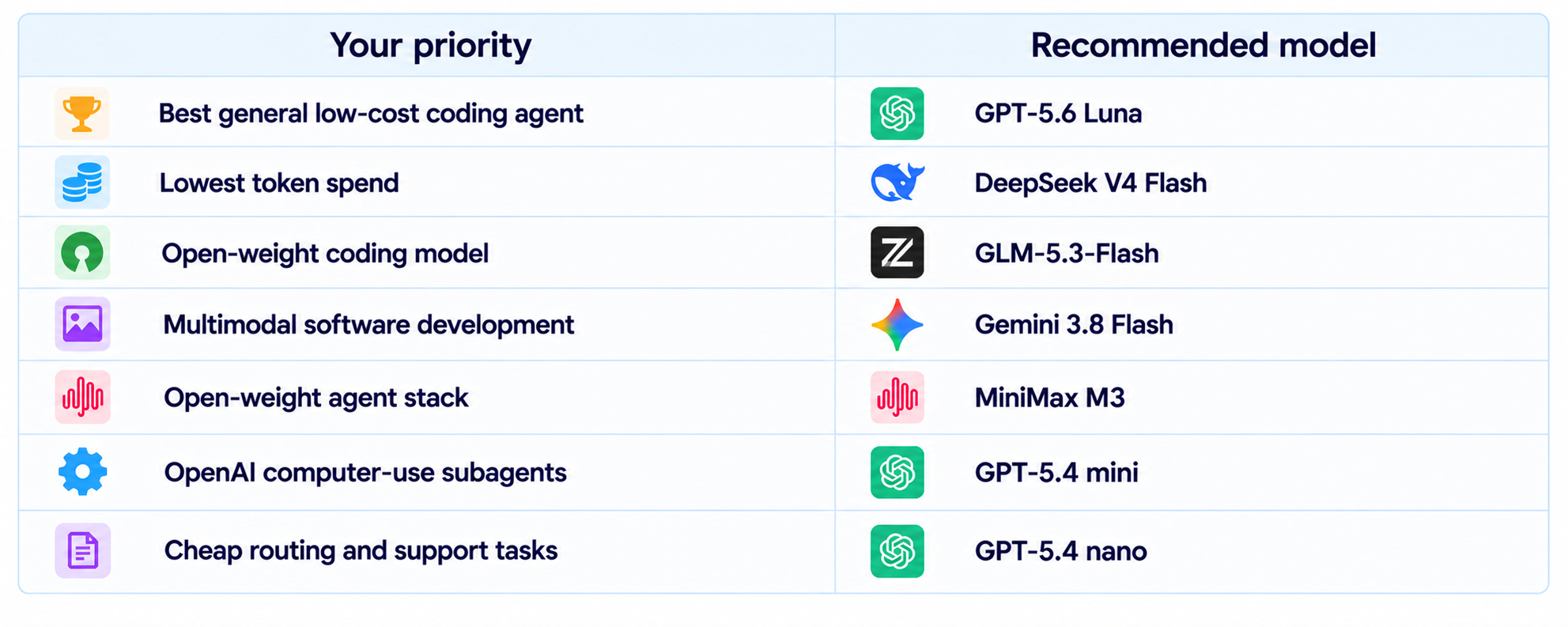
GPT-5.6 Luna is the best all-around low-cost coding model in this comparison, especially for developers already using OpenAI tooling. GLM-5.3-Flash is the strongest open-weight budget option, DeepSeek V4 Flash is the best pure cost choice, Gemini 3.8 Flash is the best multimodal workhorse, and MiniMax M3 is a strong open-weight agentic alternative.
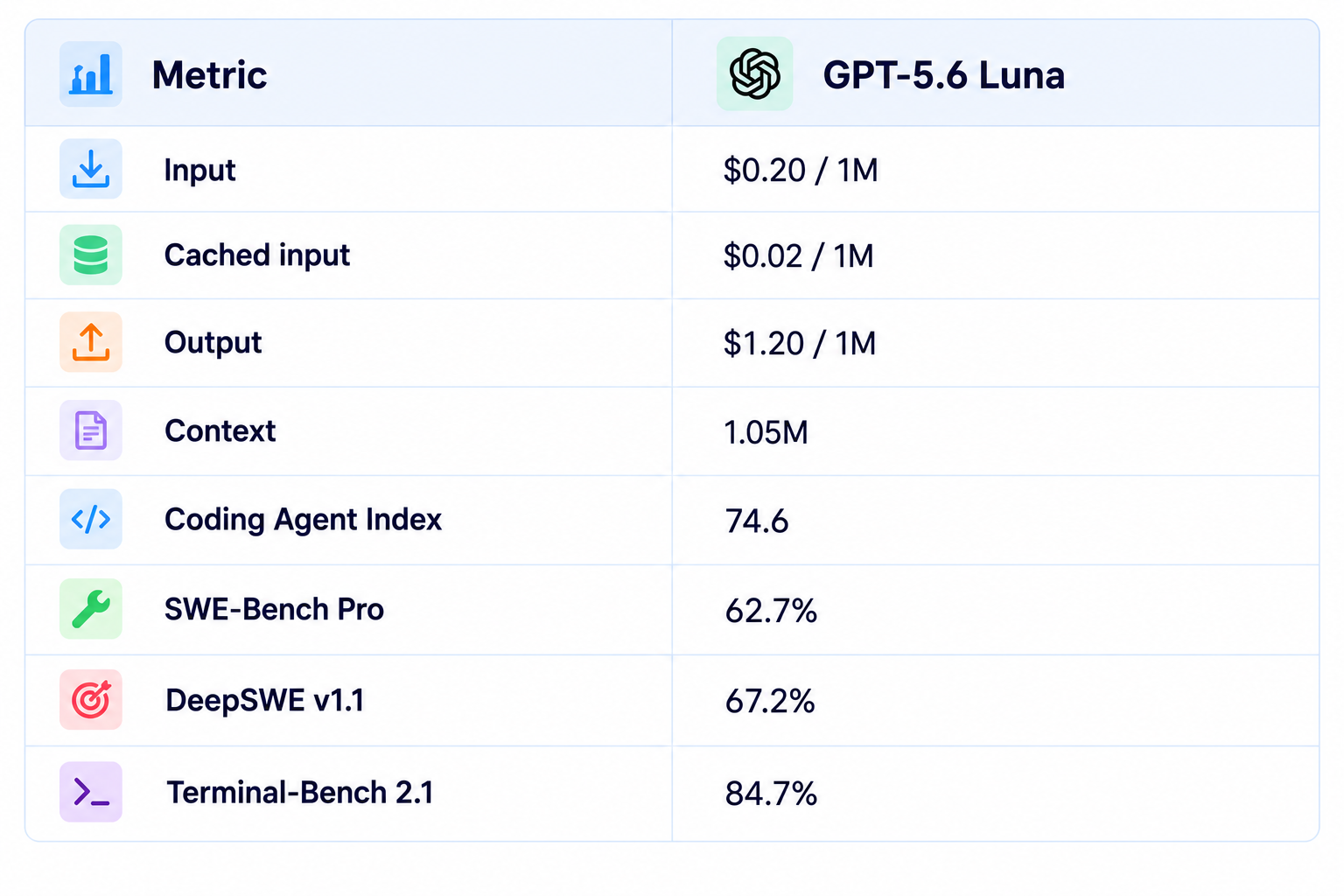
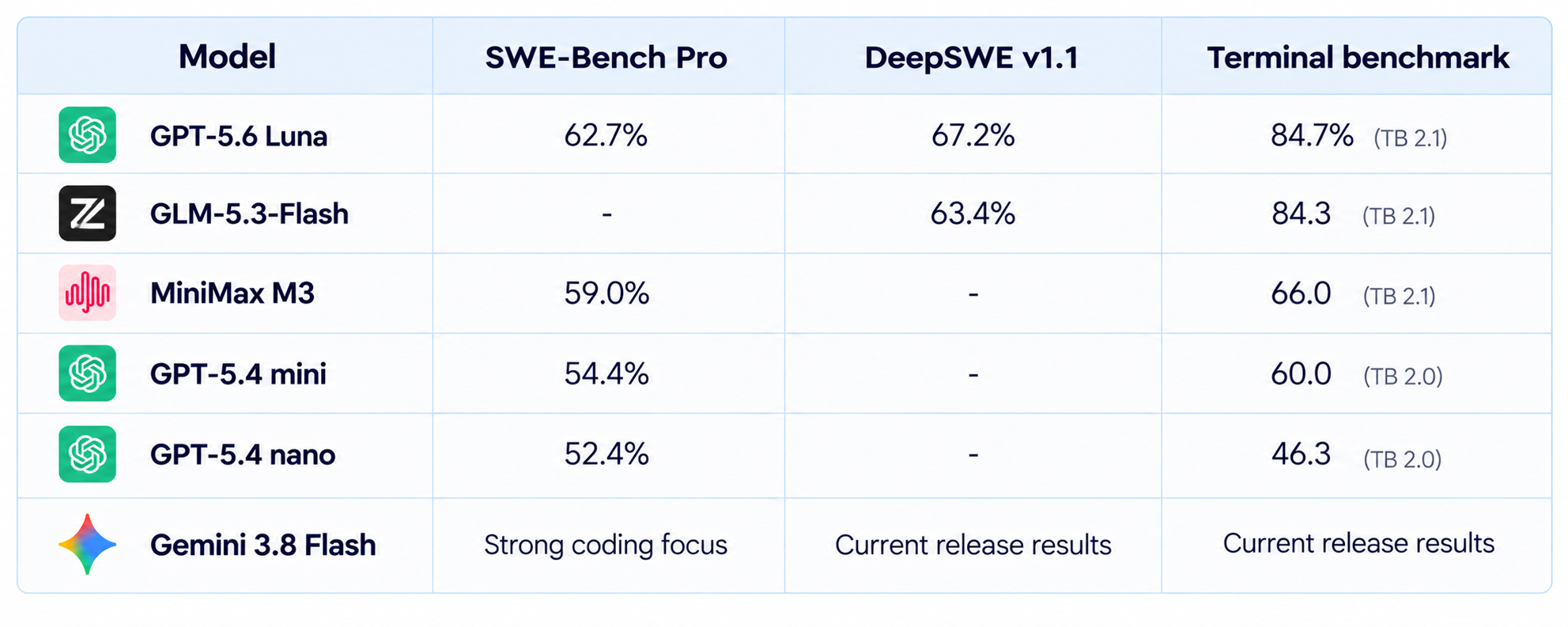
GPT-5.6 Luna combines a 74.6 Coding Agent Index score with $0.20 input and $1.20 output pricing. OpenAI also reports 62.7% on SWE-Bench Pro, 67.2% on DeepSWE v1.1 and 84.7% on Terminal-Bench 2.1.
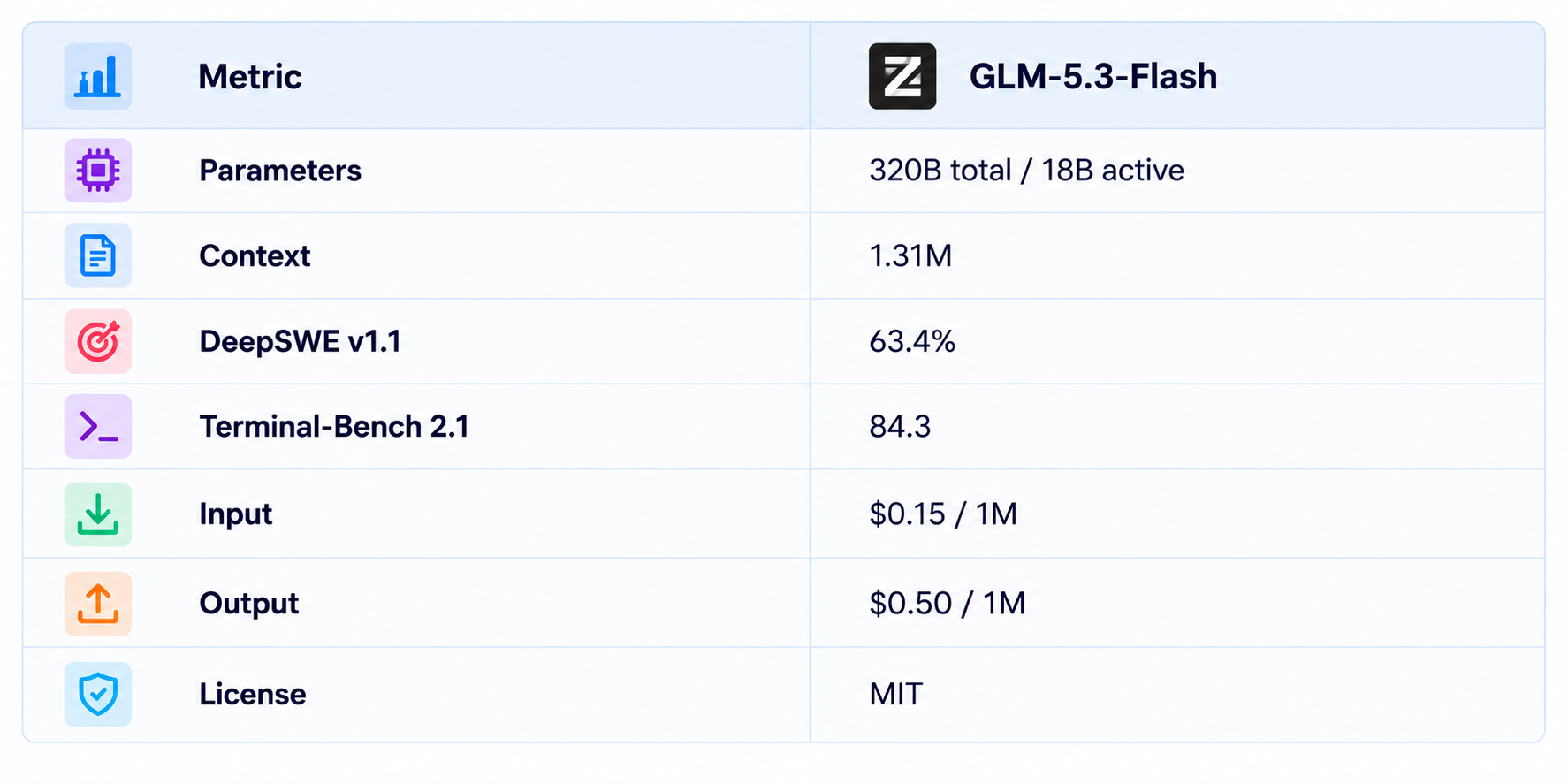
GLM-5.3-Flash is the value standout for self-hosting. It has 320B total parameters with 18B active, a 1.31M context and MIT weights. Its published results include 63.4% on DeepSWE v1.1 and 84.3 on Terminal-Bench 2.1.
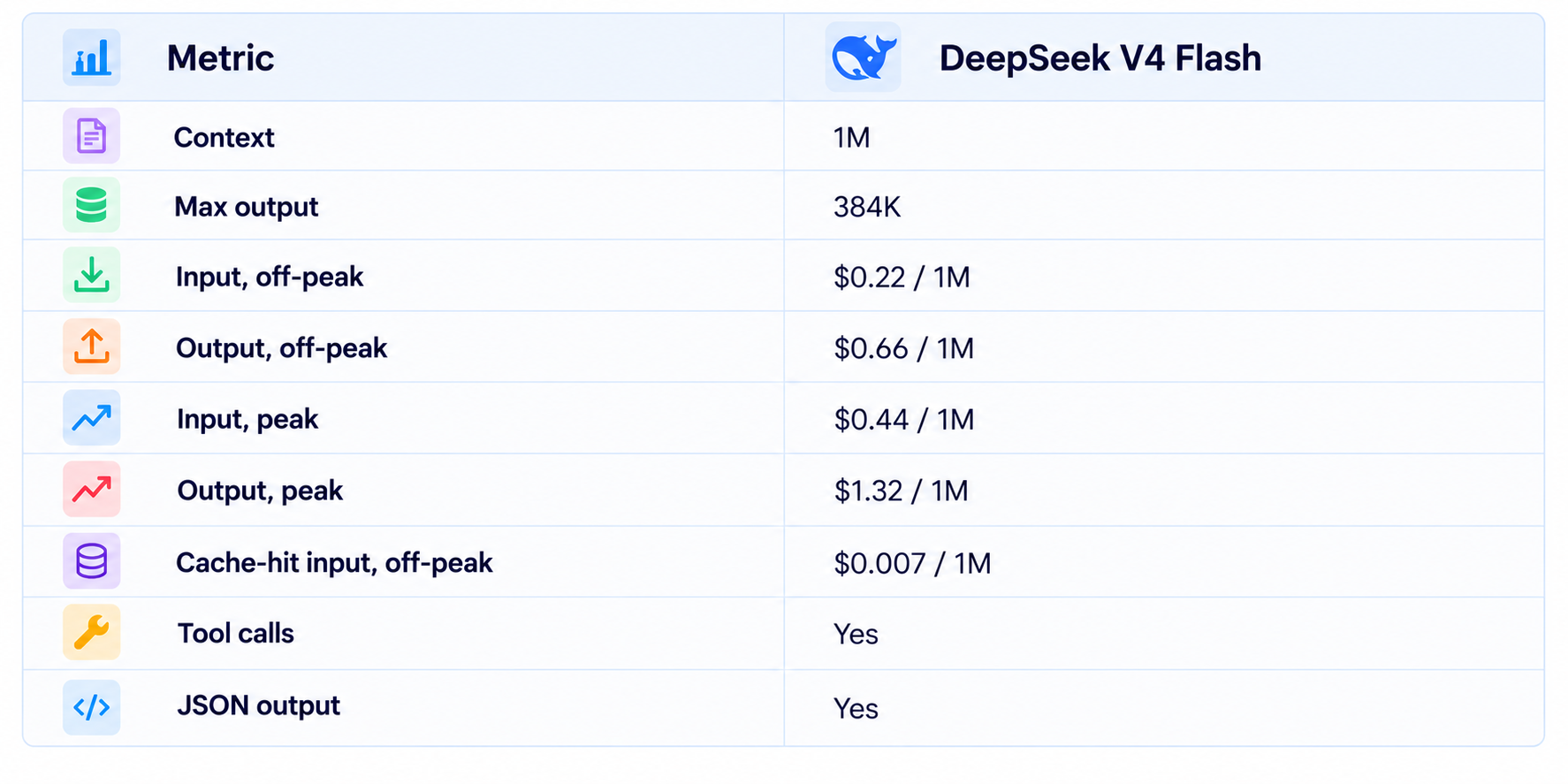
DeepSeek V4 Flash has the lowest current off-peak token rates in this set and still provides a 1M context, tool calls, JSON output and thinking modes.
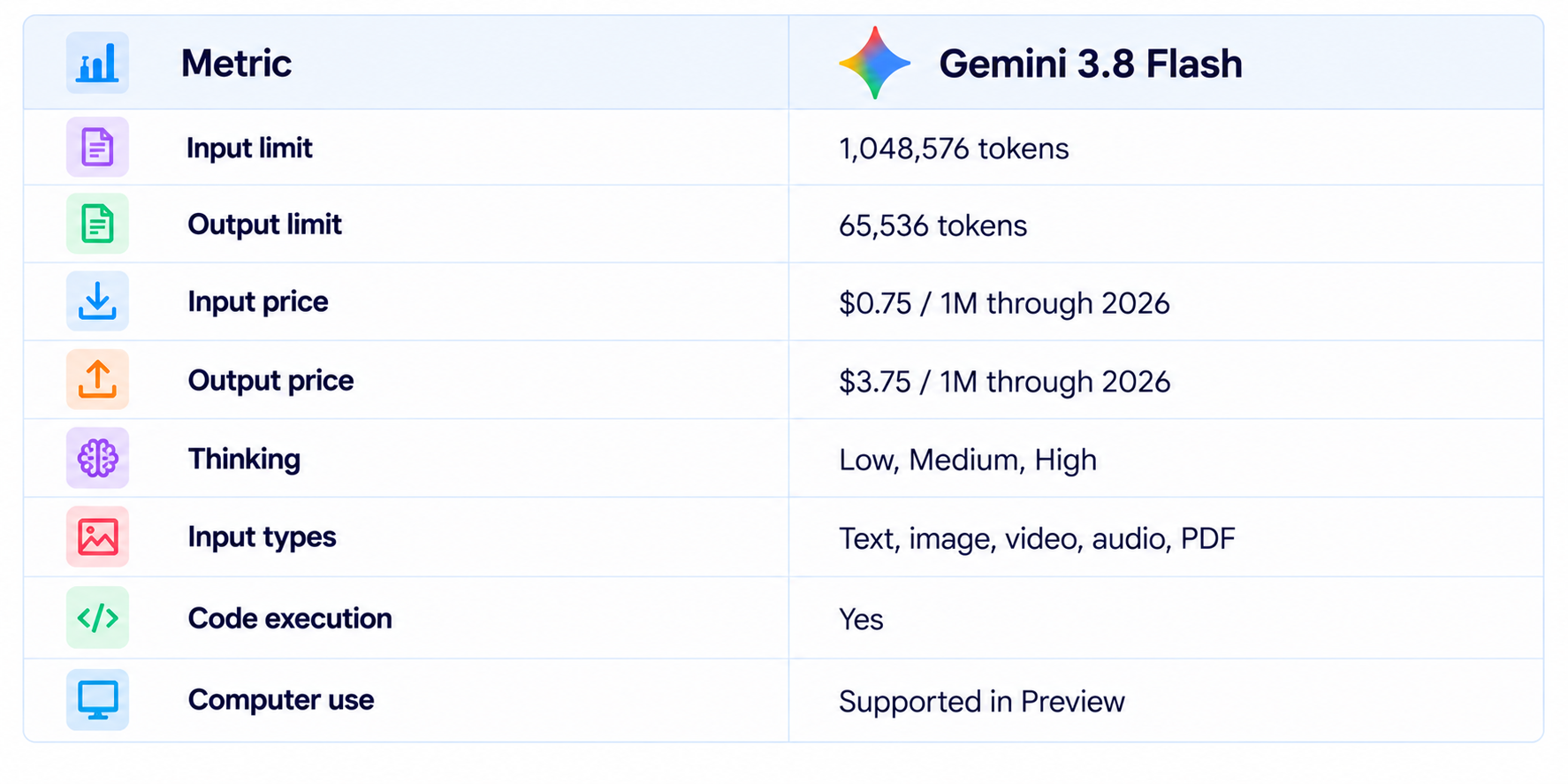
Gemini 3.8 Flash is the broadest multimodal option. Google lists a 1,048,576-token input limit, 65,536-token output limit, code execution, function calling, file search, search grounding and support for text, images, video, audio and PDFs.
My overall recommendation is to use the model that minimizes cost per completed task, not cost per token. For most teams that means a routed stack, not one model for every request.
1. What Does Under $5 Mean?
For this guide, a model qualifies when both its published input and output text-token prices are below $5 per million tokens. Promotional rates and time-dependent pricing are shown separately so the list does not hide the conditions behind an unusually low price.
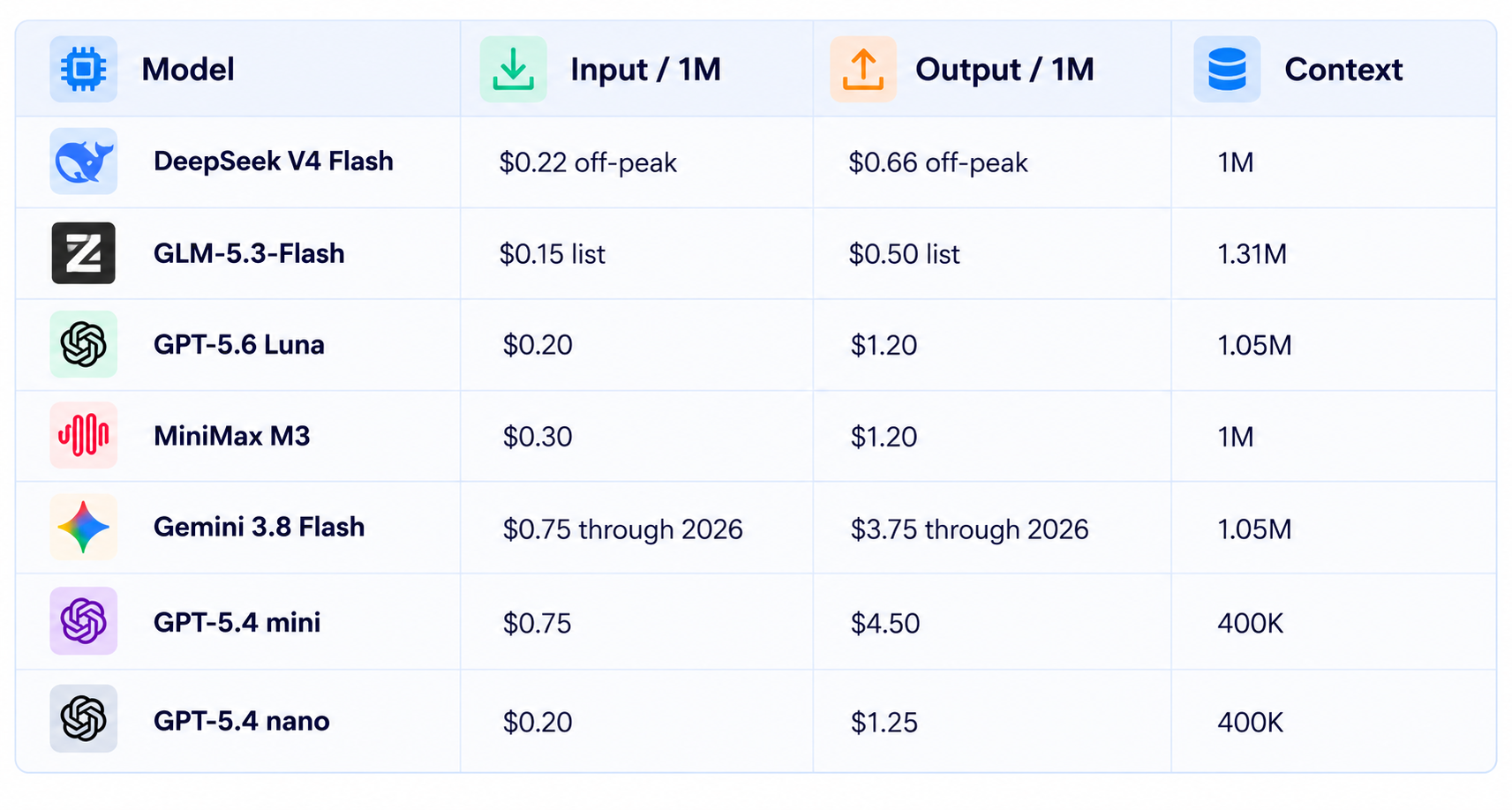
2. Best AI Coding Models Under $5 at a Glance
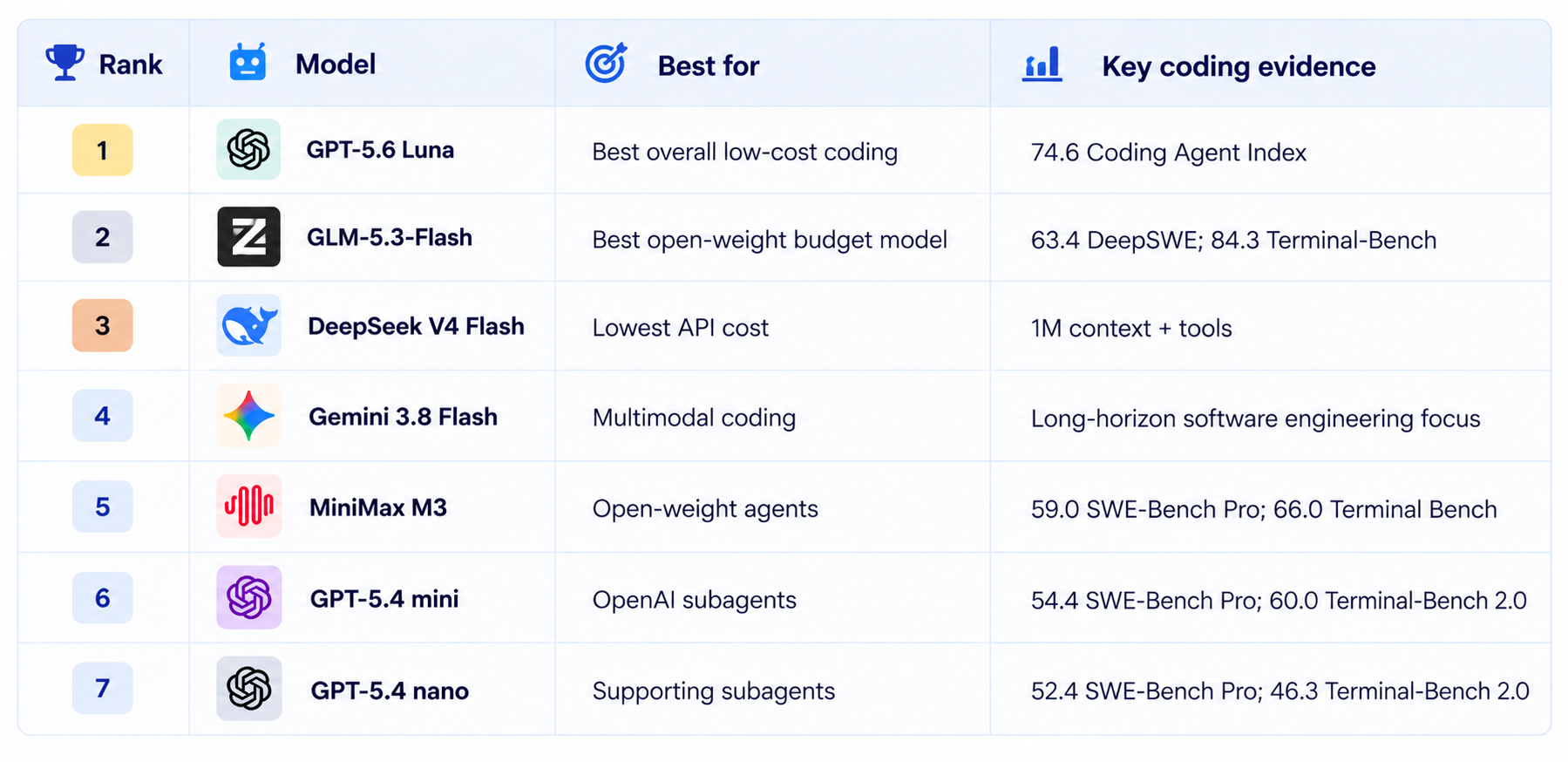
3. GPT-5.6 Luna: Best Overall Value
GPT-5.6 Luna is the strongest balanced choice here because it combines serious coding-agent performance with low pricing and the OpenAI tool ecosystem. OpenAI positions it specifically for cost-sensitive, high-volume workloads and gives it reasoning effort controls from none through max.
Its published coding results are the strongest reason to choose it. OpenAI reports 74.6 on the Coding Agent Index, 62.7% SWE-Bench Pro, 67.2% DeepSWE v1.1 and 84.7% Terminal-Bench 2.1.
The model also has a 1.05M context window, so it is not restricted to short coding prompts. That makes it useful for repository-level tasks and agent sessions where substantial context needs to remain available.
4. GLM-5.3-Flash: Best Open-Weight Budget Coder
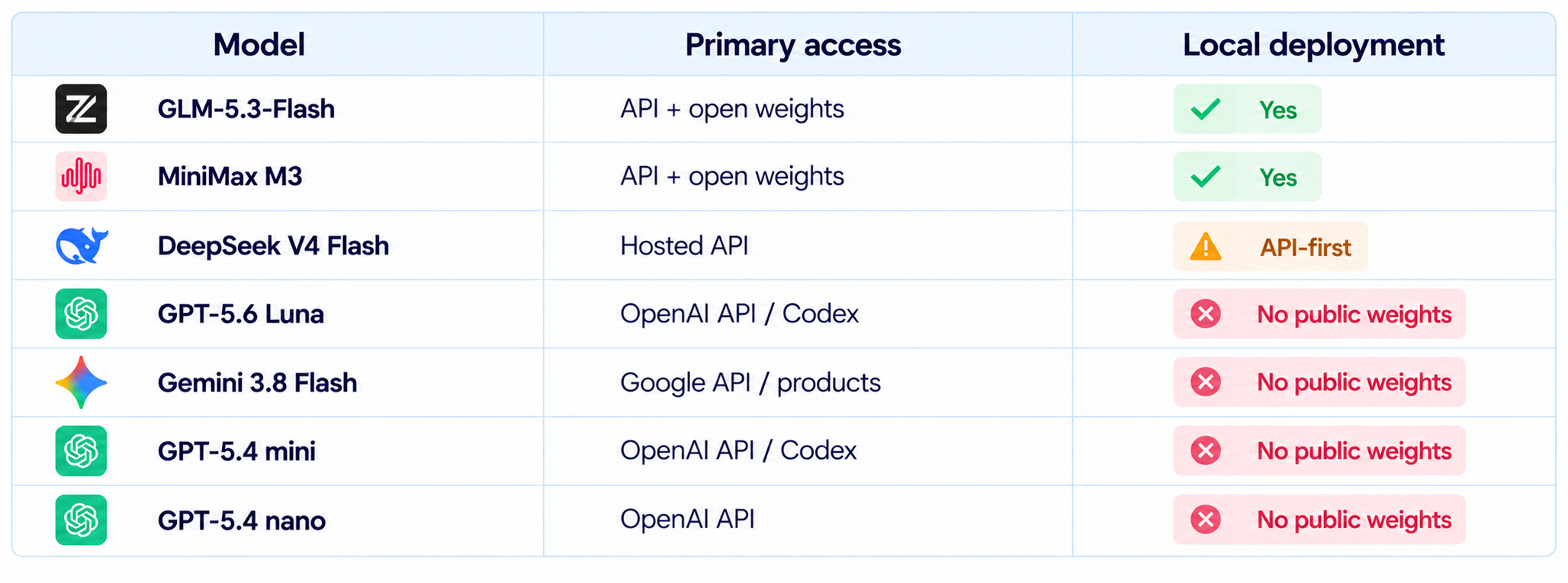
GLM-5.3-Flash combines unusually low token pricing with open weights and strong agent benchmarks. Z.ai lists $0.15 per million input and $0.50 output at list price, with a temporary 50% promotion through September 9, 2026. The model has 320B total parameters, 18B active and a 1.31M context.
For coding agents, Z.ai reports 63.4% on DeepSWE v1.1 and 48.8% on AutomationBench, while current tracking reports 84.3 on Terminal-Bench 2.1.
The other major advantage is deployment freedom. The weights are published under MIT, so teams can self-host and control the full inference environment.
5. DeepSeek V4 Flash: Best for Minimum Spend
DeepSeek V4 Flash is the cost leader. Its current API documentation lists a 1M context, 384K maximum output and support for thinking, JSON output and tool calls. Under the current peak/off-peak schedule, off-peak input is $0.22 per million and output is $0.66, while peak rates are $0.44 and $1.32.
The extremely low cache-hit input price is also valuable for coding agents that repeatedly send the same system instructions or repository prefixes. The model is therefore attractive when high request volume matters more than squeezing out the last increment of coding quality.
6. Gemini 3.8 Flash: Best Multimodal Coding Workhorse
Gemini 3.8 Flash is the model to choose when coding does not happen in a text-only environment. Google's official documentation lists text, image, video, audio and PDF inputs, plus code execution, function calling, file search, search grounding and structured outputs.
The model currently costs $0.75 per million input tokens and $3.75 per million output tokens through December 31, 2026. From January 1, 2027, Google lists $1.50 and $7.50, so it leaves this under-$5 group under the current introductory price but not at the later standard output rate.
That makes Gemini 3.8 Flash particularly useful for frontend agents that need screenshots, PDF specifications or recorded product behavior alongside source code.
7. MiniMax M3: Open-Weight Agentic Alternative
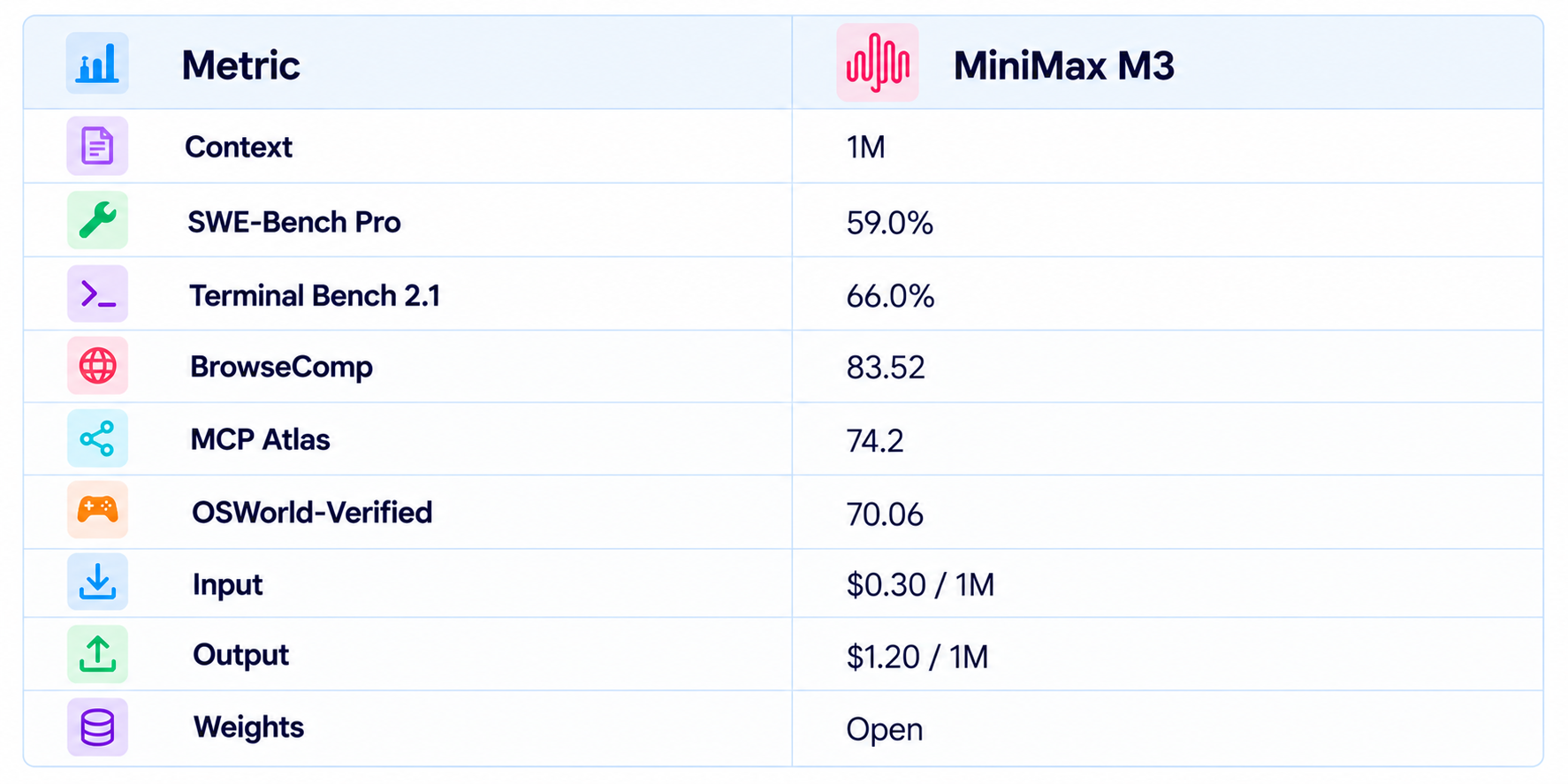
MiniMax M3 is an open-weight model designed around coding and real agent execution. MiniMax reports 59.0% on SWE-Bench Pro, 66.0% on Terminal Bench 2.1, 83.52 on BrowseComp, 74.2 on MCP Atlas and 70.06 on OSWorld-Verified.
Current pricing data lists $0.30 per million input tokens and $1.20 per million output tokens, with a 1M-token context.
That combination makes M3 especially interesting for teams that want broad agent capabilities but also want the option to run the model themselves.
8. GPT-5.4 mini: Best OpenAI Mini for Subagents
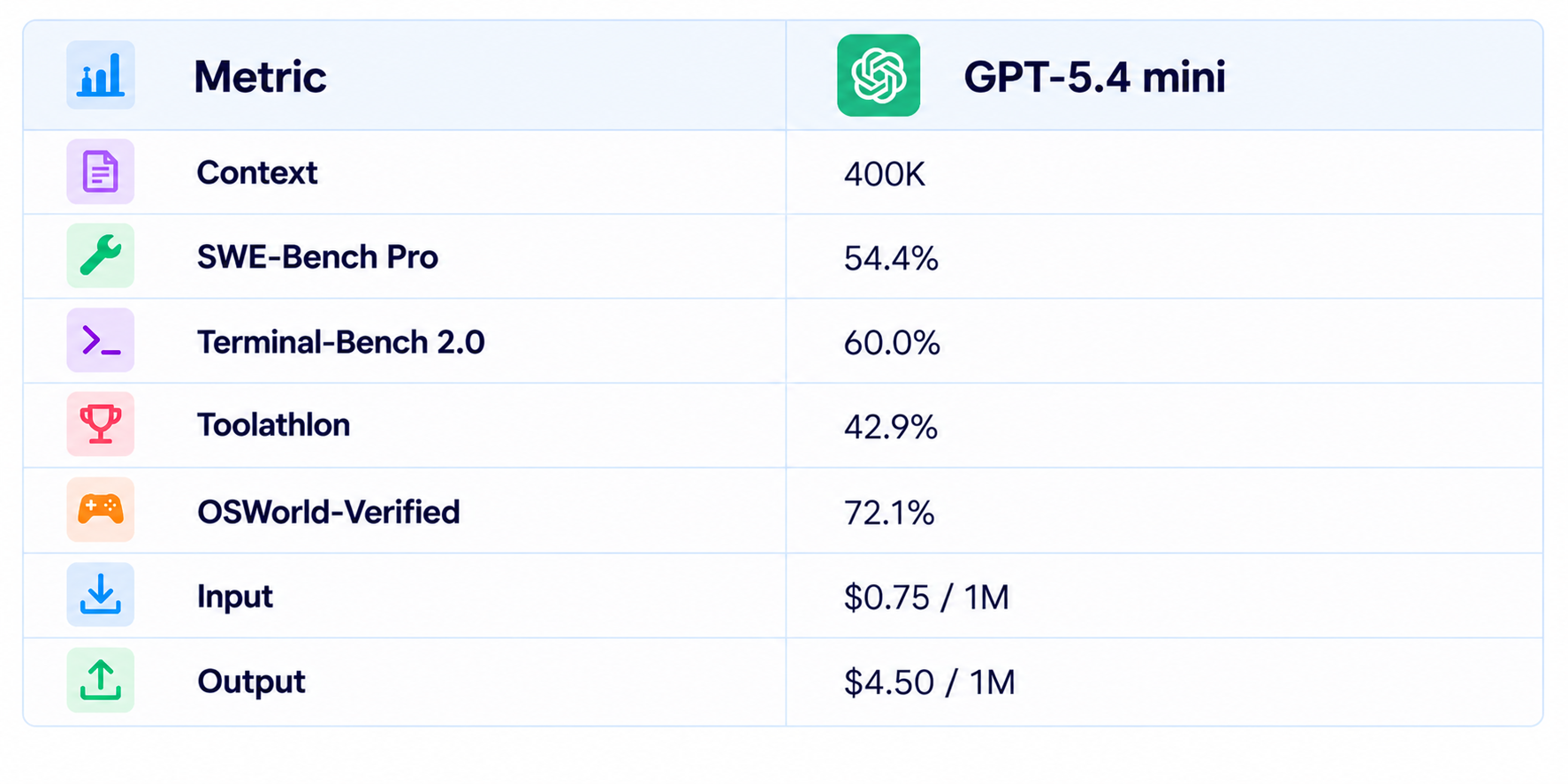
GPT-5.4 mini is designed for coding, computer use and subagents. OpenAI lists a 400K context window and support for text and image inputs, tools, web search, file search, computer use and skills. Its price is $0.75 per million input and $4.50 per million output tokens.
Its xhigh benchmark results include 54.4% SWE-Bench Pro, 60.0% Terminal-Bench 2.0, 42.9% Toolathlon and 72.1% OSWorld-Verified.
The output price is the highest in this list, so GPT-5.4 mini makes the most sense when OpenAI-native tools and computer use are more valuable than minimizing token cost.
9. GPT-5.4 nano: Best Supporting Coding Model
GPT-5.4 nano is not the strongest standalone coding model here, but it is useful for supporting subagents. OpenAI recommends it for classification, extraction, ranking and simpler coding tasks, and prices it at $0.20 per million input and $1.25 per million output tokens.
OpenAI reports 52.4% SWE-Bench Pro, 46.3% Terminal-Bench 2.0, 35.5% Toolathlon and 39.0% OSWorld-Verified at xhigh.
That makes nano especially useful as a router, classifier or low-cost helper around a stronger coding model.
10. Coding Benchmark Comparison
The benchmark versions are not identical across all models, so the table is best used as a map rather than as one universal leaderboard.
11. Price-to-Performance: Who Actually Wins?
The right winner depends on the task. DeepSeek and GLM are hard to beat on raw token economics. GPT-5.6 Luna delivers a stronger frontier-style coding profile at a very low price. Gemini adds multimodal capabilities that can save separate preprocessing steps. MiniMax gives teams an open-weight agent option.
12. The Hidden Cost of Cheap Models
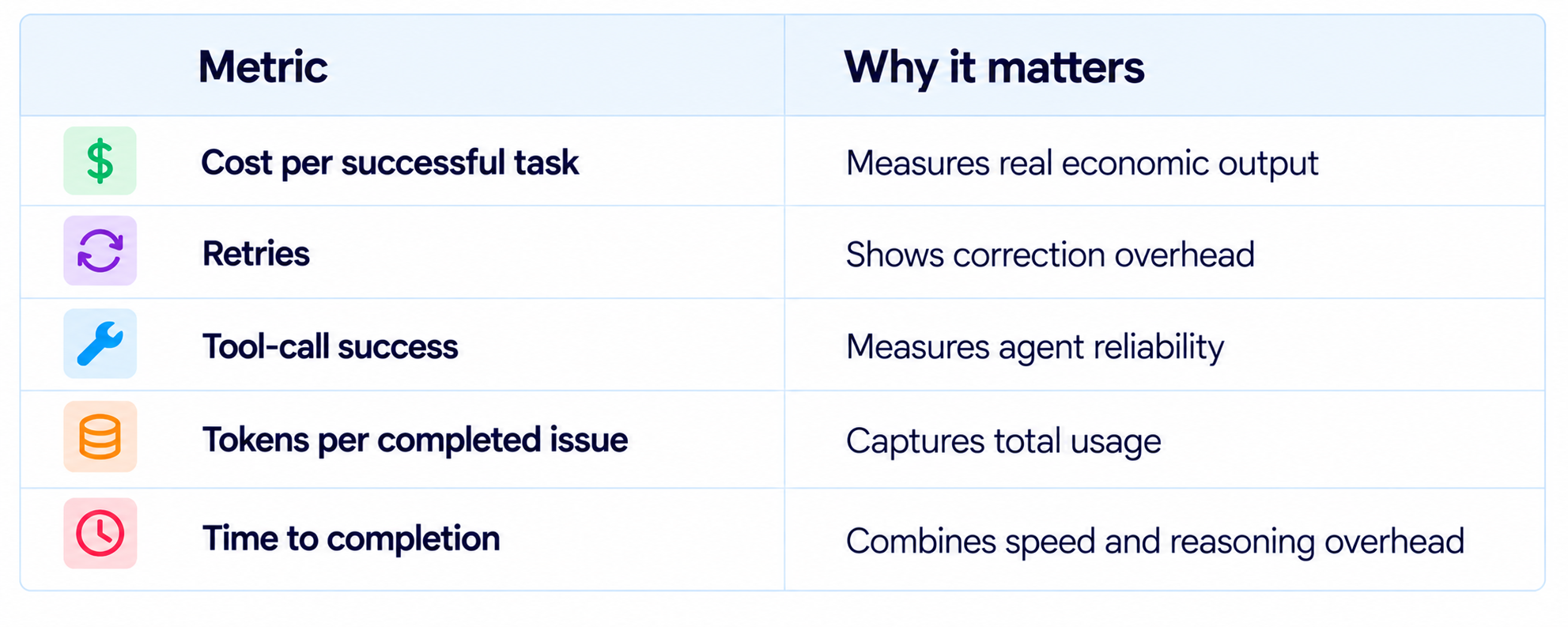
Coding-agent bills are shaped by more than the rate card. A model may read thousands of tokens of repository context, produce a reasoning trace, call a tool, inspect the result and repeat the process. One failed patch can therefore create several additional turns.
This is why cost per completed task is a better metric than cost per million tokens. A model that is 50% more expensive but finishes in half as many attempts can be cheaper in practice.
13. Which Model Should You Choose?
14. How to Build a Cheap Coding-Agent Stack
A strong architecture should not send every step to the same model. Use a cheap model for easy work, then escalate when the request crosses a difficulty threshold.
- Use DeepSeek V4 Flash or GLM-5.3-Flash for routine edits, extraction and high-volume steps.
- Use GPT-5.6 Luna for harder repository changes and important coding tasks.
- Use Gemini 3.8 Flash when screenshots, PDFs, video or audio are part of the input.
- Use GPT-5.4 nano for classification and lightweight routing.
- Use MiniMax M3 when open-weight deployment matters.
- Keep tests, linting and tool validation outside the model.
- Measure successful task cost and adjust routing from real production data.
For a practical model-routing architecture, see Model Routing for AI Coding Agents.
15. Open-Weight vs Hosted Models
Open weights can reduce long-term inference costs and give teams more control over deployment, but they shift costs into GPUs, serving infrastructure and engineering. Hosted models are easier to operate and scale, but you pay per token and remain dependent on the provider.
16. Limitations You Should Know
- Promotional pricing can change the apparent ranking quickly.
- DeepSeek's peak/off-peak schedule means token costs depend on request timing.
- Gemini 3.8 Flash qualifies here only at its 2026 introductory output price.
- Benchmark versions differ, so not every percentage is a direct head-to-head comparison.
- Open-weight models still require substantial serving hardware for larger checkpoints.
- Large context windows do not guarantee better reasoning over every codebase.
- A cheaper model can be more expensive if it creates more retries.
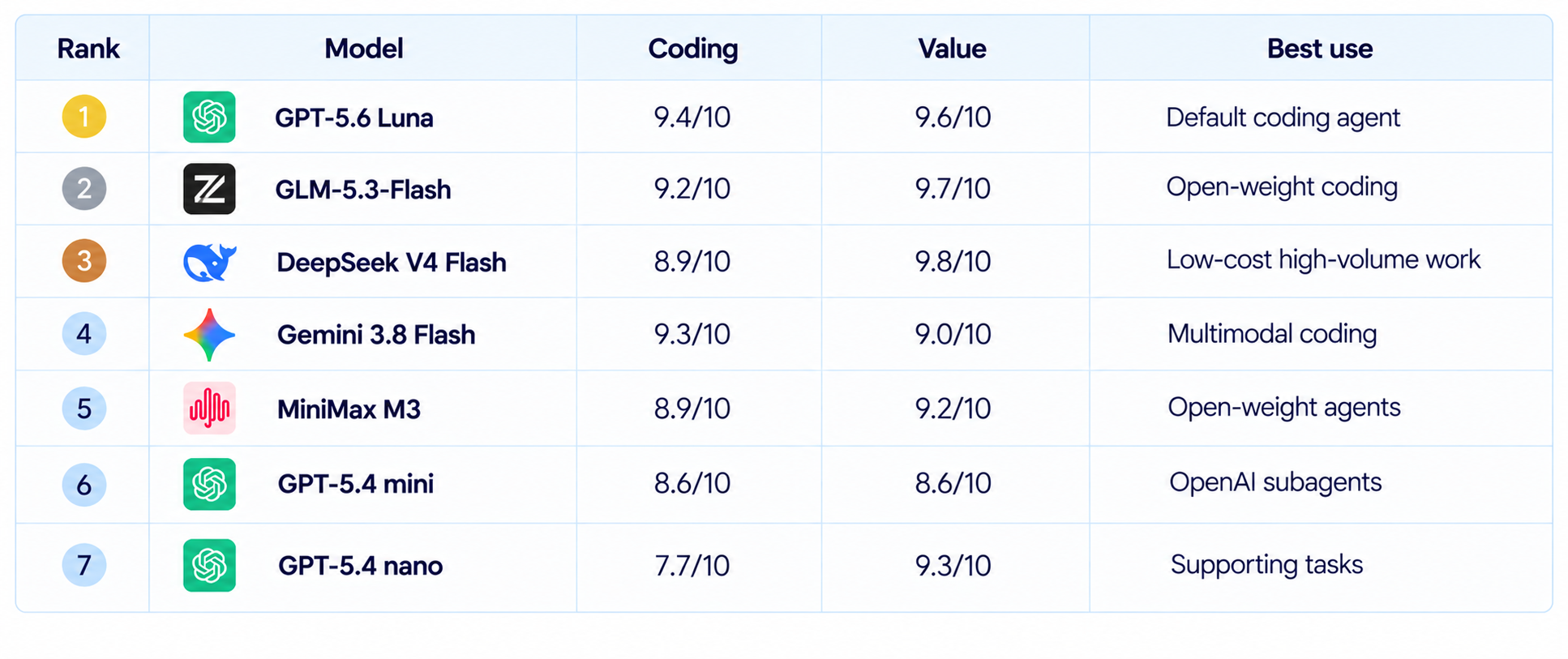
17. Final Ranking
18. Final Verdict
The sub-$5 coding market is now strong enough that developers can build serious AI software without automatically choosing a premium flagship model. The best model depends on the work, the tools around it and the number of model calls in the workflow.
GPT-5.6 Luna is the best general choice because its 74.6 Coding Agent Index and strong SWE-Bench, DeepSWE and Terminal-Bench results are paired with $0.20 input and $1.20 output pricing.
GLM-5.3-Flash is the most compelling open-weight value play, with 63.4% DeepSWE, 84.3 Terminal-Bench, a 1.31M context and $0.15/$0.50 list pricing. DeepSeek V4 Flash wins when minimizing API cost matters most, while MiniMax M3 provides a strong open-weight agent alternative.
Gemini 3.8 Flash earns its place because it combines coding and agent capabilities with native image, video, audio and PDF input, making it particularly useful for multimodal software workflows.
The important lesson is to optimize for completed work rather than the cheapest possible token. A routed architecture that uses cheap models for routine tasks and stronger models for difficult tasks will usually outperform a single-model strategy on both cost and reliability.
Bottom line: start with GPT-5.6 Luna for general coding agents, GLM-5.3-Flash for open-weight deployment, DeepSeek V4 Flash for minimum spend, Gemini 3.8 Flash for multimodal development and MiniMax M3 for an additional open-weight agent option.
Frequently Asked Questions
What is the best AI coding model under $5 per million tokens?
GPT-5.6 Luna is the best overall value in this comparison. GLM-5.3-Flash is the best open-weight choice.
What is the cheapest strong coding model?
DeepSeek V4 Flash has the lowest current off-peak rates in this list.
Is GLM-5.3-Flash good for coding?
Yes. It combines low pricing, MIT weights, 63.4% DeepSWE and 84.3 Terminal-Bench 2.1.
Is GPT-5.6 Luna good for coding?
Yes. OpenAI reports 74.6 on the Coding Agent Index, 62.7% SWE-Bench Pro, 67.2% DeepSWE and 84.7% Terminal-Bench 2.1.
Is Gemini 3.8 Flash under $5?
Yes through December 31, 2026 at $0.75 input and $3.75 output. Its standard 2027 output price is $7.50.
Is MiniMax M3 good for coding agents?
Yes. It posts 59% SWE-Bench Pro and 66% Terminal Bench 2.1 and is available with open weights.
Is GPT-5.4 mini worth it?
Yes when OpenAI's computer-use and subagent tooling matters enough to justify its $4.50 output rate.
Should I use one model for every coding task?
Usually not. Use routing so easy tasks go to cheap models and difficult tasks escalate.
What is the most important metric besides token price?
Cost per successfully completed task, including retries, tool calls and total token usage.
Recommended Blogs
Gemini 3.8 Flash Review: Accuracy, Price & Is It Worth It? (2026)
Meta Muse Spark 1.3 Review: Coding, Price & Is It Worth It? (2026)
Qwen 3.8 Max 0902 Review: Benchmarks, Price & Is It Worth It? (2026)
Mercury 2.5 AI Model Review: Speed, Price & Is It Worth It? (2026)
MiniMax FastH3 Review: Speed, Quality, VRAM & Is It Worth It? (2026)
How to Secure AI Coding Agents: Permissions, Sandboxing, MCP & Secrets
Resources & Community
Join our community of 70,000+ AI enthusiasts and learn to build powerful AI applications. Whether you're a beginner or an experienced developer, Build Fast with AI helps you understand and implement AI in your projects.
Agentic AI Launchpad 2026
A structured 6-week cohort program that takes you from AI basics to building and deploying real-world agentic AI systems. Includes live sessions, expert mentorship, project reviews and a builder community network.
Ready to go from learning to building? Join the next cohort: Agentic AI Launchpad 2026
Free AI Resources
Access free tools, workshops and micro-learning to keep building.

