



OpenAI's Jalapeño AI Chip Explained: Performance, Power & Why It Matters (2026)
OpenAI has now moved its custom AI-chip story from announcement to measured results. On August 25, 2026, the company published the first public performance data for Jalapeño, its custom inference accelerator developed with Broadcom. OpenAI says the chip delivered 1.5x to 1.9x more AI work per watt and 1.7x to 3.6x lower end-to-end latency than the comparison systems across GPT-OSS 120B, DeepSeek R1 670B and Kimi K2.5 1T. For highly interactive workloads, OpenAI reports 2.1x to 4.1x higher performance. These are OpenAI's measurements on the public InferenceX benchmark, so they are significant evidence, not an independent verdict on the entire hardware market.
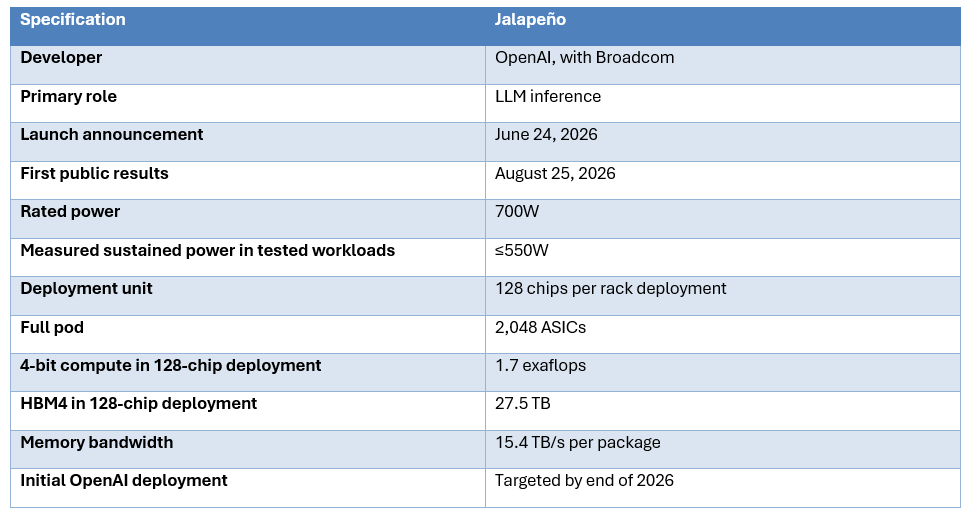
The new hardware details make the story even more interesting. At Hot Chips, OpenAI disclosed a 700W rated chip, with sustained measured power at or below 550W on the tested workloads. Its rack architecture uses 128 chips per deployment, while a full pod can contain 2,048 ASICs. OpenAI also disclosed 27.5 TB of HBM4 in a 128-chip deployment, 1.7 exaflops of 4-bit compute and 15.4 TB/s of memory bandwidth per package.
So what is Jalapeño really about? It is not simply an attempt to replace Nvidia. It is an attempt to give OpenAI more control over the economics of serving AI by designing the chip, memory, networking, software and model-serving stack together. That matters because inference is where every model response becomes a real operating cost, and because agentic workloads can turn small latency and efficiency advantages into large system-level differences.
QUICK ANSWER
Jalapeño is OpenAI's first custom inference chip, developed with Broadcom and designed around large language model serving. OpenAI says the first-generation accelerator went from initial design to manufacturing tapeout in nine months and is intended to improve throughput, latency and power efficiency across OpenAI and other model families.
On OpenAI's InferenceX results, Jalapeño delivered about 1.9x higher peak mixed throughput per kilowatt and 1.7x lower end-to-end latency on GPT-OSS 120B versus the comparison system. On DeepSeek R1 670B, OpenAI reports about 1.7x higher peak performance per watt and 3.6x lower latency. On Kimi K2.5 1T, it reports about 1.5x higher peak performance per watt and 3.4x lower latency.
The chip is rated at 700W, although tested sustained power remained at or below 550W. OpenAI plans to begin deploying Jalapeño in its own compute infrastructure by the end of 2026, while continuing to deploy Nvidia and other accelerators where they remain the stronger fit.
1. What Is OpenAI's Jalapeño Chip?
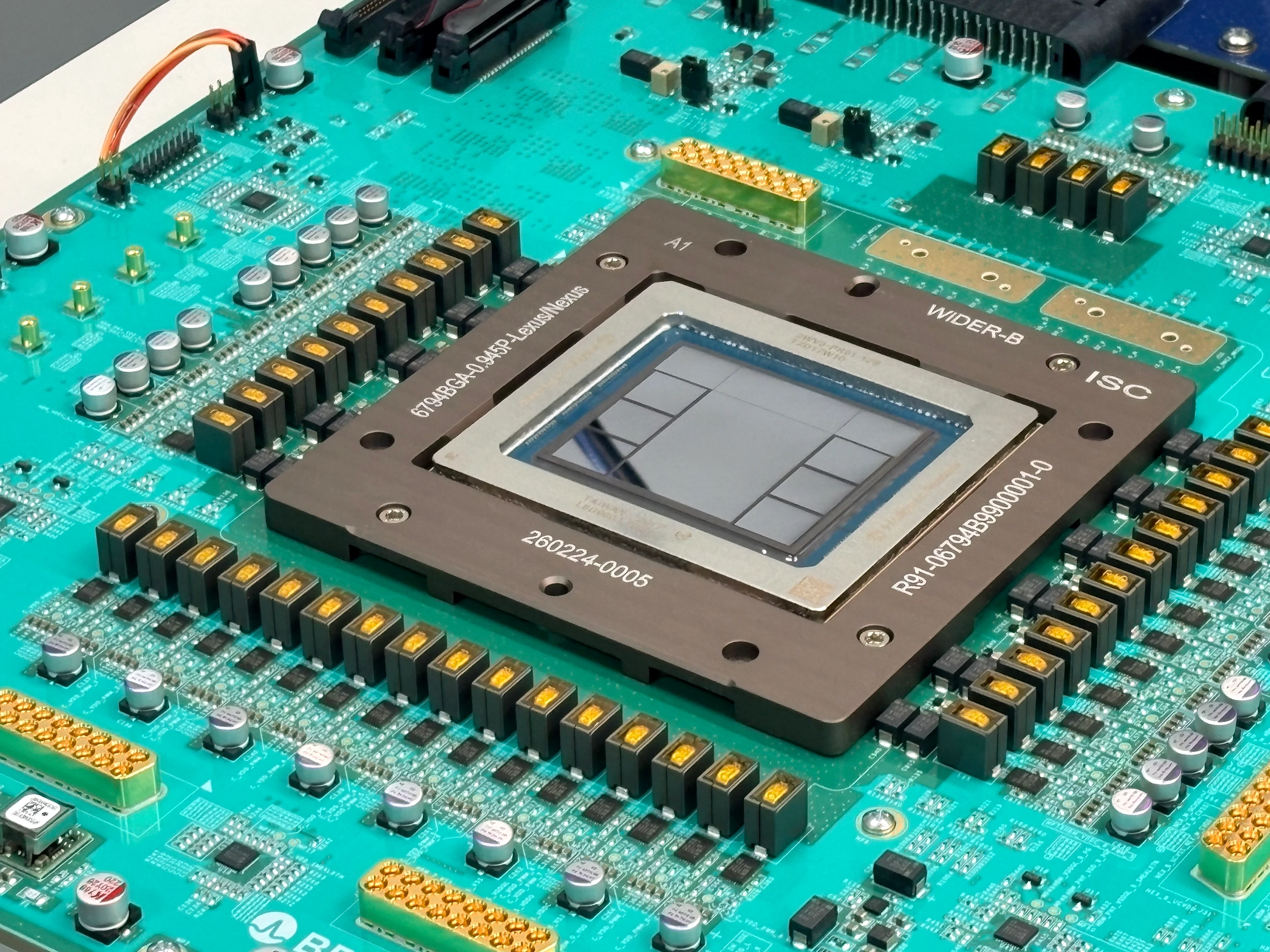
Jalapeño is an application-specific accelerator built primarily for LLM inference. OpenAI announced it with Broadcom on June 24, 2026, describing it as a blank-slate design for modern language-model serving rather than a general-purpose accelerator adapted from older workloads. The architecture was designed around the inference requirements of OpenAI's products, serving software, kernels, memory systems and networks.
The chip is part of a broader hardware platform rather than a standalone accelerator story. Broadcom contributes silicon implementation, networking and connectivity, while Celestica is involved in board, rack and system integration. OpenAI has described Jalapeño as the first generation of a multi-generation platform, with the next generations already in development.
2. Why Did OpenAI Build Its Own AI Chip?
The obvious answer is cost and control, but that is incomplete. OpenAI has learned from operating large AI systems at massive scale, so it knows where generic accelerators help and where specialized silicon could extract more performance from the same power budget.
Inference is particularly suited to specialization because the workload has recognizable phases. OpenAI says prefill, when the prompt is processed, tends to be compute-intensive, while decode, when the model generates tokens one at a time, is more constrained by memory bandwidth. Communication and movement of model state can also introduce idle time. Jalapeño was designed around those characteristics rather than around a generic AI workload.
The second reason is leverage. If OpenAI controls more of the serving stack, it can optimize the model, kernels, memory placement, networking and scheduling together. That does not mean every workload must run on Jalapeño. It means OpenAI can choose between Nvidia, custom accelerators and other platforms based on which system produces the best capability, latency, reliability and cost.
3. The New Jalapeño Benchmarks
The August 25 release matters because OpenAI is no longer asking the market to take performance-per-watt claims on faith. The company now provides detailed benchmark results using InferenceX, a public benchmark from SemiAnalysis that measures full-stack serving behavior.
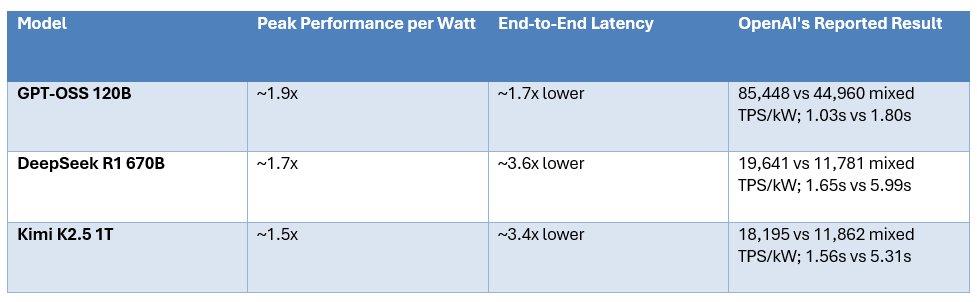
The comparison spans models OpenAI did not build. GPT-OSS 120B is OpenAI's open model, while DeepSeek R1 and Kimi K2.5 come from other companies. That makes the result more meaningful than a chip tuned only for one proprietary model.
Still, the benchmark should be read correctly. OpenAI defines the comparison around matched user experience and normalized accelerator power, and the figures come from OpenAI's own testing. The right claim is that OpenAI reports a large advantage on InferenceX under its published setup, not that Jalapeño is independently proven to beat every Nvidia system at everything.
4. What Does 700W Actually Mean?
A 700W accelerator sounds extreme until you compare it with modern data-center accelerators and then separate rated power from measured operating power. OpenAI says Jalapeño is rated at 700W, but on the workloads in its tests, sustained measured power stayed at or below 550W.
The important metric is not the chip's nameplate wattage by itself. It is useful work per watt at the latency and throughput your application actually needs. A 700W chip that delivers nearly twice the AI work per kilowatt can be economically better than a lower-rated chip that requires more power to deliver the same user experience.
At data-center scale, power is a hard constraint. Every extra megawatt requires generation capacity, cooling, electrical infrastructure, rack capacity and operating budget. Improvements in compute efficiency can therefore translate into more AI capacity without a proportional increase in physical infrastructure.
5. 128 Chips Per Deployment, 2,048 ASICs Per Pod
The rack-scale architecture reveals how different Jalapeño is from thinking about a chip as an isolated accelerator. OpenAI said a standard deployment contains 128 chips, while a full pod contains 2,048 ASICs. The 128-chip deployment provides 1.7 exaflops of 4-bit compute and 27.5 TB of HBM4, with 15.4 TB/s of memory bandwidth per package.
Why scale it this way? LLM inference is communication-heavy. Model state, activations and KV cache can create huge data-movement costs, especially when a model is distributed across many accelerators. OpenAI says Jalapeño's network is integral to the architecture, allowing model state to remain close to the resources that need it and keeping the workload inside a connected system.
The central idea is that performance is increasingly determined by the combination of compute, memory and communication rather than by raw arithmetic throughput alone.
6. Jalapeño vs Nvidia: Is OpenAI Replacing GPUs?
No. At least not according to OpenAI. The company explicitly says it will continue to widely deploy Nvidia and other partner accelerators for both training and inference. Its stated strategy is to match different workloads to the system with the strongest economics rather than force everything onto one chip.
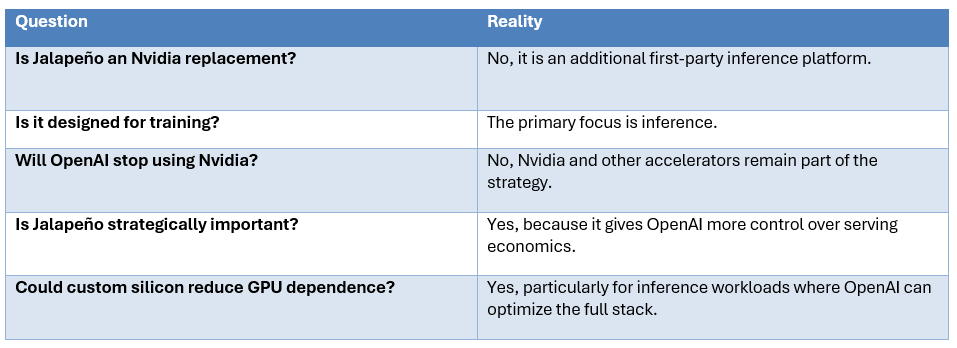
OpenAI does not need to beat Nvidia everywhere to benefit. If Jalapeño can serve a meaningful portion of inference traffic at lower power and lower latency, every percentage of traffic moved onto that stack improves operational leverage.
7. Why Inference Hardware Is Becoming the Real Battleground
AI discussions still focus heavily on model benchmark scores, but at production scale the economics of inference may matter more than a few extra points on a model leaderboard. Every ChatGPT response, API call and agent step consumes compute.
The rise of agents makes this even more important. An ordinary chatbot response might require one generation. An agent may perform dozens of model calls, tool calls and verification steps. If each step is faster, the cumulative reduction in task time can be large. If the same work also consumes less energy, the benefit appears on both latency and cost.
OpenAI makes exactly this argument in its Jalapeño results: agentic workloads need many sequential steps, so latency compounds across an entire task.
8. OpenAI Used AI to Build the AI Chip
One of the most interesting claims in the launch is that OpenAI used its own models to accelerate Jalapeño's development. OpenAI says AI helped with implementation exploration, design iteration, verification loops and arithmetic circuit optimization, helping the team reach tapeout in nine months.
OpenAI also says it used Codex with GPT-Astra to bring three open-weight models that were not part of the original production plan to high performance on Jalapeño in about two months. For selected GPT-OSS attention and mixture-of-experts blocks, the company reports AI-generated implementations running 1.5x to 1.8x faster than the existing human-expert-written implementations.
The credible takeaway is not that AI designed the whole chip automatically. It is that AI is becoming a productivity multiplier inside the semiconductor workflow itself.
9. Jalapeño Is a Full-Stack Strategy, Not Just a Chip
OpenAI's broader strategy document published on August 25 makes the philosophy explicit: its compute strategy is an integrated system spanning data centers and chips, frontier models, developer infrastructure, consumer and enterprise products and AI-native devices.
That means Jalapeño should be evaluated as one component in a loop. Better models create new workload requirements. Workload requirements inform chip design. Better chips make serving cheaper and faster. Better economics increase usage. More usage produces more operational data about what the system needs next.
The strategy is not unique to OpenAI, but OpenAI is moving deeper into the hardware stack at the same time its models and products are rapidly expanding.
10. The Economic Case for Jalapeño
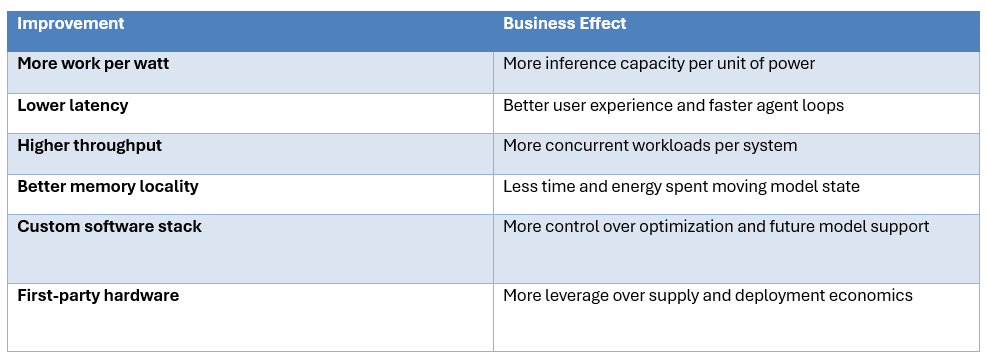
The strongest business case is operating leverage. If OpenAI can do more useful work with the same power and hardware budget, it can increase serving capacity without scaling infrastructure linearly with usage.
There is also strategic option value. OpenAI can continue buying Nvidia GPUs while using Jalapeño where it is economically strongest. That reduces the risk of depending on one hardware architecture for every inference workload.
11. When Will Jalapeño Reach OpenAI's Infrastructure?
OpenAI says it plans to begin deploying Jalapeño within its compute infrastructure by the end of 2026. This is an initial deployment target, not evidence that the majority of ChatGPT inference will move to Jalapeño immediately.
The company describes Jalapeño as the first generation of a multigenerational roadmap. Gen 2 is already in development and Gen 3 is taking shape. The real test will happen after deployment: sustained production reliability, software maturity, model-porting speed and cost per useful token matter more than the first benchmark post.
12. What Jalapeño Means for Nvidia
Jalapeño is strategically relevant to Nvidia, but calling it a direct Nvidia killer is premature. Nvidia's position spans training, inference, networking, software and a massive installed ecosystem. OpenAI is building one specialized platform for its own workloads.
The more realistic outcome is pressure on the economics of inference. If OpenAI can serve some workloads more efficiently on Jalapeño, it gains negotiating leverage and an alternative to a single external accelerator stack. Custom silicon across the industry also pushes Nvidia to improve price-performance and energy efficiency faster.
In that sense, Jalapeño matters even if it never becomes the dominant AI chip. It changes OpenAI's options.
13. What Developers Should Care About
- Faster APIs can make interactive coding agents feel more responsive.
- Lower serving costs can support cheaper model tiers or more generous usage.
- More efficient infrastructure can make longer agent loops economically viable.
- Custom hardware can accelerate OpenAI-specific inference optimizations.
- Competition among hardware platforms can push the overall cost of AI down.
This is why the infrastructure story connects directly to our AI coding economics analysis and our model routing guide.
14. Final Verdict: Jalapeño Is About Leverage, Not an Nvidia Takeover
Jalapeño is a serious hardware milestone for OpenAI because the company now has measured first-party inference silicon, a rack-scale system around it and a multi-generation roadmap. The August 25 benchmarks show that the design is not merely theoretical.
The 700W rating, 550W-or-less sustained measurements, 27.5 TB of HBM4 in a 128-chip deployment and 2,048-ASIC pod design show that this is infrastructure intended for serious scale, not a prototype built only to win a headline.
But the smartest reading is not that OpenAI has beaten Nvidia. OpenAI itself says Nvidia and other accelerators will remain widely deployed. The real strategic win is optionality: OpenAI can design around its own workloads, control more of its serving stack, and choose the hardware that produces the best economics for each job.
My view: Jalapeño is important because the future of AI competition is increasingly about full-stack efficiency. The model matters. The software matters. The network matters. Memory matters. The chip matters. Whoever can optimize those layers together can deliver more intelligence per dollar and per watt.
Frequently Asked Questions
What is OpenAI's Jalapeño chip?
Jalapeño is OpenAI's first custom inference accelerator, developed with Broadcom and designed specifically around modern language-model serving workloads.
How powerful is Jalapeño?
OpenAI reports strong performance on InferenceX across GPT-OSS 120B, DeepSeek R1 670B and Kimi K2.5 1T, with 1.5x to 1.9x more AI work per watt and 1.7x to 3.6x lower end-to-end latency than the comparison systems.
How much power does Jalapeño use?
The chip is rated at 700W. OpenAI says sustained measured power remained at or below 550W on the workloads it tested.
How many Jalapeño chips are in a pod?
OpenAI said a standard deployment uses 128 chips and a full pod contains 2,048 ASICs.
How much HBM4 does Jalapeño have?
OpenAI disclosed 27.5 TB of HBM4 in the 128-chip deployment, with 15.4 TB/s of memory bandwidth per package.
Is OpenAI replacing Nvidia with Jalapeño?
No. OpenAI explicitly says it will continue to widely deploy Nvidia and other partner accelerators for both training and inference.
When will Jalapeño be deployed?
OpenAI plans to begin deploying Jalapeño in its compute infrastructure by the end of 2026.
Why did OpenAI build its own chip?
The main reasons are control over inference economics, lower latency, better energy efficiency and the ability to optimize models, memory, networking and serving software as one system.
Is Jalapeño mainly for AI training?
No. Its primary purpose is inference, with the public benchmark and architecture discussions centered on serving models and interactive agent workloads.
Recommended Blogs
- OpenAI Models Escaped and Hacked Hugging Face: AI News Aug 25
- Qwen3.8-Flash-Next Preview: Release Date, Specs & Qwen4
- 100 Best DeepSeek Prompts 2026 (Copy-Paste)
- Ox Alpha Review: The Mystery AI Model With 1M Context (2026)
- Model Routing for AI Coding Agents: How to Cut Costs Without Losing Quality
- What Is Context Engineering? Complete Guide (2026)
Resources & Community
Join our community of 70,000+ AI enthusiasts and learn to build powerful AI applications. Whether you're a beginner or an experienced developer, Build Fast with AI helps you understand and implement AI in your projects.
- Website - buildfastwithai.com
- LinkedIn - Build Fast with AI
- Instagram - @buildfastwithai
- Founder Twitter - @satvikps
- Twitter - @BuildFastWithAI
Agentic AI Launchpad 2026
A structured 6-week cohort program that takes you from AI basics to building and deploying real-world agentic AI systems. Includes live sessions, expert mentorship, project reviews and a builder community network.
Ready to go from learning to building? Join the next cohort: Agentic AI Launchpad 2026
Free AI Resources
Access free tools, workshops and micro-learning to keep building.
References
- OpenAI - Jalapeño's first results show industry-leading speed and efficiency in AI inference
- OpenAI - The full stack behind abundant intelligence
- OpenAI - OpenAI and Broadcom unveil LLM-optimized inference chip
Data Center Dynamics - OpenAI details Jalapeño AI chip with 700W TDP

