



DeepSeek works best when you stop treating it like a generic chatbot and start treating it like a work system. Give it a role, a concrete task, the relevant context, clear constraints and an exact output format. DeepSeek's current V4 API documentation lists 1M context, tool calls and JSON output for V4 Flash and V4 Pro, which makes structured prompting especially useful for coding and agent workflows.
The 100 prompts below follow Build Fast with AI's copy-paste library format. Replace bracketed values such as [topic], [code], [company], [dataset] and [audience] before using them.
THE DEEPSEEK PROMPT FORMULA
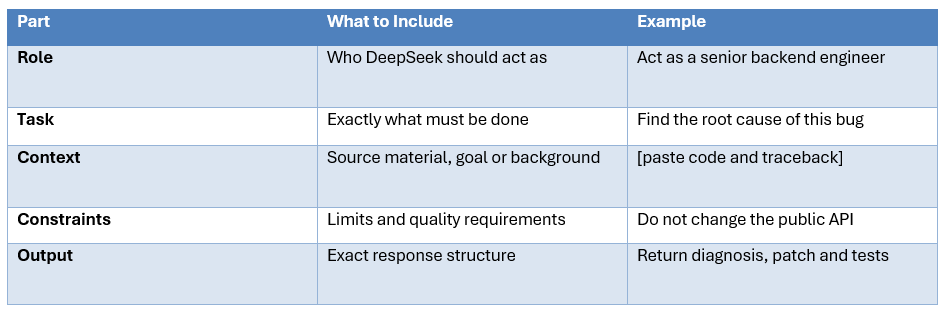
How to Use These Prompts
- Copy the prompt, then replace every bracketed placeholder.
- Paste the actual source material when the task depends on a document, codebase or dataset.
- For coding, include exact errors and expected behavior.
- For research, require evidence and label uncertainty.
- For large contexts, include relevant material rather than dumping everything.
- For agents, request structured output so the next step can consume it.
Coding & Software Engineering
1. Debug a Python Error
Act as senior Python engineer. debug this error: [error]. Context: [code and traceback]. Output: find the root cause, give the smallest safe fix, and return corrected code plus three regression tests.
2. Review a Codebase
Act as staff engineer. review this codebase: [files or repository summary]. Output: rank the ten biggest correctness, security, performance and maintainability issues and give a concrete fix for each.
3. Refactor Without Breaking APIs
Act as senior software architect. refactor [code]. Output: improve readability and maintainability without changing public APIs or behavior; return the final replacement code and key changes.
4. Find a Race Condition
Act as concurrency expert. investigate this code for race conditions: [code]. Output: identify shared state, the failure interleaving and the smallest safe synchronization strategy with a patch.
5. Write Unit Tests
Act as test engineer. write tests for [function or module]. Output: cover normal cases, edge cases, invalid inputs and regressions using [framework] with runnable code.
6. Optimize Slow Python
Act as Python performance engineer. optimize this slow code: [code]. Output: identify the bottleneck, preserve behavior, improve complexity where possible and return the optimized implementation.
7. Fix TypeScript Types
Act as senior TypeScript developer. fix this error: [error]. Code: [code]. Output: explain the type mismatch and give the cleanest fix without using any unless absolutely necessary.
8. Design a REST API
Act as backend architect. design a REST API for [product]. Output: define endpoints, schemas, authentication, validation, pagination, errors and versioning in a concise OpenAPI-style format.
9. Generate Safe SQL
Act as database engineer. write SQL for [requirement] on [database]. Output: handle NULLs, duplicates, date logic and performance; explain assumptions and return the final query.
10. Review a Pull Request
Act as strict code reviewer. review this pull request: [diff]. Output: find correctness, security and performance issues, ignore harmless style nitpicks, and rank findings by severity.
Coding Agents & Repositories
11. Plan a Repository Task
Act as coding-agent planner. plan this task: [task]. Repository: [structure]. Output: return a file-by-file implementation plan, dependencies, tests, risks and a clear completion checklist.
12. Understand an Unfamiliar Repo
Act as senior engineer. analyze this repository: [tree and key files]. Output: explain architecture, entry points, data flow and the safest place to implement [task].
13. Trace a Cross-Service Bug
Act as distributed-systems debugger. trace this bug: [report]. Evidence: [logs and code]. Output: build a timeline, identify the likely failure boundary and give the next five checks in order.
14. Generate a Safe Patch
Act as production coding agent. implement [change] in [code]. Output: preserve existing behavior outside the requested change, update tests and return changed files plus validation steps.
15. Plan a Database Migration
Act as database migration lead. plan migration from [old schema] to [new schema]. Output: include backfill, zero-downtime strategy, rollback, validation and explicit stop conditions.
16. Diagnose CI Failure
Act as CI/CD engineer. diagnose this failed pipeline: [logs]. Output: identify the first meaningful failure, separate root cause from downstream errors, and provide the minimal fix.
17. Create a Feature Checklist
Act as senior engineer. turn this feature request into a build checklist: [request]. Output: include files, tests, security, observability, deployment, rollback and acceptance criteria.
18. Verify a Tool Result
Act as coding-agent verifier. evaluate this output: [build or test output]. Output: decide whether the task is truly complete and list missing evidence or remaining risks.
19. Turn Specs Into Tickets
Act as engineering manager. convert this specification into tickets: [spec]. Output: group by dependency, add acceptance criteria, identify parallel work and flag ambiguity.
20. Create an Agent Handoff
Act as coding-agent handoff writer. summarize this task state: [state]. Output: include goal, constraints, files inspected, changes, tests, failures, unresolved questions and next action.
Research & Reasoning
21. Research a Topic
Act as senior research analyst. research [topic] using [sources]. Output: separate verified facts, interpretations and unresolved claims; return an evidence table and concise conclusion.
22. Compare Technologies
Act as technical research analyst. compare [A] and [B] for [use case]. Output: evaluate capability, cost, performance, ecosystem, implementation difficulty and risk, then recommend by user profile.
23. Build a Decision Memo
Act as executive analyst. analyze this decision: [decision]. Evidence: [data]. Output: return options, tradeoffs, recommendation, assumptions, risks and what evidence would change the choice.
24. Challenge My Assumptions
Act as skeptical expert. stress-test this belief: [belief]. Output: identify hidden assumptions, counterarguments, missing evidence and conditions where the conclusion would fail.
25. Analyze a Long Document
Act as research analyst. analyze this document: [document]. Output: extract thesis, evidence, numbers, unresolved issues and actions, citing the relevant section for each major claim.
26. Synthesize Sources
Act as synthesis editor. combine these sources: [sources]. Output: remove duplication, reconcile contradictions, preserve uncertainty and produce one coherent evidence-backed answer.
27. Map a Research Field
Act as research strategist. map the field around [topic]. Output: organize major approaches, competing claims, strongest evidence and open questions into a useful research map.
28. Find Contradictions
Act as fact-checker. compare these materials: [documents]. Output: find conflicting claims, explain why they differ and state which claim is better supported.
29. Turn Research Into Action
Act as strategy consultant. convert this research into a plan: [research]. Output: prioritize actions by impact, effort, dependency, owner and success metric.
30. Explain a Hard Concept
Act as expert teacher. explain [concept]. Output: teach it at beginner, intermediate and expert levels using one example and one common misconception.
Writing & Content
31. Write a Technical Article
Act as technical writer. write an article about [topic] for [audience]. Output: focus on the real problem, solution, examples and tradeoffs; avoid filler and unsupported superlatives.
32. Rewrite for Clarity
Act as senior editor. rewrite this text: [text]. Output: preserve meaning, remove repetition and make the flow clearer and more direct.
33. Write Three Introductions
Act as content editor. write three introductions for [topic]. Output: make each establish the problem, explain why it matters now and create curiosity without clickbait.
34. Create a Comparison Table
Act as technical editor. compare [items] across [criteria]. Output: keep cells precise, make tradeoffs obvious and flag claims that need verification.
35. Turn Notes Into a Blog
Act as professional blog writer. turn these notes into an article: [notes]. Output: preserve verified facts, make assumptions explicit and add useful headings, tables and FAQs.
36. Write an Executive Summary
Act as executive communications writer. summarize [report]. Output: cover situation, critical findings, business impact, recommendation and three risks in under 300 words.
37. Generate FAQs
Act as SEO content editor. create FAQs from this article: [article]. Output: answer directly, avoid repetition and focus on questions readers are likely to ask next.
38. Fix an AI Draft
Act as ruthless editor. improve this AI-generated draft: [draft]. Output: remove generic phrasing, unsupported claims and repetition while keeping useful detail.
39. Write a LinkedIn Post
Act as B2B technology writer. turn this insight into a LinkedIn post: [insight]. Output: open with a strong claim, include evidence and one practical takeaway without motivational filler.
40. Create a Carousel
Act as developer-education writer. turn [topic] into a 7-slide carousel. Output: give each slide one idea, a strong headline, concise text and one final actionable takeaway.
Data Analysis & SQL
41. Analyze a CSV
Act as senior data analyst. analyze this dataset: [CSV or schema]. Output: identify data-quality problems, trends, outliers and the three most important business insights.
42. Explore a Dataset
Act as data scientist. perform exploratory analysis on [dataset]. Output: recommend useful statistics and charts, flag suspicious fields and state what should be cleaned.
43. Write a SQL Report
Act as BI analyst. write SQL for [report requirements]. Output: include joins, filters, grouping and date logic, explain assumptions and suggest useful indexes.
44. Find Data Anomalies
Act as forensic data analyst. find anomalies in [dataset]. Output: look for impossible values, duplicates, missingness and distribution shifts and rank them by business importance.
45. Create a KPI Framework
Act as product analytics lead. build a KPI framework for [product]. Output: define north-star metric, supporting metrics, formulas, data sources, target direction and interpretation mistakes.
46. Explain a SQL Query
Act as SQL teacher. explain this query: [SQL]. Output: first explain business intent, then each clause, then correctness and performance risks.
47. Optimize a Query
Act as database performance engineer. optimize [SQL]. Output: identify the bottleneck, expected execution strategy and indexing opportunities, then return a behavior-preserving query.
48. Analyze an A/B Test
Act as experimentation scientist. analyze these results: [data]. Output: check uncertainty, practical significance and confounders, then make a decision only after assessing evidence quality.
49. Turn Data Into a Story
Act as data storyteller. turn these findings into a narrative: [findings]. Output: identify the central message, strongest evidence, caveats and recommended chart sequence.
50. Generate Validation SQL
Act as data-quality engineer. write validation checks for [schema and rules]. Output: cover missing values, duplicates, invalid ranges, referential failures and suspicious changes.
Business, Product & Marketing
51. Create a Business Strategy
Act as strategy consultant. build a strategy for [company] entering [market]. Output: analyze customer, competition, differentiation, pricing, distribution and risks, then give the first 90 days.
52. Analyze a Competitor
Act as competitive intelligence analyst. analyze [competitor] from [data]. Output: identify positioning, strengths, weaknesses, likely strategy and three opportunities to compete.
53. Create a GTM Plan
Act as go-to-market strategist. launch [product] for [audience]. Output: define ICP, positioning, channels, pricing, sales motion, timeline and success metrics.
54. Write a PRD
Act as product manager. turn this idea into a PRD: [idea]. Output: include problem, goals, non-goals, requirements, user stories, acceptance criteria, dependencies and metrics.
55. Build a Pricing Model
Act as pricing strategist. evaluate pricing for [product]. Output: compare flat, usage, seat and hybrid models and recommend one with customer and business tradeoffs.
56. Analyze Customer Feedback
Act as product researcher. analyze this feedback: [feedback]. Output: group themes, quantify recurring issues where possible and rank product opportunities by impact.
57. Write an Outbound Email
Act as B2B sales writer. write an outbound email for [product] to [role]. Output: focus on a credible pain point, one value proposition and a low-friction next step.
58. Build a Marketing Calendar
Act as content strategist. create a 30-day calendar for [brand]. Output: balance educational, proof, product and engagement content with channel, format and CTA.
59. Turn Features Into Benefits
Act as product marketer. convert these features into customer benefits: [features]. Output: for each include user problem, benefit, proof point and best audience.
60. Evaluate an AI Product
Act as product analyst. evaluate [AI product] for [use case]. Output: score capability, reliability, cost, privacy, integration effort and switching risk and recommend by company size.
Learning & Career
61. Learn a New Topic
Act as technical instructor. teach me [topic] from fundamentals to practice. Output: use short explanations, examples, exercises and a final mini-project.
62. Create a Study Plan
Act as learning designer. build a [weeks]-week plan for [skill] to achieve [goal]. Output: include daily tasks, practice, reviews, projects and a final assessment.
63. Explain an Error to a Student
Act as rigorous teacher. explain this error: [error]. Output: identify the misunderstood concept, correct mental model, simple example and two practice questions.
64. Quiz Me Adaptively
Act as adaptive tutor. quiz me on [topic] one question at a time. Output: start at [difficulty], hide answers until I respond, track weak areas and increase difficulty when I improve.
65. Review My Resume
Act as technical recruiter. review this resume for [role]: [resume]. Output: find weak bullets, vague claims and keyword gaps, then rewrite the weakest sections without inventing experience.
66. Mock Interview
Act as senior interviewer. interview me for [role] one question at a time. Output: cover technical and behavioral areas, grade each answer and give precise improvement feedback.
67. Create Flashcards
Act as learning designer. turn these notes into flashcards: [notes]. Output: test one idea per card, include common traps and prioritize practical concepts.
68. Build a Portfolio Project
Act as project mentor. turn [goal] into a portfolio project. Output: define architecture, milestones, MVP, stretch features, risks and evidence that would impress recruiters.
69. Teach Through a Project
Act as hands-on mentor. teach [topic] by building [project]. Output: give only the next actionable step, then adapt after I report the result.
70. Fix My Study Plan
Act as learning strategist. review this study plan: [plan]. Output: remove redundant topics, correct unrealistic pacing and rebuild it around job-ready practice.
Documents & Knowledge Work
71. Summarize a PDF
Act as document analyst. summarize [document]. Output: extract purpose, claims, numbers, risks, decisions and unresolved questions while preserving important caveats.
72. Review a Contract
Act as contract-analysis assistant. review this agreement: [contract]. Output: extract obligations, payment, termination, renewal, liability and unusual clauses and flag items for human review.
73. Compare Documents
Act as document comparison specialist. compare [document A] and [document B]. Output: identify changed claims, numbers, deadlines, responsibilities and omissions in a structured report.
74. Extract Action Items
Act as executive assistant. turn these notes into actions: [notes]. Output: include owner, deadline, dependency and priority without inventing missing details.
75. Build a Knowledge Base
Act as knowledge-management architect. turn these materials into a knowledge base: [documents]. Output: group by topic, define canonical facts, connect concepts and flag contradictions.
76. Design RAG Chunking
Act as RAG engineer. design chunking and metadata for [documents]. Output: optimize retrieval, source traceability and context efficiency and explain chunk-size tradeoffs.
77. Create Extraction Schema
Act as document-intelligence engineer. define a JSON schema for [document type]. Output: include field types, required fields, validation rules and examples for difficult cases.
78. Review a Policy
Act as policy analyst. review this policy: [policy]. Output: identify ambiguous rules, contradictions and missing edge cases and suggest clearer wording.
79. Write a Research Brief
Act as research assistant. turn these sources into a brief on [topic]. Output: include summary, evidence table, implications, uncertainties and next questions.
80. Find Evidence
Act as retrieval analyst. answer [question] from these documents: [documents]. Output: return only directly relevant evidence with source location and explain each item's relevance.
AI Agents & Automation
81. Design an AI Agent
Act as AI systems architect. design an agent for [task]. Output: define goal, state, tools, memory, routing, guardrails, failure handling, evaluation and stopping conditions.
82. Design a Multi-Agent Team
Act as multi-agent architect. design a team for [workflow]. Output: define each role, tools, context, inputs, outputs, handoffs, parallel work and human approval, avoiding unnecessary agents.
83. Specify Agent Tools
Act as agent-tool designer. define tools for an agent that must [goal]. Output: include name, purpose, input schema, validation, output schema, error cases and permissions.
84. Create a Handoff
Act as agent-orchestration designer. convert this task state into a handoff: [state]. Output: include goal, completed work, evidence, failures, pending actions, constraints and exact next step.
85. Design a Router
Act as AI routing architect. build a router for [incoming tasks]. Output: define categories, routing rules, confidence threshold, ambiguity handling and fallback behavior.
86. Design Agent Memory
Act as memory architect. design memory for [agent]. Output: separate working state, episodic memory, semantic facts and procedures and define what to store and retrieve.
87. Create an Evaluation Harness
Act as AI evaluation engineer. design a test harness for [agent]. Output: include tasks, expected outcomes, quality metrics, tool-use metrics, cost, latency and regression checks.
88. Add Agent Guardrails
Act as AI safety engineer. design guardrails for [agent use case]. Output: define permission boundaries, confirmation steps, validation, logging and rollback.
89. Improve an Agent Loop
Act as agent reliability engineer. review this agent loop: [workflow]. Output: find premature stopping, infinite loops and wasteful tool calls and return a safer loop with stop rules.
90. Create an Automation
Act as automation architect. design an AI workflow for [business process]. Output: separate deterministic and model steps and define triggers, retries, approvals, observability and rollback.
DeepSeek Reasoning & Prompt Optimization
91. Make Reasoning Explicit
Act as reasoning specialist. solve [problem] carefully. Output: state key assumptions, identify failure modes, verify the result and handle important edge cases before the final answer.
92. Force Evidence-Based Reasoning
Act as skeptical analyst. answer [question] using only [evidence]. Output: support each conclusion with evidence and clearly label what remains uncertain.
93. Improve a Weak Prompt
Act as prompt engineer. rewrite this DeepSeek prompt: [prompt]. Output: preserve the goal but add role, context, constraints, evaluation criteria and output format.
94. Return Valid JSON
Act as structured-output assistant. complete [task]. Output: return valid JSON matching [schema] with no extra commentary and validate required fields before answering.
95. Use Long Context Well
Act as long-context analyst. answer [question] from [large context]. Output: identify only relevant evidence, ignore unrelated material and return a concise evidence map.
96. Self-Verify the Answer
Act as verification specialist. solve [task]. Output: independently check factual, logical and arithmetic errors and return the final answer plus a short verification summary.
97. Compare Solutions
Act as technical decision engine. generate solutions to [problem]. Output: evaluate three options against [criteria], reject weak choices and explain why the runner-up loses.
98. Clarify Requirements
Act as product and engineering analyst. analyze this requirement: [requirement]. Output: identify ambiguities, ask only the necessary questions and provide a provisional interpretation.
99. Build an Execution Plan
Act as execution planner. convert [goal] into executable steps. Output: include inputs, outputs, dependencies, validation and stop conditions so another agent can execute it.
100. Red-Team the Answer
Act as adversarial reviewer. try to break your answer to [task]. Output: find unsupported assumptions, edge cases and contradictions, then revise the answer before returning it.
DeepSeek V4 vs V4 Flash: Which Should You Prompt?
DeepSeek's current official API documentation lists V4 Flash and V4 Pro with a 1M context window, up to 384K output, tool calls and JSON output. V4 Flash is the lower-cost tier for high-volume work, while V4 Pro is intended for harder reasoning and coding. Pricing can change, so check the live API page before production deployment.
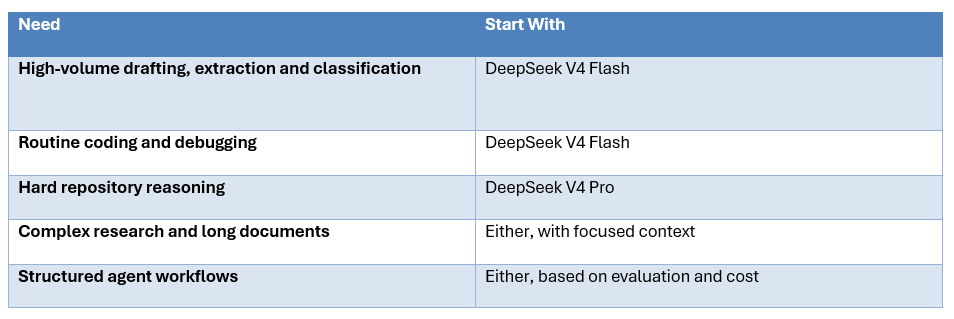
How to Turn These Into Reusable Templates
- Keep [task], [context], [constraints] and [output] as explicit variables.
- Create a small benchmark of real examples before changing a production prompt.
- Use structured outputs when the response feeds another system.
- Ask for verification on high-cost or high-risk tasks.
- Keep model-specific instructions separate from business logic so models can be swapped.
For larger agent workflows, pair these prompts with context engineering and LangGraph multi-agent orchestration.
Frequently Asked Questions
What are the best DeepSeek prompts?
The best prompts clearly define the role, task, context, constraints and output. The strongest template depends on whether you are coding, researching, analyzing data, writing or building an agent.
What is the best DeepSeek prompt for coding?
Give DeepSeek the exact task, relevant code, current and expected behavior, error output and constraints. Ask for a plan first when the change is large, then request the patch and tests.
How do I use DeepSeek for research?
Provide the research question and source material, ask it to separate facts from inference, and require evidence or source locations for important claims.
Can DeepSeek analyze long documents?
Yes. The official V4 API documentation currently lists a 1M-token context window for both V4 Flash and V4 Pro. Use only relevant context rather than filling the window by default.
Does DeepSeek support JSON output?
Yes. The current official API documentation lists JSON output support for V4 Flash and V4 Pro.
Which DeepSeek model is better for coding?
Start with V4 Flash for routine and high-volume coding. Use V4 Pro for harder repository reasoning or when the cheaper model repeatedly fails your tests.
Are DeepSeek prompts different from ChatGPT prompts?
The principles are similar, but prompts should be adapted to the model's behavior, output controls and actual task. A tested DeepSeek template is better than blindly copying a prompt built for another model.
How can I get better results from DeepSeek?
Give it more relevant context rather than simply more context, define success criteria, specify output format and verify important results against your source material or tests.
Recommended Blogs
- DeepSeek V4 Review: Benchmarks, Pricing & Verdict
- DeepSeek V4 Flash Vision Exp Review: Benchmarks & Price
- GLM-5.3 vs DeepSeek V4-Pro vs Kimi K3: Best Open Coding AI
- What Is Context Engineering? Complete Guide (2026)
- How to Use LangGraph for Multi-Agent Systems (2026)
- 100 Best Veo 3 Prompts 2026 (Copy-Paste)
Resources & Community
Join our community of 70,000+ AI enthusiasts and learn to build powerful AI applications. Whether you're a beginner or an experienced developer, Build Fast with AI helps you understand and implement AI in your projects.
- Website - buildfastwithai.com
- LinkedIn - Build Fast with AI
- Instagram - @buildfastwithai
- Founder Twitter - @satvikps
- Twitter - @BuildFastWithAI
Agentic AI Launchpad 2026
A structured 6-week cohort program that takes you from AI basics to building and deploying real-world agentic AI systems. Includes live sessions, expert mentorship, project reviews and a builder community network.
Ready to go from learning to building? Join the next cohort: Agentic AI Launchpad 2026
Free AI Resources
Access free tools, workshops and micro-learning to keep building.

