



Qwen3.8-Flash-Next Preview: Release Date, Specs & Qwen4 (2026)
Alibaba is about to hand developers an early key to Qwen4, and it is calling it Qwen3.8-Flash-Next. This is not the finished next generation flagship. It is a deliberate technology preview, an open-weight model built on the architecture that will power the full Qwen4 family, shipped early so the community can start building before the main event. If you follow open models at all, this is one of the most interesting drops of the year, and this preview breaks down exactly what is confirmed, what is still speculation, and whether you should care.
I will be clear about the line between fact and rumor throughout, because a preview is only useful if it is honest about what is known. Alibaba has confirmed the release window and the broad strokes. The community on Reddit and X has filled in the rest with educated guesses. I will label which is which, so you can plan around the confirmed parts and treat the speculation as speculation.
What Is Qwen3.8-Flash-Next?
Qwen3.8-Flash-Next is an open-weight, multimodal mixture-of-experts model from Alibaba, positioned as an early preview of the next-generation Qwen4 architecture. The name tells the story. Qwen3.8 places it in the current generation lineage, Flash signals a fast and efficient design, and Next marks it as the bridge to what comes after. It is the first public model to run on the architecture Alibaba plans to scale up into the full Qwen4 lineup.
The key idea is that Alibaba is releasing the architecture before the flagship. Instead of waiting to unveil a finished Qwen4 model, the team is shipping a preview so developers, tool builders, and the open source community can adapt their code, quantization tools, and pipelines ahead of time. When the full Qwen4 family lands, the ecosystem will already be ready for it. That is a smart, community-first move, and it is why this release matters more than a single model usually would.
If you are new to how these models work, the mixture-of-experts design at the center of Qwen3.8-Flash-Next is worth understanding first. Our explainer on what mixture of experts (MoE) is covers why activating only a small slice of a huge model is the trick behind its speed and low cost.
Release Date and Availability
Qwen3.8-Flash-Next is scheduled to release on August 26, 2026, on ModelScope, in both standard and FP8 versions. This is a confirmed date from Alibaba's announcement, not a rumor, which makes it one of the few fixed points in this preview. The FP8 version matters for anyone planning to run it locally, because it lowers the memory footprint and makes the model far more approachable on consumer and prosumer hardware.
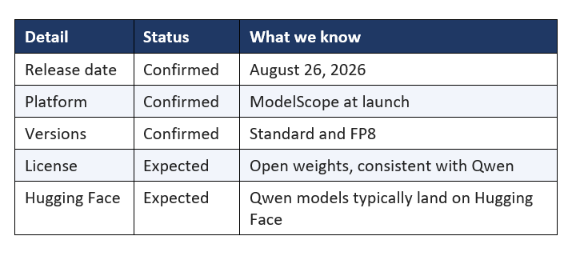
Qwen models typically land on Hugging Face
As an open-weight Qwen release, it is very likely to appear on Hugging Face under the official Qwen organization shortly after or alongside the ModelScope launch, following the pattern of every recent Qwen model. Treat the Hugging Face availability as expected rather than promised until Alibaba confirms it, but the track record is consistent enough that most developers will find it there quickly.
Qwen3.8-Flash-Next Specs (What We Know)
The headline spec of Qwen3.8-Flash-Next is a mixture-of-experts design with roughly 125 billion total parameters and only about 6 billion active per token, plus a large n-gram embedding table reported around 51 billion parameters. That active count is the whole point: a model with the knowledge capacity of 125B that runs at the speed and cost closer to a 6B model, because only the relevant experts fire for each token.
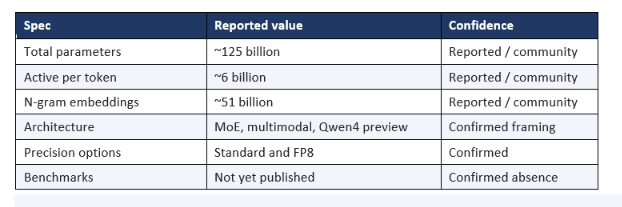
Important: hard benchmark scores for Qwen3.8-Flash-Next have not been published as of the preview. The parameter figures come from the announcement and community reporting, so treat exact numbers as provisional until Alibaba's model card is live.
The n-gram embedding table is the most unusual part, and it is what the community is most curious about. A large embedding lookup can improve how the model handles tokens and context without adding to the active compute, which fits the efficiency-first story of the whole design. Whether it delivers a real quality jump is exactly the kind of thing the first wave of testers will measure once the weights are out.
The Qwen3-Next Architecture Explained
Qwen3.8-Flash-Next builds on the Qwen3-Next architecture, which is Alibaba's efficiency-first redesign of how a large model works. Understanding it explains why this preview is exciting, because the architecture, not just the size, is the real story. Three ideas define it.
- Hybrid attention: it replaces standard attention with a mix of Gated DeltaNet and Gated Attention, which improves in-context learning while cutting compute.
- Ultra-sparse MoE: it activates only a tiny fraction of parameters per step, which is how an 80B or 125B model can run at a small model's cost.
- Multi-Token Prediction: it predicts more than one token at a time, boosting both quality and inference speed.
On the current-generation Qwen3-Next-80B-A3B, this design activates just 3 billion of 80 billion parameters, about 3.7 percent, and still matches the performance of the much larger Qwen3-235B flagship in many tasks. Qwen3.8-Flash-Next carries the same philosophy into the Qwen4 era, which is why it works as a preview: the architecture you learn now is the architecture Qwen4 will scale up.
How It Previews Qwen4
Qwen3.8-Flash-Next previews Qwen4 by shipping the next-generation architecture early, in a smaller, efficient package, before the full flagship family arrives. Alibaba is explicit that this is a technology preview, not the finished product. The goal is to let the open source ecosystem adapt tooling, inference engines, and quantization for the new architecture, so that when the larger Qwen4 models drop, everything already works.
This matters for anyone who builds on open models. Historically, a brand new architecture means weeks of waiting while inference libraries, local runners, and quantization tools catch up. By previewing the architecture now, Alibaba compresses that gap. If you maintain a tool, a pipeline, or a product on Qwen, this preview is your head start. If you just use the models, it is a preview of the speed and efficiency the whole Qwen4 line will likely bring.
It also signals Alibaba's strategy. Releasing the architecture openly and early, ahead of competitors, builds community goodwill and gets the new design battle-tested before the flagship. For the wider open model race, covered in our best open source AI models roundup, it is another sign that the efficiency frontier, not just raw size, is where the 2026 competition is being won.
Qwen3-Next-80B-A3B: The Sibling You Can Use Today
While Qwen3.8-Flash-Next is the preview, its sibling Qwen3-Next-80B-A3B is already available and is the best way to understand what is coming. It is an 80 billion parameter mixture-of-experts model that activates only 3 billion parameters per token, natively supports a 256K token context window, and can extend to around 1 million tokens. It comes in Base, Instruct, and Thinking variants.
The performance story is striking. The Base model surpasses the dense Qwen3-32B while using less than 10 percent of its training cost in GPU hours, and it delivers more than 10 times the throughput at context lengths beyond 32K tokens. The Instruct variant matches Alibaba's much larger Qwen3-235B flagship on many tasks, and the Thinking variant targets complex reasoning. If you want to feel the Qwen3-Next architecture today, this is the model to run.
For local deployment tips on the wider Qwen family, our guide on how to run Qwen3.8-Max locally walks through the hardware and setup, and much of it transfers to the Next models, especially the efficient FP8 builds.
Qwen3-Next-80B Benchmarks
On published benchmarks, Qwen3-Next-80B-A3B punches far above its active parameter count, which is the clearest preview of what Qwen3.8-Flash-Next aims to do. The Instruct model matches the flagship Qwen3-235B-A22B-Instruct on many evaluations despite activating a fraction of the parameters, and it excels in ultra-long-context tasks thanks to its 256K native window.
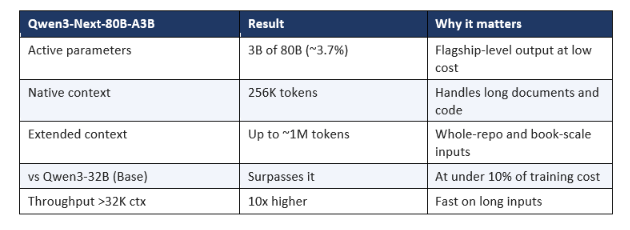
The takeaway for the Flash-Next preview is that the architecture already delivers flagship-adjacent quality at a small model's running cost. If Qwen3.8-Flash-Next carries that forward with its 125B and 6B active configuration, plus the n-gram embedding trick, the benchmarks, once published, could be very strong. Until Alibaba releases them, treat that as an informed expectation, not a claim.
Free Access and Hugging Face
Yes, Qwen3-Next models are effectively free to access, and Qwen3.8-Flash-Next is expected to follow the same open pattern. The current Qwen3-Next-80B-A3B-Instruct is available through free and low-cost routes, including a free tier on OpenRouter and the open weights on Hugging Face under the official Qwen organization, so you can try it without a large bill.
For Qwen3.8-Flash-Next specifically, the confirmed launch home is ModelScope on August 26, 2026, with a standard and an FP8 version. Given Qwen's history, expect the weights on Hugging Face too, which is where most Western developers will grab them. Open weights also mean you can run it locally for free if you have the hardware, and the FP8 build is designed to make that far more realistic on a single strong GPU.
Free and open access is a big part of why the Qwen family has spread so fast. It lowers the barrier for students, indie builders, and companies that cannot or will not send data to a closed API. For where Qwen sits among the current field, our best AI models of 2026 breakdown puts it in context against the closed leaders.
Qwen3-Coder-Next and Thinking Variants
Alibaba typically ships specialized variants alongside its base models, so a coder-focused and a thinking-focused version of the Next line are the natural expectation, though a specific Qwen3-Coder-Next preview is not yet officially confirmed. The pattern is well established: Qwen3-Next-80B-A3B already comes in Instruct and Thinking versions, and Qwen has a strong dedicated Qwen3-Coder line for software development with large context windows.
A Thinking variant is built for step-by-step reasoning, trading some speed for deeper problem solving, which suits math, logic, and complex planning. A Coder variant is tuned for reading and writing code across large repositories, which is where long context and efficiency really pay off. If the Qwen4 preview follows tradition, expect these specialized flavors to arrive so developers can pick the right tool per task. For how Qwen coding models stack up against rivals, see our comparison of DeepSeek V4 vs Kimi K3 vs GLM for open coding and our roundup of the best AI coding agents of 2026.
Note: 'Qwen3-Coder-Next Thinking' is a natural expected variant based on Qwen's release pattern, not an officially announced model as of this preview. Treat it as likely, not confirmed.
What Reddit and the Community Expect
On Reddit and X, the community expectation for Qwen3.8-Flash-Next centers on the roughly 125B total and 6B active configuration with a large n-gram embedding lookup, and a lot of excitement about local FP8 performance. It is worth stressing that much of this detail comes from community reporting and speculation with no official benchmark backing, so the enthusiasm should be read as informed anticipation rather than confirmed results.
The specific threads worth watching are the ones testing the FP8 build on single-GPU and workstation setups, because the whole promise of this model is flagship-adjacent quality at a runnable size. Early community benchmarks usually appear within days of an open weight release, so once August 26 passes, expect Reddit to fill with real numbers fast. Until then, the confirmed facts are the release date, the platform, the versions, and the Qwen4 preview framing. Everything about exact scores is still open.
My honest read: the community is right to be excited, because the current Qwen3-Next results are real and strong, and Flash-Next scales the same idea. But temper the hype until the model card and independent tests land. A preview is a promise, not a proof, and the smart move is to prepare now and judge on the numbers when they exist.
The Qwen Model Family in 2026
Qwen3.8-Flash-Next sits inside a large and fast moving Qwen family, and knowing the lineup helps you place this preview. Alibaba has shipped a wide range in 2026, from small dense models to trillion-parameter flagships, across general, coding, and multimodal use.
- Dense small models like the Qwen3 8B class, popular for their strong performance at a size that runs almost anywhere.
- Mid and large dense models such as the 32B and 72B class, balancing capability and cost.
- Flagship models like Qwen3.8-Max, the high-end option reviewed in detail on our blog.
- Efficient MoE models like Qwen3-Next-80B-A3B and now the Qwen3.8-Flash-Next preview.
For the two ends of that range, our Qwen3.8-Max review covers the flagship, and our Qwen3.8 preview covers the open-weights direction. Flash-Next is the efficiency play in that family: not the biggest, but arguably the most forward-looking, because it is the one carrying the Qwen4 architecture.
How to Run Qwen3.8-Flash-Next Locally
Running Qwen3.8-Flash-Next locally should be realistic for enthusiasts once the FP8 build lands, which is a big part of its appeal. Because only about 6 billion parameters activate per token, the model runs far faster than its 125 billion total would suggest, though you still need enough memory to hold the weights. The FP8 version roughly halves that memory footprint compared to full precision, which is exactly why Alibaba is shipping it on day one.
Here is the practical picture for when the weights drop on August 26. Expect the full model to want a high-memory GPU or a multi-GPU or unified-memory workstation for the standard build, while the FP8 build brings it within reach of a single strong card or a high-memory Apple Silicon or workstation setup. Popular local runners and inference engines usually add support for a new Qwen architecture within days, which is the whole reason this preview exists: to give those tools a head start.
A sensible plan: wait for the FP8 weights, pick a local runner that has added Qwen3-Next support, and start with a quantized build if your memory is tight. Our guide on running Qwen3.8-Max locally covers the hardware math and setup steps, and most of it transfers directly to the Next models. Test on your own tasks before trusting any single benchmark number.
Qwen3.8-Flash-Next vs Other Open Models
Against other open models, Qwen3.8-Flash-Next competes on efficiency rather than raw size, and that is a smart place to compete in 2026. The open model race has split into two camps: giant dense or high-active models that chase top benchmarks, and efficient MoE models that chase the best quality per dollar of compute. Flash-Next, like its Qwen3-Next sibling, is firmly in the second camp, and that camp is winning a lot of real-world adoption because most teams care about cost as much as peak scores.
Its natural rivals are the other efficient open models from DeepSeek, Moonshot's Kimi, and Zhipu's GLM, all of which have pushed strong open coding and reasoning models in 2026. What sets the Qwen3-Next line apart is the specific architecture mix of hybrid attention, ultra-sparse MoE, and multi-token prediction, plus Alibaba's habit of shipping open weights early and often. Whether Flash-Next tops those rivals on benchmarks is unknown until scores publish, but on the efficiency-first design philosophy, it is right at the front.
For a direct look at how the open coding models stack up today, our comparison of DeepSeek V4 vs Kimi K3 vs GLM is the best starting point, and it is exactly the field Qwen3.8-Flash-Next and the coming Qwen4 family will be measured against.
Should You Wait for It?
Whether you should wait for Qwen3.8-Flash-Next depends on what you are building. If you maintain tooling, run open models locally, or want the earliest look at the Qwen4 architecture, yes, it is worth planning around the August 26 release and testing it early. The FP8 build in particular could be a strong local option if the efficiency claims hold.
If you need a production model right now, do not wait on a preview. Use the already available Qwen3-Next-80B-A3B, which delivers the same architecture's benefits with published benchmarks and stable availability, or your current model of choice. A technology preview is, by definition, early, so treat Flash-Next as something to evaluate and prepare for, not to bet a shipping product on before the numbers are in.
My recommendation: mark August 26 on your calendar, grab the weights when they land, and run your own tasks against the FP8 build. Preview models reward the curious and the prepared. Learn the architecture now through Qwen3-Next-80B-A3B, and you will be ready to move the moment the full Qwen4 family arrives.
One last framing that keeps this in perspective. A technology preview is Alibaba showing its hand early on purpose, which is a confident move in a field where most labs guard their next architecture until launch day. That openness is good for everyone who builds on Qwen, because it means less waiting and more time to adapt. Whether Qwen3.8-Flash-Next itself becomes a daily driver or just a stepping stone to Qwen4, the smart play is the same: watch the August 26 release, read the first real benchmarks with a clear head, and let the numbers, not the hype, decide how it fits your stack.
FAQ
When does Qwen3.8-Flash-Next release?
Qwen3.8-Flash-Next is scheduled to release on August 26, 2026, on ModelScope, in standard and FP8 versions. This date is confirmed by Alibaba's announcement. As an open-weight Qwen model, it is also expected to appear on Hugging Face around the same time.
What are the Qwen3.8-Flash-Next specs?
Qwen3.8-Flash-Next is reported to be a mixture-of-experts model with about 125 billion total parameters, roughly 6 billion active per token, and a large n-gram embedding table near 51 billion parameters. It is open-weight and multimodal, built on the Qwen4 architecture. Hard benchmarks have not been published yet, so exact figures are provisional.
Is Qwen3.8-Flash-Next free?
Yes, it is expected to be free and open-weight, following the Qwen pattern. It launches on ModelScope, likely appears on Hugging Face, and open weights mean you can run it locally at no license cost if you have the hardware. The FP8 version is designed to make local use more affordable.
How is Qwen3.8-Flash-Next different from Qwen3-Next-80B-A3B?
Qwen3-Next-80B-A3B is available now with published benchmarks and 80 billion parameters at 3 billion active, while Qwen3.8-Flash-Next is a preview of the newer Qwen4 architecture with about 125 billion parameters at 6 billion active plus a large n-gram embedding table. They share the same efficiency-first philosophy, but Flash-Next is the forward-looking preview and 80B-A3B is the production-ready sibling.
What is the Qwen3-Next-80B benchmark performance?
Qwen3-Next-80B-A3B-Instruct matches the much larger Qwen3-235B flagship on many tasks despite activating only 3 billion parameters, supports 256K native context extendable to around 1 million tokens, and delivers over 10 times the throughput of Qwen3-32B at long context. The Base model surpasses Qwen3-32B at under 10 percent of its training cost.
Is there a Qwen3-Coder-Next or Thinking model?
Qwen already offers Thinking variants of the Next line and a dedicated Qwen3-Coder family, so coder and thinking versions of the Next architecture are a natural expectation. A specific Qwen3-Coder-Next preview is not officially confirmed yet, so treat it as likely based on Qwen's release pattern rather than announced.
Where can I download Qwen models on Hugging Face?
Qwen models are published on Hugging Face under the official Qwen organization, including the Qwen3-Next-80B-A3B Instruct and Thinking variants and smaller dense models like the Qwen3 8B class. Qwen3.8-Flash-Next launches on ModelScope on August 26, 2026, and is expected on Hugging Face shortly after, consistent with past releases.
How good is Qwen3-8B performance?
The Qwen3 8B class is popular because it delivers strong results for its small size, making it a practical choice for local use on modest hardware and for fast, low-cost inference. It will not match the huge MoE models on the hardest tasks, but for everyday use, prototyping, and edge deployment, the small dense Qwen models are among the most useful open options.
Is Qwen3.8-Flash-Next actually Qwen4?
No, Qwen3.8-Flash-Next is not Qwen4 itself. It is a preview built on the architecture that will power the Qwen4 family, released early so developers can prepare. The full Qwen4 flagship models come later. The name keeps it in the Qwen3.8 generation while the Next tag marks it as the bridge to the new architecture.
Does Qwen have a 72B model?
Yes, Qwen has shipped dense models in the 72B class across its generations, aimed at users who want high capability in a single dense model rather than a mixture-of-experts design. The newer direction, seen in Qwen3-Next-80B-A3B and Qwen3.8-Flash-Next, favors efficient MoE models that activate only a few billion parameters, which often match or beat older dense models of similar or larger size at a fraction of the running cost.
What makes Qwen3.8-Flash-Next a big deal?
Qwen3.8-Flash-Next matters because it hands the open source community the next-generation Qwen4 architecture early, in an efficient, likely local-runnable package, before the flagship arrives. If the efficiency of the Qwen3-Next line carries forward, it could offer flagship-adjacent quality at a small model's cost, and it lets the whole ecosystem get ready for Qwen4 ahead of time.
Recommended Blogs
- Qwen3.8-Max Review: Specs, Pricing & Honest Take
- Qwen3.8 Preview: 2.4T Params, Open Weights, Release
- Best Open Source AI Models July 2026: Full Collection
- What Is Mixture of Experts (MoE)? How It Works (2026)
- Best AI Models 2026: Full Ranked Analysis and Benchmarks

