Claude Ship Review: Anthropic's AI That Approves Your PRs
Claude Ship Review: Can You Trust AI to Approve Your Code?
For the last two years, AI has been writing more and more of our code. The bottleneck quietly moved somewhere else: review. Pull requests pile up, senior engineers spend their afternoons approving small changes, and good work waits days to merge. Anthropic's answer, launched on November 23, 2026, is Claude Ship, a set of AI agents that review a pull request, fix what they find and, if your rules allow it, approve it. That last part is what makes Claude Ship different from every AI code reviewer before it, and it's also what makes people nervous. In this review I'll explain exactly how Claude Ship works, what it costs, who can use it, and the honest question underneath it all: should you let an AI approve code that goes into production? My answer is 'yes, but slowly', and I'll show you how to roll it out without regretting it.
What Is Claude Ship?
Claude Ship is a product from Anthropic that automates the last stage of the software development pipeline: getting a pull request reviewed, fixed and approved on GitHub. Instead of a single AI reviewer that leaves comments, it's a team of three agents that hand work to each other, from first review to final approval.
It builds on Claude Code, Anthropic's coding tool, and on its existing Code Review feature, which we covered in our Claude Code review guide. The big change is scope. Code Review told you what was wrong. Claude Ship can now fix it and, under strict rules, sign off on it.
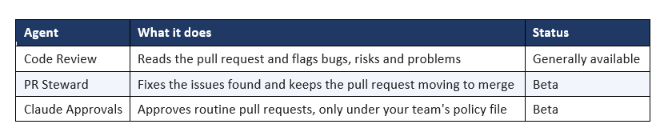
It launched as a beta. One part, Code Review, is generally available. The other two, PR Steward and Claude Approvals, are in beta. That status matters: you're getting early access to something powerful that is still being tuned.
How Claude Ship Works: The Three Agents
Claude Ship is easiest to understand as three roles you'd normally give to different people on a team.
1. Code Review
Code Review is the reviewer. It reads the changes in a pull request and points out problems: bugs, edge cases, risky changes and code that doesn't match the rest of the project. You choose how thorough it is, with Quick, Standard and Deep review settings, so a one-line typo fix doesn't get the same expensive deep review as a payments change.
2. PR Steward
PR Steward is the one that does the follow-up work. When Code Review finds something, PR Steward can make the fix and push it, rather than leaving a comment for a human to act on. Think of it as the engineer who keeps the pull request moving so it doesn't sit stale for a week.
3. Claude Approvals
Claude Approvals is the new, sensitive part. It can approve a pull request, but only when the change fits a policy file your team writes. That policy is where you decide what counts as 'routine': maybe dependency bumps, documentation, test-only changes or small fixes in low-risk folders. Anything outside the policy goes to a human. Anthropic recommends starting in observe-only mode, where Claude says what it would approve without actually approving anything.
The /ship Command in Claude Code
For developers, the most direct way in is the /ship command in Claude Code. Run it on your work, and Claude Ship takes it through the review, fix and approval steps your team has configured.
Billing works in two parts, and it's worth understanding. Running /ship counts as regular Claude Code usage. Claude Ship's own work, the reviewing, fixing and approving, is billed by tokens separately from your plan's included usage. So a busy repository can create a separate line on your bill, which is another reason to start with a pilot rather than turning it on everywhere.
Teams also stay in control of three settings: where Claude Ship runs (which repositories), which review depth to use (Quick, Standard or Deep), and which kinds of changes are always escalated to a human for a decision.
Claude Ship Pricing and Credits
Claude Ship doesn't have a flat monthly price. It's billed by token usage, separately from the usage included in your Claude plan. How much you'll pay depends on how many pull requests it handles, how large they are and which review depth you choose. Deep reviews on big pull requests cost more than quick reviews on small ones.
To encourage adoption, Anthropic is offering credits: eligible Enterprise organisations can claim at least $10,000 in Claude Ship credits by January 15, 2027. If you're on Enterprise and considering a pilot, that's a meaningful budget to test it properly before committing your own money.
My practical tip: before rolling out widely, run Claude Ship on one active repository for two weeks and divide the token cost by the number of pull requests it handled. That cost per pull request is the number to compare against the engineering time it saves.
Who Can Use Claude Ship?
Access is narrower than you might expect, so check this before you get excited.
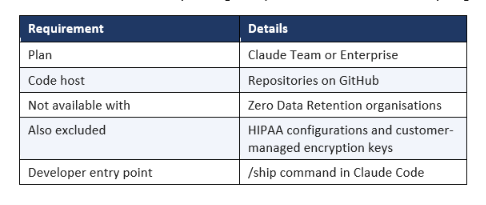
The exclusions are the important part. If your organisation uses Zero Data Retention, a HIPAA setup or its own encryption keys, typically healthcare, finance and other regulated companies, you can't use Claude Ship yet. Those are often exactly the companies with the strictest review processes, so this rules out some of the teams that might want it most. It's also GitHub-only for now, so teams on GitLab or Bitbucket will have to wait.
Quick vs Standard vs Deep Review
Claude Ship lets you pick how thorough each review is: Quick, Standard or Deep. This choice matters more than it looks, because it controls both quality and cost.
- Quick: a fast pass for small, low-risk changes such as typo fixes, copy edits, config tweaks or dependency bumps. Cheap, and good enough when there's little that can go wrong.
- Standard: the sensible default for normal feature work and bug fixes. It looks more carefully at logic and edge cases without the cost of a full deep dive.
- Deep: for changes that really matter, such as large refactors, shared libraries, data handling or anything near security. It takes longer and uses more tokens, but that's money well spent on risky code.
A practical rule of thumb: match the depth to the damage a bad merge could do, not to the size of the pull request. A tiny change to a login check deserves a Deep review; a large but purely cosmetic change may only need Quick. Setting depth by folder or by label is a simple way to make this automatic, and it keeps your token bill under control.
What a Good Approval Policy Looks Like
Claude Approvals only acts within the policy file your team writes, so the policy is where safety really lives. Anthropic hasn't published a universal template, and every codebase is different, but good policies tend to follow the same principles.
- Allow by type, not by trust: approve only specific kinds of change, for example documentation, tests, comments or version bumps of approved dependencies.
- Allow by location: limit approvals to low-risk folders, and exclude anything touching authentication, payments, permissions, infrastructure, deployment or secrets.
- Cap the size: small changes are easier to review correctly. Send anything large to a human regardless of type.
- Require green checks: only approve when tests and existing automated checks pass.
- Escalate when unsure: anything ambiguous should go to a person by default, not be approved by default.
- Review the policy itself: treat the policy file like code, with its own review and an owner who updates it as you learn.
The goal is a policy boring enough that nobody worries about what Claude approves. Start very narrow, watch the results in observe-only mode, and widen one rule at a time.
Is It Safe to Let AI Approve Code?
This is the real question, and it deserves a straight answer rather than hype.
The case for it is simple. Much of what sits in a review queue is genuinely routine: version bumps, small fixes, documentation and test changes. Having senior engineers approve those by hand is slow and wastes their time. A well-written policy that lets Claude approve only those low-risk changes, while everything else goes to a person, could clear a lot of backlog safely.
The case for caution is just as real. Anthropic has published no public benchmark for how accurate Claude Ship is. And Decrypt pointed to independent research suggesting AI models struggle to find vulnerabilities in AI-generated code, which matters because more and more of the code being reviewed is now written by AI in the first place. An AI approving AI-written code is exactly the scenario where a subtle security flaw could slip through.
My view: Claude Approvals is safe to use if your policy is narrow and you treat it as a filter, not a gatekeeper for anything important. Never let it approve changes to authentication, payments, permissions, infrastructure or security-sensitive code. We wrote more about this risk in AI coding agent security: the risk of too much access.
How to Set Up Claude Ship Safely
If you decide to try it, here's the rollout I'd recommend.
- Start with Code Review only. It's the generally available part. Use it for a couple of weeks and judge the quality of its comments on your real code.
- Turn on PR Steward on one repository. Pick an active but low-risk repository and check every fix it makes before merging.
- Run Claude Approvals in observe-only mode. Let it say what it would approve, and compare that against what your engineers actually approved.
- Write a narrow policy file. Allow only clearly routine changes: documentation, tests, dependency bumps you trust and small fixes in low-risk paths.
- Block sensitive areas explicitly. Authentication, payments, permissions, infrastructure and anything security-related should always go to a human.
- Measure, then widen. Track mistakes, cost per pull request and time saved. Expand the policy only when the numbers are good.
This approach turns Claude Ship from a risky leap into a controlled experiment, and it gives you the data to justify expanding it to the rest of the team.
Claude Ship vs Manual Code Review
Claude Ship isn't a replacement for human review; it's a way to spend human review where it matters. Here's how the two compare in practice.
- Speed: Claude Ship reviews and fixes in minutes; human review can take hours or days when people are busy.
- Consistency: Claude applies the same checks every time; humans get tired and skim long pull requests.
- Judgment: humans still understand business context, product intent and team politics far better than any AI.
- Security: experienced humans are still better at spotting subtle, novel vulnerabilities, especially in AI-written code.
- Cost: Claude Ship costs tokens; human review costs expensive engineering hours.
The best setup is both: Claude Ship handles the routine majority and catches obvious issues fast, so your engineers can focus their attention on the risky minority. If you're comparing AI coding tools more broadly, our guide to the best AI coding agents in 2026 is a good starting point.
Claude Ship Pros and Cons
Pros
- Covers the whole pipeline: review, fix and approval, not just comments.
- Policy file and observe-only mode give you real control.
- Adjustable review depth (Quick, Standard, Deep) to manage cost.
- Works from Claude Code with a simple /ship command.
- At least $10,000 in credits for eligible Enterprise teams.
Cons
- PR Steward and Claude Approvals are still in beta.
- No public benchmarks on accuracy yet.
- GitHub only, and Team or Enterprise plans only.
- Not available with Zero Data Retention, HIPAA or customer-managed keys.
- Separate token billing can be hard to predict at first.
Is Claude Ship Worth It?
For teams on Claude Team or Enterprise who use GitHub and drown in routine pull requests, Claude Ship is worth piloting now. Code Review alone is useful, PR Steward can genuinely save time on follow-up fixes, and Claude Approvals, used carefully, can clear the boring part of the backlog. The Enterprise credits make a proper trial almost free.
Just keep your expectations grounded. Two of the three agents are in beta, there are no published accuracy numbers, and letting AI approve AI-written code carries real security risk. Start in observe-only mode, keep a narrow policy, never let it approve sensitive code, and measure everything. Do that, and Claude Ship could be one of the most practical AI tools your engineering team adopts this year.
Frequently Asked Questions
What is Claude Ship?
Claude Ship is a set of AI agents from Anthropic, launched in beta on November 23, 2026, that takes GitHub pull requests from review through approval. It includes Code Review, PR Steward and Claude Approvals.
How does Claude Ship work?
Code Review finds problems in a pull request, PR Steward fixes them and keeps the PR moving, and Claude Approvals can approve routine changes under a policy file your team writes. Teams choose review depth and which changes go to a human.
How much does Claude Ship cost?
Claude Ship is billed by tokens, separately from your plan's included usage. Running the /ship command counts as regular Claude Code usage. Eligible Enterprise organisations can claim at least $10,000 in credits by January 15, 2027.
Is it safe to let Claude Ship approve pull requests?
It can be, if you use a narrow policy file, start in observe-only mode and keep sensitive code such as authentication, payments and infrastructure under human review. Anthropic hasn't published accuracy benchmarks yet, so caution is wise.
Who can use Claude Ship?
Teams on Claude Team and Enterprise plans with repositories on GitHub. It isn't available to organisations using Zero Data Retention, HIPAA configurations or customer-managed encryption keys.
What is the /ship command?
/ship is a command in Claude Code that sends your work through Claude Ship's review, fix and approval steps, based on your team's settings. It counts as regular Claude Code usage.
Is Claude Ship generally available?
Partly. Code Review is generally available, while PR Steward and Claude Approvals are in beta as of launch.
Does Claude Ship work with GitLab or Bitbucket?
Not at launch. Claude Ship currently works with repositories on GitHub only, so teams on GitLab or Bitbucket will need to wait for Anthropic to add support, or keep using Claude Code's review features in their existing workflow.
Has Anthropic published Claude Ship benchmarks?
No. At launch Anthropic had not published a public benchmark for Claude Ship's review or approval accuracy. That's a good reason to run it in observe-only mode first and measure its decisions against your own engineers before trusting it with approvals.
Recommended Blogs
- Claude Code Review Guide
- Claude Code vs Codex
- Claude Code Auto Mode
- Claude Security: AI Code Scanner
- AI Coding Agent Security Risks
- Best AI Coding Agents in 2026
References

Founder at Build Fast with AI. AI Engineer, educator, and researcher passionate about agentic AI workflows, LLM application architecture, and training the next generation of AI builders.