Shirudo Review: Cisco & OpenAI's AI Shield for Linux
What Is Shirudo? Cisco and OpenAI's AI Shield for Linux, Reviewed
Every security team knows the uncomfortable gap. A serious vulnerability gets announced, a patch exists or is coming, and then there's the wait: testing the patch, scheduling a maintenance window, restarting services, hoping nothing breaks. During that gap, attackers are already scanning for unpatched systems, and with AI now helping attackers write exploits faster, that gap is getting more dangerous. Shirudo, a new open-source project from Cisco and OpenAI announced on November 23, 2026, is an attempt to close it. Instead of waiting for a patch, it uses AI agents to write a small, temporary shield that blocks the exploit right now, inside the Linux kernel, without restarting anything. The name appears to come from the Japanese word for 'shield', which is a fair description of the idea. In this review I'll explain what Shirudo is, how it actually works, what eBPF has to do with it, and the honest reason you shouldn't put it on a production server just yet.
What Is Shirudo?
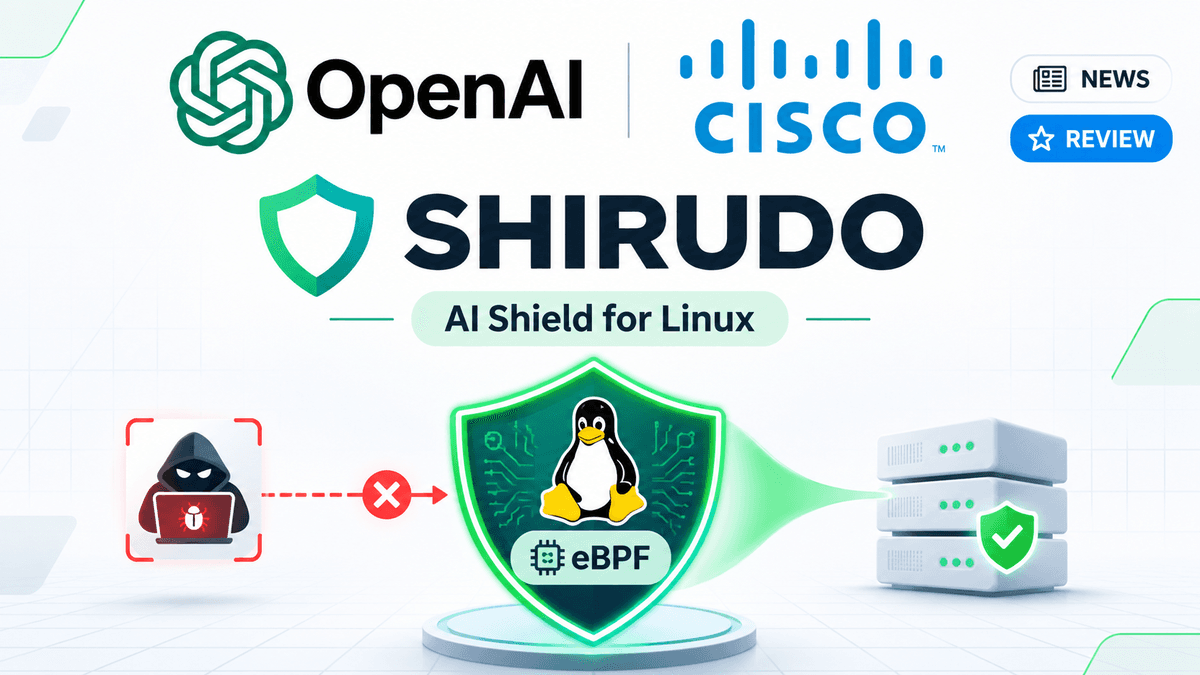
Shirudo is an open-source tool that protects Linux systems with known vulnerabilities while they wait to be patched. Its core idea is simple: when a vulnerability is known, an AI agent writes a narrowly targeted protection, a 'shield', that blocks attempts to exploit it. The shield runs inside the operating system's kernel, so it can stop the attack at a very low level, and it can be added without restarting the service it protects.
Think of it as a bandage, not surgery. The real fix is still the patch. Shirudo's job is to stop the bleeding during the days or weeks before that patch can be safely applied, which is exactly when many real-world breaches happen. Security people often call this kind of approach virtual patching, and Shirudo's twist is that AI writes the virtual patch.
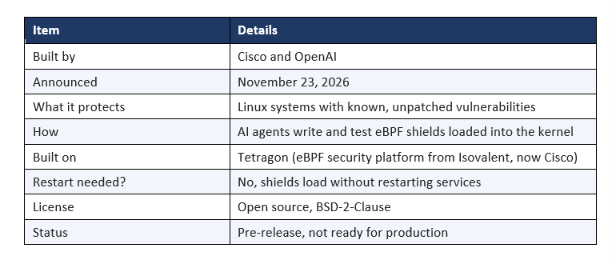
Shirudo at a glance
Who Built Shirudo: Cisco and OpenAI
The partnership makes more sense than it might seem at first. Cisco brings deep networking and security infrastructure, plus Tetragon, which it gained by acquiring Isovalent, the company behind the widely used Cilium and Tetragon projects. Cisco already uses Tetragon in its own products, including virtual patching features for its data centre switches.
OpenAI brings the AI models that write the shields, and it also has a direct interest in the outcome: OpenAI runs huge amounts of computing infrastructure and has adopted Isovalent's networking technology for its own Kubernetes clusters. Protecting AI infrastructure is, quite literally, protecting its own business. OpenAI has been moving further into security lately, which we covered in our look at OpenAI's Daybreak cybersecurity platform.
How Shirudo Works
Here's the flow, step by step, in plain terms.
- A vulnerability is known. A flaw has been disclosed in some software running on your Linux system, and you can't patch it immediately.
- An AI agent studies it. The agent works out what an exploit of that flaw looks like at the system level: which calls, files or behaviour an attack would need.
- The agent writes a shield. It produces a small eBPF program designed to block exactly that malicious behaviour while letting normal traffic through.
- The shield is tested. Before anything goes live, the agent tests the shield, inside boundaries and safety rules that humans have set.
- The shield is loaded into the kernel. It starts blocking exploit attempts immediately, with no service restart.
- The real patch arrives later. Once you apply the proper fix, the temporary shield is no longer needed.
The clever part is speed and precision. Writing a correct, narrow kernel-level protection by hand is specialist work that can take a skilled engineer a long time. If AI can do a safe first draft in minutes and test it automatically, the window of exposure shrinks dramatically.
A Simple Example: Shielding an Unpatched Server
To make this concrete, picture a company running a customer-facing Java application on a few dozen Linux servers. On a Tuesday, a serious OpenJDK vulnerability is disclosed. The patch needs testing against the application, and the next safe maintenance window is the weekend.
Without Shirudo, those servers are exposed for four or five days, and the security team spends that time watching logs and hoping. With Shirudo, an AI agent drafts a shield that blocks the specific behaviour an exploit would need, tests it within the team's rules, and loads it into the kernel on each server without restarting the application. Customers notice nothing. On Saturday, the team applies the real patch and removes the shield.
That's the whole value proposition in one story: the same patch, the same weekend, but days of exposure turned into minutes. It's also why the human rules matter so much. The team should check that the shield blocks only the attack, not normal application behaviour, before trusting it on every server.
What Is eBPF, and Why Does It Matter Here?
You can't really understand Shirudo without a quick look at eBPF, so here's the plain-English version.
The kernel is the core of the Linux operating system. Changing how it behaves used to mean modifying kernel code or loading risky kernel modules, and often restarting the machine. eBPF changed that. It lets you run small, sandboxed programs inside the kernel safely, without changing kernel code and without a restart. The kernel checks each eBPF program before it runs to make sure it can't crash the system.
That makes eBPF perfect for something like Shirudo. A shield can watch and block specific behaviour at the deepest level of the system, it can be added and removed on the fly, and the kernel's own safety checks provide a built-in layer of protection against a badly written program. In other words, eBPF is what lets Shirudo act fast without taking systems offline.
Built on Tetragon
Shirudo isn't starting from scratch. It's built on Tetragon, an eBPF-based security platform that Isovalent developed and open-sourced in May 2022. Tetragon can hook into functions inside the Linux kernel, look at their arguments and results, and enforce security policies in real time, all without shipping events out to a separate agent first.
That foundation matters for trust. Tetragon is already used in real production environments and has been tested heavily by the open-source community. Shirudo adds the AI layer on top: instead of a human writing Tetragon policies by hand for each new vulnerability, AI agents draft them. Building on a proven platform is a sensible choice for a project that, by its nature, touches the most sensitive part of a system.
Shirudo in Testing: Java4Shell and PHP
Cisco and OpenAI say Shirudo has already worked against real vulnerabilities in testing. It blocked exploitation of a recent OpenJDK flaw nicknamed Java4Shell, and of a recent PHP vulnerability.
Those are meaningful examples. Java and PHP run an enormous amount of the world's web software, and flaws in either can expose huge numbers of servers at once. Being able to shield them quickly, without restarting the application, is exactly the scenario Shirudo was designed for.
Keep this in proportion, though. These are results reported by the companies that built the tool, from testing, not independent audits in production. Two successful cases show the idea can work; they don't yet show how often it works, how often a shield might block legitimate traffic, or how it behaves across thousands of different systems.
How Humans Keep the AI in Bounds
Letting AI write code that runs inside the kernel sounds alarming, and the designers clearly know it. Shirudo's AI agents generate and test shields only within boundaries and safety guidelines that humans define. People decide what the agents are allowed to do; the agents work within that space.
On top of that, eBPF itself adds a safety net: the kernel verifies every program before it runs, which prevents many classes of crash. And because shields are temporary and removable, a bad one can be pulled quickly. That combination, human-set rules, automatic testing, kernel verification and easy removal, is a reasonable design for a tool like this. It's the same principle we argue for in AI coding agent security: the risk of too much access: give AI agents narrow, well-defined powers, not open access.
Shirudo vs Traditional Patching
Shirudo isn't a replacement for patching; it works alongside it. Here's how the two compare.
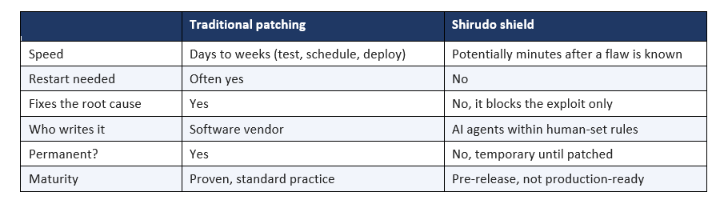
The takeaway is that they solve different problems. Patching fixes the bug. Shirudo buys you time safely until you can patch. In a world where AI is helping attackers move faster, buying time may be one of the most valuable things a security team can do.
Is Shirudo Ready for Production?
No, and Cisco and OpenAI say so themselves. Shirudo is in pre-release development and is not ready for production use. That's an honest and sensible position for a tool that runs AI-generated code inside the kernel.
So what should you do with it today? If you run a security or platform team, it's worth exploring in a lab or test environment: read the code, try it against known vulnerabilities on non-critical machines, and see how its shields behave. That builds familiarity for when it matures. What you shouldn't do is rely on it to protect production systems, or treat it as a reason to delay real patches.
The Secure Infrastructure Project
Shirudo is the first project under a broader effort called the Secure Infrastructure Project, which aims to make AI computing infrastructure secure by design. The thinking is that AI systems run on enormous, complex infrastructure, and that infrastructure needs security built in from the start rather than bolted on later.
That framing suggests Shirudo is the opening move, not the whole plan. Expect more open-source tools from the same initiative aimed at protecting the servers, networks and clusters that AI runs on. If you work on AI infrastructure, it's an initiative worth following.
Risks and Open Questions
A fair review has to name what we don't know yet.
- False positives: a shield that's too broad could block legitimate traffic and cause an outage of its own. How often does that happen?
- AI mistakes in security code: AI models can make subtle errors, and independent research has questioned how well AI handles security-sensitive code. Testing helps, but doesn't remove the risk.
- Attackers adapting: if attackers know a shield blocks one exploit path, they may look for another route to the same flaw.
- Operational trust: will security teams be comfortable letting AI-written programs run in the kernel, even temporarily? Culture may move slower than technology.
- Linux only: as an eBPF tool, it's built for Linux, so other operating systems aren't covered.
None of these sink the idea. They're the questions the project will need to answer before it's ready for real-world use, and they're good questions to ask of any AI security tool. For a look at how AI is being used to find security issues earlier, in code rather than at runtime, see our review of Claude Security, Anthropic's AI code scanner.
Who Should Pay Attention
- Security and platform engineers who manage Linux fleets and struggle with patch windows.
- Teams running Kubernetes and cloud infrastructure, where Tetragon is already familiar.
- Companies building or running AI infrastructure, the focus of the Secure Infrastructure Project.
- Security leaders tracking how AI is changing both attack and defence.
- Open-source contributors interested in eBPF and runtime security.
My Verdict
Shirudo is one of the more genuinely useful ideas to come out of the AI security wave. It aims AI at a real, painful problem, the gap between a disclosed vulnerability and a deployed patch, and it does it with sensible engineering: a proven eBPF foundation in Tetragon, human-defined boundaries, automatic testing, temporary shields and an open-source license that lets anyone inspect the code. The early test results against Java and PHP flaws are encouraging.
But it's early. It's pre-release, the results so far come from its creators, and running AI-written code in the kernel will rightly make careful teams cautious. My recommendation: if you work in security or infrastructure, star the project, try it in a lab and follow the Secure Infrastructure Project. Don't use it in production yet, and never as an excuse to skip patching. If it matures as intended, AI-written shields could become a standard part of how we defend systems in the time it takes to fix them properly.
Frequently Asked Questions
What is Shirudo?
Shirudo is an open-source Linux security project from Cisco and OpenAI, announced on November 23, 2026. It uses AI agents to write temporary eBPF shields that block exploits of known vulnerabilities until a proper patch is applied.
How does Shirudo work?
When a vulnerability is known, an AI agent writes a small eBPF program, called a shield, that blocks exploit attempts. The shield is tested within human-defined boundaries and then loaded into the Linux kernel without restarting the affected service.
Is Shirudo open source?
Yes. Shirudo is open source, and its site lists the BSD-2-Clause license, which allows broad use and modification.
What is an eBPF shield?
It's a small, sandboxed program that runs inside the Linux kernel to watch for and block specific malicious behaviour. eBPF lets these programs run safely without changing kernel code or restarting the system.
Is Shirudo ready for production?
No. Cisco and OpenAI say Shirudo is in pre-release development and not ready for production use. It's best explored in test environments for now.
What is Shirudo built on?
It's built on Tetragon, an eBPF-based security platform developed and open-sourced by Isovalent in May 2022. Isovalent is now part of Cisco.
Does Shirudo replace patching?
No. Shirudo blocks exploits temporarily but doesn't fix the underlying bug. You still need to apply the real patch; Shirudo just reduces your risk while you wait.
Recommended Blogs
- OpenAI Daybreak Cybersecurity Platform
- Claude Security: AI Code Scanner
- AI Coding Agent Security Risks
- Claude Security Plugin
References

Founder at Build Fast with AI. AI Engineer, educator, and researcher passionate about agentic AI workflows, LLM application architecture, and training the next generation of AI builders.