

Muse Code vs Claude Code vs Codex: Best AI Coding Agent (2026)
The AI coding agent wars just got a third major player. Meta launched Muse Code this week, a terminal agent that undercuts Anthropic's Claude Code and OpenAI's Codex on price while claiming benchmark wins. So which of the three should you actually use? This comparison cuts through the launch-day noise with the real numbers, the honest tradeoffs, and a clear recommendation for each type of developer.
The short answer: Claude Code is still the accuracy leader for hard, complex work. Codex is the balanced all-rounder with the deepest ecosystem. Muse Code is the value pick, cheapest by far, with a clever parallel sub-agent feature, but not the top performer yet. Most developers should pick based on whether they optimize for quality, ecosystem, or cost.
QUICK ANSWER
For the best raw performance on complex codebases, use Claude Code with Opus 5, which leads the benchmarks. For a balanced all-rounder with strong ecosystem support, use OpenAI Codex. For the lowest cost and parallel task execution, use Meta's Muse Code. All three are terminal agents that plan, write, and validate code across your repo, so the choice comes down to quality versus price.
The Three Agents at a Glance
All three tools belong to the same category: terminal coding agents that live in your command line, read your actual repository, and take on complete engineering tasks rather than answering questions in a chat box. They plan a change, write it across multiple files, and validate the result. The differences are in how well they do it, what they cost, and the standout tricks each one brings.
Claude Code from Anthropic is the current quality benchmark, powered by Claude Opus 5. OpenAI Codex is the widely adopted all-rounder, powered by GPT-5.6 Terra. Meta Muse Code is the new challenger, powered by the Muse Spark 1.2 model and built to compete on price and parallel execution. Here is the single table that captures the core tradeoff before we go deeper.
Table 1: Muse Code vs Claude Code vs Codex
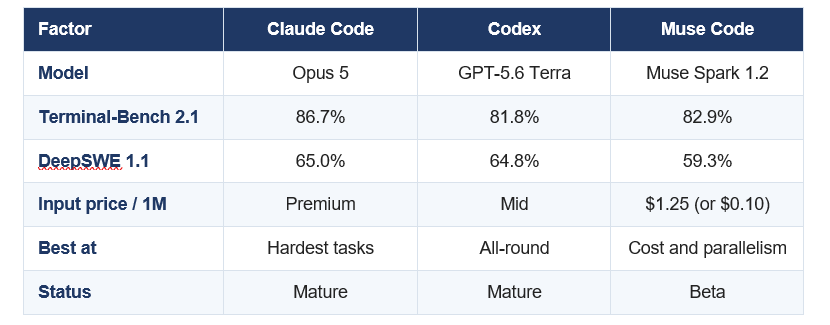
Benchmark figures are as reported by Meta on its own harness and are not yet independently verified. Muse Code's $0.10 rate is the data-sharing contributor tier.
Performance and Benchmarks
On the numbers we have, Claude Code leads, Muse Code and Codex trade the second spot, and the gap between the three is smaller than any marketing suggests. On Terminal-Bench 2.1, Claude Code with Opus 5 scored 86.7%, ahead of Muse Code at 82.9% and Codex at 81.8%. On DeepSWE 1.1, the order shifts: Claude Code led at 65.0%, Codex was right behind at 64.8%, and Muse Code trailed at 59.3%.
Two honest caveats matter here. First, these numbers came from Meta's own evaluation harness as part of the Muse Code launch, and no independent leaderboard has verified them yet, so treat them as directional rather than final. Second, benchmark scores measure controlled tasks, not the messy reality of your specific codebase, where prompt style, language, and repo size change the outcome. The safe reading is that Claude Code is ahead on hard problems, while Codex and Muse Code are close competitors a step below.
WHAT THE NUMBERS REALLY SAY
The three agents are within about five points of each other on the same test, which means all three are genuinely capable. Claude Code wins the accuracy crown today, but a five-point vendor-reported gap is not a reason to ignore a tool that costs a fraction as much. Judge these agents on price and fit as much as on the leaderboard, because for most everyday tasks all three will complete the work.
For the deeper benchmark breakdown of the new entrant, see our Meta Muse Code review, and for the models behind these agents, our Claude Opus 5 review and GPT-5.6 review.
Pricing Compared
Price is where Muse Code makes its loudest argument, and it is the clearest difference between the three. Muse Code's standard tier costs $1.25 per million input tokens with your code kept private, and it drops to around $0.10 per million on a contributor tier where you agree to share your data to train Meta's model. That standard rate already sits below what Claude Code and Codex typically charge for frontier-class agent work.
Claude Code sits at the premium end, which is consistent with it leading the benchmarks, and it is the tool teams reach for when quality justifies the spend. Codex lands in the middle, pairing solid performance with OpenAI's mature billing and ecosystem. So the pricing ladder is simple: Muse Code is cheapest, Codex is mid, and Claude Code is premium, and that order roughly matches how much you are paying for peak accuracy versus raw value.
THE CHEAP-TIER CATCH
Muse Code's headline $0.10 rate is not free money. On that contributor tier you share your code with Meta to improve its model, which is fine for hobby or open-source work but risky for proprietary or client code. Compare Muse Code's standard $1.25 tier, not its contributor tier, against Claude Code and Codex, because that is the fair like-for-like where your code stays private
Features That Set Them Apart
Beyond raw scores, each agent has a signature strength that can matter more than a few benchmark points depending on your workflow.
- Muse Code: persistent background sub-agents that work in parallel on different parts of a task at once, plus long-session memory that carries context across sessions. Best for large, parallelizable features.
- Claude Code: the strongest track record on complex, multi-step reasoning and messy real-world repos, with mature reliability. Best when correctness on hard problems is the priority.
- Codex: the deepest ecosystem and integration support from OpenAI, with broad language coverage and a large user base. Best for teams already in the OpenAI ecosystem who want a dependable all-rounder.
Notice that these strengths point at different users. The parallel sub-agents in Muse Code are a real edge for someone building many independent components at once, and that advantage does not show up on a single-task benchmark at all. Match the feature to your actual work and the right pick often gets obvious.
Claude Code: Strengths and Weaknesses
Claude Code, powered by Claude Opus 5, is the performance leader in this comparison. Its strength is accuracy and reliability on hard, complex tasks, which is why it tops the benchmarks and why many professional teams treat it as the default for critical work. It is the safe choice when a wrong answer is expensive.
The tradeoff: Claude Code is the priciest of the three, and for simple or high-volume tasks you may be paying for a quality margin you do not need. If your work is routine, a cheaper agent may finish the same job for far less. Claude Code earns its premium on the hard problems, not the easy ones.
OpenAI Codex: Strengths and Weaknesses
OpenAI Codex, powered by GPT-5.6 Terra, is the balanced all-rounder. Its strength is a mature ecosystem, broad language and tooling support, and performance that sits right behind Claude Code on the benchmarks. For teams already using OpenAI, it is the natural, low-friction choice with dependable results across a wide range of tasks.
The tradeoff: Codex rarely tops any single category. It is not the cheapest and not the highest-scoring, so it wins on being reliable everywhere rather than best at any one thing. If you want either the absolute best accuracy or the lowest price, another agent edges it out, but for a safe default that does most things well, Codex is hard to fault.
Meta Muse Code: Strengths and Weaknesses
Meta Muse Code, powered by Muse Spark 1.2, is the value challenger. Its strengths are the lowest price of the three, a genuinely useful parallel sub-agent system, and long-session memory, all wrapped in a single-command terminal install. For cost-sensitive or parallelizable work, it is immediately compelling, and being within a few points of the leaders on a first release is a strong debut.
The tradeoff: Muse Code is in beta, its benchmark wins are self-reported, and it trails Claude Code on accuracy. The cheapest tier also costs you your code privacy. It is the best value, not the best performer, so it suits experimentation and cost-driven work more than mission-critical tasks where the leader still has an edge.
For xAI's competing terminal agent that also lands near this group, see our Grok Build CLI review, and for the full field, our best coding AI comparison.
Which AI Coding Agent Should You Use?
There is no single winner, because the right agent depends on what you optimize for. Here is the clear recommendation for each type of developer, so you can decide in one read.
- Choose Claude Code if accuracy on hard, complex codebases is your top priority and the budget allows it. It leads the benchmarks and is the safe pick for critical work.
- Choose Codex if you want a dependable all-rounder, broad ecosystem support, and you are already in the OpenAI world. It does most things well without a steep learning curve.
- Choose Muse Code if cost matters most, your tasks parallelize well, or you want to trial the newest agent cheaply. Use its standard tier to keep your code private.
- Use more than one if you can. Many developers run Claude Code for hard problems and a cheaper agent like Muse Code for high-volume routine tasks, getting quality and savings at once.
Our overall pick: for most professional developers in 2026, Claude Code remains the best single coding agent on quality, and it is the one to trust with important work today. But Muse Code is the most interesting arrival, because its price pressures the entire category and its parallel sub-agents solve a real problem. The smartest move is to keep the leader for hard work and put Muse Code to work on everything cost-sensitive. Whichever you choose, this new three-way competition means better tools and lower prices for every developer.
See where each underlying model ranks overall in our best AI models of 2026.
Frequently Asked Questions
Q: What is the best AI coding agent in 2026?
For overall accuracy on complex work, Claude Code with Opus 5 is the best AI coding agent in 2026, leading the Terminal-Bench and DeepSWE benchmarks. But best depends on your priority: Codex is the best balanced all-rounder, and Muse Code is the best value. Most developers should pick based on quality, ecosystem, or cost.
Q: Is Muse Code better than Claude Code?
Not on performance. In Meta's own testing, Claude Code led Terminal-Bench 2.1 at 86.7% versus Muse Code at 82.9%, and also led on DeepSWE 1.1. Muse Code is better on price and offers parallel sub-agents, so it wins on value, not peak accuracy, and those scores are vendor-reported rather than independently verified.
Q: What is the difference between Claude Code and Codex?
Claude Code, powered by Opus 5, leads on raw accuracy for hard tasks and sits at a premium price. Codex, powered by GPT-5.6 Terra, is the balanced all-rounder with a deeper ecosystem and mid-tier pricing. Claude Code wins hardest-problem quality, while Codex wins breadth, reliability, and ecosystem integration.
Q: Which coding agent is cheapest?
Muse Code is the cheapest. Its standard tier is $1.25 per million input tokens, below Claude Code and Codex, and it drops to around $0.10 per million on a contributor tier where you share your data. Claude Code is the most premium, and Codex sits in the middle on price.
Q: Is Muse Code worth switching to?
For cost-sensitive or parallelizable work, yes, it is worth trialing on the standard tier. For mission-critical tasks where accuracy is the priority, Claude Code still leads, so do not switch your hardest work yet. A common approach is to keep Claude Code for complex problems and use Muse Code for high-volume routine tasks.
Q: Which AI coding agent is best for large codebases?
Claude Code has the strongest track record on large, complex, multi-file repositories. Muse Code targets this directly with long-session memory and parallel sub-agents, which help on big parallelizable features, but it is still in beta. For proven reliability on large codebases today, Claude Code is the safer choice.
Q: Can these agents work on the same project?
Yes. Because all three are terminal agents that act on your repository, you can use different agents for different tasks in the same project. Many developers run a premium agent like Claude Code for hard problems and a cheaper agent like Muse Code for routine changes, choosing per task rather than committing to one tool.
Q: Which coding agent is best for beginners?
Codex is often the easiest starting point thanks to its mature ecosystem, broad documentation, and large community. Claude Code is beginner-friendly too and gives the most reliable results. Muse Code is simple to install but is in beta, so beginners may prefer a more established agent until it matures.
Recommended Blogs
Resources and Community
Join our community of 70,000+ AI enthusiasts and learn to build powerful AI applications. Whether you are a beginner or an experienced developer, Build Fast with AI helps you understand and implement AI in your projects.
- Website (buildfastwithai.com)
- LinkedIn (Build Fast with AI)
- Instagram (@buildfastwithai)
- Founder Twitter (@satvikps)
- Twitter (@BuildFastWithAI)
Agentic AI Launchpad 2026
A structured 6-week cohort program that takes you from AI basics to building and deploying real-world agentic AI systems. Includes live sessions, expert mentorship, project reviews, and a builder community network.
Ready to go from learning to building? Join the next cohort: Agentic AI Launchpad 2026
Free AI Resources
Access free tools, workshops, and micro-learning to keep building:
Try each agent on a task you already know well before committing. Follow Build Fast with AI for honest, updated comparisons of every major AI coding tool.
References
Meta Superintelligence Labs releases Muse Code (MarkTechPost)

