



AI News Today: June 4, 2026 — SpaceX IPO, Anthropic & More
The single biggest day in tech-IPO history starts today. On June 4, 2026, SpaceX — the company that now owns Elon Musk's AI lab xAI — opens its investor roadshow for a $1.75 trillion debut, the largest U.S. listing ever attempted. But that headline shares the day with an Anthropic public-market push, a fresh NVIDIA chip vision out of Taipei, and a Google admission that Gemini 3.5 Pro is days away. Here's everything that actually moved in AI over the last 24 hours, ranked by signal.
1. SpaceX Opens Its $1.75 Trillion IPO Roadshow Today
SpaceX begins marketing the largest IPO in U.S. exchange history on June 4, 2026. In an amended S-1 filed June 1, the company fixed its price at $135 per share — skipping the usual price range — and plans to sell roughly 555.6 million shares to raise about $75 billion at a $1.75 trillion valuation. Pricing is set for June 11, with Class A shares due to begin trading on Nasdaq under the ticker SPCX on June 12.
That valuation would make SpaceX the seventh-most-valuable U.S. company, above Tesla's roughly $1.6 trillion. The wrinkle: SpaceX is unprofitable outside of Starlink. Its xAI unit — maker of the Grok assistant after February's merger — is projected to burn around $10 billion in 2026 alone, and the filing even flags that Anthropic is simultaneously a SpaceX compute customer and a direct Grok competitor.
Not everyone is buying the number. Morningstar pegs fair value at $780 billion — less than half the target — and the American Federation of Teachers has asked the SEC to apply extraordinary scrutiny before pension money flows in. My take: this is the first time a frontier AI lab's economics get priced in public, in real time, alongside rockets. The whole AI sector's valuation story partly rides on how SPCX trades. If you track model economics the way we do in our best AI models of May 2026 leaderboard, this is the financing layer underneath all of it.
2. Anthropic Eyes Public Markets as Claude Mythos Guards Critical Infrastructure
Anthropic confidentially filed for its own IPO on June 1, 2026, racing ahead of OpenAI toward the public market. The filing landed days after a reported $65 billion funding round that pushed the Claude maker's valuation to nearly $1 trillion, with Amazon, Google, Broadcom, SpaceX, Micron, Samsung, and SK hynix named across its compute and infrastructure stack.
On June 2, the company expanded Project Glasswing — its initiative to find and fix critical software vulnerabilities — to about 150 new organizations across more than 15 countries. At its center is Claude Mythos, the model Anthropic calls its most powerful, which it says can surface thousands of zero-day vulnerabilities over a span of weeks. For a foundational primer on how these systems actually reason and where they fit by task, our breakdown of every AI model compared by best use case is a useful companion read.
One thing developers should not miss in the noise: starting June 15, Anthropic splits Claude subscriptions, moving programmatic usage (Agent SDK, claude -p, third-party agents) into a separate monthly credit pool. If you run Claude Code in CI or automations, audit your pipelines this week.
3. OpenAI Pushes Codex Everywhere and Lands on AWS
OpenAI's freshest move is distribution, not a new flagship model. On June 2 it announced OpenAI on AWS — frontier models available through Amazon Bedrock with AWS-native security and governance, plus Codex on Bedrock for software engineering inside existing enterprise environments. Codex now reaches more than 5 million weekly users, and non-developers (analysts, marketers, bankers) make up roughly 20% of them and are growing 3x faster than developers.
The same day, OpenAI extended Codex with role-specific plugins, in-place document and spreadsheet annotations, and a preview of Sites for sharing interactive apps. It also opened the GPT-Rosalind biodefense program to qualified organizations globally — an early bet on using frontier models for public health and life-sciences defense. If you want to build agentic coding workflows yourself, the Build Fast with AI gen-ai-experiments cookbooks include runnable agent and tool-use notebooks you can adapt in an afternoon.
4. NVIDIA at Computex: the "Personal AI Computer" and a CPU Built for Agents
Jensen Huang used the Computex 2026 stage in Taipei to reframe NVIDIA as "an infrastructure company," and backed it with hardware. The headline for consumers is RTX Spark, a superchip Huang pitched as the foundation of the "personal AI computer" — local agents, frontier models, and creative workflows on a laptop. RTX Spark laptops and compact desktops are due this fall from ASUS, Dell, HP, Lenovo, Microsoft Surface, and MSI.
For data centers, NVIDIA unveiled Vera, a CPU purpose-built for AI agents that it claims completes tasks 1.8x faster than x86 chips for agentic AI, reinforcement learning, and data processing. Huang also confirmed the Vera Rubin platform is now in full production, with a single Grace Blackwell rack assembled in about five minutes. The throughline: "AI agents will be the largest users of computing." The hardware roadmap is finally being designed around agents rather than chatbots — and that shapes which models win, a theme we track in our April and May 2026 AI model leaderboard.
5. Google Confirms Gemini 3.5 Pro Is Coming This Month
In an Alphabet investor presentation published today, Google said Gemini 3.5 Flash is already available and that Gemini 3.5 Pro will arrive in June, with improvements focused on agentic coding, long-horizon tasks, and real-world capability. Monthly Gemini users have reached roughly 900 million.
Google also leaned into agents: Gemini Spark, the personal agent announced at I/O that works 24/7 in the background of the Gemini app, now connects to Google tools and will soon reach third parties via the Model Context Protocol. Search is shifting from answers to actions, and YouTube is getting a conversational "Ask YouTube" experience. If your team lives inside Google's stack, our guide to Gemini features across Google Workspace maps where these agentic upgrades will actually land in your day-to-day.
6. xAI's Grok V9 Finishes Training, Targets Claude's Coding Lead
xAI's next model is nearly here. Grok foundation model V9-Medium — a 1.5-trillion-parameter network, three times larger than the version handling current Grok traffic — has completed training, with a public release expected in mid-June. xAI trained it on Cursor developer workflows, an explicit shot at Claude's coding benchmark lead. Behind it, Grok 5 is training toward 6 trillion parameters on Colossus 2, the gigawatt-scale Memphis supercluster running roughly 550,000 NVIDIA GB200 and GB300 GPUs.
Worth a reality check: since SpaceX absorbed xAI in February, more than 50 researchers have reportedly departed, and prediction markets give Grok 5 only about a one-in-three chance of shipping by June 30. Scale is not the same as ship date. For how today's coding models actually stack up before V9 lands, our Kimi K2.6 vs Qwen 3.6 vs Opus 4.7 vs GPT-5.5 comparison is the benchmark baseline V9 will have to beat
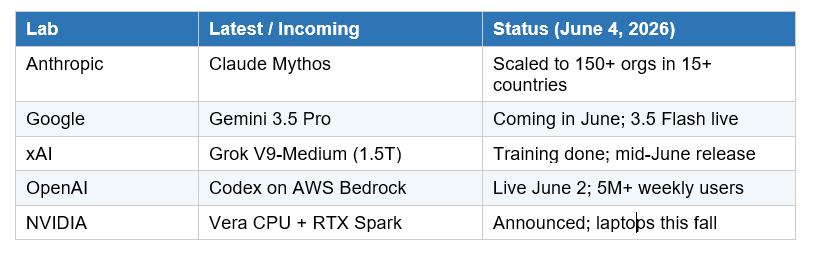
Model & Release Snapshot (June 2026)
Where the frontier sits as of today, based on vendor and reporting figures:
7. The AI Copyright War Escalates: CNN vs Perplexity
The legal front kept moving too. CNN filed a copyright and trademark suit against Perplexity, alleging it scraped and redistributed more than 17,000 of its stories, photos, and videos — CNN's first AI copyright action and reportedly the first by a TV network. That brings the count to nine organizations now suing Perplexity, including The New York Times, News Corp, the New York Post, Reddit, and Britannica.
The industry is splitting cleanly into two camps: companies that pay for content (Google, Meta, and OpenAI have struck licensing deals) and those fighting in court. Anthropic's $1.5 billion author settlement last year showed how expensive the litigation path can get. My contrarian read: the publishers winning headlines may still lose the war if "skip the links" AI search keeps draining their traffic faster than damages can replace it. For engineers, the takeaway is concrete — if you're building AI search or retrieval, plan for a licensed-content future, and study how coding and agent models compare across the open and closed frontier so your stack isn't locked to one provider's legal exposure.
Frequently Asked Questions
When is the SpaceX IPO date and what is the ticker?
SpaceX begins its investor roadshow on June 4, 2026, with pricing expected June 11 and trading set to start June 12 on Nasdaq under the ticker SPCX. The company fixed its price at $135 per share, targeting roughly $75 billion raised at a $1.75 trillion valuation.
Has Anthropic filed for an IPO?
Yes. Anthropic confidentially filed for an IPO on June 1, 2026, following a reported $65 billion funding round at a valuation approaching $1 trillion. A confidential filing lets the company work through SEC review privately before publishing financials.
What did NVIDIA announce at Computex 2026?
NVIDIA unveiled RTX Spark, a superchip for the "personal AI computer" arriving in laptops this fall, and Vera, a CPU built for AI agents that it says is 1.8x faster than x86 for agentic workloads. Jensen Huang also confirmed the Vera Rubin platform is in full production.
When is Gemini 3.5 Pro coming out?
Google said in its June 2026 Alphabet investor presentation that Gemini 3.5 Pro will launch in June, focused on agentic coding and long-horizon tasks. Gemini 3.5 Flash is already available, and Gemini now has roughly 900 million monthly users.
When will Grok V9 be released?
xAI's Grok V9-Medium, a 1.5-trillion-parameter model, has finished training and is expected to release publicly in mid-June 2026. It was trained on Cursor developer workflows to challenge Claude's coding benchmark lead.
Why is CNN suing Perplexity?
CNN alleges Perplexity scraped and redistributed more than 17,000 of its news stories, photos, and videos without permission, undermining its business model. It is one of at least nine organizations now suing Perplexity over copyright and trademark claims.
Recommended Reading
References
- CNBC — SpaceX targets fixed $135 IPO price for roadshow
- TechTimes — SpaceX IPO Roadshow Begins; Morningstar Calls $1.75T Valuation Nearly Twice Fair Value
- CBS News — Claude maker Anthropic files for IPO
- TechCrunch — Anthropic scales Claude Mythos to critical infrastructure in 15+ countries
- OpenAI Newsroom — Codex for every role, tool, and workflow
- CRN Asia — Three key takeaways from NVIDIA at Computex 2026
- Google — Alphabet investor presentation, June 2026
- TechTimes — Grok AI new model triples parameter count, release expected mid-June
- SiliconANGLE — CNN sues Perplexity alleging massive copyright infringement

