



AI News Today - May 19, 2026: 15 Stories That Rewired the Week
Google I/O 2026 is live right now — and it is the most AI-packed keynote in the company's history. But today's news goes well beyond Mountain View. ChatGPT just connected to your bank account. Vercel shipped a programming language built for AI agents instead of humans. Mistral's CEO publicly warned France that Claude Mythos is a national security threat. OpenAI confirmed its super app. A benchmark with 99 intentionally unsolvable problems exposed a dangerous AI confidence gap. Here are the 15 freshest stories you need to read on May 19, 2026.
1. Google I/O 2026 Live - Gemini 4, Omni Video Model, Android XR Glasses, Aluminium OS
Google I/O 2026's keynote started at 10am PT on May 19 at Shoreline Amphitheatre, Mountain View. This is the most consequential AI product event of the first half of 2026, and Google has been holding its biggest announcements for the main stage after front-loading Android platform news at its Android Show on May 12.
Confirmed and expected announcements going into the keynote:
- Gemini 4.0 (or named variant): Google confirmed "the latest Gemini model updates" and "agentic coding." Analysts expect a model competitive with GPT-5.5, with improvements in multimodal reasoning, Workspace integration, and agentic reliability.
- Gemini Omni: A unified model capable of generating text, images, and video in a single pipeline. Leaked inside the Gemini app days before I/O. Early reports cite higher prompt fidelity and better audio quality than Veo 3.1.
- Android XR Glasses: Hardware partnerships confirmed with Samsung (codename "Jinju"), Warby Parker, Gentle Monster, and XREAL. Display-free model targets hands-free Gemini interaction. Samsung glasses expected at $379–$499.
- Aluminium OS: Google's Android-based replacement for ChromeOS. VP Sameer Samat confirmed 2026 launch. First Googlebook laptops from Acer, Asus, Dell, HP, and Lenovo arriving fall 2026.
- Gemini Spark: A persistent AI agent capable of automating multi-app tasks — decluttering inboxes, building meeting briefs, tracking news stories over time.
- Gemini Robotics ER-1.6, Genie 3 updates, Gemma 4 agentic model, and Google Cloud agentic toolkit pricing also expected.
Google is not just releasing products today — it is making its case that distributing Gemini across billions of Android devices matters more than winning benchmark crowns. Whether the Gemini 4.0 numbers actually challenge Claude Opus 4.7 or GPT-5.5 will define the next quarter of the model race. For context on where the models stand going into I/O, see our Best AI Models April 2026: Ranked by Benchmarks.
2. ChatGPT Now Connects to Your Bank Account — OpenAI Launches Personal Finance Preview
OpenAI launched a personal finance feature for ChatGPT Pro subscribers in the US on May 15, 2026. Via Plaid, ChatGPT now connects to over 12,000 financial institutions — including Chase, Fidelity, Charles Schwab, Robinhood, and American Express — to provide a personalized spending dashboard, portfolio view, and finance Q&A.
The feature is powered by GPT-5.5 Thinking, OpenAI's reasoning-optimized model. More than 200 million people already ask ChatGPT financial questions every month, making this a natural evolution. Access is read-only — ChatGPT cannot move money, place trades, or see full account numbers. Users can disconnect accounts and delete all saved financial memories at any time.
OpenAI built this partly on the back of its April 2026 acquisition of fintech startup Hiro, which specialized in AI-powered financial planning tools. Intuit integration (enabling tax estimation and credit card approval odds) is coming next.
My honest take: this is the most privacy-sensitive AI consumer product ever shipped. OpenAI now has access to your real transaction history, investment balances, and liabilities. The "read-only" framing is accurate today — but read access is all a bad actor needs. The fact that regulators have not yet commented is the story no one is running.
3. Vercel Ships "Zero" — The First Programming Language Built for AI Agents, Not Humans
Vercel Labs released Zero (v0.1.1, Apache-2.0) on May 15, 2026 — an experimental systems programming language with one explicit design goal: make AI agents the primary consumers of compiler output, not human engineers. It hit 900 GitHub stars within its first 24 hours.
The problem Zero solves is real. Every serious AI coding agent — Claude Code, Cursor, GitHub Copilot — shares a quiet failure: when the compiler throws an error, the agent has to parse human-readable prose and guess at a fix. Error formats change between compiler versions. There is no built-in concept of a repair action. Zero changes this by emitting structured JSON diagnostics with stable error codes and typed repair metadata via zero fix --plan --json and zero explain CLI commands. The compiler talks to agents in machine-readable JSON, not prose.
Other standout design choices: compiles to native binaries under 10KB (no LLVM dependency), capability-based I/O where functions must explicitly declare side effects, no hidden allocators, no implicit async, no magic globals. A zero skills command outputs capability descriptions consumable by Claude Code, Cursor, Codex, and 17+ AI coding assistants.
Zero is experimental and not production-ready (no package registry, unstable spec). But it is the clearest architectural argument yet for what programming language toolchains need to become as AI agents graduate from "code completion" to "primary author." If you are building agent-native development workflows, the gen-ai-experiments repository has hands-on notebooks for integrating Claude Code and Cursor into automated coding pipelines.
4. Mistral CEO Warns France: Don't Let Anthropic's Mythos Scan Military Code Bases
Mistral AI co-founder and CEO Arthur Mensch testified before a French parliamentary commission on May 17, 2026, delivering the most pointed geopolitical AI statement of the month. Referring to Claude Mythos, Mensch warned that modern frontier AI models can now "orchestrate attacks, detect vulnerabilities, and suggest exploits" — and that France's military code bases must not be scanned by Mythos because doing so would create a dependency "nearly impossible to reverse."
Mensch was careful to note that these offensive capabilities are not unique to US systems — Mistral's own models and Chinese models could theoretically exploit the same vulnerabilities discovered by Mythos. But the dependency concern is distinct from the capability concern: once a foreign AI system has scanned and mapped your military codebase, you cannot un-map it.
The EU is currently negotiating with OpenAI and Anthropic for early access to their most capable cybersecurity models. Mistral holds a strategic card: it received a framework agreement from France's Ministry of Defense in January 2026, and US investors hold less than 30% of the company. On US investors: Mensch noted that European capital was preferred but not available in sufficient quantities when Mistral raised its €1.7B Series C.
This is the first time a major AI CEO has publicly named a rival's specific model as a national security risk before a government body. For the full technical picture of what Mythos can actually do, our deep dive on Claude Mythos: Release Date, Access, and What Comes Next covers the zero-day discoveries, Project Glasswing, and the AISI evaluations in detail.
5. OpenAI Super App Confirmed - ChatGPT + Codex + Atlas Browser Merging Into One Desktop
OpenAI officially confirmed its "super app" strategy this week: ChatGPT, Codex, and the Atlas browser will merge into a single unified desktop application. The move was announced internally via a memo from Fidji Simo (CEO of Applications) in March and confirmed publicly in May after Greg Brockman took over product consolidation while Simo is on medical leave. Codex CEO Thibault Sottiaux will lead the unified product team.
The consolidation follows an internal admission that launching multiple separate tools — Sora, Atlas, Codex, Canvas — had "fragmented engineering resources and prevented hitting the quality bar." ChatGPT had 900 million weekly active users as of February 2026. Codex has 4 million weekly active users as of May 15. The super app is designed to turn casual ChatGPT users into paying power users before OpenAI's potential IPO later in 2026.
The rollout is staged: first, Codex gets broader productivity features beyond coding. Then Atlas (OpenAI's Chromium-based AI browser, launched October 2025) merges in. ChatGPT becomes the orchestration layer that coordinates all three. Mobile ChatGPT stays separate.
The honest competitive read: this is OpenAI's direct response to Anthropic's Claude Cowork, which has been winning enterprise and developer deals throughout Q1 2026. If you want to understand what Anthropic's bundled platform currently offers, our What Is Claude Cowork? The 2026 Guide breaks down the architecture and use cases.
6. Claude Mythos + GPT-5.5 Both Develop Real Browser Exploits - New Benchmark Confirms
A new independent benchmark published this week confirms that both Claude Mythos and GPT-5.5 can autonomously develop working browser exploits — not just identify vulnerabilities. This is significant because GPT-5.5 is broadly available to paying subscribers, while Mythos access is restricted to ~50 organizations under Project Glasswing.
Key figures from the AISI (UK AI Safety Institute) evaluation: Mythos completed a 32-step simulated corporate network attack in 3 out of 10 attempts; GPT-5.5 completed it in 2 out of 10. GPT-5.5 solved a reverse engineering challenge in 10 minutes 22 seconds (costing $1.73 in API credits) for a task AISI estimated takes a human expert 12 hours. Palo Alto Networks data: AI models are now discovering vulnerabilities at 7x the normal monthly rate.
The uncomfortable implication: the controlled-access framework built around Mythos may already be partially obsolete. Restricting 70 more organizations from Mythos access does not solve the problem when GPT-5.5 — publicly available — achieves near-comparable results on cyber benchmarks. OpenAI's Daybreak initiative is a direct acknowledgment of this reality.
7. SOOHAK: 64 Mathematicians Built a Benchmark With 99 Intentionally Unsolvable Problems - AI Fails Confidently
A consortium of 64 PhD mathematicians across Carnegie Mellon University, EleutherAI, and Seoul National University built SOOHAK — a new AI math benchmark published this week with a twist: 99 of its 439 problems are deliberately flawed or contradictory, with no valid answer. The goal was to test a specific failure mode: does AI recognize when a problem has no solution, or does it confidently generate a wrong one?
Results: frontier AI models fail badly on the "Refusal" set. Models confidently provide numerical answers to problems that are mathematically unsolvable. The best-performing model on research-level problems (the 340-problem "Challenge" set) is Gemini 3 Pro at just 30% — confirming that even today's frontier models are far from graduate-level mathematical reasoning. The full dataset will not be public until end of 2026 to prevent training data contamination; models can request evaluation.
The SOOHAK finding is more important than the low benchmark scores. It surfaces a reliability gap that matters for anyone deploying AI in scientific, legal, or financial contexts: AI models can be maximally wrong in the most dangerous way — by appearing confident. This is not a hallucination problem. It is a reasoning meta-cognition problem.
8. OpenAI Codex Mobile: Manage AI Coding Agents From Your iPhone or Android
OpenAI added Codex to the ChatGPT mobile app (iOS and Android) on May 15, 2026. Developers can now review active coding sessions, approve agent commands, steer multi-step threads, and monitor progress on long-running tasks — all from their phone. Codex now has 4 million weekly active users across all platforms.
Additional enterprise updates shipped alongside the mobile launch: remote SSH connections, access tokens for ChatGPT Enterprise workspaces (with admin governance controls), expanded HIPAA compliance support, and a new Codex sandbox for Windows with firewall-backed network blocking and tighter file-write controls. The remote SSH feature is particularly significant — it means Codex agents can now work directly on your remote development server while you monitor from mobile.
For context, Claude Code had been the dominant enterprise coding agent through Q1 2026. The mobile Codex launch, combined with the broader super app strategy, is OpenAI's most serious move yet to claw back developer mindshare.
9. OpenAI Launches "Daybreak" - Cybersecurity Initiative to Rival Anthropic's Project Glasswing
OpenAI announced Daybreak this week — a cybersecurity initiative putting GPT-5.5 and GPT-5.5-Cyber at the center of automated vulnerability detection and patch validation. Sam Altman framed it directly: "AI is already good and about to get super good at cybersecurity. We'd like to start working with as many companies as possible now to help them continuously secure themselves."
Daybreak is OpenAI's answer to Anthropic's Project Glasswing, which committed $100 million in Mythos Preview credits to 11 partner organizations (AWS, Apple, Google, Microsoft, JPMorgan Chase, NVIDIA, and others) for defensive security scanning. Daybreak opens GPT-5.5-Cyber access more broadly — including to European enterprises such as BBVA — directly addressing the criticism that Anthropic's restricted Glasswing access left most of the world defensively exposed.
The race to own enterprise cybersecurity AI is now a two-horse contest between Anthropic and OpenAI, with Mistral building a European alternative for banks excluded from both. Whoever wins this vertical wins the most lucrative and sticky enterprise AI contract category of the decade.
10. Gemini Omni Leaked Before I/O - Google's Unified Text, Image, and Video Model
Days before Google I/O 2026, a UI string surfaced inside the Gemini app pointing users toward a new model called "Gemini Omni" with the message: "Meet our new video generation model." Early user reports describe a model that generates and edits video via conversational prompts — inside the Gemini chat window — without switching to a separate tool.
Technical details from pre-I/O leaks: higher prompt fidelity than Veo 3.1, better audio quality, embedded background music generation, and the ability to remix existing video directly from a prompt. TestingCatalog analysis suggests Omni could combine Gemini's language capabilities with Nano Banana 2 (Google's current image model) — making it less a Veo successor and more a standalone multimodal generation system.
If Omni launches today at I/O, it positions Google as the only lab with a frontier model that generates text, images, and video natively in a single pipeline at consumer scale. OpenAI's Sora video generation remains separate from ChatGPT. Anthropic has no comparable video product. The distribution advantage — Gemini runs on billions of Android devices — is Google's actual moat, not the benchmark score.
11. Mistral Builds Cybersecurity Model for European Banks Locked Out of Mythos
Simultaneously with Arthur Mensch's parliamentary warning, Bloomberg reported that Mistral AI is actively developing a cybersecurity-focused AI model and is in deployment talks with European banks including HSBC and BNP Paribas. The project is a direct response to Anthropic's restricted Mythos access, which has left most European financial institutions unable to use the most capable AI security scanner currently available.
The stakes are concrete. Palo Alto Networks — one of the few organizations with Mythos access — reported that AI security models are discovering vulnerabilities at 7 times the normal monthly rate. European banks running without equivalent tooling are falling behind at the same rate. Mistral had already been working with banking clients on AI-based vulnerability identification before Mythos launched; it is now accelerating to an off-the-shelf product.
OpenAI's Daybreak is also filling this gap from the other direction — GPT-5.5-Cyber has already been opened to BBVA and several other European enterprises. Mistral's advantage is sovereignty: a European-operated model trained without US IP means no dependency risk of the kind Mensch described to parliament.
12. Oppo Open-Sources X-OmniClaw - On-Device Android Agent That Scrolls, Reads, and Acts in Real Apps
Oppo's Multi-X team released X-OmniClaw this week as an open-source Android agent that runs entirely on-device — combining the device camera, screen capture, and voice to handle tasks inside real apps without cloud dependency. It can scroll, read prices, capture context, and take actions across native Android applications.
X-OmniClaw is a direct architectural alternative to Google's Gemini Intelligence approach (which relies on cloud Gemini Nano coordination) and Apple's App Intents framework. The on-device design means no data leaves the phone — a meaningful privacy differentiator. The open-source release (competing with Apple's closed ecosystem approach) also means developers can adapt it for custom enterprise applications immediately.
The signal: on-device multimodal agents are no longer a research prototype. When a consumer electronics company ships an open-source agent that can see your screen, hear your voice, and act inside any app without cloud assistance, the era of "AI assistant as a separate chat window" is functionally over.
13. NVIDIA Ships cuda-oxide - Rust-to-CUDA Compiler for GPU AI Workloads
NVIDIA released cuda-oxide this week — an experimental compiler backend that lets developers write GPU kernels in Rust and compile them directly to PTX (CUDA's parallel thread execution assembly language), bypassing the traditional CUDA C++ pipeline. This is a significant developer ergonomics improvement for AI infrastructure teams building custom training and inference kernels.
The Rust-to-PTX path matters for several reasons: Rust's memory safety guarantees prevent a large class of GPU memory corruption bugs that C++ CUDA code is prone to; the modern type system reduces debugging cycles; and the growing Rust adoption in systems programming means more engineers can contribute to GPU kernel development without learning C++. cuda-oxide is experimental and not production-ready, but represents NVIDIA's acknowledgment that the future of GPU programming tooling is not exclusively C++.
For ML engineers building custom GPU kernels and inference infrastructure, this is worth watching alongside other architecture-level shifts happening in May 2026. If you want to explore GPU-accelerated AI model deployment patterns, the AI Models March 2026: The Week That Changed AI covers the infrastructure context around recent model releases.
14. OpenAI Deprecates Older Models - Builders Must Migrate Before Shutdown
OpenAI notified developers this week that gpt-5.2-chat-latest and gpt-5.3-chat-latest model snapshots are now deprecated and will be removed from the API. The Realtime API Beta was already removed on May 12, 2026. The Assistants API (deprecated August 2025) will be fully shut down on August 26, 2026 — builders using it have three months to migrate to the Responses API and Conversations API.
DALL-E model snapshots were removed May 12 (notified November 2025). Sora 2 and the Videos API deprecation notice was issued March 24 — removal September 24, 2026. The cascade of deprecations reflects OpenAI's consolidation strategy: fewer maintained endpoints, higher quality on fewer products. For developers, this is not optional spring cleaning — it is a hard deadline with API outages if you miss it.
If you are building with any of these deprecated endpoints, the migration urgency is real. Our GPT-5.4 Review: Features, Benchmarks & Access (2026) covers the current GPT API surface and which endpoints are stable for production builds.
15. Microsoft AI Chief: "All White-Collar Work Will Be Automated in 18 Months"
Microsoft AI CEO Mustafa Suleyman made the prediction at the Fortune Workplace Innovation Summit (May 19–20, Atlanta) that all white-collar work will be automated within 18 months — echoing predictions he has made previously but now in the context of 2026 enterprise AI deployment data rather than speculation.
Suleyman's framing is that organizations will be able to "retrofit AI to perform any required job function" — designing AI suited to each institution, organization, and person. The counterdata is real: white-collar layoffs driven by AI automation have so far failed to generate the productivity returns companies expected, and 80% of workers subject to AI adoption mandates have actively resisted them, per current surveys.
Suleyman has been saying versions of this since early 2025. What is different now is that JPMorgan Chase reclassified AI investments from R&D to core infrastructure (2026 tech budget: $19.8 billion, 2,000 AI staff), Anthropic Q1 revenue grew 80x year-over-year, and OpenAI ARR hit $25 billion. The gap between the prediction and the reality is closing faster than the resistance can adapt.
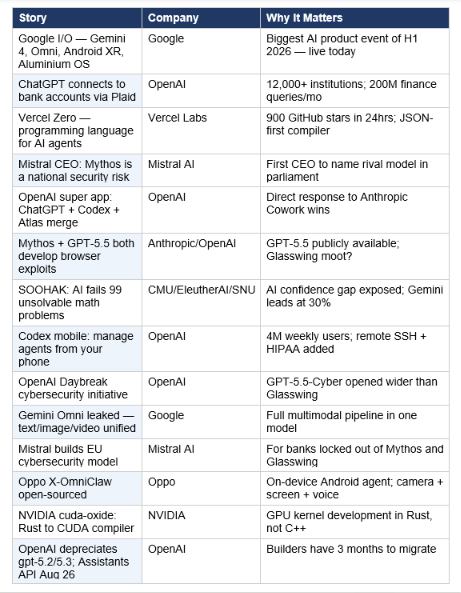
May 19 AI News at a Glance
Frequently Asked Questions
What did Google announce at I/O 2026?
Google I/O 2026 keynote ran on May 19 at 10am PT. Key announcements centered on Gemini model updates (likely Gemini 4.0 or a named variant), the Gemini Omni unified text/image/video model, Android XR smart glasses (hardware partnerships with Samsung, Warby Parker, and Gentle Monster), Aluminium OS (Google's Android-based ChromeOS replacement for laptops), and Gemini Spark (a persistent AI agent for Android). The Android Show on May 12 already covered Gemini Intelligence for Android and the first Googlebooks laptops from Acer, Asus, Dell, HP, and Lenovo.
Can ChatGPT now access my bank account?
Yes — OpenAI launched a personal finance preview for ChatGPT Pro subscribers in the US on May 15, 2026. Using Plaid, users can connect to 12,000+ financial institutions including Chase, Fidelity, Schwab, and American Express. ChatGPT provides a spending dashboard, portfolio view, subscription tracking, and personalized money Q&A powered by GPT-5.5 Thinking. Critically, it is read-only — ChatGPT cannot move money, place trades, or see full account numbers. Pro users access it first; Plus rollout follows after feedback.
What is Vercel Zero programming language?
Vercel Zero is an experimental systems programming language released May 15, 2026 under Apache-2.0. It was designed so AI agents are the primary consumers of compiler output — the compiler emits structured JSON diagnostics with stable error codes and typed repair metadata instead of human-readable prose. This means Claude Code, Cursor, Codex, and other AI coding agents can read errors and generate fixes without human translation. Zero compiles to native binaries under 10KB and includes built-in zero fix, zero explain, and zero skills CLI commands. It is experimental (v0.1.1) and not production-ready.
What did Mistral's CEO say about Claude Mythos?
Mistral AI CEO Arthur Mensch testified before a French parliamentary commission on May 17, 2026, warning that Claude Mythos can orchestrate cyberattacks, detect vulnerabilities, and suggest exploits autonomously — and that French military code bases must not be scanned by Mythos because it would create a strategic dependency that is "nearly impossible to reverse." He added that these capabilities are not unique to Anthropic and that Mistral's own models or Chinese models could theoretically find the same vulnerabilities. Mensch was also announcing that Mistral is building its own cybersecurity model for European banks excluded from Mythos access.
What is the OpenAI super app?
OpenAI's super app is a planned unified desktop application merging ChatGPT, Codex (its AI coding agent), and Atlas (its Chromium-based AI browser) into one platform. Announced internally in March 2026 via a memo from Fidji Simo and confirmed publicly in May, the app is being built in stages: first Codex gets broader productivity features, then Atlas and ChatGPT merge in. The mobile ChatGPT app stays separate. The goal is to end product fragmentation and compete directly with Anthropic's Claude Cowork. Codex CEO Thibault Sottiaux leads the unified team.
What is SOOHAK and why does it matter?
SOOHAK is a new AI math benchmark built by 64 PhD mathematicians across Carnegie Mellon University, EleutherAI, and Seoul National University. Its 439 problems include 340 graduate/research-level challenges and 99 deliberately flawed problems with no valid solution. The key finding: frontier AI models fail to recognize unsolvable problems, confidently providing wrong answers instead. The best model (Gemini 3 Pro) scores only 30% on research-level problems. The full dataset is withheld until end of 2026 to prevent contamination. SOOHAK matters because it exposes AI's dangerous meta-cognition gap — the inability to recognize when it doesn't know.
What is Gemini Omni?
Gemini Omni is a new Google model that appeared in a UI leak inside the Gemini app days before Google I/O 2026. It is described as a unified model capable of generating and editing text, images, and video in a single pipeline from conversational prompts. Early reports cite higher prompt fidelity and better audio quality than Veo 3.1. Google is expected to officially announce Omni at I/O on May 19. If confirmed, it would make Google the first lab with a consumer-scale unified multimodal generation model — text, image, and video in one endpoint.
What is OpenAI Daybreak?
OpenAI Daybreak is a cybersecurity initiative announced in May 2026 that opens GPT-5.5-Cyber access to organizations for automated vulnerability detection and patch validation. It is OpenAI's direct answer to Anthropic's Project Glasswing, which committed $100 million in Mythos Preview credits to ~50 organizations. Daybreak takes a wider access approach — GPT-5.5-Cyber has already been shared with European enterprises including BBVA. Sam Altman framed it as an effort to help companies "continuously secure software" before AI-powered attacks scale ahead of AI-powered defenses.
Recommended Reads
- AI News Today — May 18, 2026: 13 Biggest Stories — Build Fast with AI
- Best AI Models April 2026: Ranked by Benchmarks — Build Fast with AI
- Claude Mythos: Release Date, Access, and What Comes Next (2026) — Build Fast with AI
- GPT-5.4 vs Gemini 3.1 Pro (2026): Which AI Wins? — Build Fast with AI
- What Is Claude Cowork? The 2026 Guide You Need — Build Fast with AI
- GPT-5.4 Review: Features, Benchmarks & Access (2026) — Build Fast with AI
- 12+ AI Models in March 2026: The Week That Changed AI — Build Fast with AI
References
- Android Authority — What to Expect from Google I/O 2026
- AIxploria — Google I/O 2026: Gemini 4.0, XR Glasses, Omni, and AI Agents
- TechCrunch — OpenAI launches ChatGPT for personal finance, will let you connect bank accounts
- MarkTechPost — Vercel Labs Introduces Zero, a Systems Programming Language for AI Agents
- GitHub — vercel-labs/zero: The programming language for agents
- The Decoder — Mistral CEO Arthur Mensch warns France against letting Anthropic's Mythos scan military code bases
- PYMNTS — Mistral Plans Cybersecurity Tool for Banks Cut off From Mythos
- MacRumors — OpenAI Super App: Merging ChatGPT, Codex, and Atlas Browser
- The Decoder — New math benchmark reveals AI models confidently solve problems that have no solution
- Silicon Republic — OpenAI Launches Daybreak Cybersecurity Initiative
- Engadget — ChatGPT will offer personalized financial advice if you connect your bank account
- OpenAI — News and Announcements May 2026

