



Perplexity Portable Computer: How Good Is a Local AI Agent With PPLX 27B?
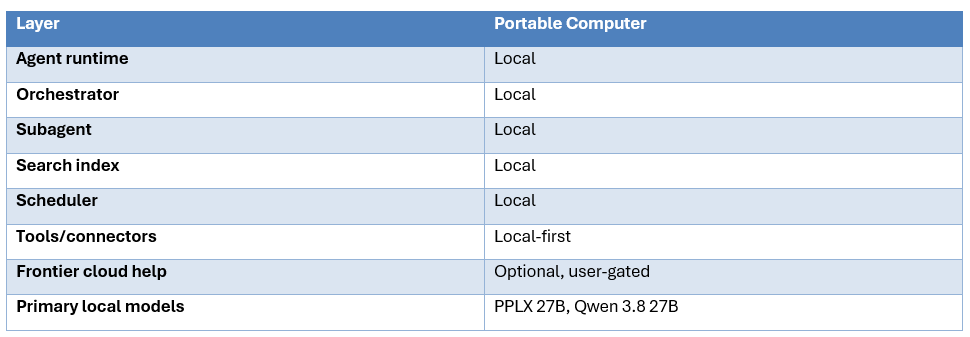
Perplexity Portable Computer is an unusual AI product because the interesting part is not only the model. It is the decision to move the agent runtime itself onto hardware the user controls. Perplexity launched it on August 25, 2026 with NVIDIA on the DGX Spark, running the orchestrator, planner, tool router, scheduler, durable task queue and local search index on-device. The local model options include PPLX 27B, a post-trained version of Qwen 3.8 27B, and Qwen 3.8 27B itself.
That architecture changes the usual cloud-agent model. Instead of sending every document, task and intermediate step to a remote model, Portable Computer starts the work locally. When a task genuinely needs stronger frontier reasoning, the local system can ask permission to escalate a specific step to a cloud model. Perplexity says the request is PII-flagged and that private documents stay on the device.
The result is promising, but the product is not a magic replacement for frontier cloud agents. Its local performance is strongest on knowledge work, document processing and many everyday agent tasks. Difficult coding tasks still benefit from cloud escalation, and the hardware requirement is significant. The more interesting question is whether the combination of local privacy, zero marginal token cost and selective cloud help creates a better overall workflow.
Perplexity Portable Computer is a local-first version of Perplexity Computer designed to run the entire agent stack on your own machine. On NVIDIA DGX Spark, Perplexity reports 82.6% on its 53-task Local Knowledge Work Bench using Qwen 3.8 27B, rising to 85.4% with its post-trained PPLX 27B. The same local setup scored 66.7% on BrowseComp and 65.1% on ParseBench-100. On Terminal Bench 2.1, the fully local setup scored 59.6%, while cloud escalation raised it to 73.0% at about $0.415 per rollout, compared with 82.4% for Claude Opus 5 alone at about $0.65 per rollout in Perplexity's test.
My verdict: 8.8/10 for local privacy and control, 8.5/10 for everyday agent work, 7.5/10 for coding, 8/10 for value if you already own compatible hardware, and 8.3/10 overall. It is compelling for developers, researchers and businesses that want local-first agent workflows with optional cloud escalation. It is not compelling if you would need to buy a roughly $4,000 to $5,000 dedicated machine simply to experiment.
1. What Is Perplexity Portable Computer?
Portable Computer is a local version of Perplexity Computer. The important distinction is that Perplexity is not merely downloading a local language model and putting a chat interface around it. The agent harness and orchestration layer run on the local machine too. Perplexity says the local runtime includes the orchestrator LLM, subagent LLM, agent harness, planner, tool router, scheduler, durable task queue and local search index.
That matters because an agent's capabilities come from the entire loop, not from the model alone. A smaller model can perform surprisingly well when its tools are well designed, context is carefully selected and the system verifies its own work. Perplexity's benchmark results are effectively a test of this model-plus-harness combination.
2. What Is PPLX 27B?
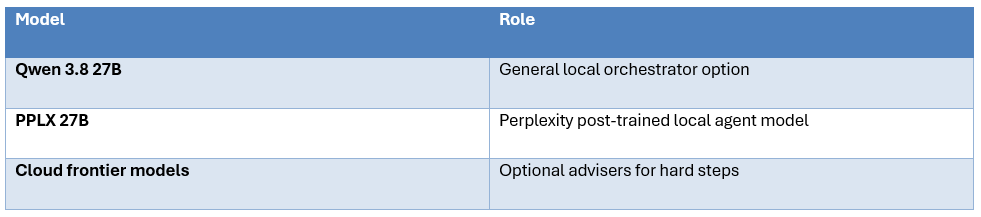
PPLX 27B is Perplexity's post-trained local model for Portable Computer. Perplexity describes it as a model trained specifically inside the Computer harness using synthetic tasks derived from how people use Computer, with no real user data. It is based on Qwen 3.8 27B, but optimized for the specific agent environment rather than treated as a generic 27B model.
This is one of the most important parts of the launch. Perplexity is effectively arguing that a smaller model can perform better when the whole harness is designed around its capabilities and limitations. That means comparing PPLX 27B only as a raw model misses the product's main innovation.
3. Real-World Performance: Local Knowledge Work
Perplexity's headline benchmark is its 53-task Local Knowledge Work Bench covering deep research, financial analysis and document creation. Portable Computer with Qwen 3.8 27B scored 82.6%, ahead of Pi at 77.6% and Hermes at 74.0% when those open harnesses used the same underlying model. PPLX 27B increased Portable Computer's score to 85.4%.
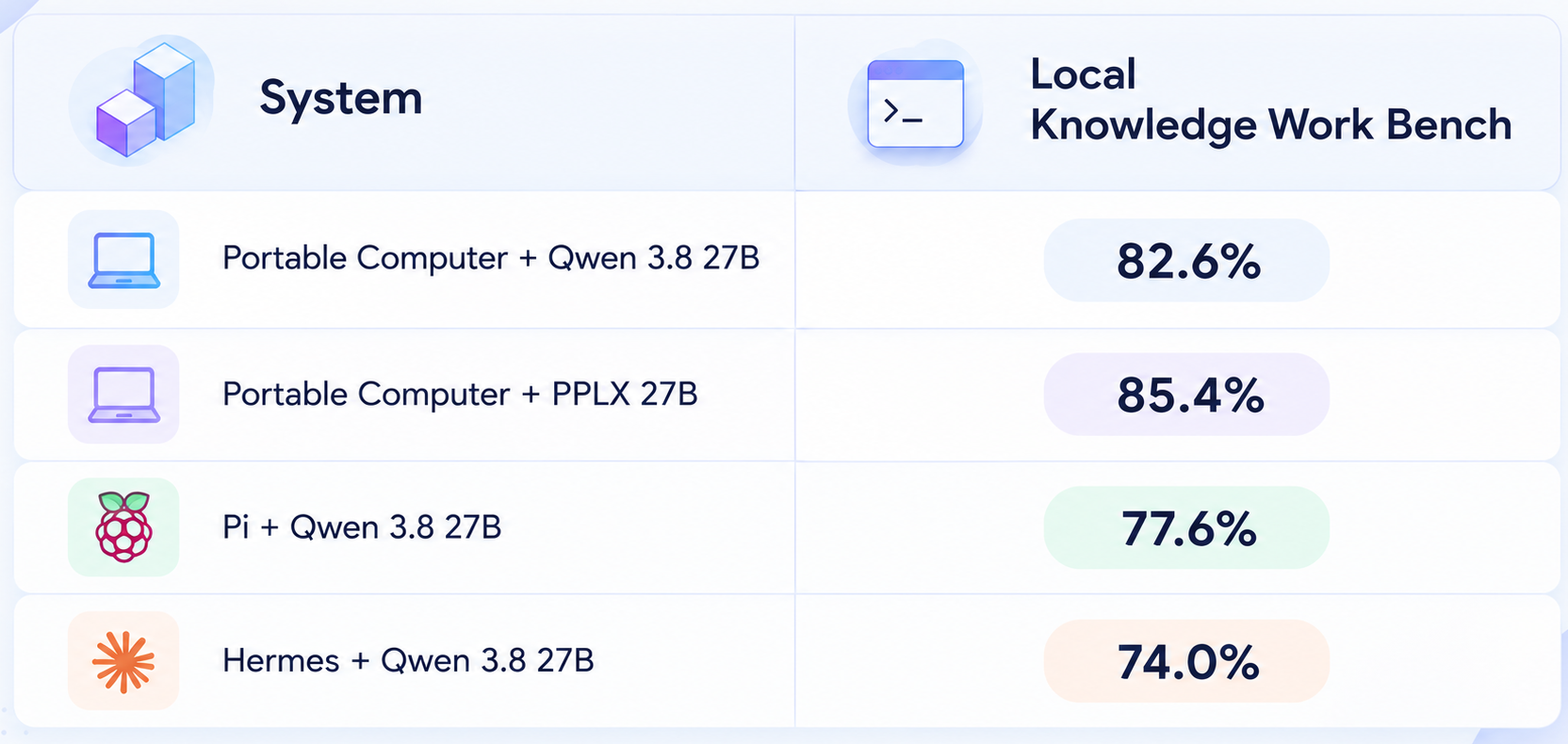
The strongest interpretation is not '27B beats every large model.' The result shows that harness design has a measurable effect on useful agent performance. Perplexity's system uses a minimal system prompt, skills loaded on demand, compact connector interfaces, self-verification and a persistent sandbox. Those choices reduce the amount of irrelevant context the small model has to juggle.
There is an important limitation: these benchmark results come from Perplexity's evaluation. Perplexity says it plans to open-source the benchmark, but independent reproduction was not yet available in the sources reviewed. Treat the scores as useful evidence about the product, not as independent proof of universal superiority.
4. BrowseComp: A Better Test of Web Research
Portable Computer scored 66.7% on 1,266 BrowseComp tasks. Perplexity reports that it used 51% less wall time and 70% fewer tokens than the Pi harness in that comparison. The test is useful because web research puts pressure on both the model and the tool loop.
The important takeaway is efficiency. A local agent does not need to dominate every benchmark if it can complete useful research with fewer tokens and less expensive inference. This is where local-first architecture starts to make economic sense.
There is also a subtle boundary: the search itself touches the web. Local-first does not mean 'nothing ever leaves the machine.' Private documents and local inference can remain local while the agent still reaches public websites for research. That distinction is central to understanding the privacy model.
5. Document Understanding With ParseBench-100
Portable Computer scored 65.1% on ParseBench-100 for visual document understanding, compared with 34.6% for Hermes and 13.9% for Pi in the cited comparison. That is a substantial gap.
This makes sense as a target use case. A local agent can keep PDFs and business documents on-device while using a small specialized harness to retrieve relevant content. For sensitive company documents, that architecture is potentially more important than squeezing out a few extra points on a generic language benchmark.
6. Coding Performance: Good Locally, Better With Escalation
Coding is where Portable Computer looks less dominant. On Terminal Bench 2.1, the fully local setup scored 59.6% at effectively zero marginal inference cost. When the local agent could escalate hard steps to a cloud adviser, the score rose to 73.0% at about $0.415 per rollout. Perplexity reports 82.4% for Claude Opus 5 alone at roughly $0.65 per rollout in the same comparison.
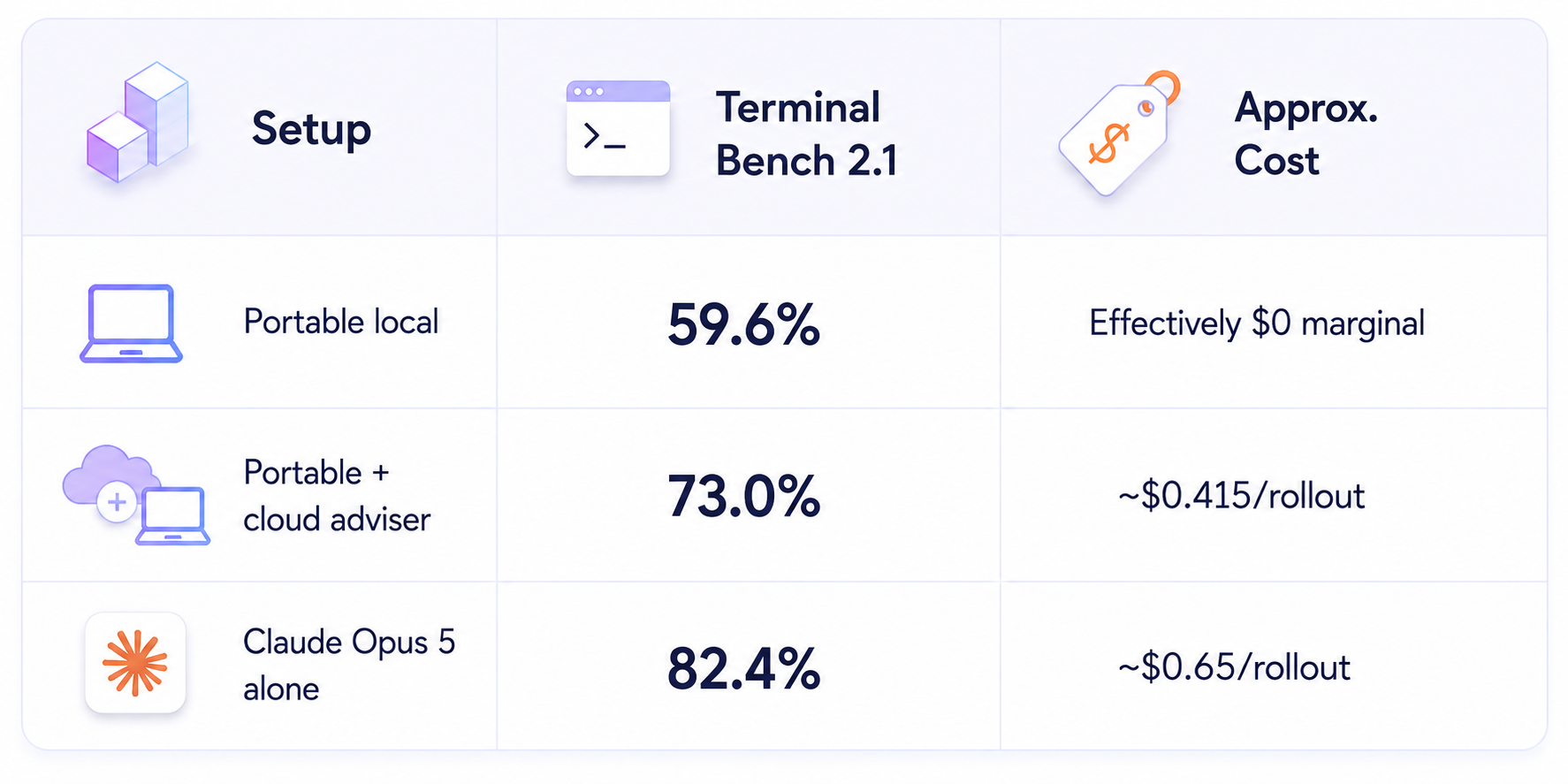
This is actually a strong result for the hybrid design. The local model handles the normal path, while only difficult steps consume cloud credits. You give up some raw frontier accuracy in exchange for lower average cost and stronger privacy.
For coding teams, that is a more realistic proposition than claiming a 27B model can replace the best cloud coding model. The right comparison is cost per successful task, not just benchmark percentage.
7. The Local-First Privacy Model
Perplexity says every task starts locally. When frontier reasoning is needed, the local orchestrator asks for approval before routing a step to the cloud. The request is PII-flagged, the cloud adviser receives text guidance rather than direct access to local files and tools, and the local orchestrator remains responsible for executing the result.
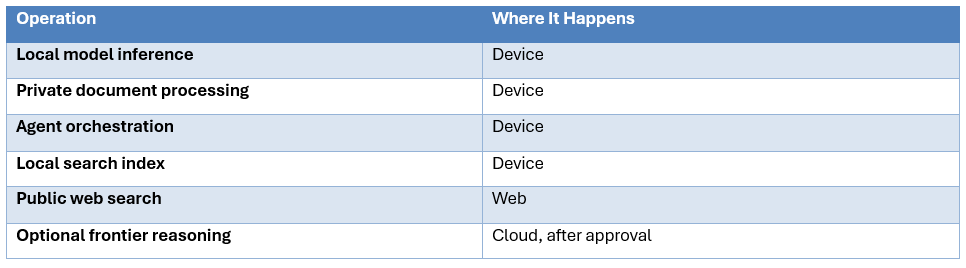
That is significantly better than a typical cloud agent for privacy-sensitive work, but it is not equivalent to total isolation. The moment you authorize a cloud step, selected information can leave the machine. Organizations should therefore define what data is permitted to cross that boundary rather than relying on the word 'local'.
8. Hardware Requirements
Portable Computer launched primarily on NVIDIA DGX Spark. The launch configuration uses NVIDIA's GB10-based system with 128 GB of unified memory and at least 1 TB of storage. Perplexity's broader hardware guidance also points to compatible NVIDIA GPU systems with at least 24 GB of VRAM for non-DGX deployments, with Windows support expected later.
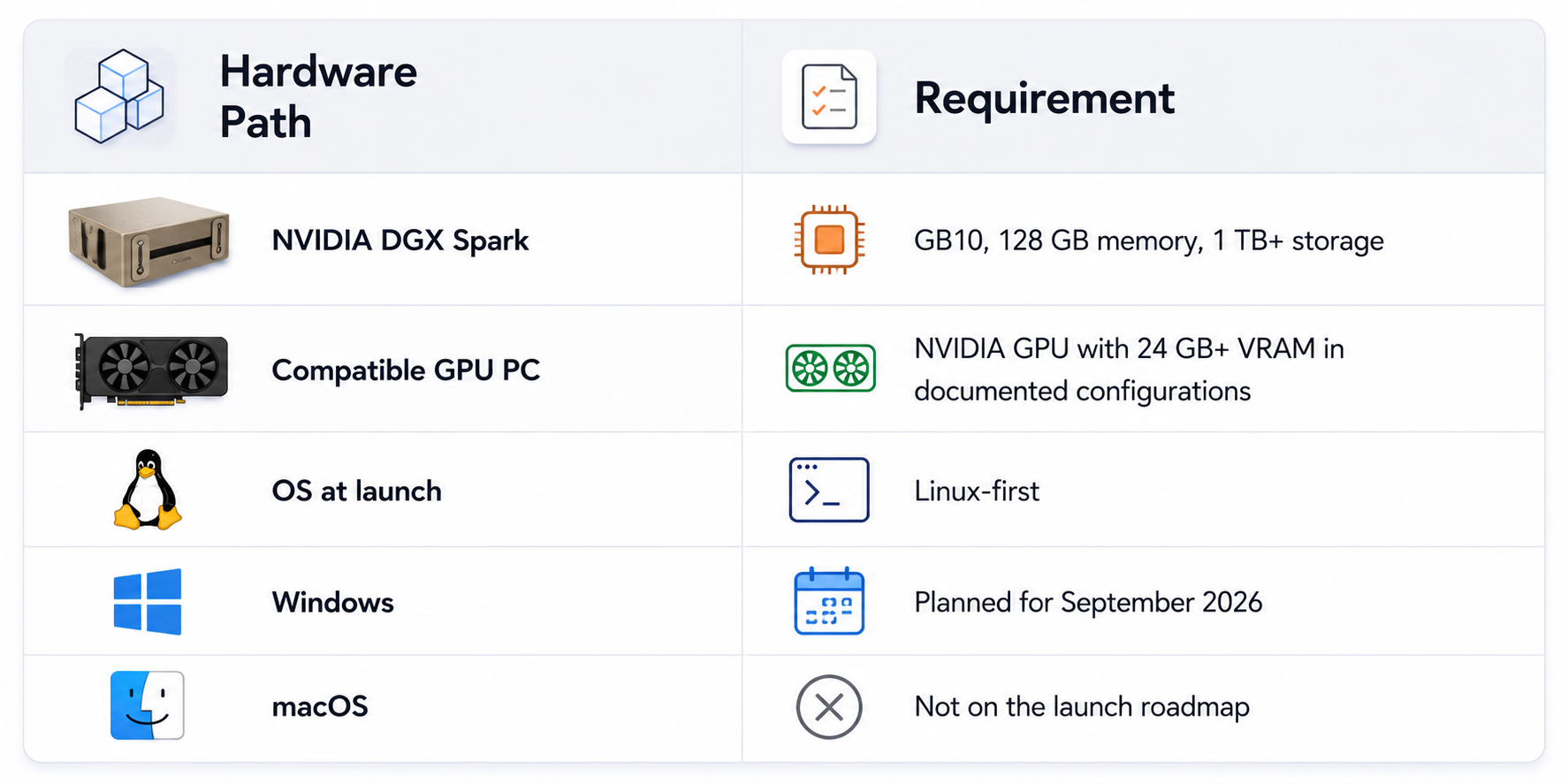
This is the biggest practical weakness. Portable Computer is portable in the software sense, not in the 'runs on any laptop' sense. A normal consumer laptop cannot simply install the system and get the same experience. The current product is aimed at people who already own serious local AI hardware or are willing to invest in it.
9. Cost: $0 Tokens Does Not Mean $0 Total Cost
Local inference consumes no per-token cloud credits, which changes the economics of long-running agent work. Repository migrations, repeated verification loops, large document analysis and recurring background tasks become much easier to justify when local inference has no additional per-token bill.
But there is a major accounting trap: local compute is not free. You pay for the machine, electricity, maintenance, storage and the opportunity cost of tying the hardware to AI workloads. For someone who already owns a suitable GPU workstation, the marginal economics can be excellent. For someone buying dedicated hardware only for Portable Computer, the payback calculation is much harder.
That is why the best comparison is not 'cloud tokens versus free local tokens.' It is total cost of ownership versus total cost per successful task over the workload you actually have.
10. The 260K Context Window Has a Catch
The local Qwen 3.8 27B model is described as having roughly a 260K-token context window, but independent analysis of the launch material says performance begins to degrade beyond about 100K tokens. Perplexity's harness addresses this by keeping the system prompt and tool list small, loading skills only when needed and compressing stale context during longer tasks.
This is a useful reminder that maximum context is not the same as useful context. A 260K window does not mean you should dump 260K tokens of repository history into every step. Context selection and compression matter more than the headline maximum.
This connects directly to our What Is Context Engineering? Complete Guide (2026).
11. Why the Harness Matters More Than the Model Size
Portable Computer's most interesting technical claim is that a 27B model becomes substantially more useful when the agent harness is designed around it. Perplexity says its system uses a minimal system prompt, on-demand skills, compact connectors, self-verification and an always-on sandbox.
That changes how developers should think about local AI. The question is no longer simply which open model is largest. The better question is which model, context strategy, tool interface and execution loop produce the best result for the workload.
This is especially relevant for agent builders. A smaller model with excellent tool schemas and a disciplined loop can outperform a stronger raw model placed inside a badly designed harness.
12. Cloud Escalation Is the Smart Part
The cloud adviser model is arguably Portable Computer's strongest product decision. Instead of choosing between a cheap local model and an expensive frontier model, the system creates a third option: local by default, cloud only for difficult steps.
That is essentially dynamic model routing applied to an entire agent system. The local model performs routine work, identifies when it needs help and asks for permission to call a stronger model. The user keeps control over the privacy boundary while still having access to frontier reasoning when it matters.
For the broader economics of dynamic model choice, see our Model Routing for AI Coding Agents guide.
13. Tools and Connectors
Portable Computer is not just a local chat model. The system can work with web search, files, shell commands and connectors such as Google Drive and Slack. Perplexity describes connectors as compact command-line tools in its local harness, rather than reproducing the full weight of a large cloud-style tool list inside the model context.
That design has two benefits. First, tool descriptions consume less context. Second, a smaller model has fewer possible actions to reason over at any one time. The result is a more constrained action space, which is useful for local agents.
For a broader beginner explanation of agents and tools, read What Is an AI Agent? Beginner Guide With Examples (2026).
14. Security and Sandboxing
Portable Computer uses an always-on sandbox for agent execution. That matters because a local coding or shell-capable agent has more power than a chatbot. A mistake can modify files, execute commands or access connected services.
The local-first architecture reduces one class of data-exposure risk, but it does not remove agent security risk. The machine itself is now part of the security boundary. Poor permissions, malicious tool input, prompt injection or unsafe shell access can still cause damage.
Our How to Secure AI Coding Agents in 2026 covers least privilege, sandboxing, secrets and MCP security in more detail.
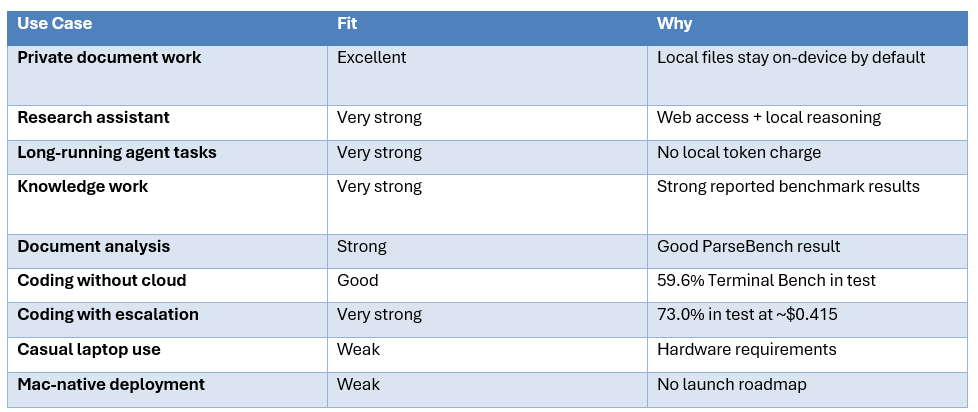
15. Where Portable Computer Is Actually Good
16. Where It Falls Short
- The benchmark evidence is mostly vendor-reported and was not yet independently reproduced in the sources reviewed.
- The hardware requirement is expensive for a casual user.
- The strongest local model is still weaker than the best frontier model on hard coding tasks.
- The system is local-first, not absolutely offline, because web search and optional cloud escalation still exist.
- Cloud escalation requires a subscription and can introduce usage costs.
- The current launch is Linux-first and depends heavily on NVIDIA hardware.
- Local model context can degrade well before the maximum advertised context size.
- Users who only need occasional AI assistance can likely get a simpler and cheaper experience from cloud services.
17. Perplexity Portable Computer vs a Normal Cloud AI Agent
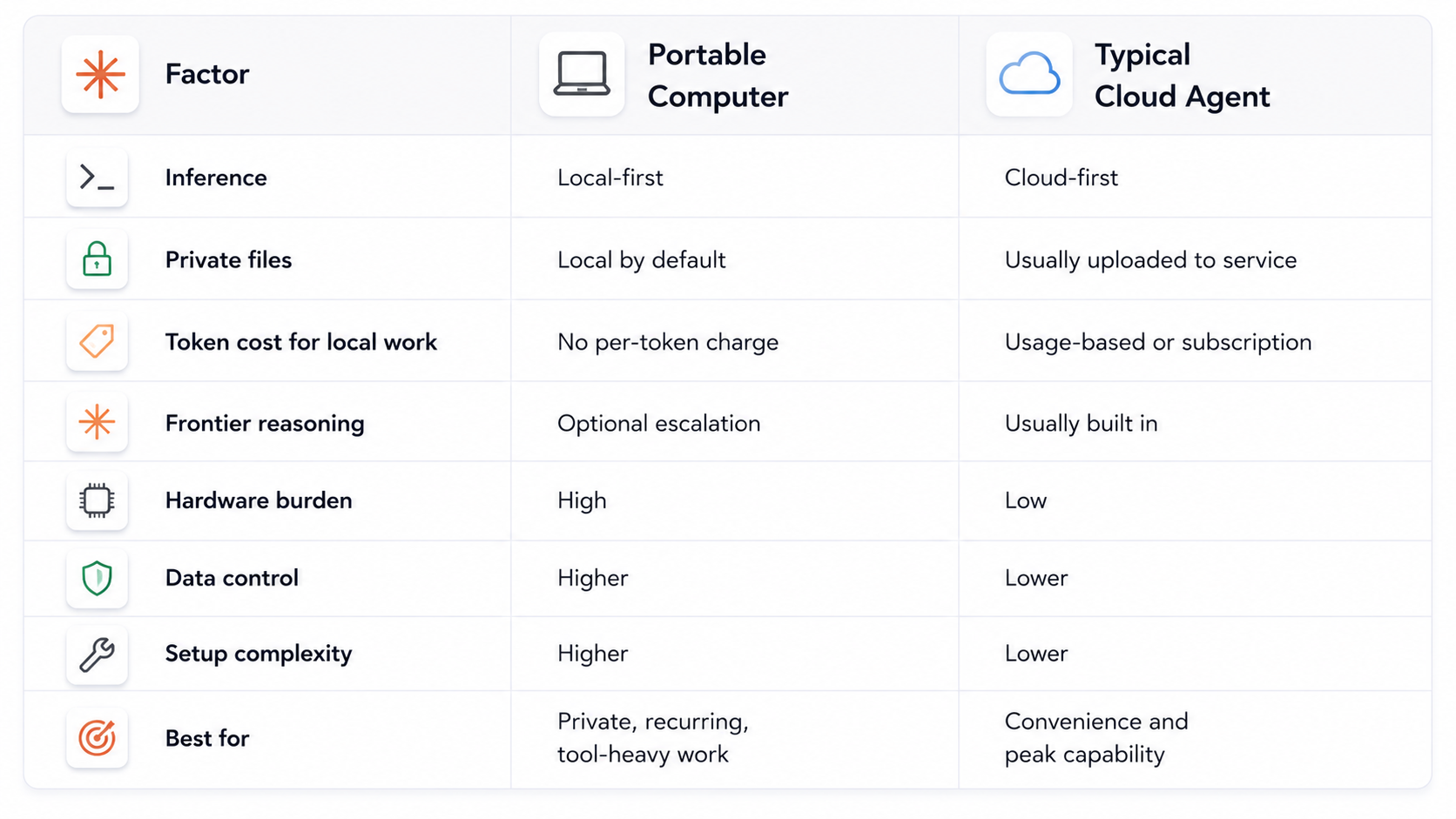
18. Should You Buy a DGX Spark for Portable Computer?
For most people, no. Buying dedicated hardware solely for one AI application is difficult to justify unless you already have a sustained local AI workload. The economics improve substantially for teams that want local inference across many workloads or that value keeping sensitive documents on-premises.
The better buying logic is workload-first. If you already own a 24 GB+ NVIDIA workstation, test Portable Computer there if your configuration is supported. If you do not own suitable hardware, calculate the annual cloud cost of your real workload before buying a dedicated machine.
The real opportunity is not the appliance. It is the architecture: local agent by default, cloud frontier help when needed, and explicit control over what crosses the boundary.
19. Is Perplexity Portable Computer Worth It?
For the right user, yes. The combination of local inference, zero marginal token cost for local steps and optional cloud escalation is genuinely differentiated. It gives developers a practical way to keep sensitive work local without giving up frontier reasoning completely.
For a normal consumer who wants a smarter search box, no. The hardware, setup and subscription requirements are too heavy compared with simply using a cloud agent.
For researchers, developers, businesses and local-AI enthusiasts, the calculation is more interesting. If you have compatible hardware and run enough recurring work, Portable Computer can turn a token-cost problem into a fixed-cost infrastructure problem. That is often the right trade when privacy and volume matter.
20. Final Verdict
Perplexity Portable Computer is not simply 'Perplexity running locally.' It is a local agent architecture with the orchestrator, tools, task state and search index on the user's machine.
PPLX 27B shows why a model-plus-harness approach can outperform the same base model inside a generic agent framework. Perplexity reports 85.4% on its 53-task Local Knowledge Work Bench for PPLX 27B inside Portable Computer.
Local performance is strongest for knowledge work, research and document tasks. Coding is good locally and substantially stronger with cloud escalation, where Perplexity reports 73.0% on Terminal Bench 2.1 at about $0.415 per rollout.
The privacy architecture is compelling because the system starts locally and asks before escalating. But it still requires users and organizations to define what information is allowed to cross the cloud boundary.
The biggest weakness is hardware cost. The software may have no local token bill, but the machine is not free.
My overall rating is 8.3/10. Portable Computer is one of the more technically interesting local-agent products of 2026, especially for people who already have capable NVIDIA hardware.
Bottom line: Portable Computer is worth it when your priority is local-first AI agents, privacy and high-volume work with optional frontier escalation. It is not worth buying dedicated hardware for if your AI use is occasional.
Frequently Asked Questions
What is Perplexity Portable Computer?
It is a local-first version of Perplexity Computer where the agent runtime, orchestrator, subagents, tool router, scheduler and local search index run on your own hardware.
What is PPLX 27B?
PPLX 27B is Perplexity's post-trained local model based on Qwen 3.8 27B and tuned specifically for the Portable Computer agent harness.
How good is PPLX 27B?
Perplexity reports 85.4% on its 53-task Local Knowledge Work Bench for Portable Computer with PPLX 27B, compared with 82.6% using Qwen 3.8 27B.
How good is Portable Computer for coding?
The fully local test scored 59.6% on Terminal Bench 2.1. Cloud adviser escalation raised the result to 73.0% at about $0.415 per rollout in Perplexity's test.
Does Portable Computer keep my private files local?
Perplexity says local documents and local inference stay on-device by default. A cloud escalation step requires approval and is PII-flagged.
What hardware does Portable Computer need?
The launch platform is NVIDIA DGX Spark. Broader supported configurations include NVIDIA GPUs with at least 24 GB of VRAM according to the cited launch documentation.
Does Portable Computer work on Windows?
Perplexity's launch is Linux-first, with Windows support expected in September 2026.
Does Portable Computer work on Mac?
macOS is not on the launch roadmap described in the current launch coverage.
Does local usage cost tokens?
Perplexity says work handled by local models carries no per-token charge. There are still hardware, power and subscription costs.
Is Portable Computer completely offline?
No. It can use web search, and optional cloud escalation exists for difficult steps. The local-first design controls when information crosses into the cloud.
Is Perplexity Portable Computer worth it?
It is worth considering for developers, researchers and businesses with compatible local hardware and privacy-sensitive, recurring workloads. It is overkill for casual AI use.
Recommended Blogs
- 100 Best Perplexity Prompts 2026 (Copy-Paste)
- What Is an AI Agent? Beginner Guide With Examples (2026)
- Best Open Source AI Models August 2026: Full Collection
- Pydantic AI: Build Type-Safe AI Agents Guide (2026)
- How to Use LangGraph for Multi-Agent Systems (2026)
- What Is Context Engineering? Complete Guide (2026)
- How to Secure AI Coding Agents in 2026: Permissions, Sandboxing, MCP & Secrets
Resources & Community
Join our community of 70,000+ AI enthusiasts and learn to build powerful AI applications. Whether you're a beginner or an experienced developer, Build Fast with AI helps you understand and implement AI in your projects.
- Website - buildfastwithai.com
- LinkedIn - Build Fast with AI
- Instagram - @buildfastwithai
- Founder Twitter - @satvikps
- Twitter - @BuildFastWithAI
Agentic AI Launchpad 2026
A structured 6-week cohort program that takes you from AI basics to building and deploying real-world agentic AI systems. Includes live sessions, expert mentorship, project reviews and a builder community network.
Ready to go from learning to building? Join the next cohort: Agentic AI Launchpad 2026
Free AI Resources
Access free tools, workshops and micro-learning to keep building.
- AI Workshops - Free resources, upcoming events and past recordings
- Unrot - Learn AI in 5 minutes a day
References
- Perplexity: Portable Computer / local-first launch materials
- Perplexity: Portable Computer research and benchmark overview
- Perplexity official announcement and launch posts
- NVIDIA: DGX Spark and Perplexity Portable Computer
- Tom's Guide: Perplexity's new local-first AI runs on your PC
- MarkTechPost: Perplexity Portable Computer on DGX Spark

