



Nex-N2.5 Review: Can Nex AGI's New Agent Family Challenge the Best Coding and Computer-Use Models?
Nex-N2.5 is Nex AGI's latest family of agentic models, built around a different idea of what an AI assistant should do. Instead of treating the model's answer as the final product, the system is designed to observe an environment, act on it, verify the result and continue until the task is complete.
Nex AGI launched Nex-N2.5 on September 8, 2026 in three sizes: Nex-N2.5 Mini, Nex-N2.5 Pro and Nex-N2.5 Max. Mini and Pro continue the multimodal foundation of Nex-N2 and focus on computer use, web browsing and visually grounded agent behavior. Max takes a separate route with a 1.6-trillion-parameter, text-only Mixture-of-Experts foundation built on DeepSeek-V4-Pro-Base.
The published results make the family interesting immediately. Max scores 86.1 on Terminal-Bench 2.1, 65.7 on SWE-Bench Pro and 65.6 on DeepSWE v1.1. Pro scores 82.7, 61.2 and 55.8, while Mini scores 73.4, 43.8 and 36.1. On the visual side, Pro reaches 82.2 on OSWorld-Verified, 67.6 on WebArena-Verified and 92.2 on OmniDoc, while Max reaches 92.6 on BrowseComp.
QUICK ANSWER
Nex-N2.5 is a three-model agent family from Nex AGI. Mini and Pro are multimodal models designed for visual computer use, browser tasks and grounded interaction, while Max is a 1.6T text-only MoE designed for demanding coding and reasoning. All three target long-horizon work where the model can act, inspect the result and continue.
For coding, Nex-N2.5 Max is the strongest member, reaching 86.1 on Terminal-Bench 2.1, 65.7 on SWE-Bench Pro and 65.6 on DeepSWE v1.1. Pro is the stronger multimodal agent, with 82.2 on OSWorld-Verified and 67.6 on WebArena-Verified. Mini provides the smallest open-weight entry point and still reaches 73.4 on Terminal-Bench 2.1.
The family is open-weight, and current OpenRouter listings offer free hosted endpoints for Mini and Pro. Current deployment listings give Mini and Pro 262,144-token contexts. Community quantization work has also produced local Mini variants for GGUF and MLX.
My verdict: 9.1/10 overall. Nex-N2.5 is particularly compelling when your application needs coding agents, browser automation, desktop interaction or visual verification instead of a model that only generates text.
1. What Is Nex-N2.5?
Nex-N2.5 is a new family of agentic AI models from Nex AGI. Nex describes the models as systems for sustained action in real environments, with the ability to operate computers and browsers, execute and test programs and self-correct using visual feedback.
That makes the family different from a traditional LLM benchmark. A coding model can write a patch. An agentic model is expected to write the patch, run it, observe what happens and correct the implementation when the result is wrong.
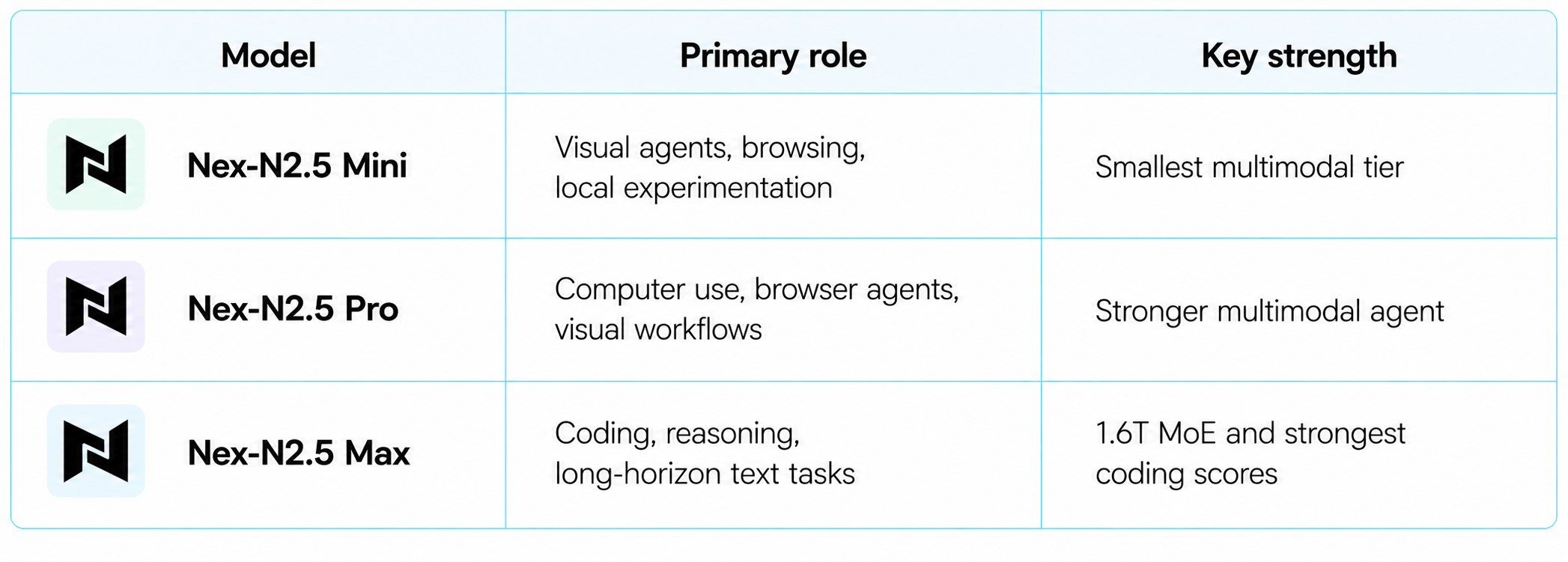
Nex-N2.5 splits this job across three model sizes. Mini and Pro handle multimodal perception and computer interaction, while Max is focused on text reasoning and software engineering. This is a useful product strategy because the visual agent and coding-agent problems have different compute requirements.
2. Nex-N2.5 Mini vs Pro vs Max
3. Nex-N2.5 Specifications
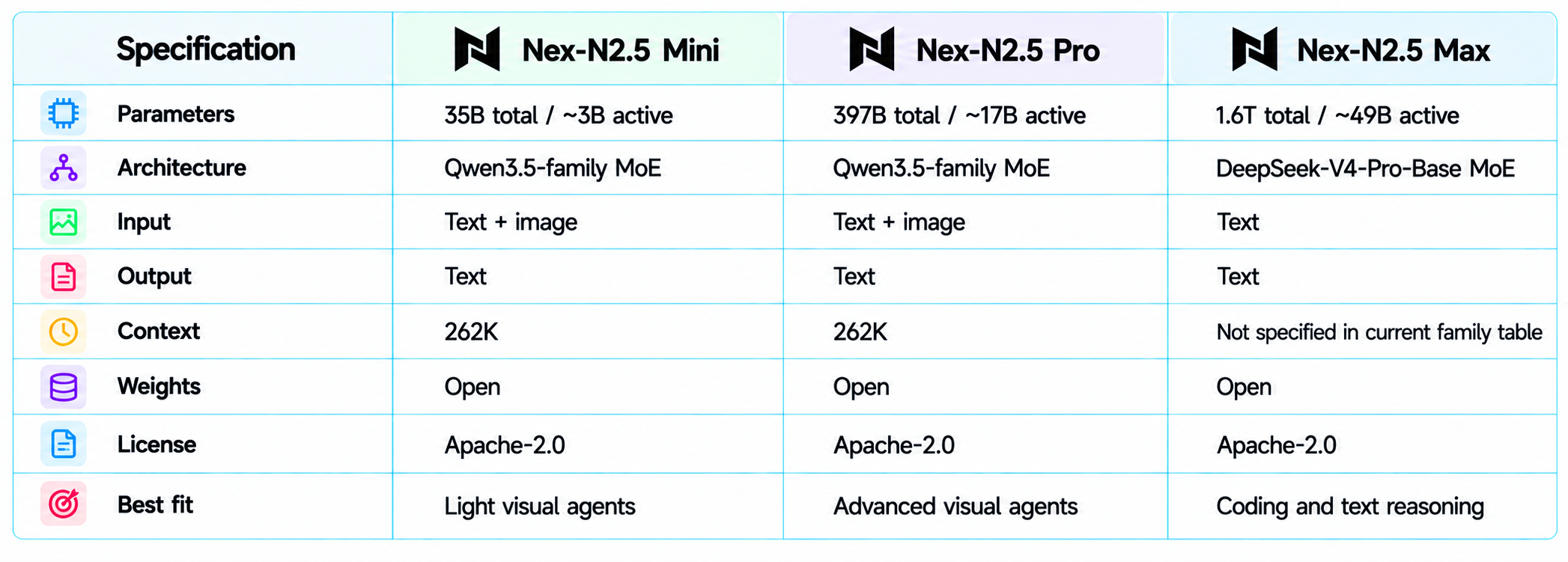
The official family release says Mini and Pro continue the multimodal Nex-N2 foundation, while Max uses a 1.6T text-only MoE foundation. Current deployment references show 262,144-token contexts for Mini and Pro.
4. Coding Benchmarks
Coding is one of the strongest reasons to consider Nex-N2.5. The family is explicitly evaluated on Terminal-Bench 2.1, SWE-Bench Pro and DeepSWE v1.1, giving a useful spread from terminal interaction to software-engineering tasks.
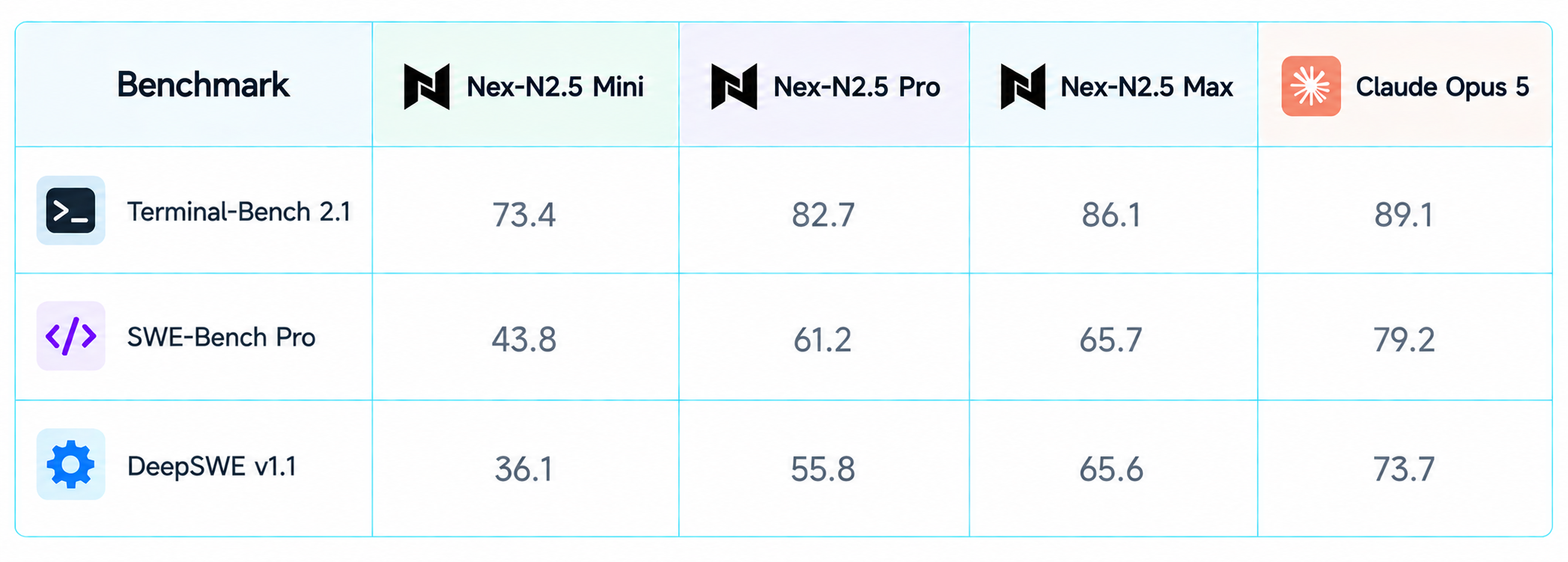
Max comes closest to the leading proprietary models, particularly on Terminal-Bench. It remains behind Claude Opus 5 across all three coding rows, but its 86.1 terminal score is only three points away from Opus 5's 89.1 in Nex-AGI's published comparison.
The scaling inside the family is also important. Pro is already substantially stronger than Mini, while Max provides the highest coding ceiling. That makes model selection meaningful rather than purely a memory or cost choice.
5. Agentic Benchmarks
Nex-N2.5 is not just a coding family. Nex AGI evaluates it on automation, tool use, knowledge work and browsing.
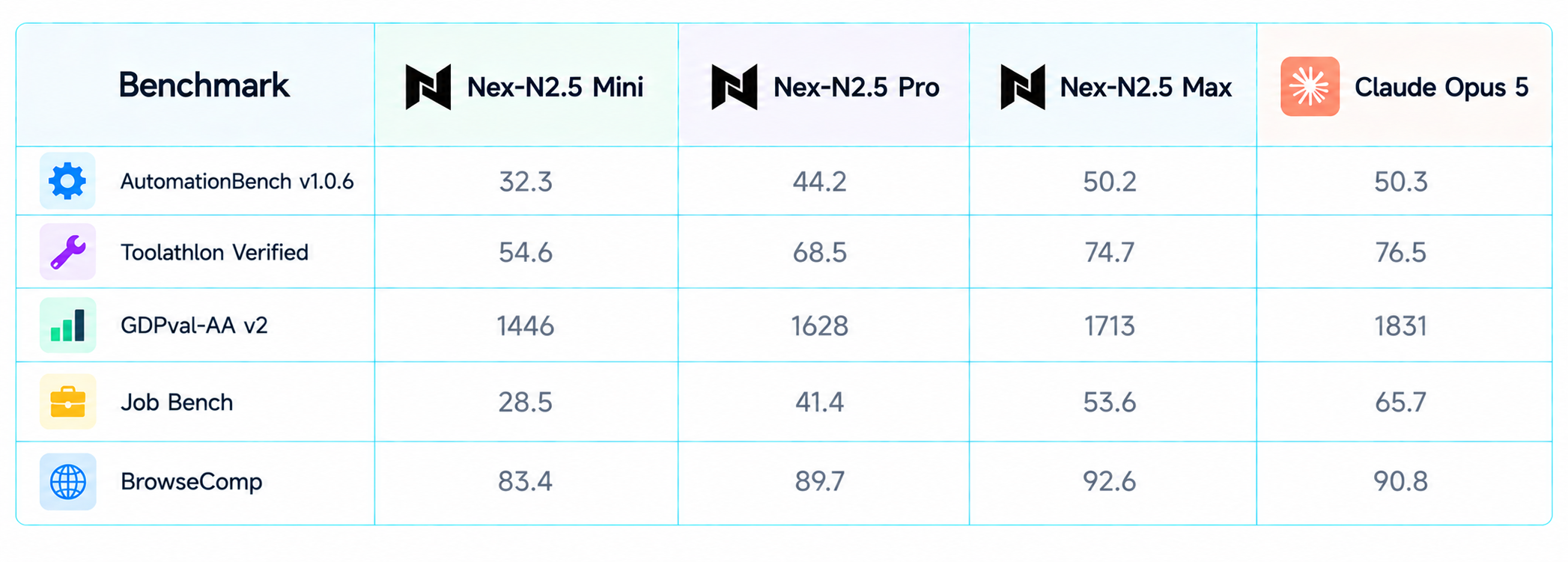
Max's 92.6 BrowseComp score is the standout row. It is higher than the listed Claude Opus 5 score of 90.8 and GPT-5.6 Sol at 90.4. Pro also performs strongly at 89.7, making it a compelling option when browsing needs to be combined with visual interaction.
6. Computer Use and Visual Agents
Mini and Pro are built around visual interaction, so their computer-use results deserve separate attention.
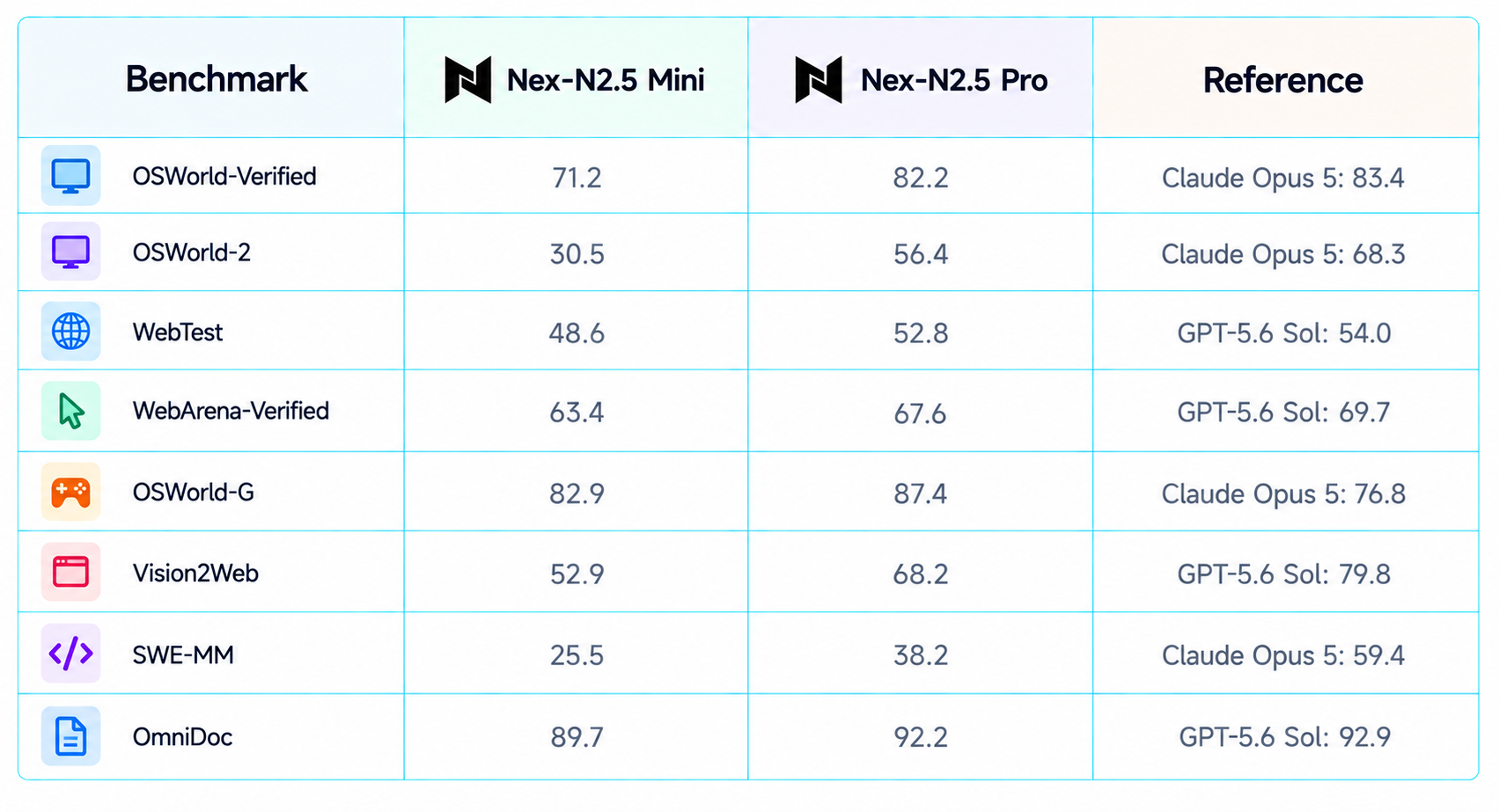
Pro's 87.4 on OSWorld-G is particularly notable because it is above the listed Claude Opus 5 and GPT-5.6 Sol results in the Nex-AGI table. Its 82.2 OSWorld-Verified result is also close to the frontier.
This is where Nex-N2.5 becomes more than another coding model. The agent can use visual state as feedback, which is useful for browser automation, GUI testing and desktop workflows.
7. Visual Feedback Is the Core Differentiator
The Nex-N2.5 design treats vision as an interface between the agent and the environment. The model observes what is actually on screen, performs an action and then uses the new visual state to decide what to do next.
For example, a developer agent can modify a web application, launch it in a browser, inspect the rendered page and recognize that a UI element is misplaced. It can then return to the code, make the correction and test again. That closes an important loop between source-code correctness and user-visible correctness.
The same workflow applies outside coding. An agent can navigate a website, fill forms, inspect results and recover when an interface changes. This is why OSWorld and WebArena are more relevant to the Pro model than ordinary chatbot benchmarks.
8. Open Weights and Local Deployment
Nex-N2.5 is an open-weight family. The official release links the Mini, Pro and Max checkpoints on Hugging Face and ModelScope, and the model cards provide deployment guidance.
Mini is the easiest model to experiment with locally. Community conversions include GGUF and MLX variants, and a Q4_K_M GGUF is about 21.17 GB. The source checkpoint uses a 262,144-token native context.
Pro and Max are much larger. Their open-weight status gives organizations control over deployment, but practical self-hosting requires substantial multi-GPU infrastructure. Open weights should therefore be read as a deployment option, not a promise that every Nex-N2.5 model fits on a desktop GPU.
9. Nex-N2.5 Pricing
Hosted pricing varies by provider. OpenRouter currently lists free endpoints for Nex-N2.5 Mini and Nex-N2.5 Pro. The free endpoints are rate limited, so they are best viewed as an easy way to test the models rather than a guarantee of unlimited production inference.
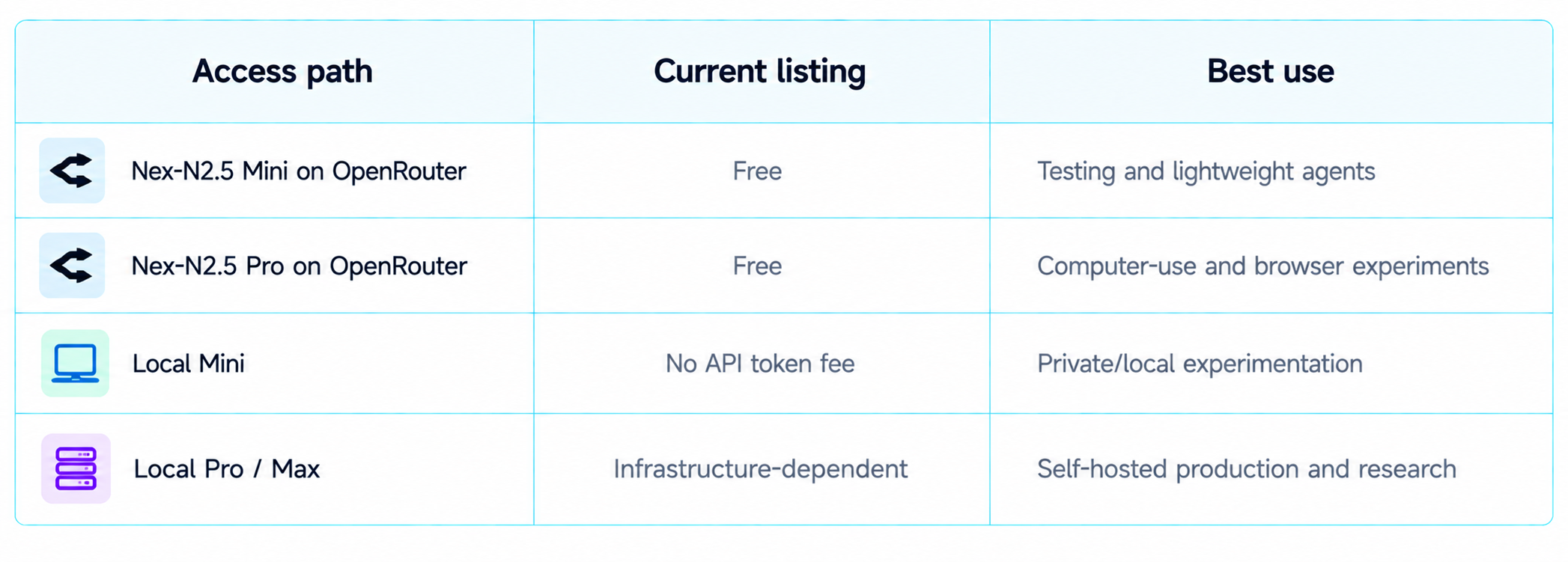
For production budgets, calculate GPU cost, concurrency and tool-call volume rather than assuming the free hosted tier can scale with the application.
10. Nex-N2.5 Context Window
Current deployment listings give Mini and Pro a 262,144-token context window. That is large enough for substantial repository context, long task histories, documentation and visual-agent state.
The official family table does not provide a separate Max context figure in the same presentation, so this review does not invent one. Max's defining specification is its 1.6T text-only MoE foundation rather than a separately published context number.
In practice, the quality of context management matters as much as capacity. An agent still has to retrieve the right files, preserve important state and avoid filling the context with irrelevant material.
11. Nex-N2.5 vs Claude Opus 5
The benchmark comparison is straightforward. Claude Opus 5 is stronger across all three published coding benchmarks for the Max comparison, while Nex-N2.5 has specific wins in browsing and visual agent tasks.
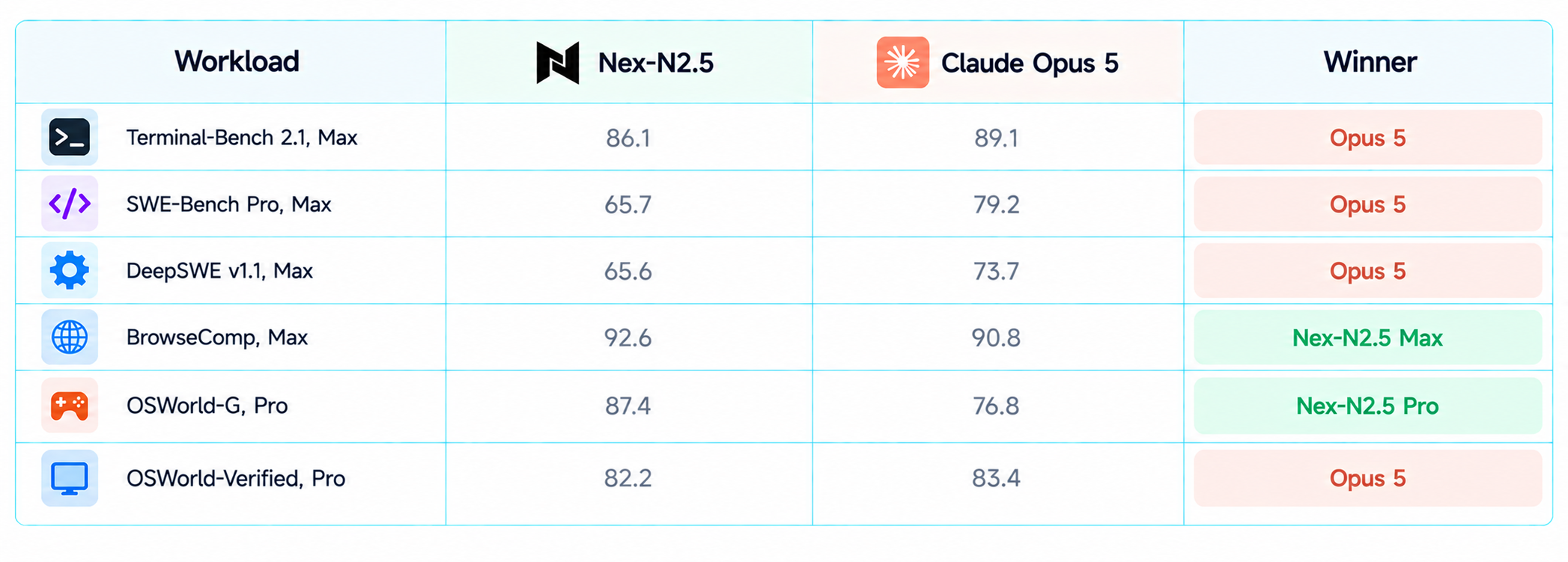
The important takeaway is specialization. Nex-N2.5 is highly attractive when open weights, visual feedback and browser interaction are central to the application. Claude Opus 5 remains the stronger choice for the hardest general coding and reasoning workloads.
12. Nex-N2.5 vs GPT-5.6 Sol
Max is competitive with GPT-5.6 Sol on several agentic benchmarks, while Pro adds a multimodal computer-use path that changes the deployment choice.
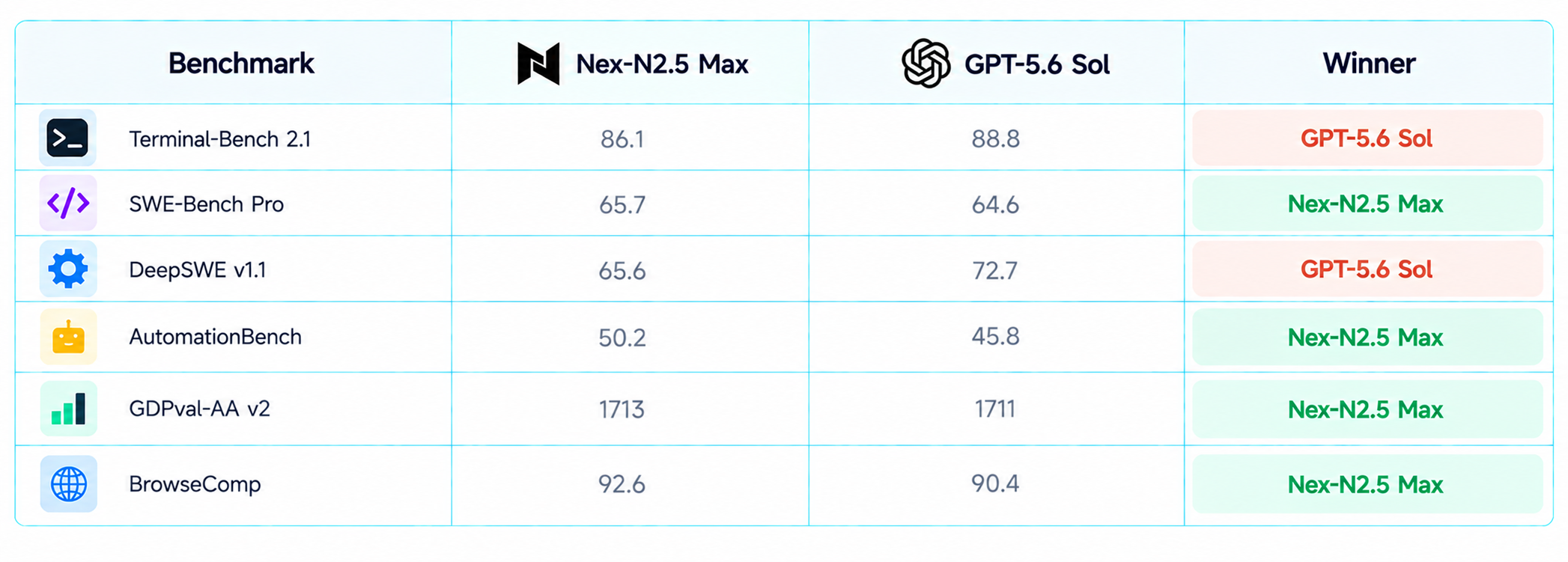
The pattern is similar to the Opus comparison. Nex-N2.5 Max is particularly strong on web-oriented and operational agent tasks, while the strongest frontier coding benchmarks can still favor the larger proprietary systems.
13. Which Nex-N2.5 Model Should You Choose?
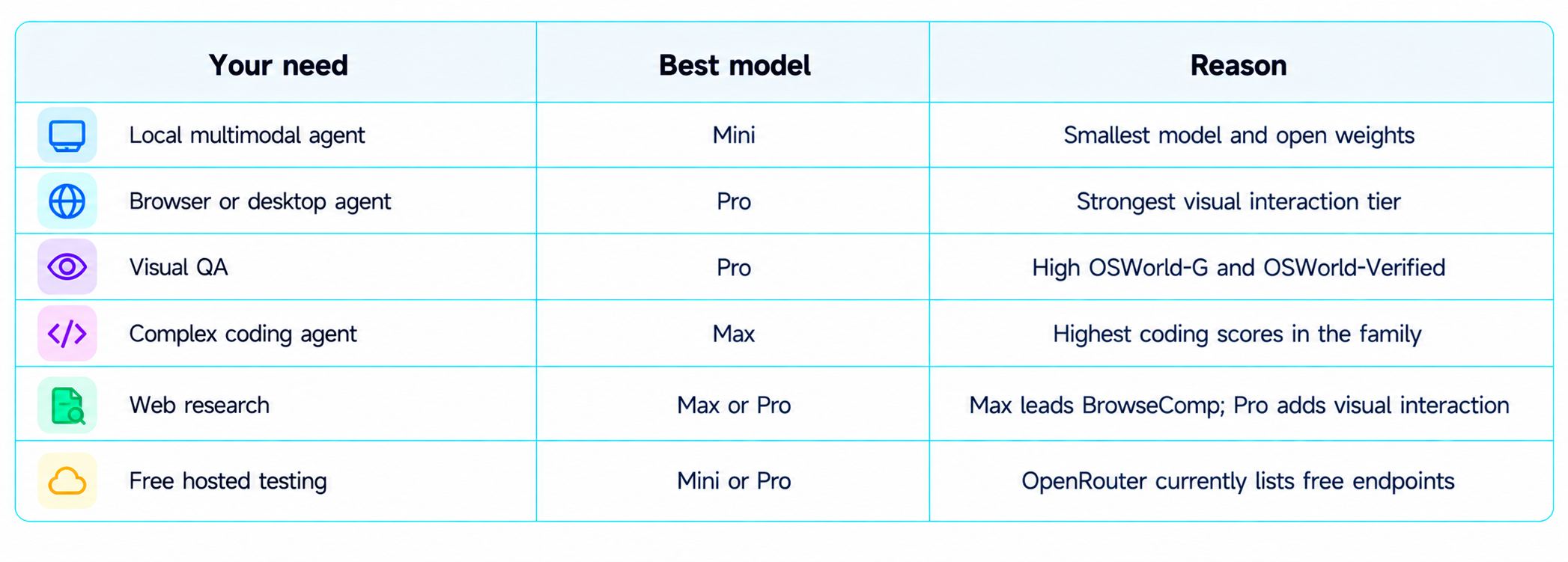
The choice is more about environment than raw model size. Max is the best text reasoning model in the family but cannot see a screen. Pro is the natural choice when the agent must operate a graphical environment. Mini is the practical entry point when hardware and cost are the main constraints.
14. Limitations You Should Know
- Max is text-only, so it cannot replace Pro for visual computer-use tasks.
- Mini and Pro have lower coding scores than Max.
- Open weights do not make Pro and Max easy to self-host on consumer hardware.
- Free OpenRouter endpoints are rate limited.
- Provider context limits can differ from the model's native maximum.
- Claude Opus 5 remains stronger on several difficult coding and agent benchmarks.
- The published benchmark table is primarily Nex-AGI's evaluation suite, so teams should reproduce important tasks on their own infrastructure before procurement.
15. Best Use Cases
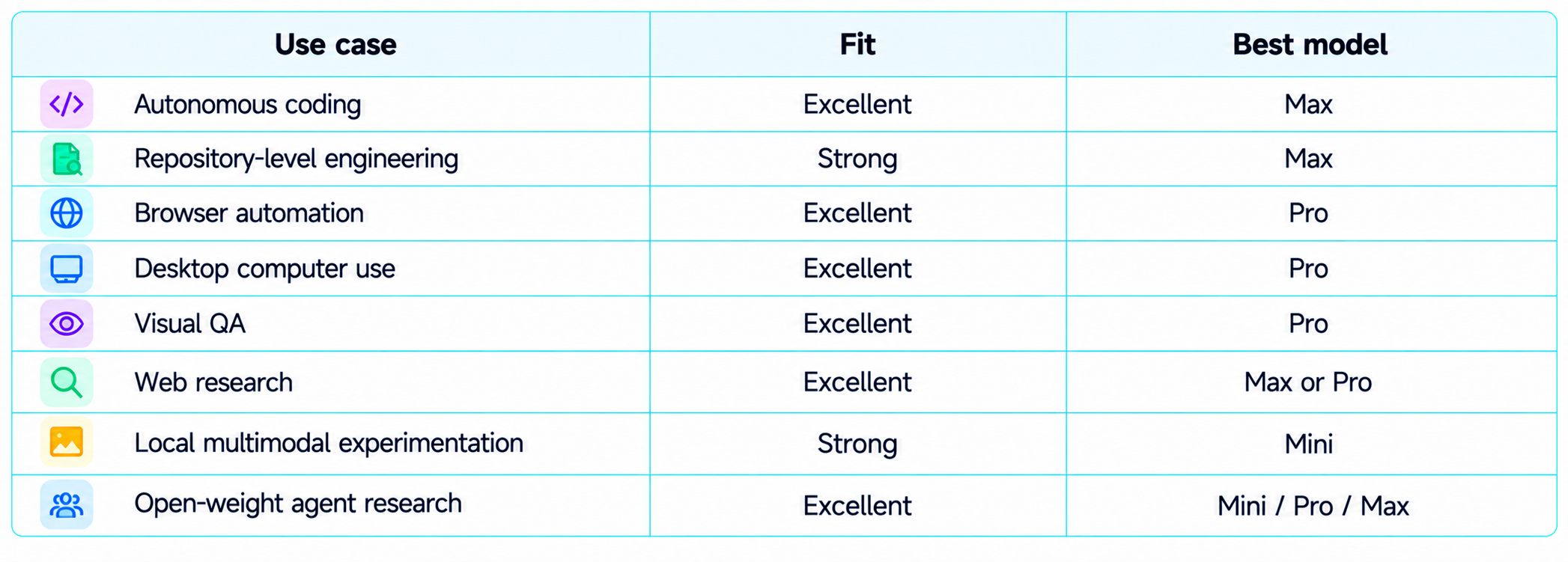
16. Recommended Production Workflow
The strongest Nex-N2.5 deployment is a tiered agent architecture.
- Use Mini for lightweight multimodal agents and low-cost experimentation.
- Use Pro for browser, desktop and visually grounded workflows.
- Use Max for complex coding, reasoning and text-heavy research.
- Route difficult terminal or general reasoning tasks to a stronger model when evaluation data justifies it.
- Use visual verification with Pro when code changes must be confirmed through the actual interface.
- Log actions, tool calls, screenshots and final task outcomes so agent reliability is measurable.
For a multi-model approach, see Model Routing for AI Coding Agents.
17. How to Evaluate Nex-N2.5 Yourself
Run the same tasks through the three Nex-N2.5 sizes when the task supports each modality. For coding, compare Max with your current coding model. For visual tasks, compare Pro with your current computer-use agent.
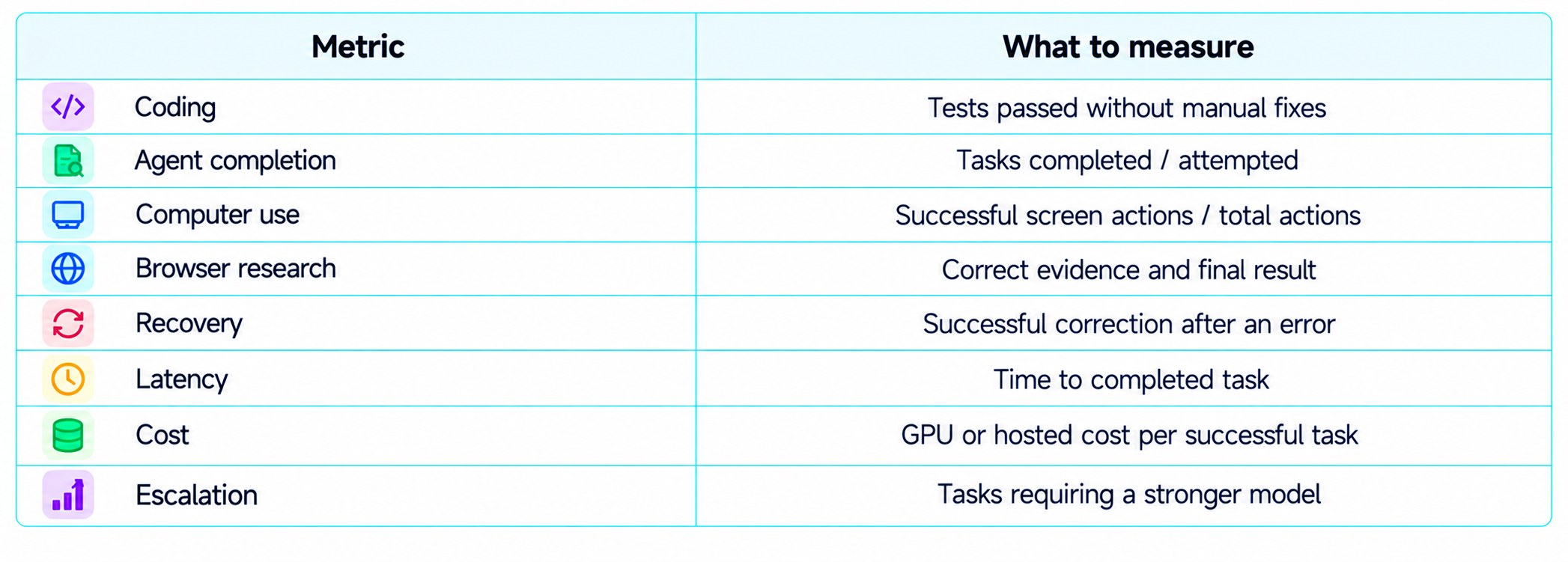
18. Is Nex-N2.5 Worth It?
Yes. Nex-N2.5 is worth testing if you are building coding agents, browser agents, desktop automation or open-weight AI systems. The family covers a wide range of agent environments without forcing every use case into the same model.
The benchmark results support that position. Max reaches 86.1 on Terminal-Bench, 65.7 on SWE-Bench Pro, 65.6 on DeepSWE and 92.6 on BrowseComp. Pro reaches 82.2 on OSWorld-Verified and 87.4 on OSWorld-G.
Open weights make the proposition even more interesting. Mini is already available through community GGUF and MLX conversions, while the full family is published for organizations that want more control over deployment.
The strongest case is not that Nex-N2.5 beats every proprietary model. It is that the family combines strong agentic benchmarks with visual feedback, open-weight access and a practical range of model sizes.
19. Final Verdict
Nex-N2.5 is one of the more interesting agent releases of September 2026 because it treats perception, action and verification as one workflow. Mini and Pro are designed to see and interact with real interfaces, while Max brings the family to a much larger text-reasoning scale for coding and knowledge work.
Max's 86.1 Terminal-Bench score is close to Claude Opus 5 at 89.1, and its 65.7 SWE-Bench Pro and 65.6 DeepSWE results keep it competitive with the other frontier systems in Nex-AGI's comparison. Pro's 87.4 OSWorld-G score is particularly strong for visual computer use, and Max's 92.6 BrowseComp score is the highest in the published comparison.
The practical advantage is the family structure. Mini gives developers an accessible multimodal model, Pro handles serious computer-use workflows, and Max provides the highest reasoning and coding ceiling. That makes Nex-N2.5 useful as a platform, not only as an individual model.
The main limitation is benchmark specialization. Claude Opus 5 remains ahead on SWE-Bench Pro, DeepSWE and Terminal-Bench, while Max cannot handle visual tasks and Pro requires much more infrastructure than Mini. The answer is model routing, not forcing one variant to do everything.
My rating: 9.4/10 for agent design, 9.2/10 for coding, 9.5/10 for open-weight flexibility, 9.1/10 for computer use and 9.1/10 overall.
Bottom line: Nex-N2.5 is worth using when your AI system needs to act in the real world. Choose Mini for accessible multimodal agents, Pro for browser and desktop interaction, and Max for serious coding and text reasoning.
Frequently Asked Questions
What is Nex-N2.5?
Nex-N2.5 is a family of agentic AI models from Nex AGI designed for coding, browsing, computer use, research and long-horizon tasks.
What are the Nex-N2.5 models?
The family includes Nex-N2.5 Mini, Nex-N2.5 Pro and Nex-N2.5 Max.
Which Nex-N2.5 model is best for coding
Nex-N2.5 Max, with 86.1 Terminal-Bench 2.1, 65.7 SWE-Bench Pro and 65.6 DeepSWE v1.1.
Which Nex-N2.5 model is best for computer use?
Nex-N2.5 Pro, because it is the stronger multimodal model and scores 82.2 on OSWorld-Verified and 87.4 on OSWorld-G.
What is the context window?
Current deployment listings give Mini and Pro a 262,144-token context. The official family table does not specify a separate Max context value.
Is Nex-N2.5 open source?
The family is open-weight, with downloadable checkpoints on Hugging Face and ModelScope.
Can Nex-N2.5 run locally?
Yes. Mini has community GGUF and MLX conversions, while Pro and Max require substantially larger multi-GPU infrastructure.
Is Nex-N2.5 free?
OpenRouter currently lists free hosted endpoints for Mini and Pro, subject to rate limits.
Does Nex-N2.5 support computer use?
Yes. Computer and browser interaction are central to Mini and Pro.
Does Nex-N2.5 support image input?
Mini and Pro accept text and image input. Max is text-only.
Is Nex-N2.5 better than Claude Opus 5?
Not universally. Nex-N2.5 has strong results on browsing and visual-agent benchmarks, while Opus 5 remains stronger on several difficult coding and agent evaluations.
Which Nex-N2.5 should I use?
Mini for smaller multimodal deployments, Pro for visual computer and browser agents, and Max for demanding coding and text reasoning.
Recommended Blogs
Meta Muse Spark 1.3 Review: Coding, Price & Is It Worth It? (2026)
Gemini 3.8 Flash Review: Accuracy, Price & Is It Worth It? (2026)
Qwen 3.8 Max 0902 Review: Benchmarks, Price & Is It Worth It? (2026)
Quasar 438B Review: Benchmarks, Speed, Price & Is It Worth It? (2026)
How to Secure AI Coding Agents: Permissions, Sandboxing, MCP & Secrets
24GB VRAM AI Models: What Can You Actually Run Locally in 2026?
Resources & Community
Join our community of 70,000+ AI enthusiasts and learn to build powerful AI applications. Whether you're a beginner or an experienced developer, Build Fast with AI helps you understand and implement AI in your projects.
Agentic AI Launchpad 2026
A structured 6-week cohort program that takes you from AI basics to building and deploying real-world agentic AI systems. Includes live sessions, expert mentorship, project reviews and a builder community network.
Ready to go from learning to building? Join the next cohort: Agentic AI Launchpad 2026
Free AI Resources
Access free tools, workshops and micro-learning to keep building.

