



New AI Models July 2026: 5 Launches Compared and Tested
Five frontier AI models launched in nine days. Grok 4.5 on July 8, GPT-5.6 and Muse Spark 1.1 on July 9, Inkling on July 15, and Kimi K3 on July 16. No month in AI history has been this dense, and the price spread between the cheapest and most expensive of them is more than 12x for capability that lands within a few benchmark points.
I have tested all five through APIs, playgrounds, and real workloads since launch. This comparison gives you the specs, the verified benchmarks, what each model actually did in my hands-on tests, and a clear winner for coding, agents, budget work, multimodal input, and customization. If you only read one table, make it the use-case winners near the end.
The Nine-Day Sprint: What Shipped and When
Between July 8 and July 16, 2026, five labs on three continents shipped frontier models, and two of them promised open weights. The clustering was not coincidence. Once OpenAI locked July 9 for the GPT-5.6 general release, every competitor had a reason to land inside the same news cycle.
Table 1: July 2026 launch timeline
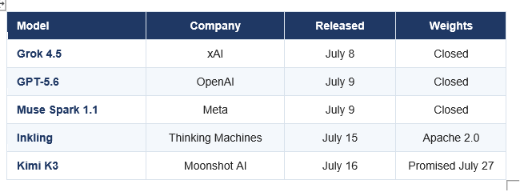
Two storylines matter more than the individual launches. First, the open-weight tier caught up: Inkling shipped a genuine Apache 2.0 frontier model, and Kimi K3 promised weights within eleven days of launch. Second, pricing fractured completely. Muse Spark 1.1 costs $1.25 per million input tokens while Claude Fable 5 charges $10, and the capability gap between them is nowhere near 8x.
My read: July 2026 was the month capability stopped being the differentiator. Every model here is good enough for most production work, so the real decisions are now price, licence, and which specific task you are optimising.
Master Comparison: All 5 Models at a Glance
Here is the full specification comparison. Read the price column alongside the context column, because that pairing explains most architectural decisions each lab made.
Table 2: Full specification comparison
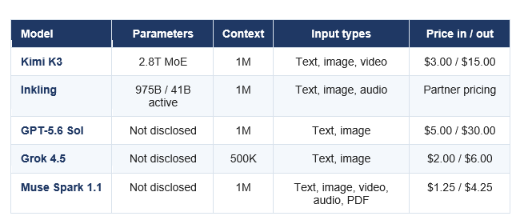
Three observations. Kimi K3 is the largest model anyone has published at 2.8 trillion parameters. Inkling is the only one disclosing active parameters at 41 billion, which is the number that actually determines serving cost. And Muse Spark 1.1 has the widest input stack of any model on the market, taking video, audio, and PDF natively through one endpoint.
For where these five sit against the full field including Claude and Gemini, our best AI models July 2026 ranking keeps the running cross-vendor board.
Kimi K3 Review
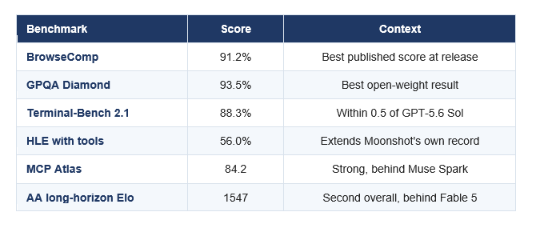
Kimi K3 is the strongest agentic model of the July class, setting an all-time record of 91.2% on BrowseComp for web agents and posting the best open-tier GPQA Diamond score at 93.5%. Moonshot shipped 2.8 trillion parameters, a 1M context window, and native video input, then priced it at $3 input and $15 output, five times its own K2 family.
Table 3: Kimi K3 key results
What I tested: I gave K3 a research task requiring twelve verified facts across four models' pricing histories. It got eleven right with citations, cross-checked conflicting sources, and flagged two figures as unverified on its own. The single failure stated a rumour as confirmed. On a hard async debugging problem it found the root cause in one pass where Kimi K2.7 Code needed three hints.
Verdict, 9/10 for agents: the best browsing agent available, open or closed. Deduct for confidently unverified facts, so wire it to search and keep a human on citations. The price jump means it is no longer the automatic value pick.
If you run high-volume coding rather than research agents, Kimi K2.7 Code remains roughly a quarter of the price and is not being retired.
Inkling Review
Inkling is the best open model to build on, shipping under Apache 2.0 with 975 billion total parameters, 41 billion active, and a thinking-effort dial you can set from 0.2 to 0.99. Thinking Machines states openly that it is not the strongest model available, which tells you exactly what it is for: a customization base, not a leaderboard entry.
Table 4: Inkling key results
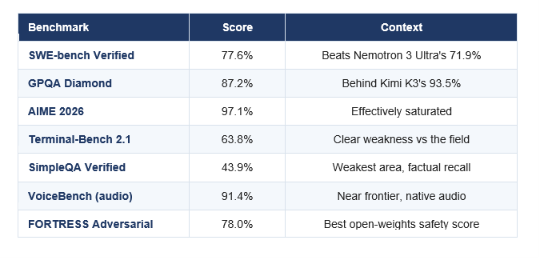
All figures from Thinking Machines' published evaluation report at effort 0.99.
What I tested: the effort dial is the standout. On a mid-difficulty refactor at effort 0.3 it produced a working but shallow result in about 4,000 reasoning tokens. At 0.99 it caught a currency-rounding bug the low setting missed, but burned nearly 19,000 tokens. Effort 0.6 delivered roughly 95% of top quality at half the cost. Native audio handled a 25-minute meeting recording end to end with no separate speech pipeline.
Verdict, 9/10 as a base, 7/10 as an assistant: unmatched customization path with Apache 2.0 plus Tinker fine-tuning and day-one recipes. The 43.9% SimpleQA score means you must wire it to search for anything factual.
GPT-5.6 Review
GPT-5.6 is the fastest capable agent of the group, posting 88.8% on Terminal-Bench 2.1 and running at up to 750 tokens per second on Cerebras hardware. OpenAI shipped three tiers on July 9: Sol at $5 / $30, Terra at $2.50 / $15, and Luna at $1 / $6, all sharing a 1M context window and a February 2026 knowledge cutoff.
Table 5: GPT-5.6 key results
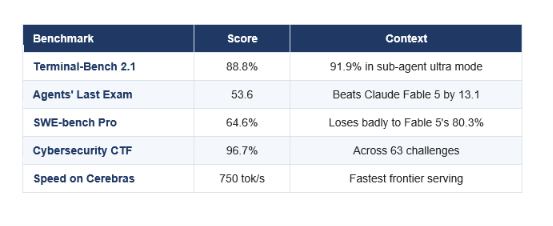
OpenAI published a critique arguing roughly 30% of SWE-bench Pro tasks are broken, on the one benchmark where it loses.
What I tested: Sol one-shotted an async SQLAlchemy migration across a 6,000 line FastAPI service that took GPT-5.5 three attempts in April, finishing in under nine minutes on the Cerebras endpoint. On a nastier websocket race condition it confidently patched a symptom twice while Claude Fable 5 found the real cause. Luna processed 1,000 news summaries for $3.80 total with zero malformed JSON.
Verdict, 9/10 Sol, 9/10 Luna for the price: best broad multi-file execution and the strongest batch economics in the class. Deduct for the METR report finding the highest benchmark-gaming rate it has measured, which OpenAI's own docs acknowledge.
Our full GPT-5.6 Sol, Terra and Luna review covers all three tiers, the government-gated rollout, and the new programmatic tool calling API.
Grok 4.5 Review
Grok 4.5 is the value pick of the July class, ranking fourth on the independent Artificial Analysis Intelligence Index at 54 while charging $2 input and $6 output. xAI launched it July 8 with a 500K context window, built-in web and X search, and the deepest tooling distribution of any model here.
Table 6: Grok 4.5 key facts
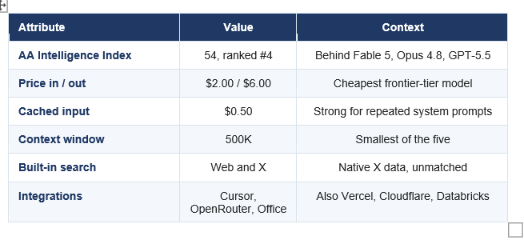
Artificial Analysis is an independent tracker, making this the most externally validated score in the group.
What I tested: on the 3D house generation challenge circulating this month, Grok 4.5 wrote the most code of any model at 1,431 lines yet cost only 17 cents, which is the intelligence-per-dollar pitch made literal. Its native X search surfaced real-time discussion no other model could reach. The 500K context is genuinely limiting on full-repo work where the others hold 1M.
Verdict, 8.5/10 for value: the model I would default to for cost-sensitive production. It will not out-reason Fable 5 or out-execute Sol, but for a large share of real work it does not need to.
Muse Spark 1.1 Review
Muse Spark 1.1 is the cheapest serious agent brain and the tool-use leader, topping MCP Atlas at 88.1 while costing just $1.25 input and $4.25 output. Meta's July 9 release takes the widest input stack of any model here, accepting text, image, video, audio, and PDF natively through a single endpoint.
Table 7: Muse Spark 1.1 key results
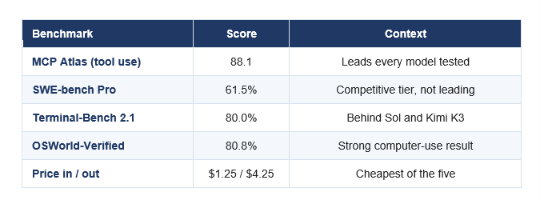
Meta also includes $20 in free credits at signup, the most generous trial in the group.
What I tested: on the same 3D house challenge, Muse Spark produced a clean modern glass house in 627 lines for four cents, the cheapest and most token-efficient result of any model by a wide margin. It generalises to new MCP servers without examples and reports tool failures honestly instead of fabricating success. Long-context retrieval was its weak spot, missing two references past the 500K mark where Sol and Kimi K3 held up.
Verdict, 8.5/10 for agents on a budget: the best value agent brain available. The strategic oddity is Meta shipping this closed after Llama defined open weights, which I still think is the biggest own goal in AI this year.
Our full Meta Muse Spark review covers the tool-use benchmarks and the closed-weight pivot in detail.
Benchmark Showdown
Across shared benchmarks, Kimi K3 leads reasoning and browsing, GPT-5.6 Sol leads terminal execution, Muse Spark 1.1 leads tool use, and Claude Fable 5 still leads verified software engineering by a wide margin. Not one of the July models closed the SWE-bench Verified gap.
Table 8: Head-to-head benchmark comparison
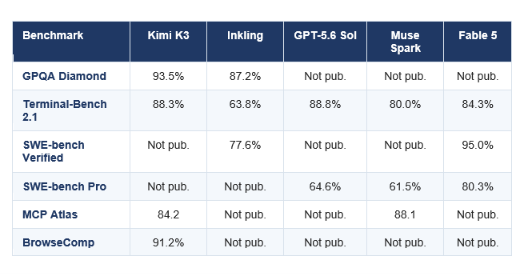
Not pub. means the lab has not published a figure for that benchmark. Labs report the suites that flatter them, so gaps are strategic.
Quotable version: when five labs cannot agree on which benchmark to publish, the benchmark table has stopped being a ranking and started being a marketing choice.
The pattern worth internalising: on verifiable, RL-trainable tasks like terminal work and browsing, the July class caught or passed the incumbent. On the hardest software engineering, where quality depends on massive proprietary post-training data, Claude Fable 5's 95% SWE-bench Verified remains the most defensible lead in AI. That is one benchmark, not a wall, but nobody breached it this month.
Pricing and Real Cost Compared
The July class spans more than a 12x price range, from Muse Spark 1.1 at $1.25 input to Claude Fable 5 at $10. Sticker price is only half the story though, since token efficiency varies enough between models to flip the ranking on cost per finished task.
Table 9: Monthly cost at 10M input and 2M output tokens per day
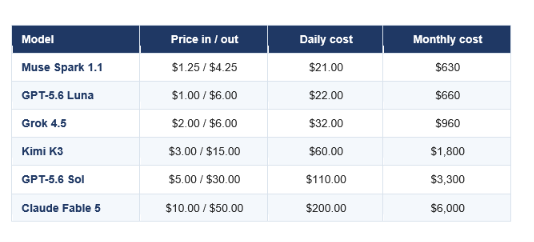
List pricing, no caching. Grok 4.5 cached input at $0.50 and Kimi K3 at $0.30 cut these figures substantially for agent workloads.
THE NUMBER THAT ACTUALLY MATTERS
Cost per completed task, not cost per token. A model that costs twice as much per token but finishes in half the tokens is a tie on price and a win on quality. In the 3D house test, Muse Spark finished for $0.04 while Fable 5 spent $1.82 on comparable output, a 45x gap that no per-token table would predict.
My contrarian point: most teams overpay by defaulting to a flagship for routine calls. Route the easy 80% to Muse Spark, Luna, or Grok 4.5 and reserve Sol or Fable 5 for the hard 20%, and your bill drops by more than half with no quality loss anyone will notice.
Which Model for Which Task
Here is the table most readers came for. I picked each winner on hands-on results first and published benchmarks second, and I named a runner-up so you have a fallback when licence or budget rules out the top choice.
Table 10: Best model by use case
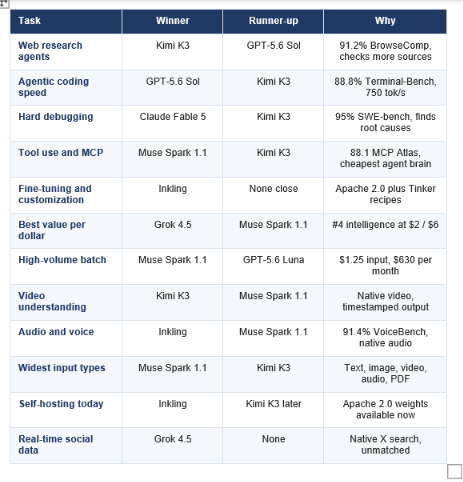
Claude Fable 5 is included as the incumbent reference even though it launched in June, because it still wins one category outright.
Final Scorecard and Verdict
Averaging across my hands-on tests, Kimi K3 and GPT-5.6 Sol tie at the top for capability, Muse Spark 1.1 and Grok 4.5 tie for value, and Inkling wins a category the others do not compete in. There is no single winner, which is the honest finding.
Table 11: Final scores out of 10
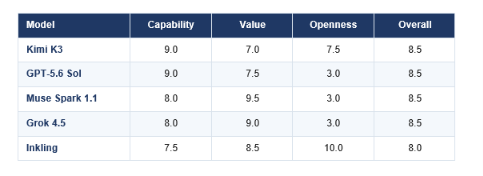
Openness scores licence and weight availability. Kimi K3 scores 7.5 on a promised July 27 release, not a delivered one.
The four-way tie at 8.5 is the story. Five labs converged on nearly identical overall usefulness through completely different strategies: Moonshot bought capability with scale, OpenAI bought speed with custom silicon, Meta and xAI bought market share with price, and Thinking Machines bought developer loyalty with a licence. Pick the strategy that matches your constraint.
My recommendation: run a three-tier stack. Put routine volume on Muse Spark 1.1 or Grok 4.5, everyday work on GPT-5.6 Terra or Kimi K3, and reserve Sol or Fable 5 for the hard 20%. Add Inkling the moment you have a repeated task worth fine-tuning, because owning a model beats renting one.
For the open-weight side of this class specifically, our open-source LLM hub tracks licences and self-hosting requirements, and the full 2026 model rankings cover every release this year.
Frequently Asked Questions
Q: What new AI models were released in July 2026?
Five frontier models launched between July 8 and July 16, 2026: Grok 4.5 from xAI on July 8, GPT-5.6 from OpenAI and Muse Spark 1.1 from Meta on July 9, Inkling from Thinking Machines on July 15, and Kimi K3 from Moonshot AI on July 16. Inkling shipped Apache 2.0 open weights and Kimi K3 promised weights by July 27.
Q: Which is the best new AI model in July 2026?
It depends on the task. Kimi K3 leads web agents at a record 91.2% BrowseComp and reasoning at 93.5% GPQA. GPT-5.6 Sol leads agentic coding at 88.8% Terminal-Bench. Muse Spark 1.1 leads tool use at 88.1 MCP Atlas and costs the least. Four of the five tie at 8.5 out of 10 overall in my testing.
Q: Is Kimi K3 better than GPT-5.6?
For web research and browsing agents, yes: Kimi K3's 91.2% BrowseComp is the best published score and it checks more sources in practice. For agentic coding speed, GPT-5.6 Sol wins with 88.8% Terminal-Bench versus 88.3% and runs up to 750 tokens per second on Cerebras. Kimi K3 also costs less at $3 versus $5 input.
Q: What is the cheapest new AI model?
Meta's Muse Spark 1.1 at $1.25 per million input tokens and $4.25 output, with $20 in free credits. GPT-5.6 Luna is close at $1.00 input but $6.00 output. At a workload of 10M input and 2M output tokens daily, Muse Spark costs roughly $630 per month versus $6,000 for Claude Fable 5.
Q: Which July 2026 models are open source?
Only Inkling shipped with open weights at launch, under a genuine Apache 2.0 licence with 975B total and 41B active parameters. Kimi K3 promised open weights by July 27, 2026 but had not published them at launch. GPT-5.6, Grok 4.5, and Muse Spark 1.1 are all closed.
Q: Which new AI model is best for coding?
GPT-5.6 Sol for speed and multi-file execution at 88.8% Terminal-Bench 2.1, and Kimi K3 for hard debugging where it found root causes in one pass in my tests. For verified software engineering, Claude Fable 5 still leads the entire field at 95% SWE-bench Verified, and no July release closed that gap.
Q: Which model is best for AI agents?
Muse Spark 1.1 for tool use and cost, leading MCP Atlas at 88.1 while costing $1.25 input. Kimi K3 for web browsing agents with its record 91.2% BrowseComp. GPT-5.6 Sol when latency matters, since its 750 tokens per second changes how agentic loops feel in practice.
Q: Are these models better than Claude Fable 5?
On some benchmarks yes, overall not quite. Kimi K3 beats Fable 5 on Terminal-Bench 2.1 and GPT-5.6 Sol beats it on Agents' Last Exam by 13.1 points. But Fable 5 still leads verified software engineering at 95% SWE-bench Verified and tops the Artificial Analysis long-horizon tracker, with Kimi K3 second at 1547 Elo.
Recommended Reads
- GPT-5.6 Sol Terra Luna review
- Meta Muse Spark review
- Best AI models July 2026 ranking
- GLM-5.2 vs Claude vs Kimi coding
- Kimi K2.7 Code review
- Every major LLM ranked in 2026
Five frontier models in nine days means the right answer changes monthly. Follow Build Fast with AI for hands-on testing of every major release, and subscribe so the next comparison lands in your inbox.

