



MiniCPM5-2B Review: Is This the Best Small Open Model?
MiniCPM5-2B is one of the most interesting small open-weight language models released in September 2026 because it is trying to solve a very practical problem: getting useful reasoning, coding and agent behavior without paying the memory and latency costs of a much larger model. OpenBMB positions the model for local assistants, coding agents, tool-use workflows and resource-constrained deployment. The released checkpoint has 2,516,756,480 total parameters, 42 layers, grouped-query attention with 16 query heads and 2 KV heads, and a native 131,072-token context window.
The headline benchmark result is equally interesting. OpenBMB reports a 53.9 average across its selected comparison set, ahead of the 51.1 score shown for Qwen3.5-4B in the same table. It also reports 69.1 on LiveCodeBench v6, 86.5 on AIME 2026, 94.6 on MATH-500, 66.6 on BFCL v4 and 97.1 on tau2-Bench Telecom. Those are strong numbers for a model this small, but they should be read as model-card results rather than proof that MiniCPM5-2B universally beats every 4B model. Some harder long-horizon evaluations still favor larger alternatives.
Quick Answer: Is MiniCPM5-2B Good?
Yes. MiniCPM5-2B is a serious small language model for local AI, coding assistance, reasoning, tool use and lightweight agent workflows. Its biggest strengths are capability per parameter, a native 131K context window, multiple local deployment formats and strong results on OpenBMB’s code, math and tool-use evaluations. The model is available in BF16, GGUF, MLX and GPTQ formats, with official deployment paths for Transformers, vLLM, SGLang, llama.cpp, Ollama and LM Studio.
My recommendation is more specific than “best small model.” MiniCPM5-2B looks excellent when the goal is a compact local worker that can reason, write code and call tools. It is less convincing as a universal replacement for larger models on difficult software engineering, frontier scientific reasoning or long-horizon terminal work. Its current benchmark profile is strongest when capability needs to fit inside a small deployment budget.
1. What Is MiniCPM5-2B?
MiniCPM5-2B is the second model in OpenBMB’s MiniCPM5 series. It is a dense causal language model built on the standard LlamaForCausalLM architecture, which matters for deployment because mainstream runtimes can load it without relying on a proprietary serving stack. OpenBMB designed it around on-device and resource-constrained use cases rather than only cloud-scale inference.
Unlike a model that only targets chat, MiniCPM5-2B is explicitly positioned for coding agents, tool use and reasoning. The official documentation also supports a hybrid Think and No-Think workflow, allowing the same checkpoint to be used for faster direct answers or more deliberate reasoning. That makes the model more interesting for local assistants where users need control over latency versus reasoning depth.
2. MiniCPM5-2B Specifications
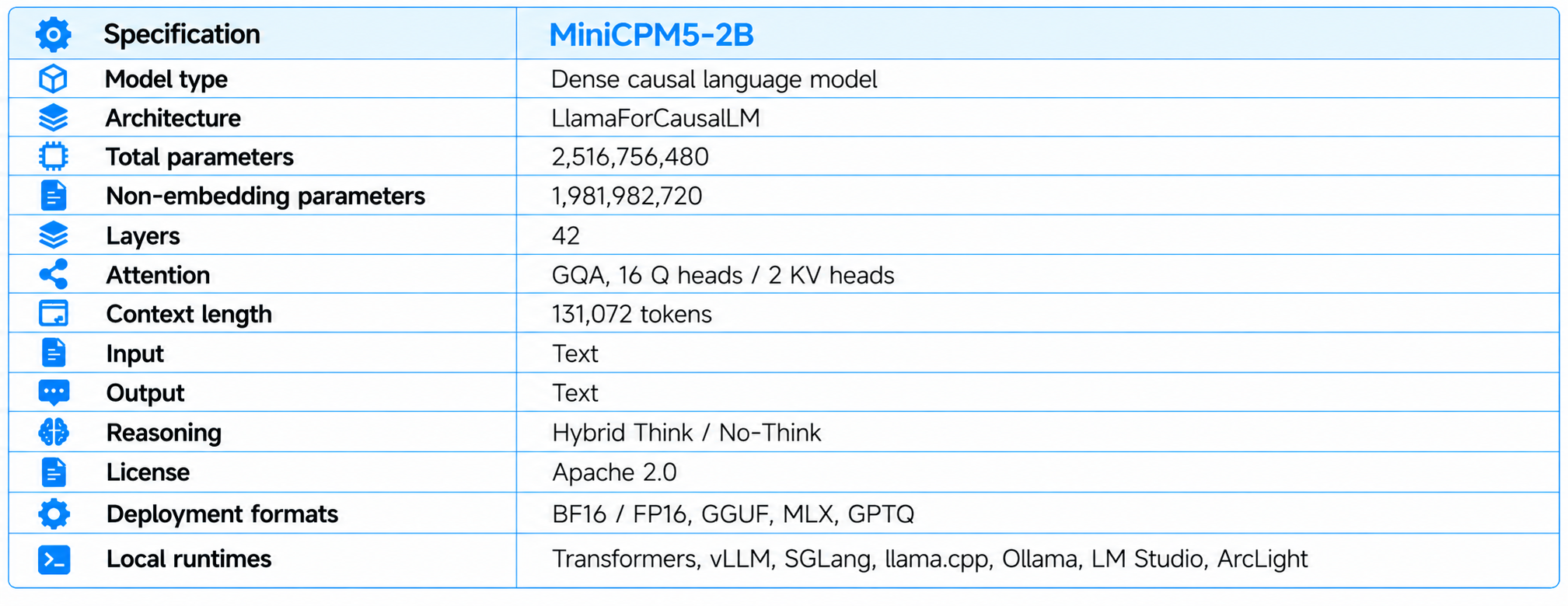
The specification that matters most for builders is the combination of a small dense model with long context. A 131K window does not make MiniCPM5-2B a frontier long-context model by itself, but it gives local applications room for large files, codebases, logs and multi-step agent context. The model card also publishes a long list of local deployment options, which reduces the friction between downloading the weights and actually using them.
3. MiniCPM5-2B Benchmarks
This is where MiniCPM5-2B gets attention. OpenBMB reports a 53.9 average in its comparison table, versus 51.1 for Qwen3.5-4B, 33.2 for Qwen3.5-2B, 24.6 for LFM2.5-2.6B in the published table presentation, and lower scores for several other listed models. Because the average is an author-defined comparison construct, the individual benchmark rows are more useful than treating 53.9 as a universal intelligence score.
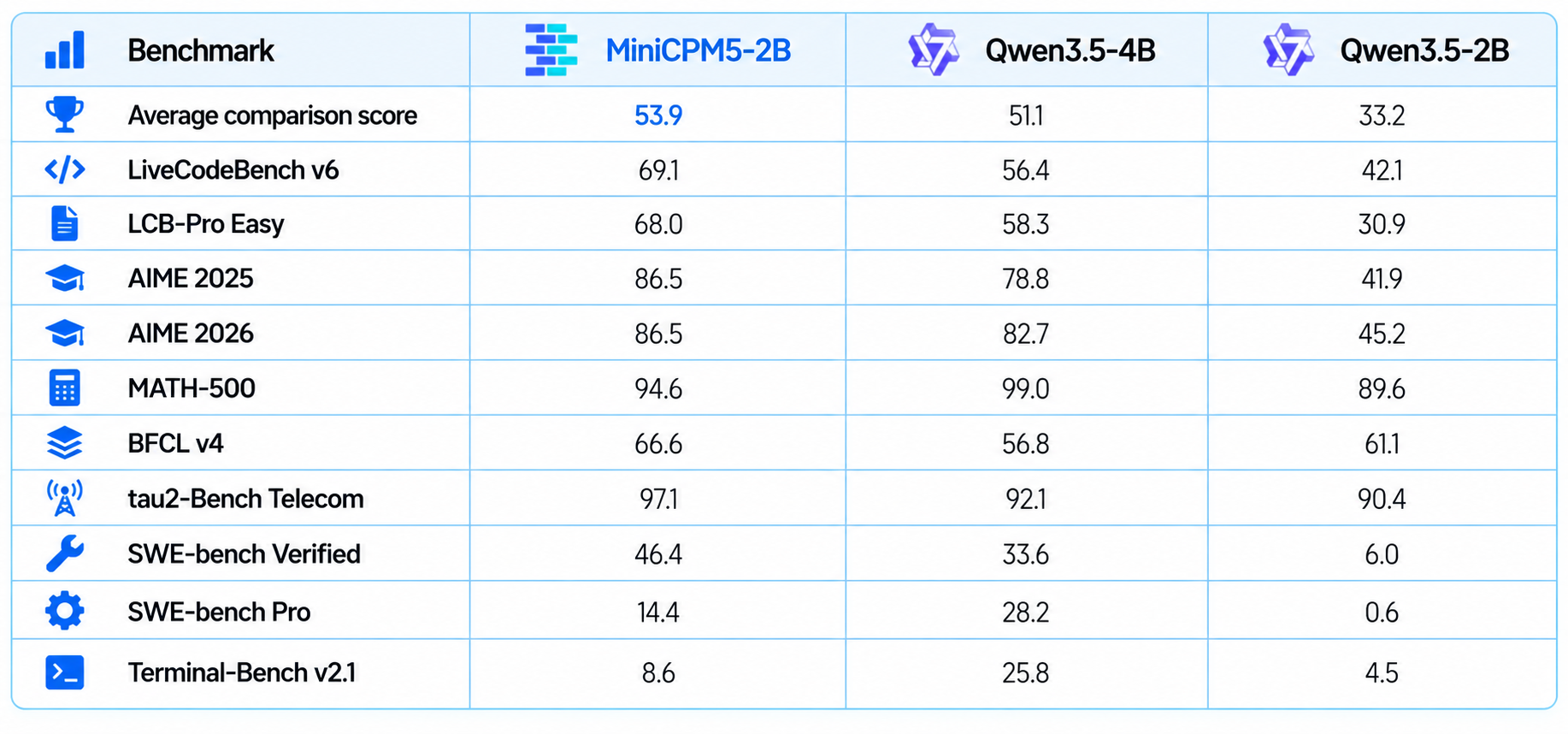
The table shows the real story better than the headline. MiniCPM5-2B is unusually strong for math, code generation and several tool-oriented evaluations. But it does not win everything. Qwen3.5-4B remains stronger on MATH-500, SWE-bench Pro and Terminal-Bench v2.1 in the cited OpenBMB results. That is a useful warning against calling MiniCPM5-2B the “best 2B AI model” without qualification. It is better described as an unusually capable compact model with a particularly strong benchmark profile for its size.
4. MiniCPM5-2B Coding Performance
MiniCPM5-2B is explicitly designed for coding agents, and the benchmark results support taking that claim seriously. Its LiveCodeBench v6 score is 69.1, while the published SWE-bench Verified score is 46.4. For a model with roughly 2.5B total parameters, that is a striking result.
The important caveat is that coding benchmarks measure different kinds of work. LiveCodeBench rewards problem solving and code generation. SWE-bench asks the system to resolve real software issues. Terminal-Bench adds command-line and multi-step execution pressure. MiniCPM5-2B looks strong on several of these, but its 8.6 Terminal-Bench v2.1 result and 14.4 SWE-bench Pro result show that deeper autonomous software engineering remains harder than producing good code in narrower tasks.
For local developers, that suggests a clear role. MiniCPM5-2B is a strong candidate for code explanation, small bug fixes, code generation, structured edits, test creation and lightweight repository workflows. For large refactors or difficult autonomous terminal sessions, a larger coding model may still save time overall.
5. MiniCPM5-2B Reasoning Performance
The reasoning numbers are one of the model’s most impressive parts. OpenBMB reports 86.5 on both AIME 2025 and AIME 2026, 63.8 on HMMT February 2026 and 94.6 on MATH-500. These results put the model well above many same-size baselines in the published comparison set.
That does not mean MiniCPM5-2B is a frontier reasoning model. Humanity’s Last Exam is 8.9 in the cited results, and larger models can still dominate the hardest open-ended reasoning tasks. The useful takeaway is that the model has a very strong reasoning floor for a compact local LLM. It is small enough to deploy easily, but capable enough to make reasoning a genuine part of the workload rather than a marketing label.
6. MiniCPM5-2B Tool Calling and AI Agents
Tool calling is another reason MiniCPM5-2B matters. OpenBMB recommends SGLang for function or tool calling. The model emits XML-style tool calls, and SGLang’s MiniCPM5 parser converts them into OpenAI-compatible tool_calls. vLLM also provides a native MiniCPM5 parser and can launch the model with automatic tool selection enabled.
The benchmark profile backs this use case. MiniCPM5-2B scores 66.6 on BFCL v4 and 97.1 on tau2-Bench Telecom in the published results. GAIA Text-103 is also reported at 88.7. These numbers suggest that the model is not simply a text generator with weak structured action support. It can be a useful compact model for agent loops, especially when the surrounding system enforces tool permissions, validation and recovery.
For an AI agent, however, model quality is only one part of the system. Tool selection, argument correctness, recovery, latency, cost and authorization still matter. Our guide on AI agent evaluation covers the metrics that should be measured before treating a small model as production-ready.
7. MiniCPM5-2B Context Length: 131K
MiniCPM5-2B supports a native 131,072-token context window, often described as roughly 128K in deployment documentation. That is large enough for serious local workloads such as large source files, documentation sets, logs, long prompts and multi-file application context.
There is an important difference between “has a 131K context window” and “works best with 131K on your hardware.” Long context consumes KV-cache memory, so smaller GPUs often need a lower max-model-len such as 8K or 32K to leave room for generation and other runtime overhead. vLLM’s current recipe explicitly recommends dropping max-model-len on smaller GPUs when necessary.
8. How Much VRAM Does MiniCPM5-2B Need?
The model is unusually easy to fit locally. The official vLLM recipe lists about 5 GB for BF16 weights and notes that the model fits on a single GPU. Third-party hardware estimates for an 8K context put BF16/FP16 at about 6.3 GB, Q8 GGUF around 3.7 GB and Q4 GGUF around 2.4 GB, although actual memory depends on the runtime, context length, KV cache, batching and other overhead.
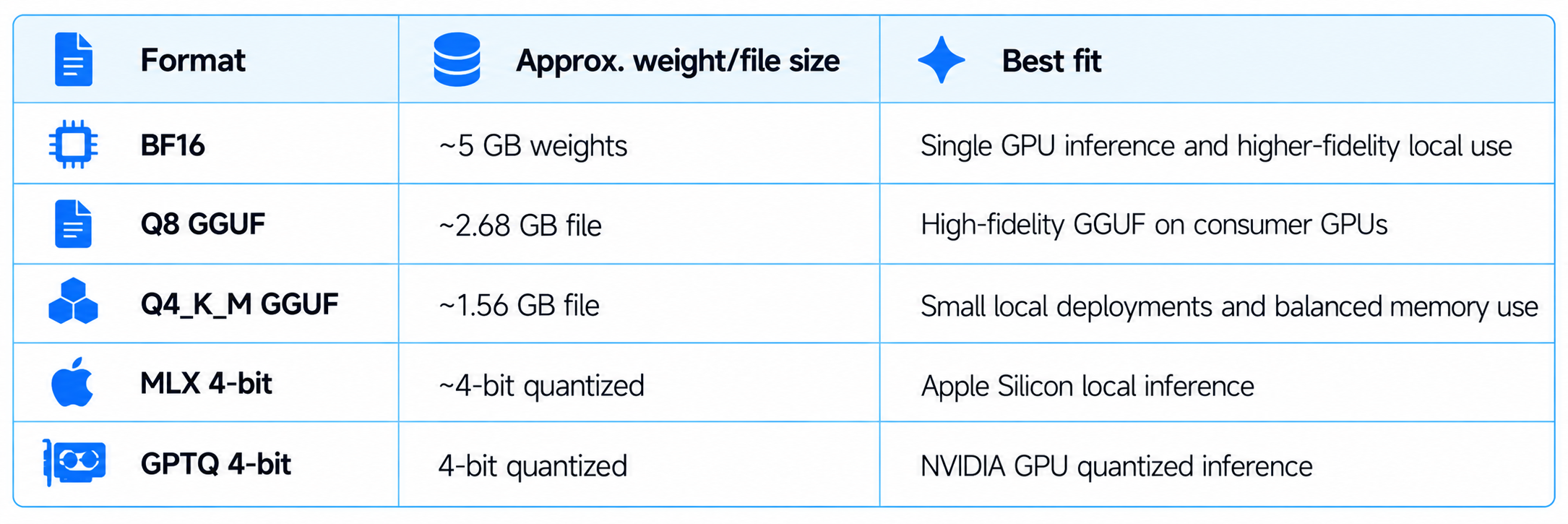
The GGUF file size is not the same thing as total VRAM consumption. A Q4 model file can be only around 1.56 GB while the runtime uses additional memory for the KV cache and execution buffers. This distinction becomes especially important at 32K, 64K or 128K context lengths. The safest hardware planning method is therefore to choose your quantization first and then leave headroom for the context you actually intend to run.
9. MiniCPM5-2B GGUF, Ollama, MLX, GPTQ and vLLM
One of the best reasons to test MiniCPM5-2B is deployment flexibility. OpenBMB publishes dedicated model paths for GGUF, MLX and GPTQ, plus runtime documentation for Ollama, LM Studio, llama.cpp, vLLM and SGLang.
For the simplest local setup, GGUF plus Ollama or LM Studio is the obvious route. The official GGUF repository is designed for llama.cpp, Ollama and LM Studio, and current community deployments use the model directly through Hugging Face-backed Ollama commands.
For server-style inference, vLLM is the stronger choice. The current recipe requires vLLM 0.21.0 or newer, supports a single-GPU TP=1 deployment and includes native MiniCPM5 parsing for tool calling. SGLang is recommended by OpenBMB when tool calling is the main requirement.
For Apple Silicon, the official MLX variant provides a 4-bit local path. GPTQ is the equivalent practical option for compatible GPU workflows. This breadth is important because the “best local AI model” is not only about benchmark accuracy. The model also needs to fit the hardware and runtime that builders actually have.
10. MiniCPM5-2B vs Qwen3.5-2B
The direct comparison is favorable to MiniCPM5-2B in OpenBMB’s benchmark table. The published average is 53.9 versus 33.2 for Qwen3.5-2B. MiniCPM5-2B also leads on LiveCodeBench v6, AIME 2025, AIME 2026, MATH-500 and several tool benchmarks, although Qwen3.5-2B scores better on some instruction-following metrics such as IFEval.
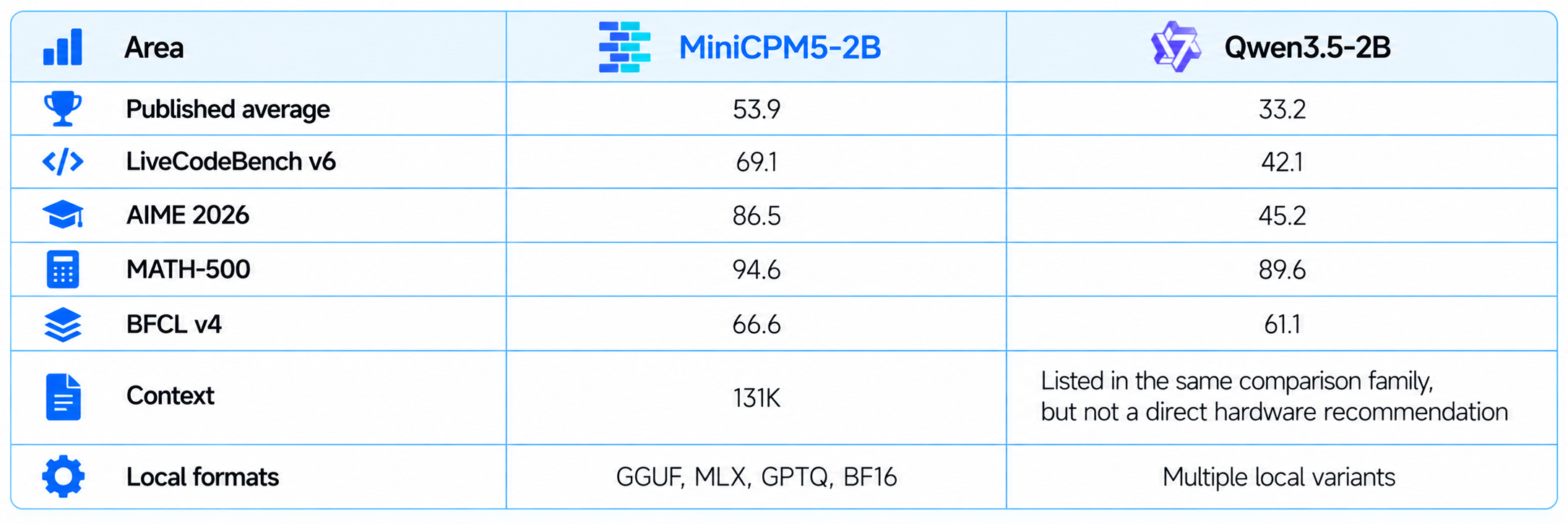
On the evidence available today, MiniCPM5-2B is the more compelling choice when coding, reasoning and tool use are the priority. The important qualification is that these are model-card comparisons, not a controlled independent head-to-head benchmark run under identical settings. Use them as a strong signal, not as the final word.
11. MiniCPM5-2B vs Qwen3.5-4B
This comparison is more interesting because the larger model still wins some important categories. MiniCPM5-2B has the higher published average, 53.9 versus 51.1, and it beats Qwen3.5-4B on LiveCodeBench v6, AIME 2025 and AIME 2026. But Qwen3.5-4B remains ahead on MATH-500, SWE-bench Pro and Terminal-Bench v2.1.
That means the “2B beats 4B” claim is real only within the scope of the published comparison. The practical interpretation is better: MiniCPM5-2B delivers an unusually high capability-to-size ratio, while a 4B model can still be the better option when difficult software engineering and deeper terminal workflows dominate.
12. MiniCPM5-2B vs LFM2.5-2.6B
MiniCPM5-2B also compares favorably with LFM2.5-2.6B on the published table. The reported average is 53.9 versus 33.2, while MiniCPM5-2B shows much stronger results on LiveCodeBench, AIME, MATH-500, BFCL and tau2-Bench Telecom.
For builders looking for a compact local LLM, that makes MiniCPM5-2B one of the first models in this size class that is worth evaluating for serious workflows rather than only lightweight chat.
13. Strengths and Weaknesses
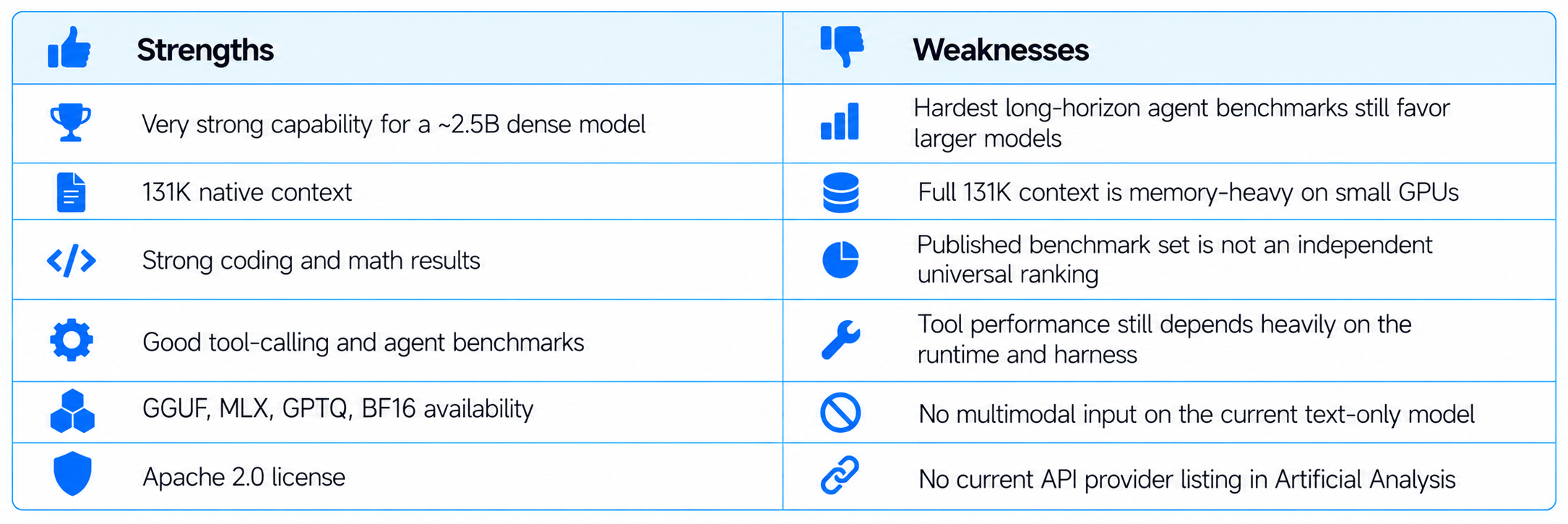
The weaknesses are important because they keep the review grounded. MiniCPM5-2B is not a smaller version of a frontier model. Its value is efficiency. It can do a surprising amount of useful work while remaining practical on consumer hardware, but you should not expect it to eliminate the need for larger models on every difficult task.
14. Who Should Use MiniCPM5-2B?
- Local AI builders: It is a strong fit for people who want a compact local LLM with strong reasoning and coding ability.
- Coding assistants: Use it for code generation, explanation, debugging, test writing and lightweight repository workflows.
- AI agent developers: Tool calling makes it useful as a compact reasoning worker inside a larger agent architecture.
- Apple Silicon users: The official MLX path makes local experimentation straightforward.
- Low-memory GPU users: GGUF and 4-bit variants reduce the weight footprint substantially.
- Developers testing small-model routing: Use MiniCPM5-2B as a lower-cost first-pass model and escalate difficult tasks to larger models when evaluation shows a quality gap.
15. Who Should Not Use MiniCPM5-2B?
Do not choose MiniCPM5-2B just because a benchmark screenshot says it beats a 4B model. If your application depends heavily on long-horizon coding, terminal execution, advanced research reasoning or multimodal input, you should test larger or specialized models. The published Terminal-Bench and SWE-bench Pro results are a useful reminder that compact models still have a ceiling on difficult autonomous software work.
16. How to Run MiniCPM5-2B Locally
The easiest route depends on your hardware and use case. For a desktop user, GGUF through Ollama or LM Studio is the lowest-friction setup. For a server or OpenAI-compatible endpoint, vLLM is the most direct path. For tool calling, SGLang has the clearest official recommendation. Apple Silicon users should look at the MLX release.
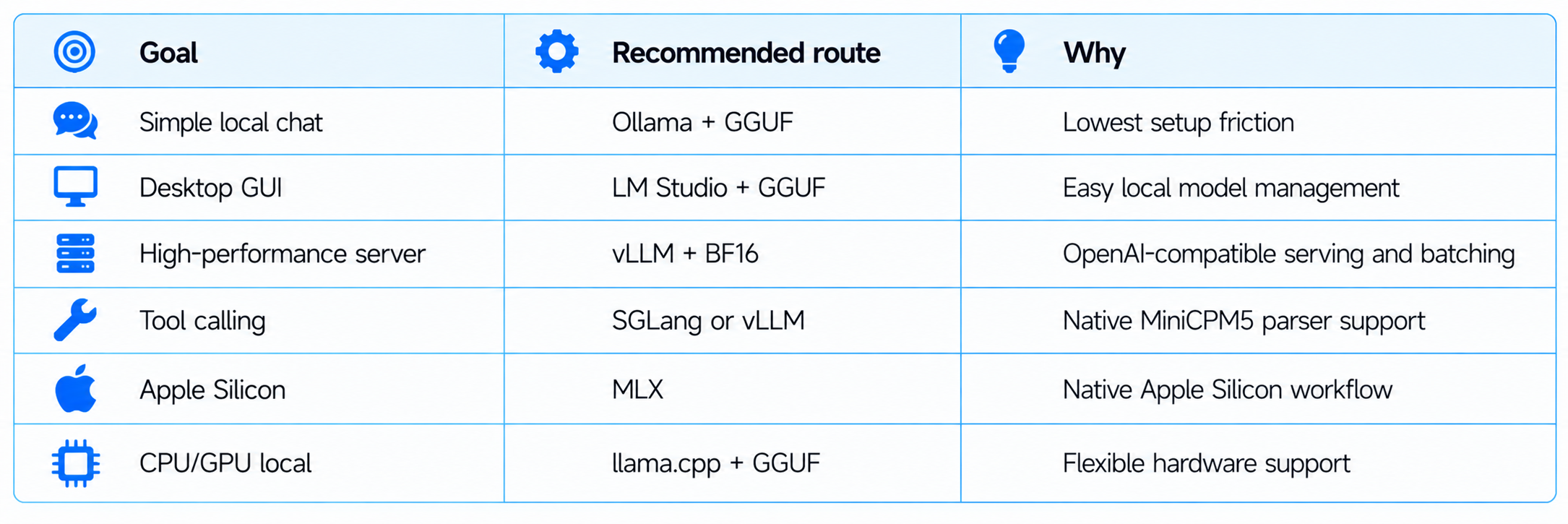
For vLLM, the current recipe is straightforward: install vLLM 0.21.0 or newer, serve openbmb/MiniCPM5-2B with TP=1, and lower max-model-len on smaller GPUs when context memory becomes the bottleneck. For tool calling, add the MiniCPM5 tool-call parser.
17. A Better Way to Evaluate MiniCPM5-2B
Benchmarks tell you why to test a model. Your workload tells you whether to keep it. For a local AI deployment, I would run the same representative prompts through MiniCPM5-2B, your current small model and one larger fallback model. Measure task success, time to first token, output speed, tokens used, memory consumption, tool-call correctness and the rate of tasks that need a retry or escalation.
For agent workflows, also capture traces rather than looking only at the final answer. An agent can get the final result while taking unnecessary steps, selecting the wrong tool or failing to use a tool response correctly. Our AI Agent Evaluation: 15 Metrics Beyond Accuracy guide covers that evaluation pattern in detail.
18. Is MiniCPM5-2B Worth It?
Yes, especially for local AI. The combination is unusually practical: a roughly 2.5B dense model, native 131K context, strong code and math benchmarks, tool-calling support, Apache 2.0 licensing and multiple local formats. That is a very good profile for developers who care more about capability per gigabyte than chasing the highest benchmark score at any cost.
The bigger question is whether it is worth replacing a stronger local model with it. In many cases, the answer is “use both.” A small model like MiniCPM5-2B can handle routine tasks cheaply in local hardware, while a larger model handles the difficult tail. This is exactly the kind of routing strategy covered in our Model Routing for AI Coding Agents guide.
19. Final Verdict
MiniCPM5-2B is one of the most compelling small open-weight models to appear in 2026. The reason is not a single benchmark. It is the combination of small size, 131K context, good reasoning, strong code results, practical tool calling and broad local deployment support.
The benchmark record deserves both attention and caution. OpenBMB reports a 53.9 average in its comparison, above the 51.1 shown for Qwen3.5-4B, plus 69.1 LiveCodeBench v6, 86.5 AIME 2026, 94.6 MATH-500, 46.4 SWE-bench Verified, 66.6 BFCL v4 and 97.1 tau2-Bench Telecom. Those are remarkable numbers for a compact model. But Qwen3.5-4B still wins on MATH-500, SWE-bench Pro and Terminal-Bench v2.1 in the same published results, so MiniCPM5-2B is not an automatic replacement for larger models.
My rating: 9.2/10 for capability per parameter, 9.3/10 for local deployment, 8.8/10 for coding agents, 9.0/10 for tool use and 9.1/10 overall.
Bottom line: MiniCPM5-2B is worth testing if you want a small open model for local AI, coding, reasoning or agent workflows. It is particularly attractive on 8GB-class and larger consumer hardware, but your usable context length will depend on the runtime and KV-cache budget. Treat the benchmark headline as a reason to benchmark it yourself, not as a reason to stop comparing.
Frequently Asked Questions
What is MiniCPM5-2B?
MiniCPM5-2B is OpenBMB’s dense 2B-class causal language model for local assistants, coding agents, tool-use workflows and reasoning. It has 2,516,756,480 total parameters and a 131,072-token context window.
Is MiniCPM5-2B good?
Yes. It is unusually capable for its size, especially on code, math, tool use and compact local deployment.
What are the MiniCPM5-2B benchmark results?
OpenBMB reports 53.9 on its comparison average, 69.1 on LiveCodeBench v6, 86.5 on AIME 2026, 94.6 on MATH-500, 46.4 on SWE-bench Verified, 66.6 on BFCL v4 and 97.1 on tau2-Bench Telecom.
What is the MiniCPM5-2B context length?
The native context length is 131,072 tokens, commonly described as 128K in deployment docs.
How much VRAM does MiniCPM5-2B need?
About 5 GB for BF16 weights according to the vLLM recipe. Quantized versions use less for the weights, but total runtime memory also includes KV cache and execution overhead.
Can MiniCPM5-2B run locally?
Yes. Official deployment paths include Transformers, vLLM, SGLang, llama.cpp, Ollama, LM Studio and MLX.
Can MiniCPM5-2B run in Ollama?
Yes. OpenBMB publishes a GGUF deployment path for Ollama, and the official GGUF repository lists Ollama as a supported runtime.
Does MiniCPM5-2B support tool calling?
Yes. SGLang is the recommended backend for tool calling, and vLLM supports a native MiniCPM5 parser.
Is MiniCPM5-2B better than Qwen3.5-2B?
In OpenBMB’s published comparison, MiniCPM5-2B has the higher average and stronger results on several code, math and tool-use evaluations, though not every instruction-following metric.
Is MiniCPM5-2B better than Qwen3.5-4B?
Not universally. MiniCPM5-2B has the higher published average in OpenBMB’s table, but Qwen3.5-4B remains stronger on MATH-500, SWE-bench Pro and Terminal-Bench v2.1.
Is MiniCPM5-2B open source?
The model is released under Apache 2.0 and its weights are publicly available. For precision, “open-weight” is the safer term when discussing downloadable model weights versus fully open source software.
Is MiniCPM5-2B worth it?
Yes, especially for local AI, coding assistance, reasoning and lightweight agents where a compact footprint matters.
Recommended Blogs
- 24GB VRAM AI Models: What Can You Actually Run Locally in 2026?
- How to Run GLM-5.3 Locally: Hardware, VRAM & Setup (2026)
- Model Routing for AI Coding Agents: How to Cut Costs Without Losing Quality
- What Is an AI Agent? Beginner Guide With Examples (2026)
- How to Secure AI Coding Agents: Permissions, Sandboxing, MCP & Secrets
- Pydantic AI: Build Type-Safe AI Agents Guide(2026)
- Best Open Source AI Models August 2026: Full Collection
Resources & Community
Join our community of 70,000+ AI enthusiasts and learn to build powerful AI applications. Whether you are a beginner or an experienced developer, Build Fast with AI helps you understand and implement AI in your projects.
- Website - buildfastwithai.com
- LinkedIn - Build Fast with AI
- Instagram - @buildfastwithai
- Founder X - @satvikps
- X - @BuildFastWithAI
Agentic AI Launchpad 2026
A structured 6-week cohort program that takes you from AI basics to building and deploying real-world agentic AI systems. Includes live sessions, expert mentorship, project reviews and a builder community network.
Ready to go from learning to building? Join the next cohort: Agentic AI Launchpad 2026
Free AI Resources
Access free tools, workshops and micro-learning to keep building.
- AI Workshops - Free resources, upcoming events and past recordings
- Unrot - Learn AI in 5 minutes a day
References
- OpenBMB MiniCPM5-2B official model card
- OpenBMB MiniCPM5-2B GGUF
- OpenBMB MiniCPM5-2B GPTQ
- OpenBMB MiniCPM5-2B MLX
- vLLM MiniCPM5-2B deployment recipe
- OpenBMB MiniCPM documentation and deployment repository
- Artificial Analysis MiniCPM5-2B model page
- Artificial Analysis MiniCPM5-2B provider analysis
- Compendia Labs: MiniCPM5-2B Beats 4B-Class Models on Benchmarks

