



LongLive-2.0: How NVIDIA Turned Long-Video AI Into an Infrastructure Problem
On May 13, 2026, NVIDIA Research released LongLive-2.0 — a system that hits 45.7 frames per second of long-video generation on Blackwell GPUs, runs entirely in NVFP4 4-bit precision end to end, and trains 2.15× faster than its bf16 predecessor. The headline number gets the attention. The real story is buried in the paper: NVIDIA stopped trying to fix long video with a smarter model and rebuilt the entire training and inference stack instead.
This is the shift nobody is talking about clearly. For two years, every long-video lab has been chasing the same dragon — better diffusion architectures, fancier teacher-forcing schemes, more elaborate distillation tricks. LongLive-2.0 walks past that whole conversation and asks a different question: what if the bottleneck is not the model, but the GPU memory, the kernel precision, the sequence-parallel layout, and the VAE decoder running on the wrong thread?
Spoiler: it was all of those. And the fix produced the cleanest training pipeline the long-video field has seen since the original Self-Forcing paper.
1. What is LongLive-2.0?
LongLive-2.0 is an NVFP4-based parallel infrastructure for long video generation, released by NVIDIA Research on May 13, 2026 as the second-generation evolution of the LongLive project. The full name on arXiv is 'LongLive-2.0: An NVFP4 Parallel Infrastructure for Long Video Generation,' and that title is doing real work — it is telling you the contribution is the infrastructure, not the model.
The system has three pieces. A training stack that pairs sequence-parallel autoregressive training (called Balanced SP) with NVFP4 precision, cutting GPU memory and accelerating GEMM operations whose share of total compute grows with video length. An inference stack that quantizes both model weights and the KV cache to NVFP4 (W4A4) on Blackwell GPUs, with asynchronous streaming VAE decoding to overlap denoising and decoding. And a base model — LongLive-2.0-5B — built on the Wan2.2-TI2V-5B AR diffusion backbone, distilled into a few-step inference variant via standalone LoRA weights.
LongLive-2.0 is the second major release in NVIDIA's deepening push into video and multimodal AI in 2026, following the original LongLive 1.0 paper accepted at ICLR 2026 and the broader NVIDIA AI models 2026 lineup that includes Nemotron, NeMo, and the LTX-2 video stack. NVIDIA is no longer just selling the GPUs — it is now shipping the frameworks that show everyone else how to use them at the frontier.
Authorship matters here too. The paper is co-led by Yukang Chen and Luozhou Wang, with Song Han (MIT, NVIDIA Distinguished Scientist) and a 16-author team spanning NVIDIA Research, MIT, and academic collaborators. This is the same group that shipped Wan2.1, the original AR video backbone — they are not new to the long-video problem. They have been quietly iterating on it for two years.
2. The NVFP4 bet: why 4-bit precision matters here
NVFP4 is the killer feature. It is also the bet that could have gone wrong — and the reason the rest of the paper exists.
NVFP4 is NVIDIA's 4-bit floating-point format introduced with Blackwell architecture in 2024. It encodes values in 4 bits instead of the 16 bits used by BF16, and it is accelerated natively by Blackwell's latest-generation Tensor Cores. In theory: 4× less memory, 4× more arithmetic throughput. In practice: most teams cannot use it without catastrophic quality loss because aggressive quantization breaks long-context attention patterns.
LongLive-2.0 is, by NVIDIA's own characterization, the first end-to-end NVFP4 training and inference system for long video generation. End-to-end is the key qualifier. Prior NVFP4 work quantized weights only, or activations only, or inference only. LongLive-2.0 uses NVFP4 for AR training, for DMD step distillation, for W4A4 inference, and for the KV cache itself — which is where the memory savings actually compound at long video lengths.
Here is the quantization payoff in the paper's own numbers. Switching from BF16 to NVFP4 inference cuts peak memory from 29.7 GB to 19.4 GB. The 4-step 5B model hits 29.7 FPS, beating every listed baseline. The 2-step variant pushes that to 45.7 FPS at the same 19.4 GB footprint. End-to-end latency for a 64-second video lands at 36.3 seconds. That is a video model generating its output faster than the video plays back.
The hardware caveat is honest and printed plainly in the paper: NVFP4 acceleration is Blackwell-only. On non-Blackwell GPUs (A100, H100, H200), you get the memory savings from NVFP4 weights and KV cache, but not the kernel-level throughput gain — and the team falls back to sequence-parallel inference to compensate. This is the same hardware-software co-design pattern that drove NVIDIA Nemotron Nano 3 Omni's efficiency gains earlier this year, and it tells you something about where NVIDIA's full-stack moat is going: not the model, the entire pipeline tuned for the silicon.
3. Balanced sequence parallelism and the clean training pipeline
The clever part of LongLive-2.0 is not the precision format — it is what the team did once they had the memory headroom. They threw out the multi-stage training pipeline.
Existing long-video AR training, including the Self-Forcing family, relies on a chain of stages: ODE initialization to seed a clean trajectory, distribution matching distillation (DMD) to compress the diffusion process, and then long-video fine-tuning on top. Each stage is fiddly. Each stage introduces failure modes. And the chain is what makes long video generation feel like an art form rather than a process.
LongLive-2.0 collapses this. The team directly tunes a bidirectional diffusion model (Wan2.2-TI2V-5B) into a long, multi-shot, interactive autoregressive diffusion model in a single AR training stage. No ODE bootstrap. No intermediate DMD pass. Real-time generation is then achieved by injecting standalone LoRA weights for few-step inference (4 steps, then 2 steps). One training pipeline, two inference modes.
The engineering trick that makes this work is called Balanced SP — Balanced Sequence Parallel training. It co-designs an efficient teacher-forcing layout with sequence-parallel execution, pairing clean-history and noisy-target temporal chunks on each rank. The result is a natural teacher-forcing mask with SP-aware chunked VAE encoding. Translation for the rest of us: the GPUs do not sit idle waiting for the VAE to finish encoding the next chunk, and the training step does not waste compute on padding or imbalanced workloads across ranks.
Quotable: this is the closest the long-video field has come to a 'just train the damn thing' pipeline, and the speedup numbers are why everyone in the space is going to read this paper twice.
4. Benchmarks: 45.7 FPS, 2.15× training, 1.84× inference
LongLive-2.0 ships with three benchmark wins worth taking seriously, and one important context note about where the comparisons end.
Here is the headline performance profile:
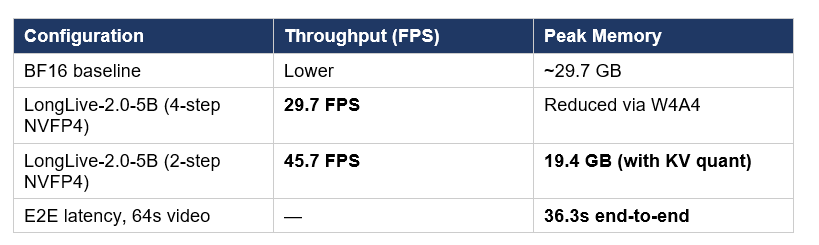
The training speedup is 2.15× over the BF16 baseline pipeline. The inference speedup is 1.84×. Peak memory drops from ~29.7 GB to 19.4 GB once both NVFP4 weights and quantized KV cache are enabled — a 35% reduction that matters more for long videos than short ones, because KV cache size scales linearly with sequence length.
On VBench (the standard short-video evaluation), LongLive-2.0-5B holds strong scores while clocking the highest FPS among the listed baselines. The team explicitly notes that the asynchronous decoder reduces end-to-end latency by overlapping denoising and VAE decoding — a software change with hardware-scale impact, and the kind of optimization that only emerges when you treat the system as a whole rather than a model with a generator pipe stuck on the end.
Where the benchmark comparisons get thin: LongLive-2.0 is benchmarked against open-source long-video baselines (Self-Forcing variants, SkyReels, the original LongLive 1.0). It is not benchmarked head-to-head against closed-source video frontiers like Seedance 2.0 from ByteDance or Google's Gemini Omni video model. That is a fair scoping decision — those models are products with hidden architectures, not research artifacts you can fairly compare against an open infrastructure paper — but it is worth flagging if you are evaluating LongLive-2.0 for production deployment instead of research replication.
5. LongLive 1.0 vs LongLive-2.0
If you have not been following the LongLive line, the gap between September 2025's release and May 2026's release is large enough to matter:
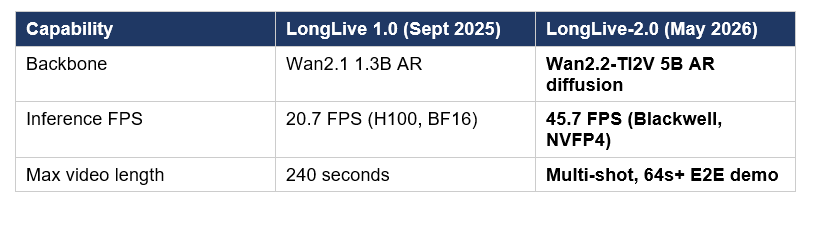
LongLive 1.0 was, in its author's own framing, a 're-engineering of an existing 1.3B AR video backbone with clever fixes added in.' It introduced attention sink, KV-recache for prompt switching, and streaming long-tuning. It was a model trick. A good one — accepted at ICLR 2026 — but a model trick.
LongLive-2.0 is a different beast. The team scaled the backbone from 1.3B to 5B parameters, switched from causal-only AR to AR diffusion, and rebuilt the precision stack from BF16 to native NVFP4. The 20.7 FPS → 45.7 FPS jump is roughly 2.2×, but that obscures the bigger shift: 1.0 ran on a single H100; 2.0 is co-designed for Blackwell. NVIDIA is making it clear which generation of hardware they expect serious long-video work to happen on.
6. Where LongLive-2.0 fits in the 2026 video landscape
Long-video AI in 2026 is no longer a homogenous field. It is split into three distinct camps, and LongLive-2.0 is firmly in one of them.
Camp 1 is closed-source product video. Seedance 2.0 (ByteDance) at Elo 1,269, OpenAI Sora 2, Google Veo 3.1, the leaked Gemini Omni. These are aimed at creators, generate up to ~15-30 seconds of high-fidelity output, and run on infrastructure you cannot see or touch. They win on quality and accessibility, lose on transparency and cost.
Camp 2 is open-source generative video for creators. Lightricks LTX-2, FLUX.2 Klein, Helios from ByteDance/Peking University. These are Apache-licensed or open-weight, run on consumer RTX or single H100 hardware, and prioritize creator workflows over research infrastructure. They win on accessibility for makers, lose on the cutting edge of long-horizon generation.
LongLive-2.0 is in Camp 3: research infrastructure for long, interactive, multi-shot video. The peers here are Self-Forcing variants, SANA-Video, and the long-horizon work coming out of academic labs. The point is not to ship a Veo competitor next month — it is to publish the training and inference recipe that everyone else's video model will eventually adopt. Six months from now, when the open-source video frontier moves again, expect NVFP4 and Balanced SP to show up in three or four other papers from different labs.
My honest take: this is the most important video AI release of May 2026, and almost nobody is going to use it directly. That sounds like a criticism. It is not. Infrastructure papers always look quiet on launch day and loud six months later, once the techniques they introduced are quietly powering the next round of consumer products.
7. How to access LongLive-2.0
Everything you need to run or read LongLive-2.0 is public as of May 23, 2026. NVIDIA shipped it as a full research release, not a paper-only teaser.
The four access points:
- Paper — arXiv 2605.18739, 'LongLive-2.0: An NVFP4 Parallel Infrastructure for Long Video Generation'
- Code — github.com/NVlabs/LongLive (LongLive 2.0 on main branch, 1.0 preserved in v1.0 branch)
- Model weights — Hugging Face: Efficient-Large-Model/LongLive-2.0-5B (BF16 checkpoints + few-step LoRA adapter)
- Project page — nvlabs.github.io/LongLive/LongLive2/ with demo videos and full benchmark tables
The model on Hugging Face is the base AR-trained Wan2.2-TI2V-5B generator plus a DMD-distilled few-step LoRA adapter. Inference loads the base generator, applies the LoRA modules, then loads the LoRA weights. License is the NVIDIA Open Model License Agreement, governed by NVIDIA API Trial Terms — read those before you ship a commercial product on top of it.
If you want to build experiments on top of the LongLive-2.0 release without writing a training pipeline from scratch, Build Fast with AI's 130+ open-source GenAI cookbooks cover the LangChain, diffusion fine-tuning, and multimodal evaluation patterns that port cleanly to any NVIDIA Open Model release — useful scaffolding for anyone running LongLive-2.0 alongside their own datasets.
8. The honest limitations
LongLive-2.0 is a strong research artifact. It is not a finished product, and four things are worth knowing before you commit a roadmap to it.
First: the Blackwell tax. The headline 45.7 FPS number is achieved on Blackwell GPUs (GB200) with native NVFP4 Tensor Core acceleration. If you are running A100, H100, or H200 hardware, you get the memory savings from quantization but not the kernel speedup — and you have to rely on sequence-parallel inference to bridge the gap. The team is honest about this; it is in the paper's limitations section. But it does mean the 'real' performance ceiling for most current production fleets is meaningfully lower than the headline.
Second: no head-to-head against closed frontier video. The paper is benchmarked against open-source baselines. It is not benchmarked against Sora 2, Veo 3.1, Seedance 2.0, or Gemini Omni — and the quality gap on creative-product evaluations is unknown. LongLive-2.0 is solving a different problem (long, interactive, multi-shot AR video at high throughput) and that scoping is fair, but it means you cannot use these numbers to argue 'LongLive beats Sora.'
Third: the model is 5B parameters. That is small by 2026 standards — Wan2.2-TI2V-5B is meaningfully smaller than the 14B+ models behind most closed-source video frontiers. The throughput and memory wins are partially structural (NVFP4, Balanced SP) and partially because the underlying model is compact. Scaling LongLive-2.0's recipe to a 14B or 22B backbone is left to future work, and there is no guarantee the gains hold linearly.
Fourth: it is research code, not a service. There is no NVIDIA NIM microservice for LongLive-2.0 yet, no managed endpoint, no Cosmos-style API. If you want frontier video generation in a product today, you are still routing to the closed-source video stack we covered in the May 20 news roundup — Gemini Omni, Seedance, Veo. LongLive-2.0 is what those products will probably look like under the hood twelve months from now.
9. Frequently Asked Questions
What is LongLive-2.0?
LongLive-2.0 is an NVFP4-based parallel infrastructure for long video generation, released by NVIDIA Research on May 13, 2026. It combines sequence-parallel autoregressive training (Balanced SP), end-to-end NVFP4 4-bit precision, and asynchronous streaming VAE decoding to achieve 45.7 FPS inference on Blackwell GPUs with the LongLive-2.0-5B model. The system is the second-generation evolution of the original LongLive paper accepted at ICLR 2026.
What does LongLive mean in the AI context?
LongLive is the name of NVIDIA Research's project line for real-time interactive long video generation. The name signals the core technical goal: keeping a video generation model 'alive' (coherent, responsive, and high quality) across long durations rather than collapsing after a few seconds. It is unrelated to song lyrics or the unrelated 'efficient large model' phrasing that sometimes shows up alongside it in search results.
How does NVFP4 work in LongLive-2.0?
NVFP4 is NVIDIA's 4-bit floating-point format, natively accelerated by Blackwell Tensor Cores. LongLive-2.0 uses NVFP4 end-to-end: for AR training, for DMD step distillation, for W4A4 inference (weights and activations both in 4-bit), and for the KV cache. This is the first published end-to-end NVFP4 training and inference system for long video generation, cutting GPU memory from ~29.7 GB to 19.4 GB and accelerating GEMM operations whose share of compute grows with video length.
How fast is LongLive-2.0?
LongLive-2.0-5B achieves 45.7 FPS inference with the 2-step variant on Blackwell GPUs, and 29.7 FPS with the 4-step variant. End-to-end latency for a 64-second video is approximately 36.3 seconds, which means the model generates output faster than the video plays back. Training is 2.15× faster than the BF16 baseline pipeline, and inference is 1.84× faster overall.
Is LongLive-2.0 open source?
Yes, with caveats. The code is public on GitHub at NVlabs/LongLive, the paper is on arXiv, and model weights are on Hugging Face under the NVIDIA Open Model License Agreement. That license is more permissive than a fully proprietary release but is not Apache 2.0 — it is governed by the NVIDIA API Trial Terms of Service. Review the license before deploying commercially.
What is the difference between LongLive 1.0 and LongLive-2.0?
LongLive 1.0 (September 2025) was a 1.3B AR video model built on Wan2.1, running at 20.7 FPS on H100 with BF16 precision. LongLive-2.0 (May 2026) is a 5B AR diffusion model built on Wan2.2-TI2V, running at 45.7 FPS on Blackwell with end-to-end NVFP4 precision, Balanced SP training, and a clean direct-AR training pipeline that eliminates the multi-stage ODE-and-DMD chain. The 2.0 release also adds multi-shot generation and asynchronous streaming VAE decoding.
What GPU do you need to run LongLive-2.0?
Native NVFP4 acceleration requires Blackwell GPUs (GB200 and successors) with the latest-generation Tensor Cores. On non-Blackwell GPUs (A100, H100, H200), LongLive-2.0 still runs and benefits from NVFP4 memory savings, but does not get the kernel-level throughput boost — and falls back to sequence-parallel inference to match Blackwell speeds. For research and reproduction, H100 is sufficient. For production-grade real-time generation, Blackwell is the target.
Does LongLive-2.0 generate sound or just video?
LongLive-2.0 is a visual-only video generation system. It does not generate synchronized audio. For synchronized audio-video generation, the open-source alternatives are Lightricks LTX-2 (which produces video and audio in a single forward pass) and ByteDance Seedance 2.0 (which accepts multi-modal reference inputs). NVIDIA has separate work on speech and audio AI through the NeMo framework — see the Build Fast with AI guide on NeMo for that side of the stack.
Recommended Blogs
- NVIDIA AI Models 2026: Full Guide, Rankings & Comparisons
- NVIDIA Nemotron Nano 3 Omni (2026)
- Mastering Speech AI with NVIDIA NeMo: A Hands-On Guide
- Seedance 2.0 Review: ByteDance Tops AI Video in 2026
- Gemini Omni: Google's Leaked AI Video Model Explained
- 12+ AI Models in March 2026: The Week That Changed AI
- AI News Today - May 20, 2026: 14 Biggest Stories
References
- Yukang Chen et al. — LongLive-2.0: An NVFP4 Parallel Infrastructure for Long Video Generation (arXiv 2605.18739)
- arXiv (HTML) — LongLive-2.0 full paper with experiments and ablations
- NVlabs/LongLive — Official GitHub repository (LongLive 2.0 + 1.0)
- Hugging Face — Efficient-Large-Model/LongLive-2.0-5B model weights
- NVIDIA Research — LongLive 2.0 project page
- NVIDIA Research — LongLive 1.0 publication (Efficient AI Lab)
- Hugging Face Papers — LongLive-2.0 discussion thread

