



GLM-5.3-Flash Review: Benchmarks, Price & Is It Worth It? (2026)
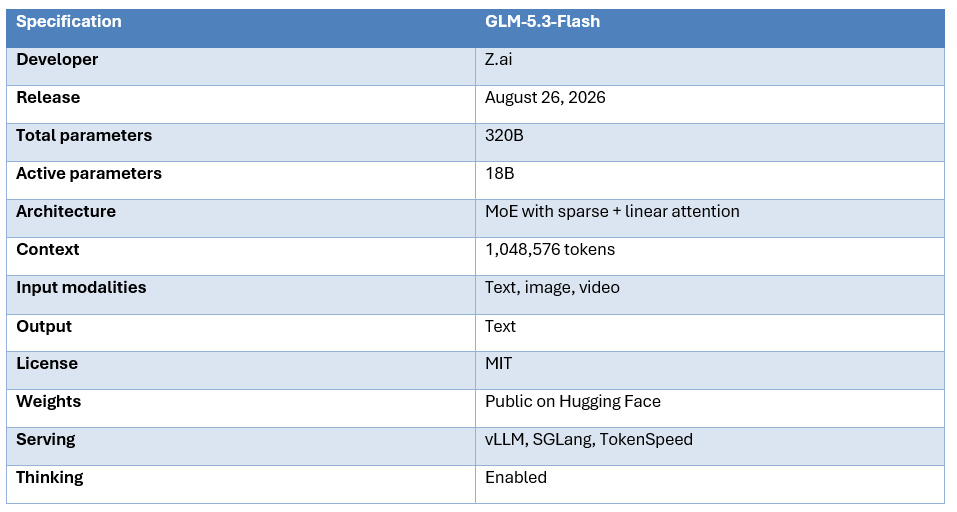
GLM-5.3-Flash is the model that finally solved the mystery behind Ox Alpha. Z.ai officially released it on August 26, 2026, revealing that the anonymous model that had appeared through OpenRouter and OpenCode was its new 320B-parameter GLM-5.3-Flash. The model is the first natively multimodal member of the GLM-5 series, with text, image and video input, 18B active parameters, a 1M-token context window and open weights under the MIT license.
The interesting part is not simply the parameter count. GLM-5.3-Flash is designed around efficiency. Z.ai says it uses a newly trained base with a hybrid sparse and linear attention architecture, Manifold-Constrained Hyper-Connections and a 30T-token multimodal pretraining corpus. The goal is to approach frontier coding and agent performance while costing far less to serve.
The launch numbers are aggressive. Z.ai reports 84.3 on Terminal-Bench 2.1, 63.4 on DeepSWE v1.1, 48.8 on AutomationBench, 78.4 on Toolathlon Verified and 55.3 on Humanity's Last Exam with tools. Artificial Analysis independently puts the model at 57 on its Intelligence Index, with roughly 50 tokens per second output and a $0.15 input, $0.50 output rate at list price.
QUICK ANSWER
GLM-5.3-Flash is worth testing if you want near-frontier coding and agentic capability without paying frontier-model prices. It is a 320B total, 18B-active MoE with 1M context, native image and video input, open MIT weights and support for vLLM, SGLang and TokenSpeed.
The current list price is $0.15 per million input tokens, $0.50 per million output tokens and $0.03 per million cached input tokens. Z.ai is running a 50% launch promotion through September 9, 2026, reducing those rates to $0.075, $0.25 and $0.015 during the promotion.
My verdict: this is one of the strongest value-oriented open models released in August. It is not the fastest model in independent measurements, and it can be verbose, but the combination of coding quality, multimodality, 1M context, open weights and pricing is unusually strong.
1. What Is GLM-5.3-Flash?
GLM-5.3-Flash is Z.ai's new efficient flagship in the GLM-5 family. Unlike the text-only GLM-5.3 released earlier in August, Flash is natively multimodal and was built from a newly trained base model. Z.ai describes it as a hybrid sparse and linear attention architecture designed to reduce long-context serving cost while maintaining strong reasoning and agent performance.
The name 'Flash' should not fool you into thinking this is a tiny model. The total capacity is enormous. Flash refers to the model's efficiency profile, especially the amount of active computation and the serving-oriented architecture.
2. GLM-5.3-Flash Is Also the Ox Alpha Model
The Ox Alpha connection is no longer speculation. Z.ai's release and independent coverage identify GLM-5.3-Flash as the model that had been tested anonymously under the Ox Alpha name. That matters because Ox Alpha had already attracted attention for frontier-like coding, long context and image or video capability while the provider was unclear.
The reveal changes the trust question. Instead of an unidentified model receiving private code through an unknown operator, developers now have a named provider, public model weights and a published license. The anonymous Ox Alpha story is useful historical context, but from August 26 onward the model to evaluate is the official GLM-5.3-Flash release.
For the full backstory, read our Ox Alpha Review.
3. Architecture: Why 18B Active Is the Important Number
The 320B total parameter number describes the model's full capacity, not the amount of computation used for every token. GLM-5.3-Flash activates only about 18B parameters per token through sparse routing. That lets the model retain a large parameter pool while keeping per-token compute substantially below a 320B dense model.
Z.ai combines sparse and linear attention to reduce the cost of processing long sequences. The model also uses Manifold-Constrained Hyper-Connections and a 30T-token multimodal pretraining corpus. Together, these changes are intended to improve scaling efficiency rather than simply increase raw parameter count.
This architecture is a particularly good fit for agents. Long coding sessions create large context windows and repeated model calls. A model that keeps large capacity while limiting active computation can provide a better balance between quality and inference cost.
4. GLM-5.3-Flash Benchmarks
Z.ai's published scorecard puts GLM-5.3-Flash close to Claude Opus 4.8 on some coding benchmarks and well above GLM-5.2 on several agentic tasks. It reports 84.3 on Terminal-Bench 2.1, 63.4 on DeepSWE v1.1, 48.8 on AutomationBench v1.0.6, 78.4 on Toolathlon Verified and 55.3 on Humanity's Last Exam with tools.
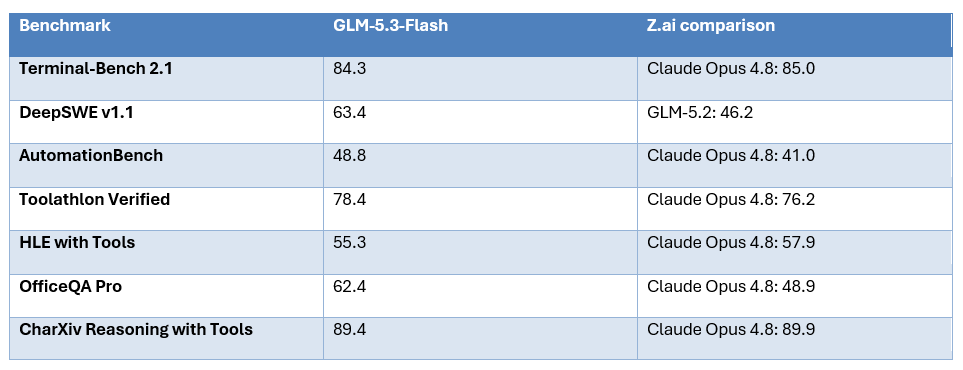
These results are impressive, but the source matters. Most of the table is Z.ai's own evaluation, with selected comparison models and settings. The right conclusion is that Flash is demonstrably competitive on several demanding tasks, not that one launch table proves it is globally better than Claude, GPT or Gemini.
5. Independent Benchmark Check
Artificial Analysis independently scores GLM-5.3-Flash at 57 on its Intelligence Index. Its current measurements put output speed around 50 tokens per second and describe the model as slower than average and very verbose. The platform lists $0.15 input and $0.50 output per million tokens at list price.
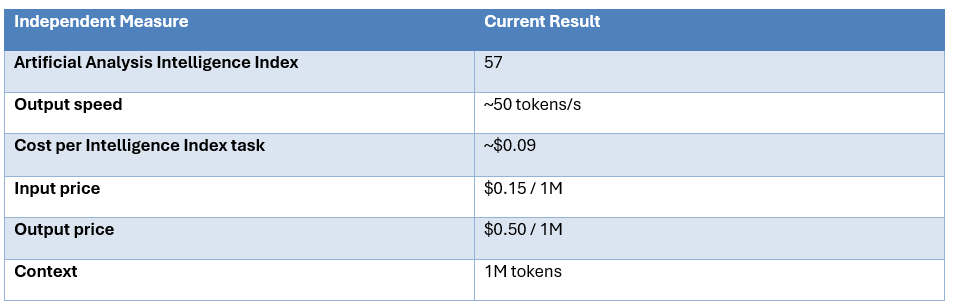
This independent view is important because it adds the weakness that vendor launch tables can hide. GLM-5.3-Flash is not the fastest model simply because it is called Flash. If your application is latency-sensitive, test time-to-first-token and sustained output speed, not only benchmark accuracy.
6. Price: The Real Flash Advantage
The standard list price is $0.15 per million input tokens, $0.50 per million output tokens and $0.03 per million cached input tokens. Z.ai's launch promotion cuts those rates by half through September 9, 2026.
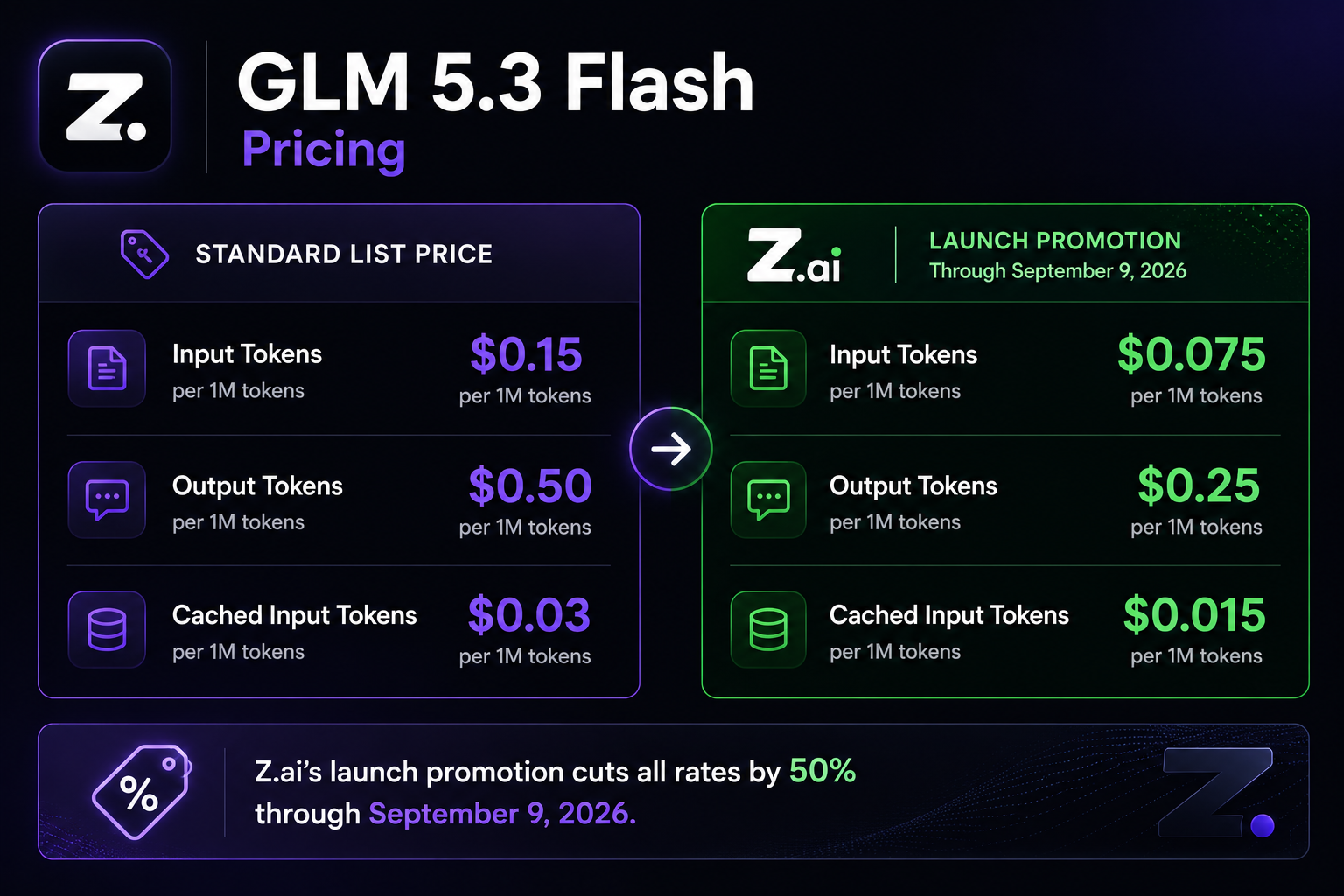
This price changes how you can architect an agent. Instead of sending every step to a premium frontier model, Flash can handle routine coding, tool calls, context processing and visual inspection, while the hardest decisions are routed to a more expensive model.
That is the exact logic behind our Model Routing for AI Coding Agents guide.
7. How Much Cheaper Is Flash Than GLM-5.3?
Current third-party pricing trackers put the earlier GLM-5.3 around $1.40 per million input tokens and $4.40 per million output tokens, compared with $0.15 and $0.50 for Flash at list price. On a roughly 3:1 input-to-output workload, Flash is around 6.5 times cheaper. The exact ratio changes with cache usage and workload mix, but the difference is large.
That makes the two models complementary. GLM-5.3 can remain the heavyweight choice for the hardest reasoning, while Flash becomes the default worker for tasks where frontier capability is unnecessary.
For a wider value comparison, see our Best Open Source AI Models August 2026.
8. Coding: Is GLM-5.3-Flash Actually Good?
Yes. Coding is probably the strongest reason to use it. Terminal-Bench 2.1 at 84.3 is close to Claude Opus 4.8's 85.0 in Z.ai's table, while DeepSWE at 63.4 is far above GLM-5.2's 46.2. Z.ai also shows Flash ahead of Opus 4.8 on AutomationBench and Toolathlon Verified.
The model supports tool use and computer-oriented workflows, making it much more useful for agents than a pure code-completion system. It can reason over a repository, inspect a visual state and use tools within the same workflow.
For the broader coding-model field, read our Best Open Source AI Models August 2026.
9. Multimodal: The Feature Original GLM-5.3 Does Not Have
GLM-5.3-Flash is the first natively multimodal GLM-5 model. It accepts text, images and video, expanding the model beyond standard code and text workflows. Z.ai reports strong scores on OfficeQA Pro, CharXiv Reasoning, Chartography, BabyVision, MVBench and MMVU.
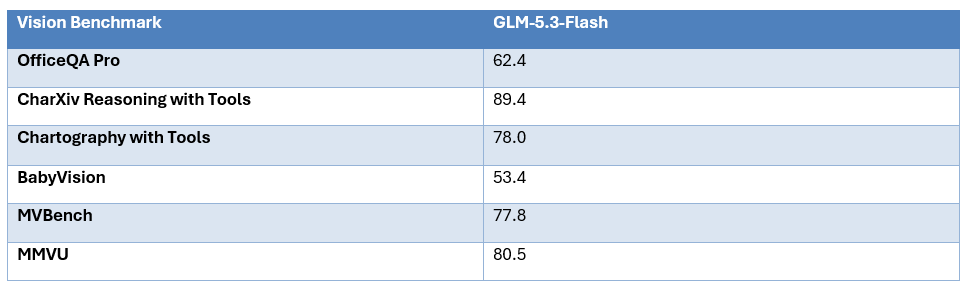
For developers, the practical advantage is combining code with visual evidence. A web agent can inspect a screenshot, understand the page and modify code. A support workflow can inspect an image before responding. A document pipeline can combine charts and text without a separate vision model.
10. 1M Context: Useful, But Do Not Abuse It
GLM-5.3-Flash supports a 1,048,576-token context window. That is useful for large repositories, long transcripts, document collections and long-running agent traces.
But a million-token window is not a substitute for good context management. Dumping every file or transcript into the prompt can increase memory use and distract the model. Retrieval, compression and task-specific context selection still matter.
Our What Is Context Engineering? Complete Guide (2026) covers this problem in depth.
11. Open Weights and Local Deployment
Z.ai has released the GLM-5.3-Flash weights on Hugging Face under the MIT license. The official model material lists Transformers support, while Z.ai says local inference currently works with SGLang, vLLM and TokenSpeed.
The catch is memory. A 320B total model is still a serious server-class checkpoint even though only 18B parameters are active for each token. The weights, KV cache and runtime buffers all consume memory. So '18B active' should not be interpreted as 'runs comfortably on an 18B-class GPU'.
The open release nevertheless changes the trust and deployment equation. Developers can inspect the weights, run their own infrastructure and decide where sensitive prompts and code are processed rather than relying on an anonymous hosted endpoint.
12. GLM-5.3-Flash vs GLM-5.3
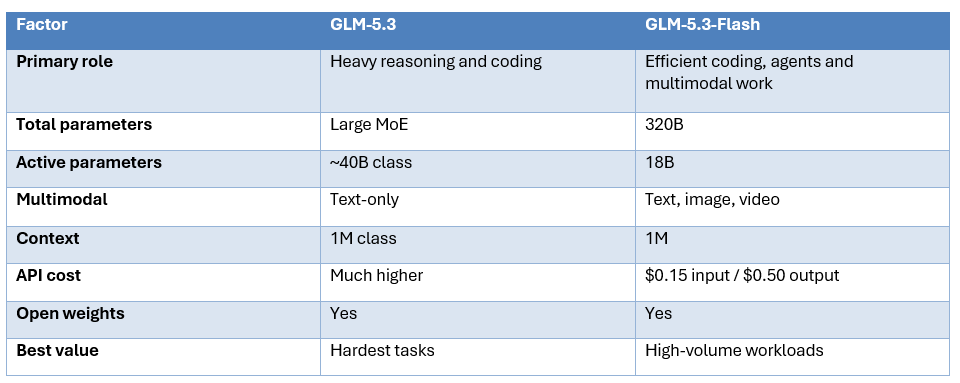
The strategic distinction is simple: GLM-5.3 is the heavyweight, Flash is the workhorse. That makes Flash more economically useful for many production applications even if the full GLM-5.3 is stronger on some difficult tasks.
13. GLM-5.3-Flash vs Claude Opus 4.8
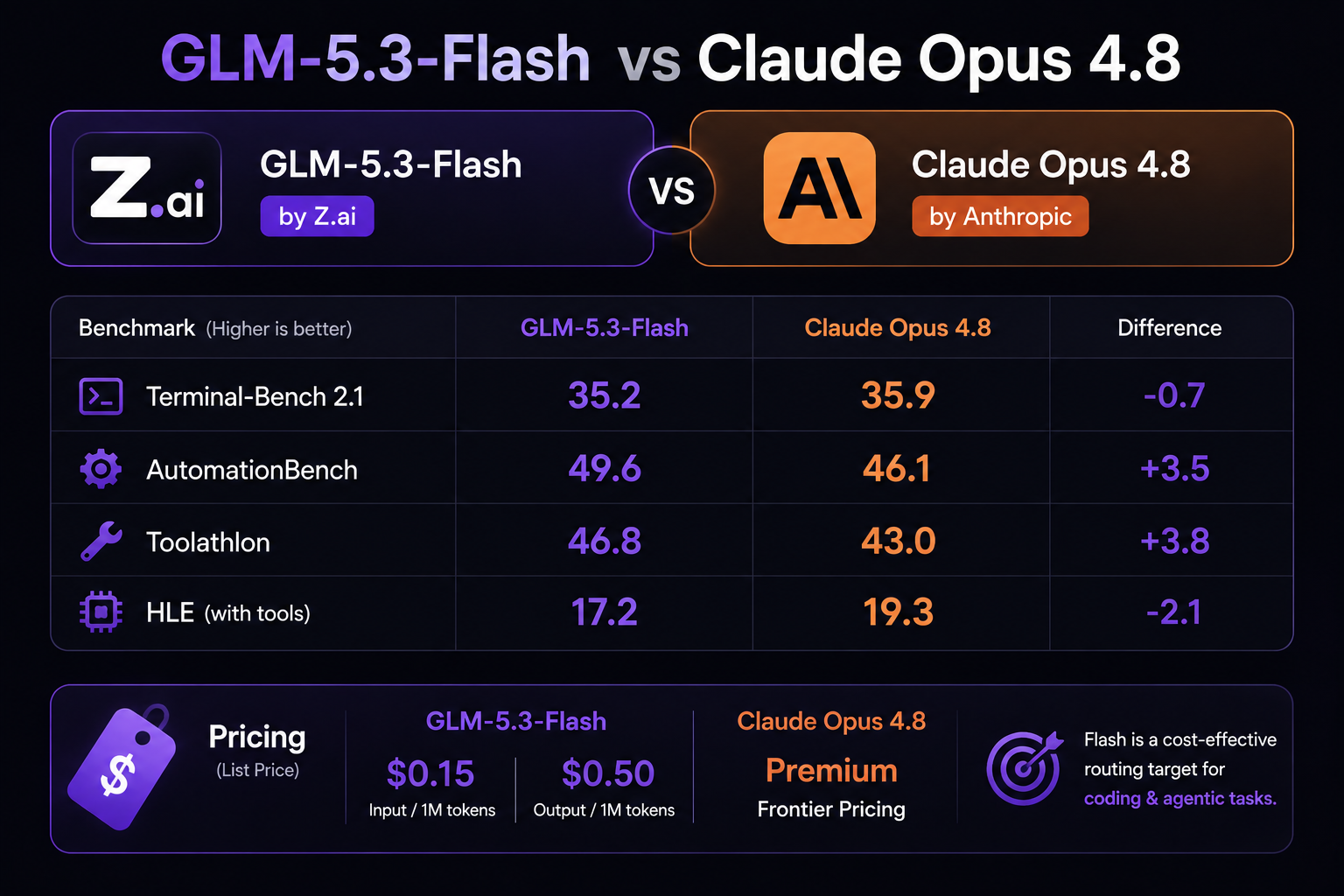
Z.ai's published table shows Flash within 0.7 points of Opus 4.8 on Terminal-Bench 2.1, ahead on AutomationBench and Toolathlon, and behind on HLE with tools. That is a credible sign of strong coding and agent capability, but it is not enough to claim overall superiority.
The price difference is more straightforward. Flash's $0.15 input and $0.50 output list price is far below premium frontier pricing. That makes Flash especially attractive as a routing target, where a product can reserve expensive models for the hardest requests.
14. Biggest Weaknesses
- Independent measurements describe it as slower than average, so the Flash name does not mean maximum output speed.
- It can be very verbose, increasing output-token usage and making some agent traces harder to read.
- The 320B total model remains expensive to self-host compared with smaller open models.
- The strongest benchmark comparisons are vendor-reported and should be validated against your own tasks.
- The model is new, so long-term production reliability and ecosystem maturity are still being established.
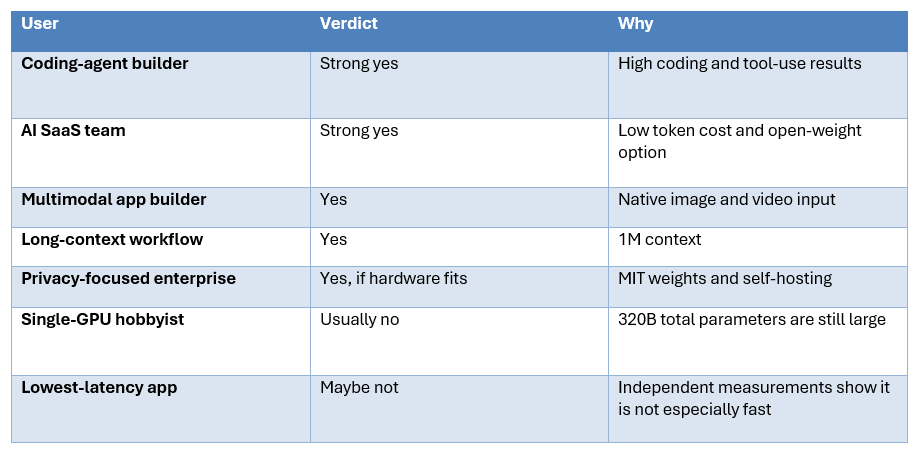
15. Who Should Use GLM-5.3-Flash?
16. Is GLM-5.3-Flash Worth It?
Yes, and the value proposition is probably the most important part of the release. You get a 320B-capacity model with only 18B active parameters, 1M context, native vision and video, strong coding and agent benchmarks, public MIT weights and an API price low enough to compete with the efficiency tier.
The biggest mistake would be treating Flash as a universal replacement for every frontier model. It is better understood as a high-capability worker. It can handle a large share of routine coding, tool use, multimodal inspection and reasoning, while a more expensive model takes the genuinely difficult cases.
The launch promotion makes the current price especially attractive, but it has an expiry date. Any production cost model should be based on the $0.15 input and $0.50 output list rates, not on the temporary discount.
17. Final Verdict
GLM-5.3-Flash is one of the most important open-weight value releases of August 2026. The combination of 320B total capacity, 18B active computation, multimodality and 1M context is technically ambitious.
The coding and agent numbers are strong. Z.ai reports 84.3 Terminal-Bench, 63.4 DeepSWE, 48.8 AutomationBench and 78.4 Toolathlon Verified, while Artificial Analysis independently gives it a 57 Intelligence Index score.
The price is even more disruptive. At $0.15 input and $0.50 output per million tokens, Flash is dramatically cheaper than heavyweight frontier models. The temporary 50% launch discount makes the current window even cheaper.
The catch is speed and infrastructure. Artificial Analysis describes the model as slower than average and very verbose, while the 320B total model remains a serious self-hosting project.
My verdict: GLM-5.3-Flash is worth using, especially for coding agents, multimodal workflows and high-volume AI products. It is not the undisputed best model in the world, and it should not be marketed that way. The smarter claim is that it is one of the best combinations of frontier-like capability, open weights and low cost currently available.
A Practical Cost Example for AI Agents
Consider an agent that reads 80,000 input tokens, produces 8,000 output tokens and repeats that cycle 100 times during a task. At list pricing, the input side is about $1.20 and the output side about $0.40, for roughly $1.60 before cache discounts and any other platform fees. Under the temporary launch pricing, the same arithmetic is about $0.80. The exact bill depends on the provider's tokenization and how much input is cached, but this illustrates why a model at Flash pricing can change agent architecture. You can afford more model calls, more verification and more multimodal inspection before the economics become painful.
Why Verbosity Matters
The verbosity finding from independent evaluation deserves more attention than it gets. If a model routinely returns unnecessarily long answers, the problem is not only readability. Output tokens directly affect cost, and long agent traces can consume context faster. A practical production setup should therefore constrain response formats wherever possible, especially for tool calls, JSON, code diffs and structured extraction. A model that is slightly less capable but consistently concise can sometimes be cheaper in production than a marginally stronger model that generates much more text.
How We Would Use It
For a coding product, a sensible architecture would place GLM-5.3-Flash in the worker tier. It can handle repository search, code explanation, routine fixes, screenshot inspection, tool execution and many verification steps. Escalate difficult architecture decisions or unusually ambiguous debugging to a premium reasoning model. This gives you a quality floor without paying frontier prices for every token. The approach is especially attractive because Flash is open-weight, so a team can later move selected workloads from API inference to self-hosted infrastructure as utilization grows.
Frequently Asked Questions
What is GLM-5.3-Flash?
GLM-5.3-Flash is Z.ai's 320B-parameter, 18B-active multimodal MoE model released on August 26, 2026 with a 1M-token context window and MIT-licensed weights.
Is GLM-5.3-Flash the same as Ox Alpha?
Yes. Z.ai's official release and independent coverage identify GLM-5.3-Flash as the model previously tested anonymously as Ox Alpha.
How good is GLM-5.3-Flash for coding?
Z.ai reports 84.3 on Terminal-Bench 2.1 and 63.4 on DeepSWE v1.1, putting it close to or above several frontier comparison models on its published coding table.
How much does GLM-5.3-Flash cost?
The list price is $0.15 per million input tokens and $0.50 per million output tokens, with $0.03 per million cached input tokens. A 50% launch promotion runs through September 9, 2026.
What is the context window?
GLM-5.3-Flash supports a 1,048,576-token context window.
Is GLM-5.3-Flash multimodal?
Yes. It accepts text, images and video.
Can I run GLM-5.3-Flash locally?
Yes. The weights are public under the MIT license and Z.ai lists vLLM, SGLang and TokenSpeed support. The main limitation is hardware because the model has 320B total parameters.
Is GLM-5.3-Flash faster than other frontier models?
Not necessarily. Artificial Analysis measures output around 50 tokens per second and describes it as slower than average.
Is GLM-5.3-Flash better than GLM-5.3?
Flash is more efficient and adds multimodality, while the full GLM-5.3 remains the heavyweight option for the hardest tasks. They are complementary rather than simple replacements.
Is GLM-5.3-Flash worth using?
Yes. Its combination of coding performance, multimodality, 1M context, public weights and low API pricing makes it one of the strongest value models to test in late August 2026.
Recommended Blogs
- Ox Alpha Review: The Mystery AI Model With 1M Context (2026)
- Qwen3.8-Flash-Next Review: Benchmarks, Cost & Is It Worth It? (2026)
- Best Open Source AI Models August 2026: Full Collection
- 100 Best DeepSeek Prompts 2026 (Copy-Paste)
- DeepSeek V4 Flash Vision Exp Review: Benchmarks & Price
- Gemini 3.7 Flash Is Changing AI Coding Economics: Speed vs Intelligence vs Cost
- What Is Context Engineering? Complete Guide (2026)
- How to Use LangGraph for Multi-Agent Systems (2026)
Resources & Community
Join our community of 70,000+ AI enthusiasts and learn to build powerful AI applications. Whether you're a beginner or an experienced developer, Build Fast with AI helps you understand and implement AI in your projects.
- Website - buildfastwithai.com
- LinkedIn - Build Fast with AI
- Instagram - @buildfastwithai
- Founder Twitter - @satvikps
- Twitter - @BuildFastWithAI
Agentic AI Launchpad 2026
A structured 6-week cohort program that takes you from AI basics to building and deploying real-world agentic AI systems. Includes live sessions, expert mentorship, project reviews and a builder community network.
Ready to go from learning to building? Join the next cohort: Agentic AI Launchpad 2026
Free AI Resources
Access free tools, workshops and micro-learning to keep building.

