



Fugu Ultra Review: 73.7% SWE-Bench Pro, Honestly Assessed
Sakana AI built a model that beats Claude Opus 4.8 at coding without training a model at all. Fugu Ultra scores 73.7% on SWE-Bench Pro against Opus 4.8's 69.2%, GPT-5.5's 58.6% and Gemini 3.1 Pro's 54.2%, and it does it by orchestrating those same models behind a single API rather than competing with them.
That is either the smartest architecture decision of 2026 or an elaborate way of charging you a premium to call models you could call yourself. After digging through the published benchmarks, the technical report, and what independent testers found in the first 24 hours, my answer is: genuinely both, depending entirely on what you are building.
Version note before we start: the current shipping model is fugu-ultra-v1.0, renamed from the original fugu-ultra-20260615 identifier. There is no Fugu Ultra v1.1 as of this writing. The only changes since the June 22, 2026 launch have been a pricing correction and the separate Fugu-Cyber endpoint released July 21. If you have seen a v1.1 mentioned, it is not something Sakana has published.
What Is Fugu Ultra?
Fugu Ultra is Sakana AI's high-accuracy orchestration model, released June 22, 2026, that coordinates a pool of frontier models behind a single OpenAI-compatible API rather than being a single trained model itself. It is the premium tier above the standard Fugu, tuned for complex multi-step work like research, security analysis and repository-scale coding instead of low-latency chat.
The mechanism is what makes it interesting. When you send a request, Fugu Ultra decides whether to answer directly or assemble a team of expert models, then manages delegation, verification and synthesis internally. Sakana's TRINITY and Conductor research frameworks assign roles across that pool, splitting work into Thinker, Worker and Verifier duties. The coordination itself is learned rather than hardcoded as if-else routing rules, which is the genuine research contribution here.
Table 1: Fugu Ultra at a glance
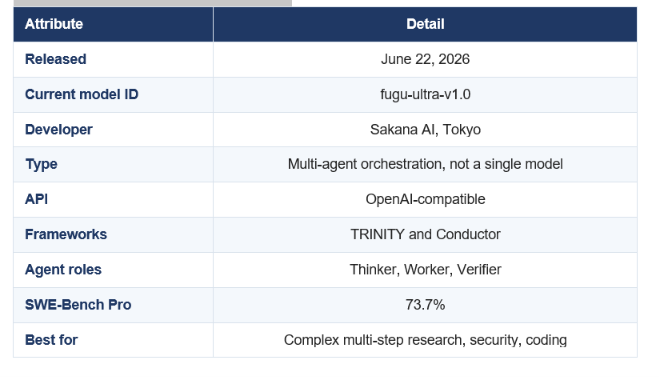
Named models in the orchestrated pool include GPT-5.5, Gemini 3.1 Pro and Claude Opus 4.8.
Fugu Ultra Benchmarks: The Numbers
Fugu Ultra leads every publicly accessible model on SWE-Bench Pro at 73.7%, and Sakana reports it best on 8 of the 11 rows in its published benchmark table. On the algorithmic side it lands in the low-to-mid 90s on LiveCodeBench Pro, and around 82 on TerminalBench 2.1.
Table 2: SWE-Bench Pro comparison
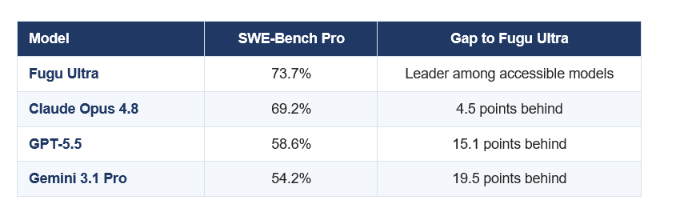
Scores are Sakana's own reporting. Baselines are provider-reported rather than independently re-run under identical conditions.
Three caveats sit under those numbers, and all three matter. The benchmarks were run with the mini-swe-agent harness, and the scaffold you wrap around a model materially changes its score, so a different harness produces different results. The competitor baselines are provider-reported figures rather than head-to-head reruns. And the scores are Sakana's own, with no independent confirmation at the time of writing.
My read on the benchmark table: the 4.5-point lead over Opus 4.8 is real but narrow enough that harness choice could account for a chunk of it. The 15-point lead over GPT-5.5 is large enough to survive most methodological quibbles. Treat the direction as credible and the precise margins as soft.
The Missing Model: Why Fable 5 Is Not in the Table
Claude Fable 5, the actual leader on SWE-Bench Pro at 80.3%, is absent from Sakana's comparison because export controls prevent Fugu from including it in the orchestrated pool. That single fact reframes the entire benchmark story, and it is the most important thing to understand about this model.
Anthropic's June 2026 export controls on Fable 5 and Mythos Preview restricted access for certain regions and providers. Sakana, based in Tokyo, cannot route to Fable 5, so it cannot benchmark against a model it cannot call. The honest framing of Fugu Ultra's achievement is therefore: the best score among models you can actually access through this API, not the best score available in the world.
Table 3: The full picture including restricted models
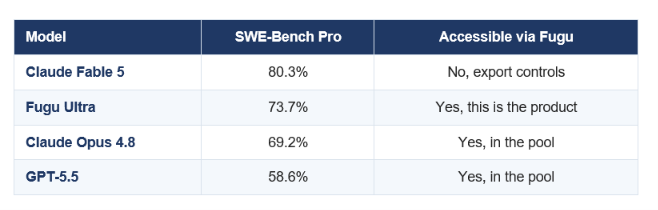
Fugu Ultra trails Fable 5 by 6.6 points. It leads everything Sakana is permitted to orchestrate.
THE STRATEGIC POINT MOST COVERAGE MISSES
Orchestration is not just a performance play, it is a resilience play. A swappable pool means that when one provider restricts access, gets rate-limited, or goes down, the system routes around it. In a year where export controls reshaped who can use which model, that architectural choice looks less like a clever trick and more like infrastructure planning.
We covered the geopolitics of this in depth in our Sakana Fugu review on routing around export controls, which is the essential background for understanding why this company built an orchestrator instead of a model.
How the Orchestration Actually Works
Fugu Ultra assigns Thinker, Worker and Verifier roles across its model pool using Sakana's TRINITY and Conductor frameworks, with the coordination learned during training rather than written as fixed rules. You send one API call and receive one response, with all the delegation and synthesis hidden behind that interface.
The Verifier role is the part I find most defensible. Having one model check another's output is a meaningfully better design than trusting a single model's first answer, and it is the same adversarial-verification principle that makes Sakana's Fugu-Cyber security scanner credible. When a system disagrees with itself and resolves the disagreement, the output tends to be more reliable than any single pass.
The trade-off is latency and cost. Multiple models working in sequence on a complex task takes real time, which is exactly why Sakana splits the lineup: standard Fugu for latency-sensitive everyday work, Fugu Ultra for accuracy on hard problems where waiting is acceptable. If you route a simple chat request to Ultra, you are paying premium prices and waiting longer for an answer a cheap model would have handled.
Sakana applied the same architecture to security with strong results. Our Fugu-Cyber review covers how the verification panel works when the stakes are vulnerability detection rather than code generation.
What Independent Testers Found
Within 24 hours of launch, independent testers reported a sharp gap between the benchmark claims and real-world use. Shader and interactive-scene tests on Fugu Ultra at high effort took around 30 minutes to complete, and testers described the output as fine but not matching Claude Fable 5 in practice.
That thirty-minute figure deserves attention if you are planning an interactive workflow. A benchmark measures whether a task eventually completes correctly. It does not measure whether you are willing to sit through the wait. For batch work, an overnight refactor, or a research task you kick off and return to, thirty minutes is irrelevant. For a developer iterating on a shader in a creative loop, it is disqualifying.
The pattern I keep seeing with orchestration models: they win on tasks with a verifiable end state and lose on tasks that need fast feedback. Fugu Ultra is built for the first category, and the early testing confirms it. Judge it on a long agentic job, not on a quick iteration.
The other consistent finding is more philosophical. One tester noted that Fugu Ultra beat Mythos on a benchmark and then routed the actual work to GPT-5.5, which leads directly to the biggest open question about this product.
The Transparency Problem
You do not get told which model answered your request. Sakana does not fully enumerate the composition of the orchestrated pool or expose which member handled a given call, and for some teams that is a dealbreaker regardless of the benchmark scores.
Consider what this means practically. If your compliance team needs to know which providers process your data, an undisclosed pool is a problem. If your prompts are tuned for a specific model's quirks, silent routing undermines them. If you are debugging why quality dropped last Tuesday, you cannot check whether the router changed its mind. And if the pool is quietly rebalanced toward cheaper models over time, you would have no way to detect it.
- Compliance and data residency: you cannot document what you cannot see.
- Prompt portability: prompts tuned to one model may hit another without warning.
- Debugging: quality regressions are hard to trace to a cause.
- Vendor risk: pool composition can shift without a changelog you can audit.
My contrarian take: the transparency gap is the actual product, not a flaw in it. Sakana's pitch is that you stop caring which model runs your task, the same way you stopped caring which server handles your web request. That abstraction is genuinely valuable, and it is also exactly what a regulated enterprise cannot accept. Both statements are true, and which one governs depends on your industry, not on the benchmarks.
Fugu vs Fugu Ultra vs Fugu-Cyber
Sakana now ships three orchestration products, each tuned for a different job. Picking the wrong one is the most common way to waste money on this platform.
Table 4: The Sakana Fugu lineup
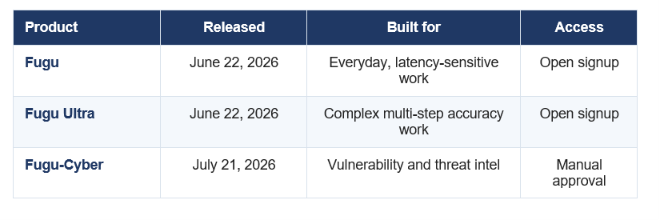
Fugu-Cyber scores 86.9% on CyberGym and 72.1% on CTI-REALM, and requires an application with a stated use case.
Simple selection rule: use Fugu when speed matters, Ultra when correctness matters more than latency, and Cyber only for security analysis where you have a human reviewer to verify findings. Running Ultra on everything is the expensive mistake.
Pricing and Where to Access It
Fugu Ultra is available through Sakana's own console and a growing set of third-party gateways, including the Vercel AI Gateway. Because the API is OpenAI-compatible, swapping it into an existing codebase is usually a base-URL and model-name change rather than a rewrite.
Pricing runs through subscription tiers on Sakana's console, with pay-as-you-go enterprise options, and Fugu Ultra sits at the premium end where individual complex messages can reach around $10 each. Sakana also corrected pricing for fugu-ultra-v1.0 after launch, so verify the current rate in the console rather than trusting any figure in an article, including this one. One availability note that catches people out: EU access has been restricted, so confirm your region before planning a deployment.
BUDGET THE WAY THE ARCHITECTURE WORKS
You are paying for several frontier models to work on one task, plus the orchestration layer. That is why Ultra costs what it does. The economics only make sense when a wrong answer is expensive: a bad security patch, a failed migration, a research conclusion someone acts on. For routine generation, the standard Fugu tier or a direct call to a cheaper model wins on cost every time.
Who Should Use Fugu Ultra
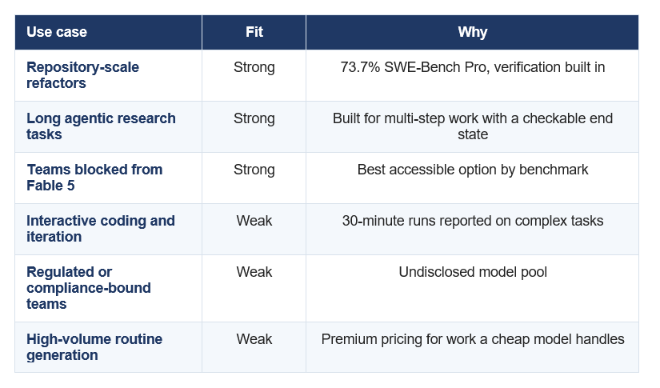
Use Fugu Ultra for long-horizon, correctness-critical work where you cannot access Claude Fable 5 and where a 30-minute run is acceptable. Avoid it for interactive iteration, for compliance environments that require knowing your model provider, and for routine generation where a cheaper direct call does the job.
Table 5: Fit by use case
EU availability has been restricted. Confirm regional access before committing to a deployment.
Verdict, 8 out of 10: Fugu Ultra is the strongest coding model most teams can actually access, and the orchestration approach is a genuinely smart answer to a fragmenting model market. I dock it for self-reported benchmarks, the undisclosed pool, latency on complex tasks, and pricing that punishes casual use. If you are choosing between Ultra and a direct Opus 4.8 call for hard repository work, Ultra earns the premium. For anything else, look down the lineup first.
For how Fugu Ultra compares against the wider field of coding models, see our GLM-5.2 vs Claude vs GPT-5.6 vs Kimi coding comparison and the July 2026 model ranking.
Frequently Asked Questions
Q: What is Fugu Ultra?
Fugu Ultra is Sakana AI's high-accuracy orchestration model, released June 22, 2026, that coordinates a pool of frontier models behind a single OpenAI-compatible API. It is not a single trained model. It assigns Thinker, Worker and Verifier roles across models including GPT-5.5, Gemini 3.1 Pro and Claude Opus 4.8, using the TRINITY and Conductor frameworks.
Q: How good is Fugu Ultra on SWE-Bench Pro?
Fugu Ultra scores 73.7% on SWE-Bench Pro, ahead of Claude Opus 4.8 at 69.2%, GPT-5.5 at 58.6% and Gemini 3.1 Pro at 54.2%. Sakana reports it best on 8 of 11 rows in its published table. The scores are self-reported and were run with the mini-swe-agent harness, which affects results.
Q: Is Fugu Ultra better than Claude Opus 4.8?
On SWE-Bench Pro, yes, by 4.5 points (73.7% against 69.2%). That margin is narrow enough that benchmark harness choice could account for part of it, and the scores are Sakana's own. Claude Fable 5 still leads the benchmark outright at 80.3%, but export controls keep it out of Fugu's pool and comparison.
Q: How much does Fugu Ultra cost?
Fugu Ultra is the premium tier of Sakana's lineup, sold through console subscription tiers with pay-as-you-go enterprise options, where individual complex messages can reach around $10. Sakana corrected pricing for fugu-ultra-v1.0 after launch, so check the current rate in the console before budgeting.
Q: What models does Fugu Ultra use?
Named models in the orchestrated pool include GPT-5.5, Gemini 3.1 Pro and Claude Opus 4.8. Sakana does not fully enumerate the pool or disclose which model handled a specific request, which is a genuine limitation for teams with compliance or data-residency requirements.
Q: Is there a Fugu Ultra v1.1?
No. The current shipping version is fugu-ultra-v1.0, renamed from the original fugu-ultra-20260615 identifier. Since the June 22, 2026 launch, the changes have been a pricing correction and the separate Fugu-Cyber endpoint released July 21, 2026, not a v1.1 model update.
Q: What is the difference between Fugu and Fugu Ultra?
Standard Fugu balances performance with low latency for everyday tasks, coding and chatbots. Fugu Ultra optimises for accuracy on complex multi-step problems such as research, security analysis and repository-scale work, at higher cost and latency. Both launched June 22, 2026 through the same OpenAI-compatible API.
Q: Is Fugu Ultra good for coding agents?
For long-horizon agentic coding with a verifiable end state, yes. It leads accessible models on SWE-Bench Pro and includes built-in verification. For interactive iteration it is weaker, since independent testers reported complex shader and interactive-scene tasks taking around 30 minutes at high effort.
Recommended Reads
- Sakana Fugu review and export controls
- Sakana Fugu-Cyber review
- GLM-5.2 vs Claude vs Kimi coding
- Best AI models July 2026 ranking
- GPT-5.6 Sol Terra Luna review
Benchmarks tell you what a model can do. Your own repository tells you what it will do. Test Fugu Ultra on a real task before you trust the table, and follow Build Fast with AI for honest coverage of every major release.

