



DeepSeek V4.1 Flash Review: Is DeepSeek's New Flash Model Now Its Best Value Coding AI?
DeepSeek-V4.1-Flash is the newest Flash model from DeepSeek, and it changes the role of the Flash tier. It is not simply a cheaper sibling to a Pro model. DeepSeek describes V4.1 Flash as the smallest member of its new architecture family, designed for a higher capability ceiling, faster inference, higher throughput and scaling to larger models.
The release also brings native multimodal visual understanding to the Flash line. Instead of pairing the earlier V4 Flash text model with a separate Vision Exp path, V4.1 Flash integrates visual understanding into the new model architecture. The API family continues to offer a 1M-token context and up to 384K maximum output.
The benchmark story is unusually strong for a Flash model. DeepSeek reports 90.9 on GPQA Diamond, a 3,471 Codeforces rating, 90.6 on Terminal-Bench 2.1, 74.2% on DeepSWE v1.1, 88.1 on CyberGym and 65.4 on NL2Repo-Bench. That gives V4.1 Flash a serious profile across coding, agents, cybersecurity and reasoning.
QUICK ANSWER
DeepSeek V4.1 Flash is a released Flash-series model with native multimodal visual understanding, a 1M-token context and 384K maximum output. It targets coding, software agents, long-context reasoning and high-throughput API workloads.
DeepSeek reports 90.6 on Terminal-Bench 2.1, 74.2% on DeepSWE v1.1, 88.1 on CyberGym, 65.4 on NL2Repo-Bench, 90.9 on GPQA Diamond and a 3,471 Codeforces rating. Compared with the previous V4 Flash 0731 release, the published coding results move sharply higher: Terminal-Bench 2.1 rises from 82.7 to 90.6 and DeepSWE from 54.4 to 74.2.
Pricing also improves. From September 10, 2026, DeepSeek's Flash schedule is $0.003 per million cache-hit input tokens, $0.15 per million uncached input tokens and $0.60 per million output tokens off-peak. Peak pricing is double. DeepSeek also says V4 Pro requests will be routed to V4.1 Flash and billed at Flash pricing until V4.1 Pro arrives.
My verdict: 9.5/10 overall. V4.1 Flash is one of the strongest value-focused models for coding agents, multimodal developer workflows and high-volume API use.
1. What Is DeepSeek V4.1 Flash?
DeepSeek V4.1 Flash is the smallest model in DeepSeek's new V4.1 architecture family. DeepSeek says the architecture is designed for a higher capability ceiling, faster inference, higher throughput and scaling to larger models.
The most visible product change is native multimodal visual understanding. V4.1 Flash is designed to accept visual input directly, turning the Flash endpoint into a more general multimodal reasoning model instead of requiring a separate vision variant.
DeepSeek is also treating V4.1 Flash as an operational replacement for V4 Pro during the transition to V4.1 Pro. That makes the release important beyond its own benchmark scores: it changes which model powers existing Pro API traffic.
2. DeepSeek V4.1 Flash Specifications
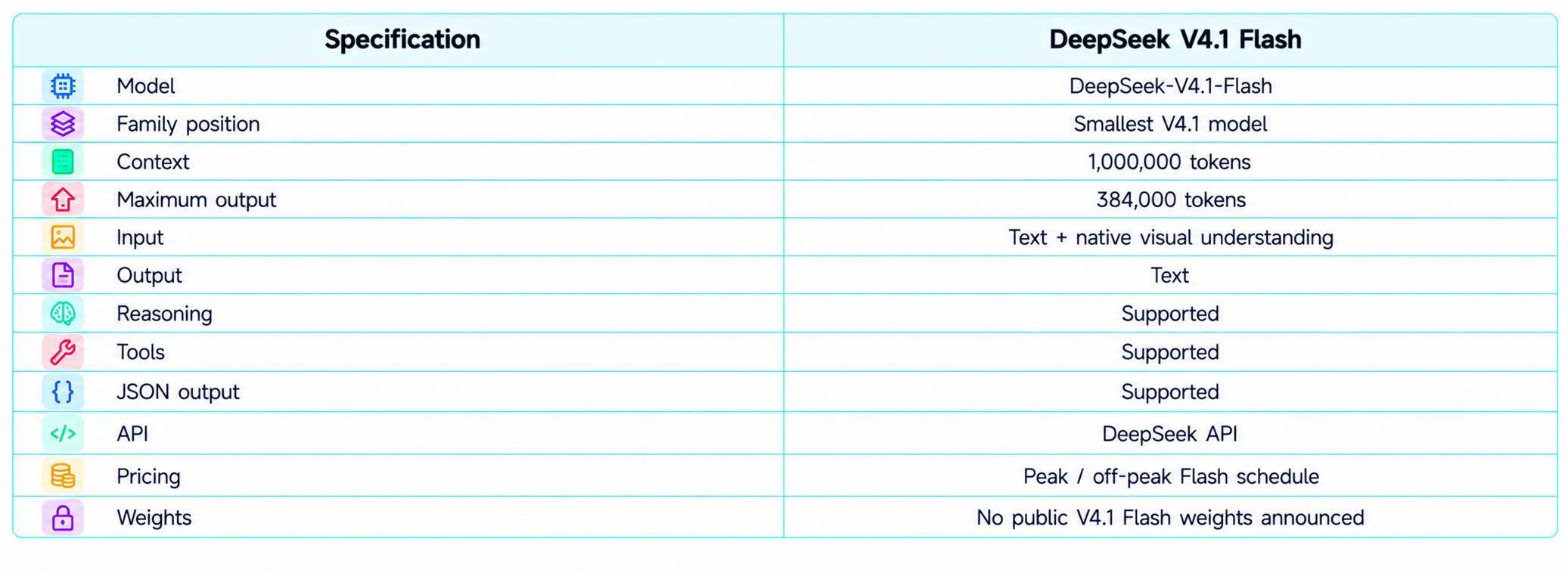
The model inherits the large-context and developer-facing capabilities of the V4 API family while adding native multimodal understanding. That makes it suitable for coding tasks that include screenshots, diagrams, UI states and other visual context.
3. DeepSeek V4.1 Flash Benchmarks
DeepSeek published a broad evaluation suite for the release. The results cover scientific reasoning, competitive programming, coding agents, security, automation and multimodal tool use.
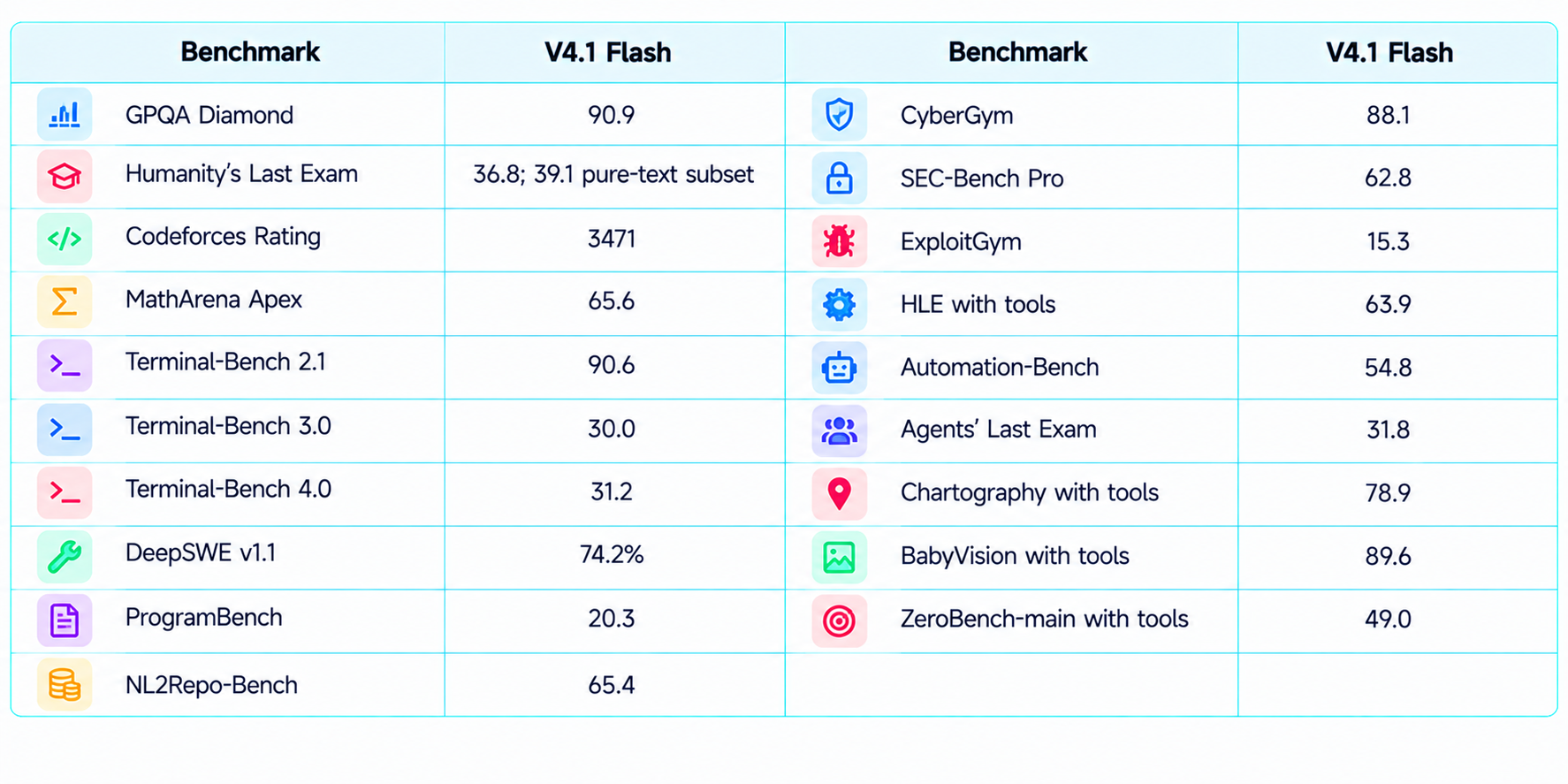
The benchmark spread matters. V4.1 Flash is not relying on one headline coding test. It posts strong results across terminal agents, long-horizon software engineering, cybersecurity and visual reasoning.
4. DeepSeek V4.1 Flash vs V4 Flash 0731
The generational improvement is clearest when the current release is compared with DeepSeek's July 31 V4 Flash 0731 update.
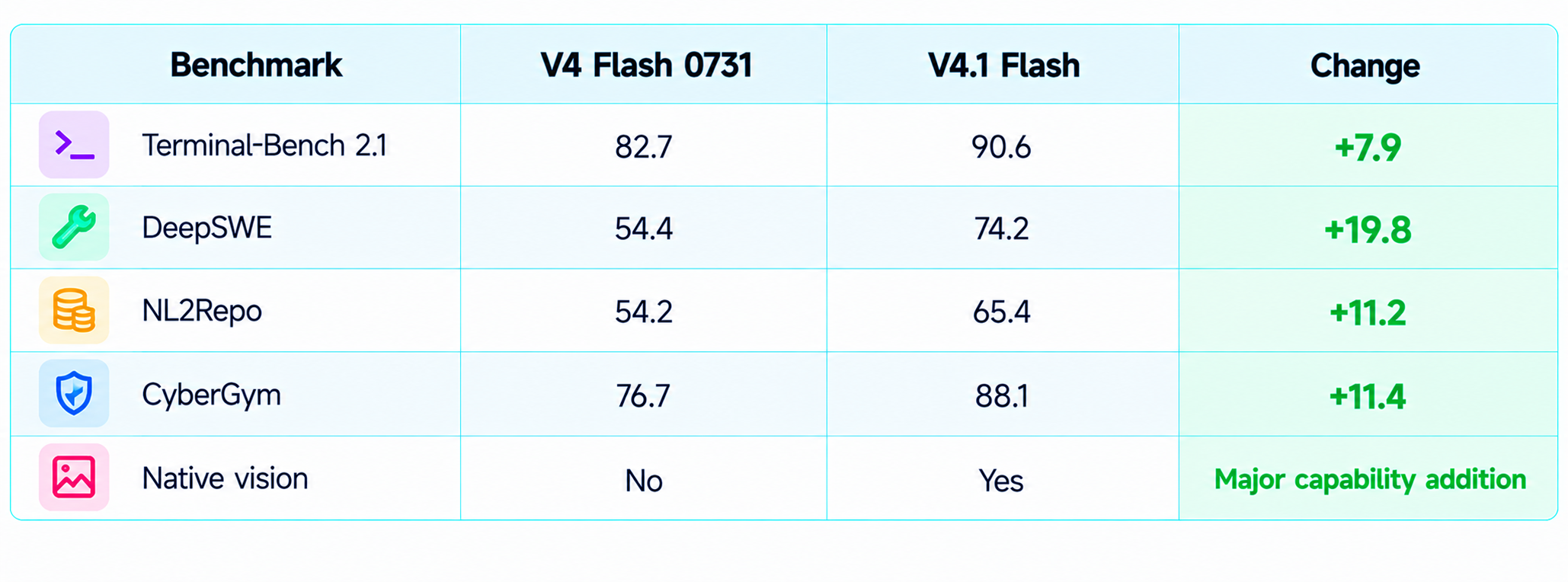
This is more than a small refresh. V4.1 Flash raises coding-agent results across several evaluations while adding native visual understanding. The result is a Flash model that covers more of the workflow without requiring separate endpoints.
5. Coding Performance
Coding is the main reason developers should care about V4.1 Flash. DeepSeek reports 90.6 on Terminal-Bench 2.1 and 74.2% on DeepSWE v1.1. Terminal-Bench measures agentic terminal work, while DeepSWE focuses on longer software-engineering tasks.
Those benchmarks map well to modern coding agents. A useful coding agent has to inspect a repository, make changes, run tools, interpret failures and continue until the task is complete.
The previous V4 Flash 0731 scores of 82.7 on Terminal-Bench 2.1 and 54.4 on DeepSWE show how large the new generation's reported improvement is.
6. Terminal-Bench 2.1 and Newer Versions
The 90.6 Terminal-Bench 2.1 result is the release's strongest coding headline. It is a major improvement over V4 Flash 0731's 82.7.
The same release also reports 30.0 on Terminal-Bench 3.0 and 31.2 on Terminal-Bench 4.0. Those absolute values should not be compared directly with 90.6 because each benchmark generation has different tasks and scoring.
Taken together, the results show a model with strong terminal-agent capability across multiple benchmark generations rather than a single isolated high score.
7. DeepSWE v1.1
V4.1 Flash scores 74.2% on DeepSWE v1.1. That is a large increase over the 54.4 reported for V4 Flash 0731.
DeepSWE is especially relevant to repository-level development because it evaluates longer software-engineering tasks. A strong result suggests the model can sustain reasoning across multiple connected actions rather than only produce isolated snippets.
For teams building autonomous coding agents, this is one of the strongest reasons to test V4.1 Flash as a default worker model.
8. Native Multimodal Vision
V4.1 Flash is designed with native multimodal visual understanding. This differentiates it from the earlier V4 Flash Vision Exp model, which added vision as a separate experimental variant.
DeepSeek's release suite includes BabyVision with tools at 89.6 and Chartography with tools at 78.9. Those evaluations are useful because they test visual understanding in the context of tool use rather than treating vision as an isolated feature.
For software developers, native vision is practical. A coding agent can inspect a screenshot of a broken interface, read a diagram or analyze a visual test result while continuing to reason through the same workflow.
9. Cybersecurity and Secure Coding
The release includes 88.1 on CyberGym, 62.8 on SEC-Bench Pro and 15.3 on ExploitGym. These results show that DeepSeek is testing the model on security-specific coding and agent tasks, not only general code generation.
CyberGym is particularly notable because security agents need to reason about code, vulnerabilities and execution outcomes. A strong result can make V4.1 Flash useful for secure-code review, vulnerability analysis and controlled security automation, although production security decisions still need deterministic validation and human review.
10. Pricing
DeepSeek's September 10 Flash pricing is exceptionally aggressive. Off-peak rates are $0.003 per million cache-hit input tokens, $0.15 per million uncached input tokens and $0.60 per million output tokens. Peak rates double to $0.006, $0.30 and $1.20.
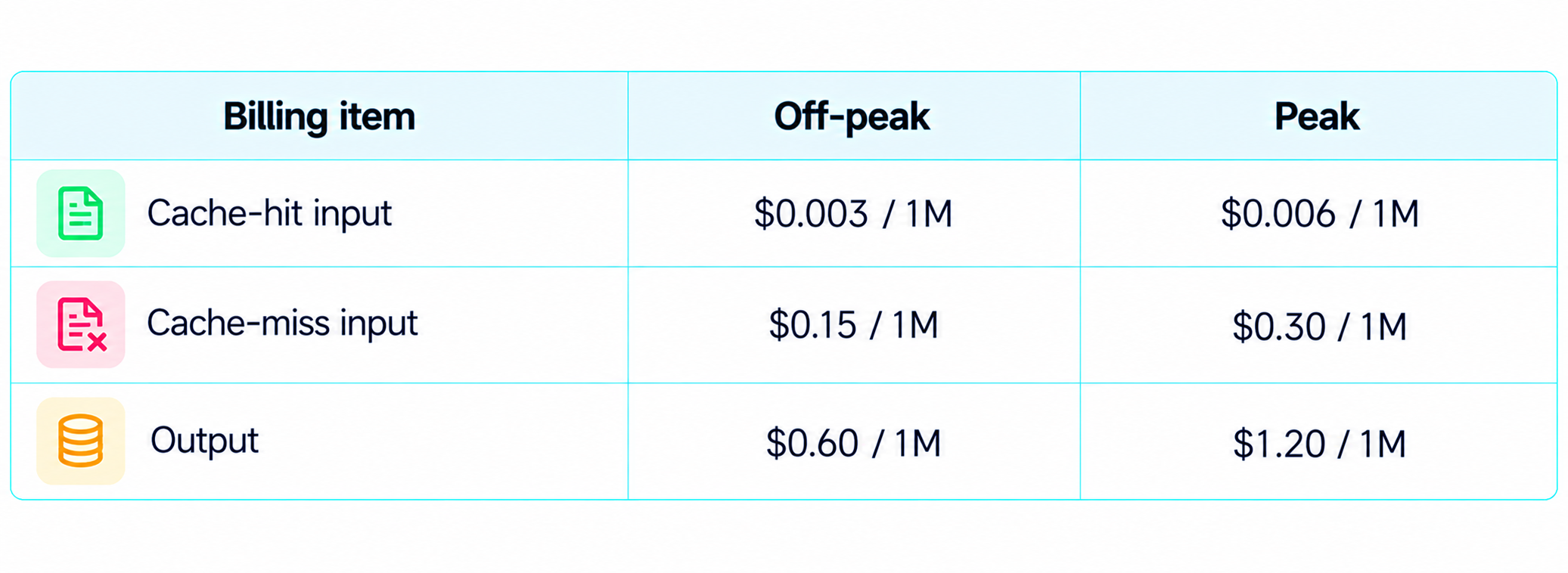
Peak hours are Monday through Friday, 01:00-04:00 UTC and 06:00-10:00 UTC. All other hours are off-peak. For large batch workloads, the schedule makes time-of-day a direct cost-control lever.
11. Why the Cache Price Matters
The $0.003 per million cache-hit input price is so low that repeated context becomes extremely inexpensive. This matters for coding agents because a large repository prefix, system prompt or tool schema can be reused across many requests.
Teams should therefore design around prefix reuse when possible. Stable instructions and reusable context can increase cache hits and materially lower the input side of an agent's bill.
Output still deserves attention. Reasoning agents can produce large amounts of generated text, so the $0.60 off-peak output rate is the more important figure when calculating the total cost of a complex agent session.
12. Speed and Throughput
V4.1 Flash was designed specifically for faster inference and higher throughput. During the short beta that preceded the release, developer measurements commonly reported more than 300 tokens per second, with some long-generation tests exceeding 400 tokens per second. Current provider listings also show the model in the 300-token-per-second range.
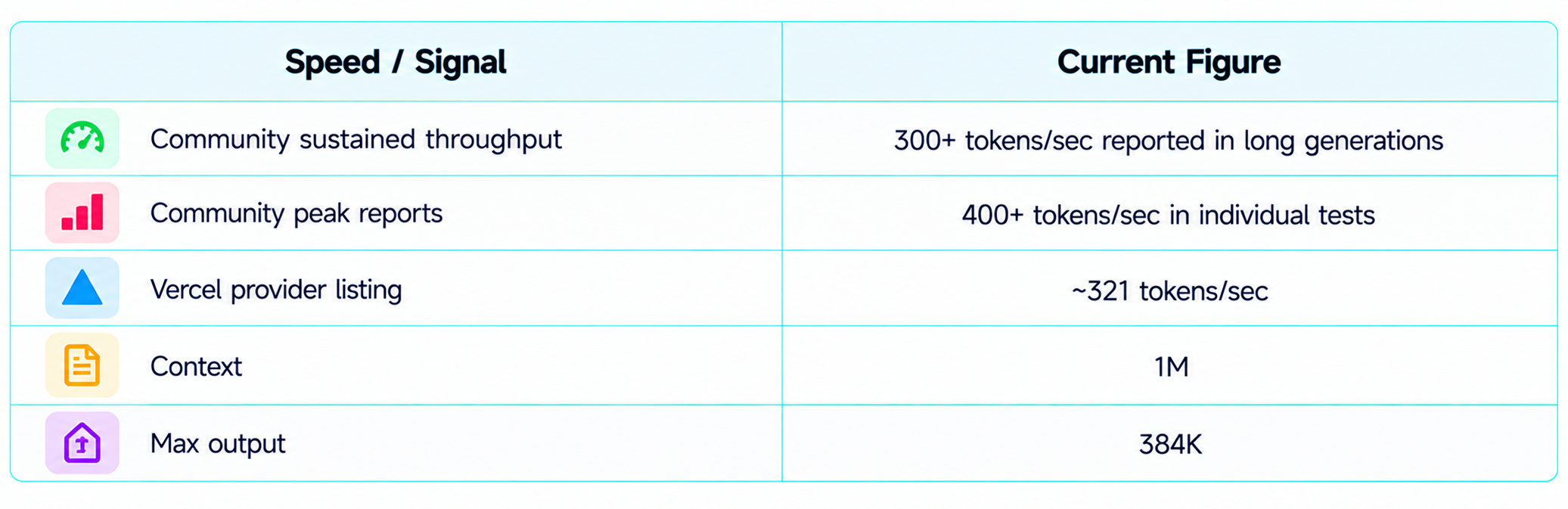
These numbers are provider or community measurements rather than a standardized DeepSeek hardware test. The consistent direction is still clear: V4.1 Flash is built as a high-throughput model.
13. V4 Pro Routing
DeepSeek announced a major operational change with the V4.1 Flash launch. After the new model goes live and until V4.1 Pro is released, requests sent to the V4 Pro endpoint will be routed to V4.1 Flash and billed at Flash pricing.
That is unusual because the endpoint name can remain deepseek-v4-pro while the served model changes. Developers should therefore expect V4 Pro behavior to evolve during the transition even if application code does not change.
For new integrations, the more important takeaway is that DeepSeek itself considers V4.1 Flash capable enough to become the interim model behind its Pro traffic.
14. V4.1 Flash vs V4 Pro
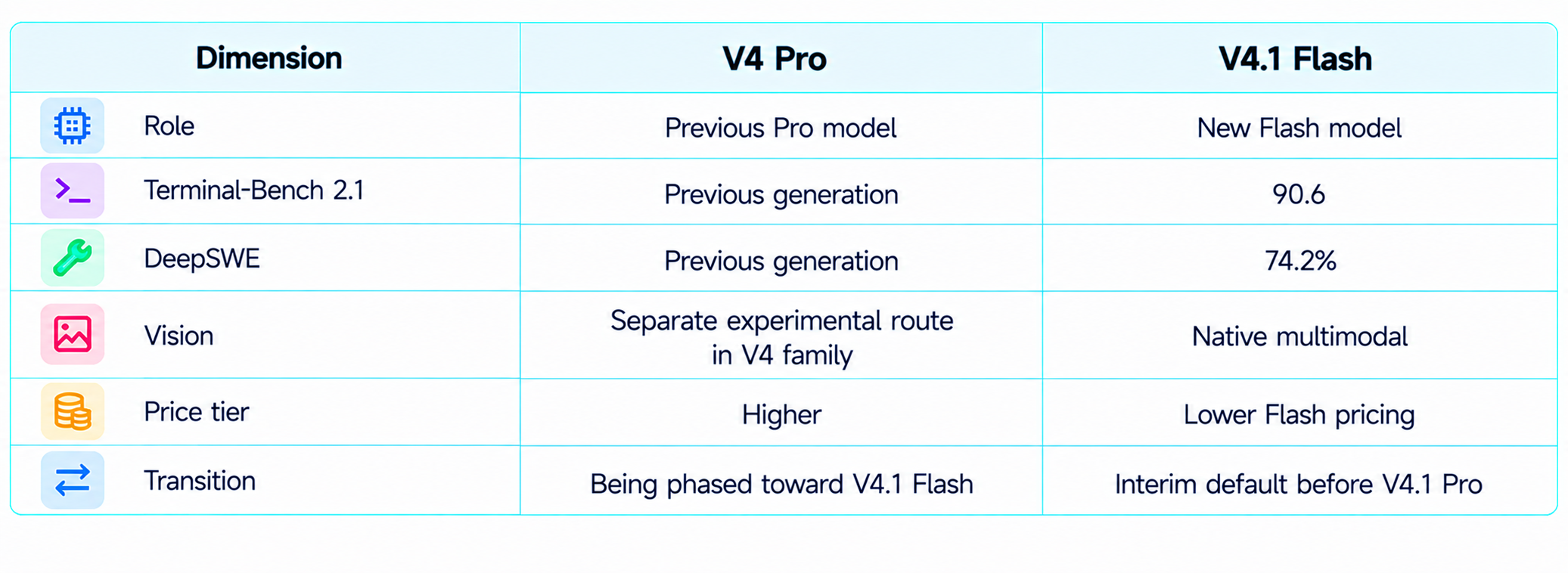
DeepSeek's own statement is that V4.1 Flash surpassed V4 Pro across performance, cost, speed and task-completion time in its internal and external testing. That is a company claim, but the published benchmark results provide a substantial quantitative basis for why DeepSeek is making the transition.
15. V4.1 Flash vs Claude Opus 5
The comparison with Claude Opus 5 is now much more interesting because V4.1 Flash's coding results are competitive with or above Opus 5 on some published tests.
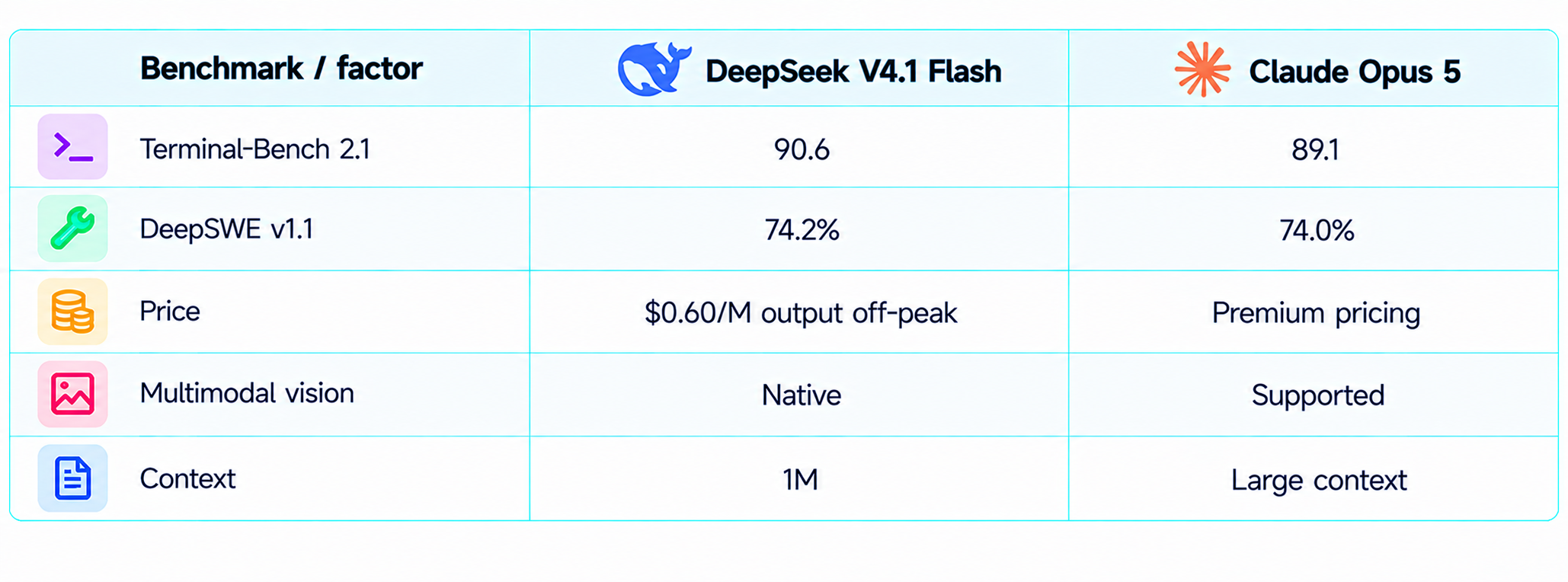
On Terminal-Bench 2.1 and DeepSWE v1.1, V4.1 Flash is at or above the published Opus 5 reference figures. That is a major result for a Flash model. The biggest practical difference is cost: V4.1 Flash is priced for high-volume use rather than premium-only requests.
16. V4.1 Flash vs Gemini 3.8 Flash
Both models target the same broad buyer: developers who need coding, agents, multimodal input and fast responses without using the most expensive model tier for every call.
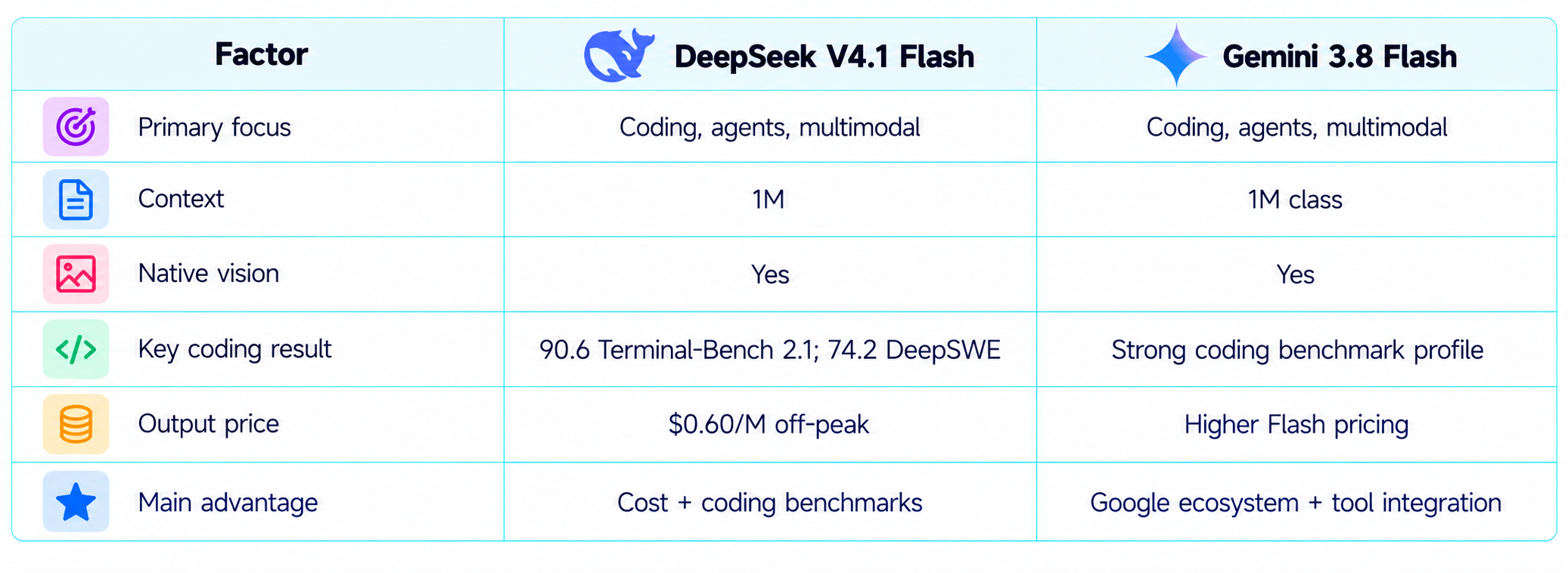
For a DeepSeek-native stack, V4.1 Flash is a particularly strong value proposition. Gemini 3.8 Flash remains attractive when Google's surrounding developer ecosystem or existing deployment is the deciding factor.
17. API and Developer Features
The V4 API family supports JSON output, tool calls, the Responses API and Anthropic-compatible API access. The V4.1 release adds native multimodal input on the new architecture. That combination makes the model easy to place inside existing coding agents and automation frameworks.
The model is therefore not limited to chat. Developers can build structured workflows where the output feeds another tool, another agent or a deterministic application component.
18. Open Source and Local Availability
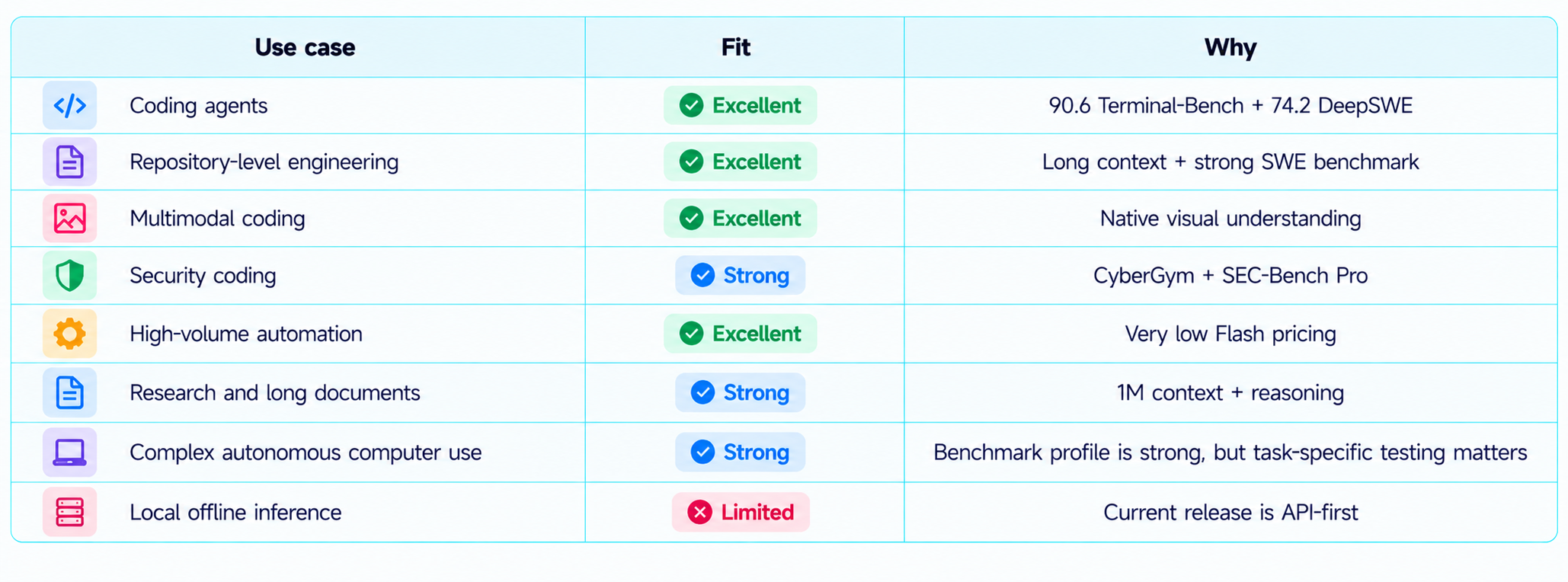
DeepSeek's current V4.1 Flash release is API-first and does not announce downloadable V4.1 Flash weights. Developers should not assume that previous DeepSeek open-weight releases imply local weights for this model.
For teams that require offline inference or full model ownership, open-weight alternatives remain the appropriate category. For teams prioritizing API speed and cost, V4.1 Flash is the stronger fit.
19. Best Use Cases
20. Limitations You Should Know
- DeepSeek's benchmark results are vendor-published and should be interpreted as official model evaluations, not independent reproduction.
- Terminal-Bench 2.1, 3.0 and 4.0 are different benchmark generations and their scores should not be compared directly.
- Native vision expands the model considerably, but output remains text.
- Peak and off-peak pricing can change the daily operating cost of batch workloads.
- Low token prices do not guarantee low cost per completed task if an agent needs many retries or produces large reasoning traces.
- The current API release does not provide downloadable V4.1 Flash weights.
- V4 Pro routing can change the model behavior behind an existing endpoint during the transition to V4.1 Pro.
21. Recommended Production Workflow
- Use V4.1 Flash as the default worker for routine coding and agent calls.
- Use native vision for screenshots, diagrams and UI debugging.
- Keep stable repository context reusable to maximize cache hits.
- Schedule large batch workloads during off-peak hours.
- Use stronger models for the small set of tasks that your evaluation shows V4.1 Flash cannot complete reliably.
- Track cost per completed task rather than token price alone.
- Keep automated tests, structured validation and tool logging in every coding loop.
For model routing strategies, read Model Routing for AI Coding Agents.
22. How to Evaluate DeepSeek V4.1 Flash Yourself
Use your actual repository, prompts and tools. Compare V4.1 Flash with V4 Flash 0731 and your current production model under identical conditions.
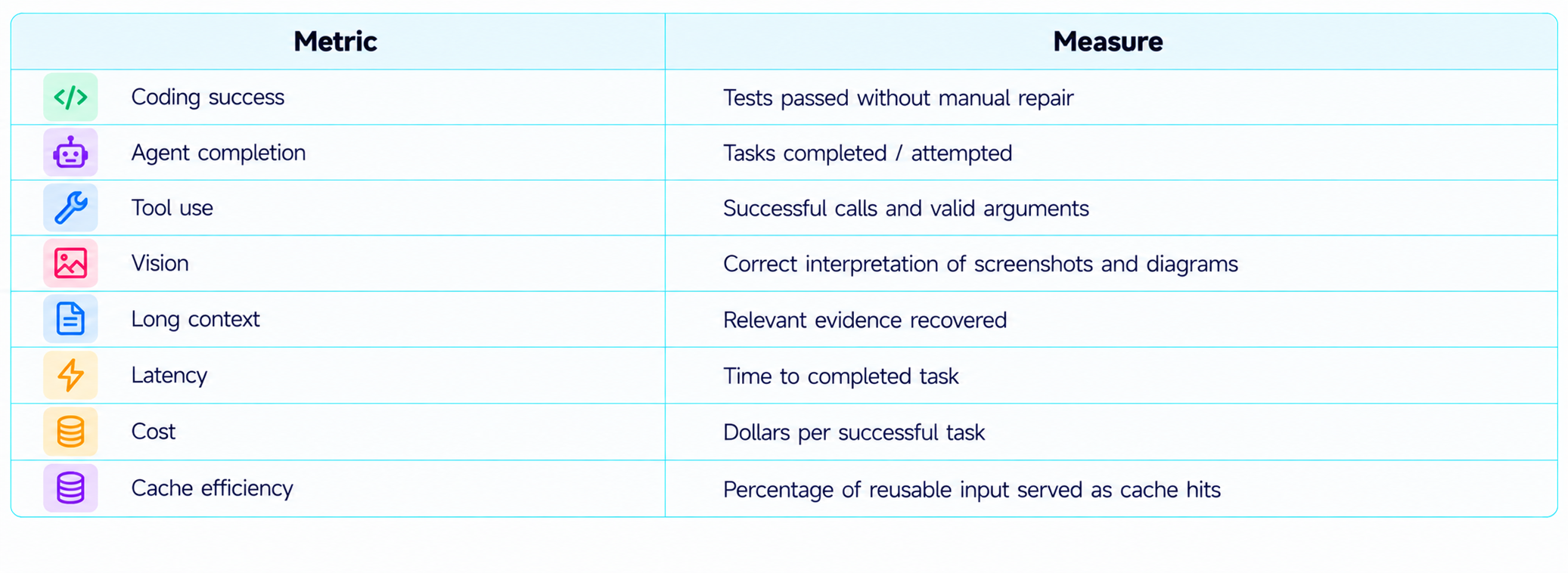
This evaluation tells you whether the benchmark gains translate into less human supervision and lower cost in your own workflow.
23. Is DeepSeek V4.1 Flash Worth It?
Yes. The model now has the benchmark profile to justify serious production testing rather than casual experimentation. Its 90.6 Terminal-Bench 2.1, 74.2% DeepSWE and 88.1 CyberGym results make it a credible worker model for coding and agent systems.
Native vision broadens the model into multimodal developer workflows, while the 1M context and aggressive Flash pricing make it practical for high-volume use.
The biggest advantage is the combination. A model can be strong enough to handle difficult software tasks, fast enough to keep an agent responsive and inexpensive enough to call repeatedly.
24. Final Verdict
DeepSeek V4.1 Flash is one of the strongest value-focused AI model releases of September 2026. It takes the Flash concept and pushes it much closer to frontier coding and agent performance while adding native multimodal vision.
The benchmark results are the foundation of the case: 90.6 Terminal-Bench 2.1, 74.2% DeepSWE v1.1, 88.1 CyberGym, 65.4 NL2Repo-Bench, 90.9 GPQA Diamond and 3,471 Codeforces. The previous V4 Flash 0731 release was materially lower on the same coding suite.
DeepSeek's pricing makes the release even more interesting. Off-peak output is $0.60 per million tokens, uncached input is $0.15 and cache-hit input is $0.003, with peak rates at double. Those rates make model routing and high-volume agent use unusually affordable.
The V4 Pro routing change is the final signal. DeepSeek is willing to put V4.1 Flash behind Pro requests until V4.1 Pro arrives, effectively making Flash the model that carries the next stage of the V4 platform.
My rating: 9.6/10 for coding, 9.5/10 for price-to-performance, 9.4/10 for agentic workflows, 9.2/10 for multimodal capability and 9.5/10 overall.
Bottom line: DeepSeek V4.1 Flash is an excellent default model for coding agents, high-volume automation, multimodal developer tasks and long-context reasoning. It does not make every premium model obsolete, but it makes the expensive-model tier much easier to reserve for the hardest work.
Frequently Asked Questions
What is DeepSeek V4.1 Flash?
It is DeepSeek's newest Flash model and the smallest model in the new V4.1 architecture family, focused on coding, agents, speed and native multimodal visual understanding.
When was DeepSeek V4.1 Flash released?
DeepSeek officially released V4.1 Flash on September 10, 2026.
What are the DeepSeek V4.1 Flash benchmark scores?
Key published results include 90.6 Terminal-Bench 2.1, 74.2% DeepSWE v1.1, 88.1 CyberGym, 65.4 NL2Repo-Bench, 90.9 GPQA Diamond and a 3,471 Codeforces rating.
How much does DeepSeek V4.1 Flash cost?
Off-peak pricing is $0.003 per million cache-hit input tokens, $0.15 per million uncached input tokens and $0.60 per million output tokens. Peak pricing is double.
What is the context window?
The DeepSeek V4 API family supports a 1M-token context and 384K maximum output.
Does V4.1 Flash support vision?
Yes. Native multimodal visual understanding is a core capability of the new V4.1 Flash architecture.
Is V4.1 Flash better than V4 Pro?
DeepSeek says its internal and external testing showed V4.1 Flash surpassed V4 Pro in performance, cost, speed and task-completion time, and DeepSeek is routing V4 Pro requests to Flash until V4.1 Pro arrives.
Is DeepSeek V4.1 Flash good for coding?
Yes. It scores 90.6 on Terminal-Bench 2.1 and 74.2% on DeepSWE v1.1.
Is DeepSeek V4.1 Flash open source?
The current release is API-first and does not announce downloadable V4.1 Flash weights.
Is DeepSeek V4.1 Flash worth it?
Yes. It is especially compelling for coding agents, multimodal development and high-volume API workloads.
Recommended Blogs
Meta Muse Spark 1.3 Review: Coding, Price & Is It Worth It? (2026)
Gemini 3.8 Flash Review: Accuracy, Price & Is It Worth It? (2026)
Qwen 3.8 Max 0902 Review: Benchmarks, Price & Is It Worth It? (2026)
Mercury 2.5 AI Model Review: Speed, Price & Is It Worth It? (2026)
How to Secure AI Coding Agents: Permissions, Sandboxing, MCP & Secrets
Resources & Community
Join our community of 70,000+ AI enthusiasts and learn to build powerful AI applications. Whether you're a beginner or an experienced developer, Build Fast with AI helps you understand and implement AI in your projects.
Agentic AI Launchpad 2026
A structured 6-week cohort program that takes you from AI basics to building and deploying real-world agentic AI systems. Includes live sessions, expert mentorship, project reviews and a builder community network.
Ready to go from learning to building? Join the next cohort: Agentic AI Launchpad 2026
Free AI Resources
Access free tools, workshops and micro-learning to keep building.

