



Best AI Models This Week: Late July 2026 Rankings
The best AI model ranking changed on Thursday. Anthropic released Claude Opus 5 on July 24 at $5 per million input tokens, half of Claude Fable 5's price, and it beats Fable 5 on several benchmarks while adding a cost dial. That single launch reshuffled the value tier of every ranking, including this one.
This is our live, updated take on the best AI models right now, at the end of the busiest model month of 2026. I have tested or tracked all of them, and the ranking below is sorted by what you are actually building, not by a single benchmark, because the honest answer to best AI model has been it depends for a while now. Here is the specific version of it depends, with current prices and clear verdicts.
The one-line state of play: Claude Fable 5 is still the frontier flagship, Claude Opus 5 is the new value king, GPT-5.6 Sol owns agentic speed, and the best model you can download yourself is now almost always Chinese. Nobody has swept the board, and that is the whole story.
What Changed This Week
The headline change is Claude Opus 5, which arrived July 24 as a near-frontier model at half of Fable 5's price with a low/medium/high effort dial. It more than doubled Opus 4.8 on hard coding and beat Fable 5 on computer-use and knowledge-work benchmarks, instantly becoming the value pick most teams should default to.
Table 1: This week's ranking moves
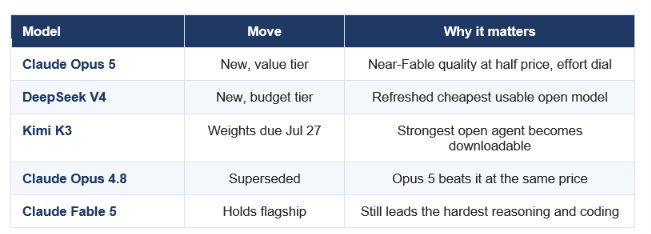
Prices unchanged at the top: Fable 5 stays $10 / $50, and Opus 5 matches Opus 4.8 at $5 / $25.
Two smaller shifts matter too. DeepSeek V4 landed the same day as Opus 5, refreshing the rock-bottom budget tier, and Moonshot promised free Kimi K3 weights for July 27, which would hand self-hosters the strongest open agent yet. The frontier itself did not move: Fable 5 still leads the hardest tasks. What moved is how little you now pay for near-frontier quality.
For the month-level view heading into this week, our full ranked analysis of the best AI models is the deeper companion to this weekly update.
The Master Ranking: Top 12 Models
Here are the 12 best AI models available right now, ranked by overall capability, with the current price and the one job each does best. Read the price column next to the strength column, because the value story is where this week got interesting.
Table 2: Best AI models, late July 2026
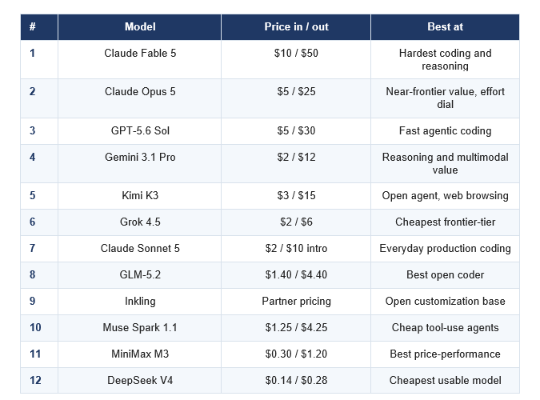
Claude Mythos 5 sits above Fable 5 on paper but is restricted to approved partners, so it is left off the practical list.
From DeepSeek V4 at $0.28 output to Fable 5 at $50, the top of this list costs roughly 180 times the bottom for capability that lands within a tier or two on most tasks. No workload needs the most expensive model for every call, which is why the smart pattern remains routing between tiers rather than standardizing on one.
Best Overall AI Model
Claude Fable 5 is still the best overall AI model, with 95% on SWE-bench Verified and the most careful reasoning of any accessible model, but Claude Opus 5 is now the better buy for most teams. After this week, the honest recommendation splits: Fable 5 if you need the absolute best and can pay for it, Opus 5 if you want most of that quality at half the price.
Opus 5 is the more interesting story. It approaches Fable 5's quality at $5 input against $10, adds an effort dial that lets you spend on intelligence only when a task needs it, and beats Fable 5 outright on computer-use (OSWorld 2.0) and knowledge-work (GDPval) benchmarks. The one caveat: its headline coding score used Opus 4.8 as a fallback when a safety filter refused a request, and Anthropic did not disclose how often, so verify the coding lead on your own work before betting a migration on it.
My verdict: for a new project starting today, default to Opus 5 and reserve Fable 5 for the genuinely hardest problems. A year ago the best model was also the most expensive. This week, the best value and the best quality are finally two different, sensible choices.
Best AI Model for Coding
For coding, Claude Fable 5 leads the hardest problems, Claude Opus 5 and GPT-5.6 Sol trade blows just below it, and GLM-5.2 is the best open option. Anthropic and OpenAI own the top of this category, and the right pick depends on whether you are optimizing for difficulty, speed or cost.
Table 3: Best coding models this week
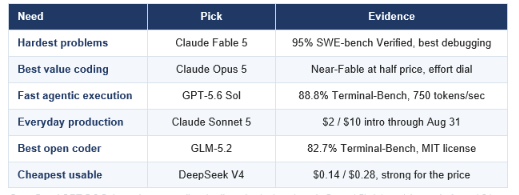
Opus 5 and GPT-5.6 Sol are close on coding, trading wins by benchmark. Sonnet 5's intro pricing ends August 31.
My recommended stack for a real engineering team changed this week. Make Opus 5 your default (it replaces both Opus 4.8 and, for most tasks, the case for paying Fable 5 prices), keep Fable 5 in reserve for the gnarliest debugging, and reach for GPT-5.6 Sol when raw execution speed on a big multi-file change matters more than anything else.
For the full head-to-head on the coding tier specifically, our GLM-5.2 vs Claude vs GPT-5.6 vs Kimi comparison breaks down cost per merged pull request.
Best AI Model for Reasoning
For reasoning, Gemini 3.1 Pro is the best accessible value at 94.3% on GPQA Diamond for $2 input, while Claude Fable 5 leads the very hardest exam-style reasoning and Claude Opus 5 posts a startling abstract-reasoning result. Opus 5 scored roughly three times the next-best model on ARC-AGI-3, which tests inferring rules from novel game worlds.
That ARC-AGI-3 number is the reasoning story of the week. If it holds up under independent testing, a jump from Opus 4.8's 1.5% to Opus 5's 30.2% is a genuine step in abstract reasoning, not a rounding-error benchmark win. For accessible, everyday reasoning value, though, Gemini 3.1 Pro remains the one I would start with, because 94.3% GPQA at $2 input is hard to argue with. Claude Mythos 5 outscores everyone on paper but stays locked to approved partners.
Quotable version: the best reasoning you can actually buy costs $2 to $5 per million tokens this week, not $25. The frontier keeps getting cheaper for everyone except the labs training it.
Best AI Model for Agents
For agents and tool use, GPT-5.6 Sol leads on speed, Muse Spark 1.1 leads on value, Kimi K3 leads on web browsing, and Claude Opus 5 is the new pick for reliable long-horizon autonomy. Agentic work rewards a different profile than raw benchmarks: fast tool calls, honest failure reporting and self-verification matter more than a single score.
Table 4: Best agent models this week
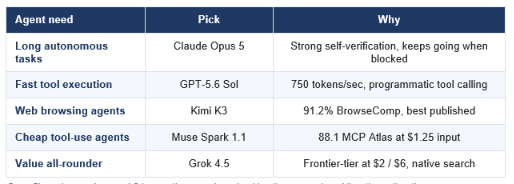
Opus 5's real upgrade over 4.8 is agentic reasoning: checking its own work and iterating rather than a raw intelligence jump.
Opus 5 earns its place here specifically because its biggest improvement is not answering questions better, it is not giving up. It checks its own work, iterates when blocked, and builds internal tools to finish a task, which is exactly the behaviour that makes an agent trustworthy enough to leave running. For agents that must complete long chains without a human babysitting them, that reliability beats a few benchmark points elsewhere.
Best Value and Budget Models
For value, DeepSeek V4 is the cheapest usable model at $0.14 input, MiniMax M3 offers the best frontier-adjacent quality per dollar, and Grok 4.5 is the cheapest true frontier-tier option. This is where 2026 gets genuinely exciting, because near-top capability no longer requires top pricing.
Table 5: Best value models
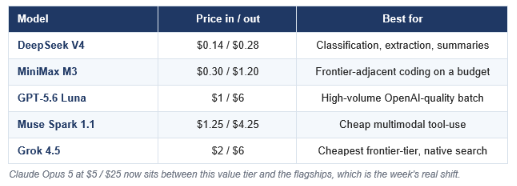
Claude Opus 5 at $5 / $25 now sits between this value tier and the flagships, which is the week's real shift.
My contrarian point stands and got stronger this week: most teams overpay by defaulting to a flagship for routine calls. With Opus 5 halving the price of near-frontier quality and DeepSeek V4 sitting at $0.28 output, the gap between routing intelligently and standardizing on one expensive model is now enormous. Send the routine 80% of calls to a value model and reserve the flagships for the hard 20%.
Best Open-Weight Models
The best open-weight models this week are Kimi K3 for agents, GLM-5.2 for coding, Inkling for customization, and DeepSeek V4 for cost, and the open tier keeps closing the gap to closed models. If you need self-hosting, fine-tuning or data control, these four cover most needs, and the crown has firmly moved to Chinese labs plus Thinking Machines.
Kimi K3 is the headline, with free weights promised for July 27, a 2.8 trillion parameter model that posted the best open reasoning scores at launch. GLM-5.2 remains the best open coder under MIT at $1.40 input. Inkling from Thinking Machines is the best Apache 2.0 base to fine-tune into your own model. And DeepSeek V4 keeps the cost floor. The one honest caveat: none of these quite match Fable 5 or Opus 5 on the hardest problems, so open weights remain a value, control and customization play rather than a capability crown.
Our dedicated best open source AI models collection ranks the full open field with licenses and self-hosting requirements.
Best Multimodal Model
Gemini 3.1 Pro remains the best multimodal model, combining top-tier vision, native video and frontier reasoning at $2 input and $12 output. Google's long lead in multimodality held through this week, and no competitor matches its combination of image, video and document understanding at this price.
Two challengers deserve a mention. Meta's Muse Spark 1.1 has the widest input stack, taking text, image, video, audio and PDF natively through one endpoint, which is unmatched for breadth even if Gemini leads on quality. And Kimi K3 added native video this month, the first open-weight model to seriously attempt it. For pure multimodal reasoning quality, though, Gemini 3.1 Pro stays the default, and its 94.3% GPQA means you are not trading intelligence for vision.
How to Choose: Cost Per Task
Choose your model by cost per finished task, not by the per-token sticker price, because token efficiency varies enough to flip the ranking. A model that costs twice as much per token but finishes in half the tokens is a tie on price and a win on quality. After this week, the smartest setup for most teams is a three-tier routed stack.
Table 6: The recommended routed stack
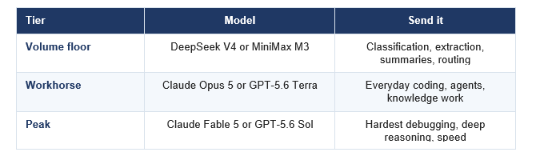
Opus 5's arrival makes the workhorse tier dramatically stronger this week without raising its cost.
The winning strategy in 2026 is a routed stack, not a single model. Switching cost is near zero because every major provider is SDK-compatible, so there is no excuse to overpay on easy calls. The teams getting the most from AI right now are not the ones using the single best model, they are the ones routing intelligently between three tiers by task difficulty.
The prompting skills that make each tier reliable transfer across all of them. Our 50 best Claude prompts is the practical companion to this ranking.
Frequently Asked Questions
Q: What is the best AI model this week?
Claude Fable 5 remains the best overall AI model for the hardest tasks, but Claude Opus 5, released July 24, 2026, is the better buy for most teams at half the price with near-frontier quality and a cost dial. GPT-5.6 Sol leads agentic coding speed, and Gemini 3.1 Pro offers the best reasoning value.
Q: Is Claude Opus 5 the best AI model now?
Opus 5 is the best value AI model, not the outright best. It reaches near-Claude Fable 5 quality at half the price ($5 vs $10 input), beats Fable 5 on some computer-use and knowledge-work benchmarks, and adds an effort dial. Fable 5 still leads the hardest reasoning and coding overall.
Q: What is the best AI model for coding right now?
Claude Fable 5 leads the hardest coding at 95% SWE-bench Verified, Claude Opus 5 is the best value at half the price, and GPT-5.6 Sol is fastest at 88.8% Terminal-Bench and 750 tokens per second. For open coding, GLM-5.2 leads at 82.7% Terminal-Bench under an MIT license.
Q: What is the best open source AI model in July 2026?
Kimi K3 is the strongest open agent, with free weights promised for July 27, followed by GLM-5.2 for coding, Inkling for customization under Apache 2.0, and DeepSeek V4 for cost. Chinese labs and Thinking Machines now lead the open-weight tier, which has closed most of the gap to closed models.
Q: What is the cheapest good AI model?
DeepSeek V4 is the cheapest usable model at $0.14 input and $0.28 output per million tokens, ideal for classification and summarization. MiniMax M3 at $0.30 / $1.20 is the cheapest with frontier-adjacent coding, and Grok 4.5 at $2 / $6 is the cheapest true frontier-tier model.
Q: Is Claude Opus 5 better than GPT-5.6?
They trade wins. Opus 5 leads Frontier-Bench and ARC-AGI-3, while GPT-5.6 Sol leads DeepSWE and runs faster at 750 tokens per second. Opus 5 is cheaper at $5 input versus Sol's $5 with $30 output against Opus 5's $25. For most coding, they are close enough that price and speed should decide.
Q: Which AI model is best for agents?
For long autonomous tasks, Claude Opus 5's self-verification makes it a strong pick this week. GPT-5.6 Sol leads on tool-execution speed, Kimi K3 leads web browsing at 91.2% BrowseComp, and Muse Spark 1.1 leads cheap tool use at 88.1 MCP Atlas for $1.25 input.
Recommended Blogs
- Best AI Models July 2026 ranked
- Best AI Models full ranked analysis
- Best open source AI models
- GLM-5.2 vs Claude vs GPT-5.6 vs Kimi
- Every major LLM ranked 2026
Resources and Community
Join our community of 70,000+ AI enthusiasts and learn to build powerful AI applications. Whether you are a beginner or an experienced developer, Build Fast with AI helps you understand and implement AI in your projects.
- Website (buildfastwithai.com)
- LinkedIn (Build Fast with AI)
- Instagram (@buildfastwithai)
- Founder Twitter (@satvikps)
- Twitter (@BuildFastWithAI)
Agentic AI Launchpad 2026
A structured 6-week cohort program that takes you from AI basics to building and deploying real-world agentic AI systems. Includes live sessions, expert mentorship, project reviews, and a builder community network.
Ready to go from learning to building? Join the next cohort: Agentic AI Launchpad 2026
Free AI Resources
Access free tools, workshops, and micro-learning to keep building:
We update this ranking every week as new models ship. Follow Build Fast with AI, and subscribe so the next update lands in your inbox.

