



20 Best AI Prompts for SEO & Content Writing 2026 (Copy-Paste)
Most people use AI for SEO the lazy way: they type write a blog about X, paste the result, and wonder why it does not rank. The output is generic because the prompt was generic. A good SEO prompt is engineered, not typed, and once you understand the format, every prompt in this pack becomes a reliable tool instead of a coin flip. This guide gives you the prompt format first, then a reusable template, then 20 copy-paste prompts built for real SEO and content writing work in 2026.
Every prompt below uses bracketed variables like [KEYWORD], [TOPIC], and [AUDIENCE] so you can drop in your own details and go. They work in Claude, ChatGPT, Gemini, or any capable model. Read the format and template sections first, because they are what turn these from nice prompts into a repeatable system you can use every day.
How AI Changed SEO and Content Writing in 2026
AI changed SEO by collapsing the time from keyword to draft, but it also raised the bar for what ranks. When anyone can generate a passable article in seconds, passable no longer competes. Search engines and answer engines now reward content that shows real expertise, matches intent precisely, and is genuinely useful, which means the winners are people who use AI to work faster and then add human judgment on top.
There is a second shift worth naming: answer engines. Google's AI Overviews and assistants like Claude and ChatGPT now summarize content directly, so being quotable and answer-first matters as much as classic ranking. That is why several prompts in this pack focus on extractable answers, FAQs, and entities. The goal in 2026 is not just to rank a page, it is to be the source the answer engines pull from. The right prompts get you both, as long as you edit and fact-check the output.
The AI Prompt Format That Works for SEO
A strong AI prompt for SEO has five parts: role, context, task, format, and constraints. Skip any of them and the model fills the gap with a guess, which is exactly where generic, unrankable content comes from. Get all five right and the model behaves like a trained SEO specialist who knows your brief. Here is what each part does.
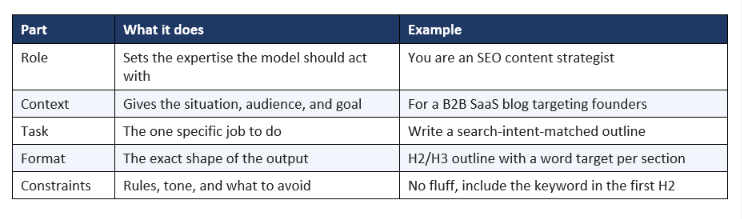
Notice the pattern. Role plus context tell the model who to be and for whom. Task plus format tell it what to make and in what shape. Constraints keep it on brand and on strategy. The single biggest upgrade you can make to any prompt is adding specificity to context and constraints, because that is where SEO lives: the audience, the intent, the keyword placement, and the tone. For the deeper theory behind why this works, our beginner guide to agentic AI explains how models reason from instructions.
One more principle: give the model something to react to. Paste a competitor snippet, your brand voice sample, or a target keyword list, and quality jumps, because the model is now grounded in real inputs instead of inventing them. The prompts below are written to accept exactly these inputs through their variables.
The Reusable SEO Prompt Template
This is the one template to keep. It bakes the five part format into a fill-in-the-blank structure you can adapt to any SEO or content writing task. Copy it, replace the brackets, and you have a strong prompt for almost anything.
You are a [ROLE, e.g. senior SEO content strategist].
Context: I am creating [CONTENT TYPE] for [AUDIENCE] in the [INDUSTRY/NICHE].
The primary keyword is [KEYWORD]. The search intent is [informational/commercial/transactional].
The goal of this content is to [GOAL, e.g. rank and convert readers into trial signups].
Task: [THE SPECIFIC TASK, e.g. write an SEO-optimized outline].
Format: [EXACT OUTPUT SHAPE, e.g. H2/H3 outline, table, 300-word section].
Constraints:
- Match the search intent above.
- Use the keyword naturally in the first 100 words and at least one H2.
- Write in a [TONE] voice, at a [READING LEVEL] reading level.
- No fluff, no banned phrases, no keyword stuffing.
- Include specific numbers, examples, and entities where useful.
Before you start, ask me up to 3 questions if anything is unclear.
Two lines in this template do heavy lifting. The intent line forces the model to write for what the searcher actually wants, which is the core of modern SEO. The final line, asking the model to raise questions first, catches missing context before it wastes a full draft on the wrong assumption. Use that closing line on any big task and your output quality climbs noticeably.
How to Use These Prompts
Using these prompts takes three steps: pick the prompt for your task, replace the bracketed variables, and paste it into your AI model of choice. That is it. A few pointers make the results much better.
- Replace every bracket. Leftover placeholders like [KEYWORD] confuse the model, so fill them all in before sending.
- Feed it real inputs. Paste your actual keyword list, competitor URLs, or brand voice sample when a prompt allows it.
- Iterate. Treat the first output as a draft, then refine with follow ups like make section 2 more specific.
- Always fact-check. AI can invent stats and sources, so verify every number and claim before publishing.
These prompts work across models. For everyday content, any strong model is fine, and our roundup of the best AI models of 2026 can help you pick. If you want more packs after this, see our 150 best Claude prompts and 100 best ChatGPT prompts.
Keyword & Search Intent Prompts (1 to 4)
These prompts handle the foundation of SEO: finding the right keywords and understanding what searchers actually want. Get this stage right and everything downstream gets easier, because you are writing for real demand and real intent.
1. Keyword Cluster Builder
Turns one seed keyword into a full topic cluster so you can plan a hub of related content instead of a single post.
You are an SEO strategist. My seed keyword is [KEYWORD] for [AUDIENCE].
Generate a keyword cluster: 1 pillar topic, 8 to 12 supporting subtopics,
and for each, the likely search intent and a suggested content format.
Present it as a table with columns: subtopic, intent, format, priority.
Best for: Planning a content hub or a month of posts around one theme.
2. Search Intent Classifier
Tells you what searchers actually want for a keyword so you write the right type of content instead of guessing.
Analyze the search intent behind [KEYWORD].
Classify it as informational, commercial, transactional, or navigational,
explain the reasoning, describe what the ideal page for this query looks like,
and list the top 5 things that page must include to satisfy the searcher.
Best for: Before writing anything, to make sure the format matches intent.
3. Long-Tail Keyword Finder
Generates low-competition long-tail keywords and questions you can realistically rank for as a newer site.
Act as an SEO researcher. For the topic [TOPIC] and audience [AUDIENCE],
list 20 long-tail keywords and 10 question-based queries with low competition potential.
Group them by funnel stage (awareness, consideration, decision)
and note the likely intent for each.
Best for: New or young sites that cannot rank for head terms yet.
4. People Also Ask Extractor
Builds a list of real questions to answer in your content, which helps you win featured snippets and AI Overviews.
For the keyword [KEYWORD], list 15 questions people also ask around this topic,
grouped by subtopic. For each question, write a concise 2 to 3 sentence answer
that could be used directly as an FAQ or an extractable snippet.
Best for: Building FAQ sections and targeting answer engines.
On-Page SEO Prompts (5 to 8)
On-page prompts turn a topic into a page that search engines and answer engines can read, rank, and quote. They cover titles, outlines, headings, and the entities that signal topical depth.
5. SEO Title & Meta Description Writer
Produces click-worthy, keyword-first titles and meta descriptions that fit Google's pixel limits.
Write 5 SEO titles (under 60 characters, keyword first) and 5 meta descriptions
(under 155 characters, with a specific hook or stat) for a page targeting [KEYWORD].
The page is about [TOPIC] for [AUDIENCE]. Make each title distinct in angle,
and avoid clickbait that the page cannot deliver on.
Best for: Every new page, to maximize click-through from search.
6. SEO Content Outline Generator
Creates a search-intent-matched outline with H2s, H3s, and word targets so your draft is structured to rank.
You are an SEO content strategist. Create a detailed outline for an article
targeting [KEYWORD] with [informational/commercial] intent, for [AUDIENCE].
Include an H1, a logical H2/H3 structure, a suggested word count per section,
where to place the keyword, and 3 to 5 questions to answer for AEO.
Best for: Turning a keyword into a rank-ready structure before writing.
7. Header & Snippet Optimizer
Rewrites your headings so each one starts with an answer-first sentence, which helps with snippets and AI Overviews.
Here are my article headings and their first sentences: [PASTE].
Rewrite each so the first sentence directly answers the header's implied question
in 2 to 4 sentences, is snippet-friendly, and includes relevant entities.
Keep the tone [TONE] and do not pad.
Best for: Optimizing an existing draft for featured snippets.
8. Schema & Entity Enricher
Identifies the entities and schema types your page should include to strengthen topical relevance for search engines.
For an article about [TOPIC] targeting [KEYWORD], list the key entities
(people, tools, concepts, places) I should mention for topical authority,
recommend the schema types to add (Article, FAQPage, HowTo, etc.),
and suggest 5 authoritative external sources worth citing.
Best for: Boosting topical depth and GEO signals on a page.
Content Writing Prompts (9 to 13)
These prompts do the actual writing, from full drafts to intros, brand voice, FAQs, and landing pages. Treat every output as a strong first draft that you then edit for accuracy and voice.
9. Full SEO Article Draft
Writes a complete, structured first draft matched to search intent, which you then edit for voice and accuracy.
You are an expert content writer. Write a [WORD COUNT]-word article on [TOPIC]
targeting [KEYWORD] for [AUDIENCE] with [intent] intent.
Use an answer-first opening, clear H2/H3 structure, short paragraphs,
specific examples and numbers, and a natural keyword placement.
Tone: [TONE]. Do not use filler or clickbait. End with a short FAQ.
Best for: Producing a strong first draft fast, then editing.
10. Power Introduction Writer
Crafts a hook that reduces bounce by opening with a stat, a bold claim, or a direct question instead of fluff.
Write 3 different opening paragraphs for an article on [TOPIC] targeting [KEYWORD].
Option A: open with a surprising stat. Option B: open with a contrarian claim.
Option C: open with a direct question. Each must include the keyword naturally
in the first 100 words and make the reader want to keep going.
Best for: Improving intros that lose readers in the first lines.
11. Brand Voice Rewriter
Rewrites AI or draft text to match your brand voice using a sample, so content stops sounding generic.
Here is a sample of my brand voice: [PASTE 150 to 300 words].
Now rewrite the following text to match that voice exactly,
keeping the SEO keywords and structure intact: [PASTE TEXT].
Preserve meaning, improve flow, and remove any generic AI phrasing.
Best for: Making AI drafts sound like a human on your team.
12. FAQ Section Generator
Builds an extractable FAQ that targets People Also Ask boxes and AI answer engines.
Write an FAQ section for an article on [TOPIC] targeting [KEYWORD].
Include 6 to 8 real questions searchers ask, each with a 2 to 4 sentence,
answer-first response that could be pulled as a featured snippet.
Use natural language and include the keyword or a variation where it fits.
Best for: Adding AEO-friendly FAQs to any post.
13. Product & Landing Page Copy
Writes conversion-focused, SEO-aware copy for commercial pages that need to rank and sell.
Write landing page copy for [PRODUCT] targeting [KEYWORD] with commercial intent.
Include: a benefit-led H1, 3 value propositions, a features-to-benefits section,
social proof placeholders, and 2 CTA options. Keep it scannable,
keyword-aware but natural, and written for [AUDIENCE].
Best for: Money pages that must convert and rank.
Optimization & Repurposing Prompts (14 to 17)
Publishing is the start, not the finish. These prompts help you close content gaps, refresh older posts, repurpose one article into many, and build internal links that spread ranking power.
14. Content Gap Analyzer
Compares your draft against top-ranking pages so you can add what is missing and outrank them.
Here is my draft: [PASTE]. Here are the top 3 ranking articles for [KEYWORD]: [PASTE or summarize].
Identify content gaps: subtopics, questions, entities, and formats they cover
that my draft is missing. Prioritize the gaps by likely SEO impact.
Best for: Upgrading a draft to beat the current top results.
15. Content Refresh Optimizer
Tells you exactly how to update an older post so it regains or improves its rankings.
Here is an existing article: [PASTE or URL summary]. It targets [KEYWORD].
Suggest a refresh plan: outdated sections to update, new subtopics to add,
keywords to target, internal links to add, and title or meta changes.
Prioritize the changes most likely to improve rankings.
Best for: Reviving posts that have slipped in the rankings.
16. Repurpose Blog Into Social
Turns one article into a week of platform-ready social posts, multiplying the value of each blog.
Turn this article into social content: [PASTE or summary].
Create 1 LinkedIn post, 1 X thread (5 to 7 posts), 3 short-form video hooks,
and 1 newsletter blurb. Keep the core message, adapt tone per platform,
and include a soft CTA to read the full article.
Best for: Getting more reach from every blog you publish.
17. Internal Linking Suggester
Recommends smart internal links with natural anchor text, which spreads authority and helps rankings.
Here is my new article on [TOPIC]: [PASTE or summary].
Here is a list of my existing posts: [PASTE titles and URLs].
Suggest 4 to 6 internal links to add, with the exact anchor text to use
and where in the article each link fits naturally.
Best for: Building internal link structure across your blog.
Technical & Strategy Prompts (18 to 20)
The final group zooms out to strategy: planning a calendar, reverse-engineering competitors, and auditing pages before they go live. These are the prompts that make your SEO compound over months.
18. Content Calendar Planner
Builds a keyword-driven content calendar so your SEO efforts compound instead of being random.
Act as a content strategist. For [NICHE] targeting [AUDIENCE],
create a 1-month content calendar: 12 post ideas with target keywords,
search intent, format, and priority. Mix quick-win long-tail posts
with 1 or 2 pillar pieces. Present as a table.
Best for: Planning a month of SEO content in one go.
19. Competitor Content Teardown
Analyzes why a competitor ranks so you can reverse-engineer and beat their strategy.
Analyze this top-ranking competitor article for [KEYWORD]: [PASTE or summary].
Break down why it likely ranks: structure, depth, intent match, entities,
and formats used. Then give me a concrete plan to create something better,
with a suggested outline and angle that differentiates my version.
Best for: Targeting a keyword a competitor currently owns.
20. SEO Audit Checklist Generator
Produces a prioritized on-page SEO checklist for any article before you hit publish.
Create a pre-publish SEO checklist for an article targeting [KEYWORD].
Cover title and meta, keyword placement, headings, internal and external links,
readability, images and alt text, schema, and AEO elements.
Format as a checklist I can tick off, ordered by impact.
Best for: Quality-checking every post before it goes live.
Tips to Get Better Results
A few habits turn these prompts from good to excellent, because the model can only be as sharp as your inputs and follow ups.
- Add real data. Paste keyword lists, competitor snippets, and brand samples so the model grounds its output in reality.
- Chain prompts. Use the intent classifier, then the outline generator, then the draft prompt, so each step builds on the last.
- Ask for options. Requesting 3 variations of a title or intro gives you a better final pick than a single try.
- Set constraints hard. Tell the model what to avoid, since a clear no is often more useful than another instruction.
If you want a broader set of ready made prompts beyond SEO, our 200 best AI prompts for work and 100 best AI marketing prompts extend this pack into adjacent tasks.
Mistakes to Avoid
Most AI SEO content fails for a handful of avoidable reasons. Steer clear of these and your output stays rank-worthy.
- Publishing raw AI output. Always edit for accuracy, voice, and originality before it goes live.
- Keyword stuffing. Modern SEO rewards natural language and intent match, not repetition.
- Ignoring search intent. A great article that answers the wrong intent will not rank, no matter how polished.
- Skipping fact-checks. AI invents stats and sources, and one fake citation can sink your credibility.
- No human angle. Add real experience, opinions, and examples, because pure AI text reads flat and lifts nothing.
The through line across all of these mistakes is the same: AI is a drafting and thinking partner, not a publish button. The teams that win with AI content in 2026 use these prompts to move fast on research, structure, and first drafts, then spend their saved time on the human layer that actually earns rankings and trust. Use the pack that way, and 20 prompts turn into a genuine content engine rather than a shortcut that gets you penalized.
FAQ
What is the best AI prompt format for SEO?
The best AI prompt format for SEO includes five parts: role, context, task, output format, and constraints. Role and context set who the model is and who it writes for, task and format define the output, and constraints keep it on brand and intent. Adding the target keyword and search intent to the context is what makes the output rank-ready.
What are good ChatGPT prompts for content writing?
Good content writing prompts specify the topic, keyword, audience, intent, tone, and output shape, and ask for an answer-first structure with a natural keyword placement. The prompts in this pack, such as the full SEO article draft and brand voice rewriter, are built exactly this way and work in ChatGPT, Claude, or Gemini.
How do I write an SEO prompt template?
Write an SEO prompt template by turning the five part format into fill-in-the-blank fields: role, context with keyword and intent, task, format, and constraints. Use the reusable template in this guide, replace the bracketed variables like [KEYWORD] and [AUDIENCE], and add a closing line that asks the model to raise questions before it starts.
Can AI prompts help me rank on Google?
Yes, AI prompts help you rank when they are used to match search intent, structure content well, and cover gaps competitors miss, but the AI output still needs human editing, fact-checking, and real expertise. AI speeds up research, outlining, and drafting; it does not replace original insight, which is what Google and answer engines reward.
Which AI model is best for SEO content?
The best model depends on your needs, and strong 2026 options all handle SEO writing well. Pick based on quality, cost, and workflow fit, and see our best AI models of 2026 breakdown to compare. The prompts in this pack are model-agnostic and work across all of them.
Are AI-written articles bad for SEO?
AI-written articles are not automatically bad for SEO, but raw, unedited AI content usually is. Google rewards helpful, accurate, original content regardless of how it was made. Use AI to draft and structure, then add human expertise, fact-check every claim, and edit for voice, and the content can rank as well as fully human writing.
How many keywords should one AI prompt target?
One prompt and one page should target one primary keyword and a small set of closely related terms, not a scattered list. Modern SEO works on topics and intent, so give the prompt a single primary keyword plus a few natural variations, and let the model cover the subtopics that support that one intent. Trying to force many unrelated keywords into one piece weakens the whole thing.
Can I use these prompts for local SEO?
Yes, add location context and these prompts adapt to local SEO instantly. Include [CITY] or [REGION] in the context and constraints, ask for locally relevant entities and questions, and request location-specific titles and FAQs. The keyword cluster, search intent, and content brief prompts all work well for local pages once you ground them in a place.
Do I still need an SEO tool if I have these prompts?
Prompts and SEO tools do different jobs, so the best results come from using both. Tools give you real search volume, difficulty, and ranking data, while these prompts turn that data into intent-matched content fast. Feed real numbers from your tool into the prompts through the variables, and you get the accuracy of data plus the speed of AI.
Recommended Blogs
- 150 Best Claude Prompts That Work in 2026
- 100 Best ChatGPT Prompts 2026 (Copy-Paste)
- 200 Best AI Prompts for Work 2026 (Copy-Paste)
- 100 Best AI Marketing Prompts 2026 (Copy-Paste)
- Best AI Models 2026: Full Ranked Analysis and Benchmarks

