



On March 11, 2026, an anonymous AI model named Hunter Alpha appeared on OpenRouter with no branding, no documentation, and one extraordinary spec sheet: one trillion parameters, a one-million-token context window, and free access. Within seven days, it had processed over one trillion tokens. It topped OpenRouter's daily usage charts for multiple consecutive days. Developers testing it against Claude Opus 4.6 and GPT-5.4 at zero cost could not figure out who built it. The community consensus: this must be DeepSeek V4. It was not. On March 18, 2026, Luo Fuli, head of Xiaomi's MiMo research division and formerly a leading researcher at DeepSeek, revealed that Hunter Alpha was an early internal test build of MiMo-V2-Pro. Xiaomi's stock jumped 5.8% on the news. The stealth launch became the most successful model validation experiment in AI history: a phone company had quietly placed its flagship AI model on the world's largest model aggregation platform, let developers from every major AI team stress-test it for seven days, gathered real usage data, and then launched with a production API behind a model that the market had already validated. This review covers the full MiMo-V2-Pro story: what the model is, how it got built, what Hunter Alpha was, the complete benchmark picture, the architecture, the pricing, the agentic framework integrations, the data jurisdiction concerns, and how MiMo-V2-Pro compares to the models it was measured against before anyone knew its name.
1. The Hunter Alpha Story: The Best Product Launch in AI History
The Hunter Alpha launch was not an accident. It was a deliberate go-to-market strategy that no major AI lab had attempted before, and its success was so complete that it changed how the industry thinks about model validation. The strategy: deploy your model anonymously on the world's most-used model aggregation platform, where the developer community doing serious AI work comes every day to compare models. Give it a codename that reveals nothing. Set the price to free. Provide no documentation. Let the model speak entirely for itself. Within 24 hours of Hunter Alpha appearing on March 11, 2026, it was climbing the OpenRouter usage charts. Within three days, it was at the top. The community speculation was intense: the architecture felt like DeepSeek V4, the performance was consistent with frontier models, and the free pricing made everyone assume it was a Chinese lab's strategic move to gain market share before monetizing. Developers from major enterprise AI teams were testing it against their current deployments. Independent researchers were writing benchmark comparisons. Twitter threads were analyzing the inference behavior. And none of them knew whose model they were using.
On March 18, 2026, seven days after the launch, Luo Fuli posted the reveal on social media: Hunter Alpha was MiMo-V2-Pro, Xiaomi's flagship foundation model. The model had already processed more than one trillion tokens before its public launch. Xiaomi had more real-world usage data on MiMo-V2-Pro than most AI labs collect in their first month of production. They knew which tasks it handled best, which edge cases it failed on, which developer communities adopted it fastest, and what the performance profile looked like under actual load rather than benchmark conditions. The 5.8% jump in Xiaomi's stock price on the reveal date was the market's reaction to understanding that a phone company had just demonstrated it could build a frontier-tier AI model and validate it in production before the competition even knew to respond. The strategy was not just technically successful. It was one of the most effective competitive intelligence operations in the history of the AI industry.
2. What Is MiMo-V2-Pro? Architecture and Core Specs
MiMo-V2-Pro is Xiaomi's flagship foundation model, officially launched March 18, 2026. It is designed for agentic AI applications: autonomous workflows, complex reasoning, and multi-step task execution. This is not a general-purpose chat model. It is explicitly engineered to serve as the brain of agent systems, and every architectural decision reflects that purpose.
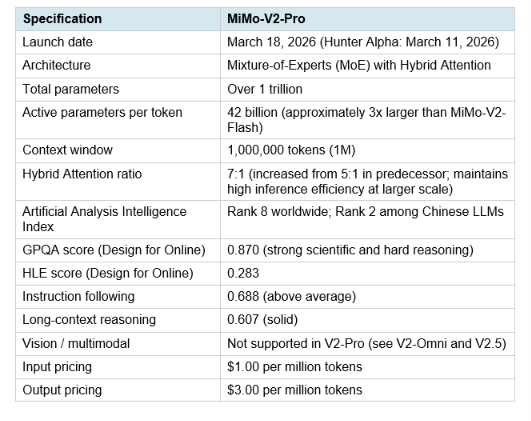
The Hybrid Attention mechanism with the 7:1 ratio is the architectural detail worth understanding. Standard transformer attention scales quadratically with context length: doubling the context length quadruples the attention computation. Hybrid Attention replaces some full-attention layers with sliding-window or linear-complexity attention, dramatically reducing the cost of long-context inference. Xiaomi increased the hybrid ratio from 5:1 to 7:1 in V2-Pro compared to the Flash predecessor, meaning a higher proportion of attention layers use the efficient variant. This is what allows a 1M-token context window to be commercially viable at $1/$3 per million tokens rather than requiring the 4 to 10x price premium that earlier 1M-context models charged. For the broader open-weight model competitive landscape where MiMo-V2-Pro sits, the GLM-5.2 vs Claude Opus vs GPT-5.6 vs Kimi coding comparison covers the full 2026 open-weight and closed-source coding model race that MiMo-V2-Pro entered.
3. The Team: Luo Fuli and the DeepSeek Connection
MiMo-V2-Pro was built by a team headed by Luo Fuli, a former leading researcher at DeepSeek. This connection explains two things that surprised the AI community about Hunter Alpha: the model's architectural feel, which multiple developers noted resembled DeepSeek's approach, and the model's quality relative to Xiaomi's consumer electronics reputation. The DeepSeek connection is worth taking seriously for what it implies about the team's capability and philosophy. DeepSeek became the most discussed Chinese AI lab in 2024 and 2025 specifically for its efficiency-first model design: maximizing capability per parameter, minimizing training and inference compute cost, and publishing research that demonstrated frontier-class performance at a fraction of the cost of Western labs' models. Luo Fuli bringing that philosophy to Xiaomi's MiMo project explains why MiMo-V2-Pro approaches Claude Opus 4.6 performance at Claude Haiku pricing. The community's initial assumption that Hunter Alpha was DeepSeek V4 was not as wrong as it sounds. It was built by someone who spent significant time at DeepSeek, using architectural approaches informed by that experience, on a scale that matches DeepSeek's ambition. The reveal that it was Xiaomi rather than DeepSeek was surprising because of the source company's identity, not because the model felt inconsistent with DeepSeek's approach.
4. Benchmark Performance: What the Numbers Say
MiMo-V2-Pro's benchmark position is more nuanced than the Hunter Alpha hype suggested. The correct read is: a model that performs at the frontier tier on agentic and tool-use benchmarks, approaches but does not beat Claude Opus 4.6 on coding and general intelligence, and dramatically undercuts the price of every model in its performance tier.
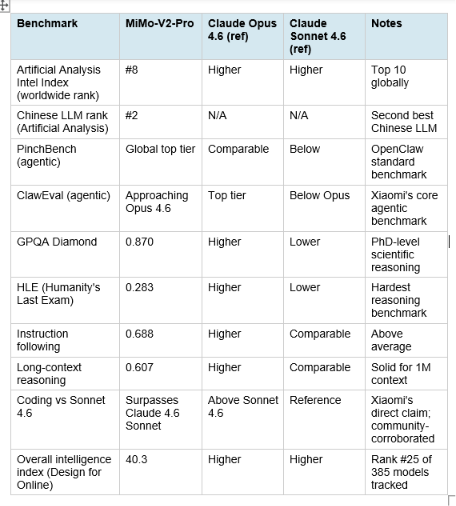
The honest benchmark read has three distinct layers. First: on agentic benchmarks (PinchBench and ClawEval), MiMo-V2-Pro achieves globally leading results. This is not vendor positioning; it is independently ranked on OpenRouter's benchmark display and corroborated by Design for Online's agentic index of 68. Second: on general intelligence and coding, MiMo-V2-Pro approaches but does not beat Claude Opus 4.6. Xiaomi's official language is precise: 'perceived performance approaching that of Opus 4.6.' Not exceeding. Not matching. Approaching. The community testing during Hunter Alpha corroborated this: in the majority of scenarios developers tested during the stealth week, MiMo-V2-Pro outperformed Claude 4.6 Sonnet, while the most challenging problems still showed Opus 4.6 ahead. Third: MiMo-V2-Pro surpasses Claude 4.6 Sonnet specifically on coding tasks. This is Xiaomi's direct claim, independently corroborated by the Hunter Alpha testing week. For teams that were using Sonnet 4.6 as their coding model at $3 per million input tokens, MiMo-V2-Pro at $1 per million delivers better coding output at one-third the cost.
5. Agentic Capability: Built for Agent Frameworks
The defining characteristic of MiMo-V2-Pro is not its raw intelligence ceiling. It is its optimization for agentic scenarios. The architecture, the training process, and the evaluation framework are all specifically designed for the question: how well does this model function as the reasoning core of an autonomous agent system? Xiaomi frames this explicitly in their official announcement: MiMo-V2-Pro is designed to serve as the brain of agent systems, orchestrating complex workflows, driving production engineering tasks, and delivering results reliably. The phrase 'reliably' is doing important work here. Many models can execute agentic tasks in isolation. Fewer execute them reliably across hundreds of sequential steps where a single wrong tool call or hallucinated function argument causes the entire workflow to fail. The training approach targets this specific reliability: MiMo-V2-Pro is fine-tuned via SFT (supervised fine-tuning) and RL (reinforcement learning) across complex, diverse agent scaffolds, with a focus on stronger tool-call accuracy and multi-step reasoning. The RL training uses a particularly interesting signal: the model is not just trained to produce correct answers, but to produce correct agent actions across realistic workflow chains where the evaluation spans the entire task, not just individual steps.
The scaling law dimension: Xiaomi claims that MiMo-V2-Pro demonstrates scaling laws that extend to agentic performance, not just text generation quality. As model size increases (V2-Pro at 1T parameters vs V2-Flash at approximately 309B), agentic capability scales alongside general reasoning, without the capability erosion that smaller models sometimes show when pushed into complex multi-step agent scenarios. This is the claim that matters most for teams choosing between MiMo-V2-Pro and the plethora of smaller, faster, cheaper alternatives. For the comparison against other 2026 models with strong agentic credentials, the best AI models July 2026 guide covers the full agentic benchmark landscape including Claude Code, GPT-5.6 Sol Ultra, and Kimi K2.7's Agent Swarm.
6. Coding Performance: Surpassing Claude 4.6 Sonnet
Coding is where MiMo-V2-Pro's most specific competitive claims live, and where independent community testing most clearly corroborated the official benchmarks. Two distinct coding capability dimensions are worth separating: raw code generation quality and software engineering within agentic workflows. On raw code generation, Xiaomi claims MiMo-V2-Pro's coding ability surpasses Claude 4.6 Sonnet. This was corroborated by the Hunter Alpha week: developers building real coding applications and testing against Sonnet 4.6 in side-by-side comparisons reported MiMo-V2-Pro as better on the majority of tasks. Xiaomi's internal engineers report that in deep evaluations, MiMo-V2-Pro's experience approaches Claude Opus 4.6, demonstrating stronger system design and task planning, more elegant code style, and more efficient problem-solving paths. The 'approaches' qualifier is consistent: not at Opus level, but meaningfully closer than Sonnet. On software engineering within agentic workflows, the Hunter Alpha test phase data is even more specific: the top apps by call volume during the Hunter Alpha test phase were all coding-focused tools. Engineers from companies with sophisticated AI infrastructure were choosing MiMo-V2-Pro for coding agent tasks over both Claude Sonnet 4.6 and GPT models available at the time. This is not benchmark preference; it is usage behavior from people with production stakes.
Frontend code is specifically called out as a strength. Within OpenClaw, MiMo-V2-Pro generates polished, fully functional web pages in a single query, balancing visual quality with practical usability. The specific example in the official announcement is a web page mimicking 1990s print magazine aesthetics, which is a non-trivial design constraint that requires both visual reasoning about the aesthetic and code generation that implements it accurately.
7. Pricing: The Cost Model That Shocked the Market
The pricing of MiMo-V2-Pro, at $1.00 per million input tokens and $3.00 per million output tokens, is the number that makes every other claim in this review strategically significant. To understand why, compare against the models it is being positioned against
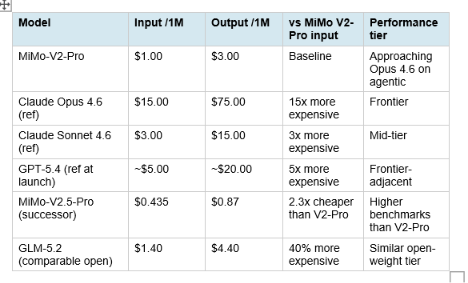
The pricing gap against Claude Opus 4.6 is the headline: MiMo-V2-Pro approaches Opus 4.6's agentic performance at $1/$3 versus Opus 4.6's $15/$75. That is a 15x input and 25x output price gap for a model in the same approximate performance neighborhood on the benchmarks that matter most for agent deployments. Even against the mid-tier Claude Sonnet 4.6, where MiMo-V2-Pro claims coding superiority, the price is one-third of Sonnet's input rate. For high-volume coding agent deployments where the API bill compounds daily, the difference between $1/$3 and $3/$15 is not a preference; it is a product decision that determines whether the business model of the application works. Context pricing adds nuance: Xiaomi offers tiered context pricing with 256K and 1M token tiers. Queries that fit within 256K tokens are significantly cheaper than 1M queries. Teams that can architect their agent workflows to stay within 256K context for most tasks, escalating to 1M only when genuinely needed, can reduce their effective per-query cost materially below the $1/$3 headline rate. MiMo Cache Write was temporarily free at launch, further reducing the cost of repeated context.
8. Agent Framework Integrations
MiMo-V2-Pro launched with day-one native integrations with five major agent development frameworks, with Xiaomi and each framework offering one week of free API access for new developers. This is not a marketing arrangement; it reflects the fact that MiMo-V2-Pro was specifically fine-tuned across diverse agent scaffolds and validated within these frameworks during the Hunter Alpha period.
- OpenClaw: the primary integration. OpenClaw is described as a general-purpose agent framework gaining significant traction in the open-source community, positioned as Xiaomi's reference agent environment. MiMo-V2-Pro was fine-tuned specifically for OpenClaw's PinchBench and ClawEval benchmarks, where it achieves globally leading results. The 1M-token context window is specifically described as making it comfortable for high-intensity, real-world OpenClaw application flows.
- OpenCode: coding-focused agent framework. The integration reflects MiMo-V2-Pro's specific coding strength and its performance in software engineering agentic workflows.
- KiloCode: a developer productivity-focused agent framework. The integration targets the vibe coding and developer workflow use cases where MiMo-V2-Pro's day-one community adoption was concentrated.
- Blackbox AI: an AI-native coding platform with its own agent capabilities. The integration extends MiMo-V2-Pro access to Blackbox's existing developer user base.
- Cline: a VS Code extension for AI-powered code editing with agentic capabilities. Cline's user base are developers who use AI models within their existing IDE workflows rather than dedicated agent platforms. The integration makes MiMo-V2-Pro accessible to this segment without requiring a platform switch.
For developers building on these frameworks, the framework integrations matter more than the raw model API for one specific reason: the fine-tuning across diverse agent scaffolds means MiMo-V2-Pro's tool-call accuracy and multi-step reasoning is specifically calibrated for these environments. A model that is good in general may still underperform a model that is specifically fine-tuned on the specific tool-call patterns and workflow structures of the framework you are using. For the developer tools where Cline and similar coding agents are most relevant, the 7 AI developer tools that changed workflow in August 2026 covers the coding agent landscape that MiMo-V2-Pro's framework integrations are targeting.
9. MiMo-V2-Pro vs Claude Opus 4.6 vs GPT-5.4 vs GLM-5.1
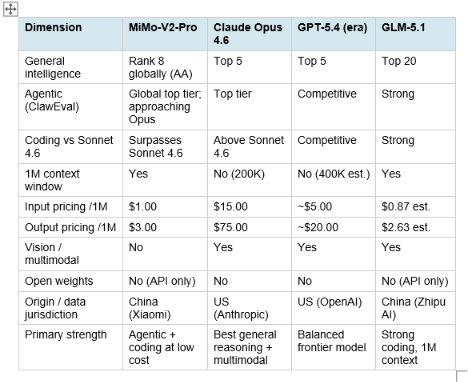
The honest competitive summary: MiMo-V2-Pro wins on price-performance for agentic and coding workloads by a wide margin against any model in its benchmark peer group. It does not win on general intelligence ceiling (Claude Opus 4.6 leads), vision and multimodal capability (no support in V2-Pro), or data jurisdiction for regulated industries (Chinese-hosted). For the specific use case of cost-efficient agentic AI with a large context window, there was nothing better priced this way when it launched in March 2026.
10. Data Jurisdiction: The China Question
MiMo-V2-Pro runs on servers operated by Xiaomi, a Chinese company. This means data processed through MiMo-V2-Pro's API is subject to Chinese data law, including provisions for government access that differ materially from EU GDPR and US data frameworks. ComputerTech's review documents this directly: 'Xiaomi hasn't published detailed data handling policies for international users.' This is the accurate summary of the situation as of the March 2026 launch. The Hunter Alpha controversy added a separate dimension: some competitors argued that the stealth launch allowed Xiaomi to gather competitive intelligence on developer usage patterns, preferences, and workflow structures without revealing the source. OpenRouter's decision to host anonymous models without disclosed provenance sparked debate about platform responsibility in the AI community. The practical guidance: for general developer workflows, research, and experimentation, the data jurisdiction question is often secondary to model quality and cost. For enterprise applications handling regulated data (healthcare, finance, legal, government), customer PII, or content that would create compliance issues if subject to Chinese data law, MiMo-V2-Pro requires explicit legal review before production deployment. The absence of detailed data handling policies for international users makes it unsuitable as a default choice for regulated industry production workloads until Xiaomi publishes comprehensive data governance documentation.
11. MiMo-V2-Pro vs MiMo-V2.5-Pro: What Changed
MiMo-V2.5-Pro launched on April 22, 2026, five weeks after MiMo-V2-Pro. For teams evaluating the MiMo family today, the relevant question is not just whether to use MiMo, but which generation to use. The changes in V2.5-Pro are significant enough that V2-Pro is primarily of historical and comparative interest for teams starting fresh today.
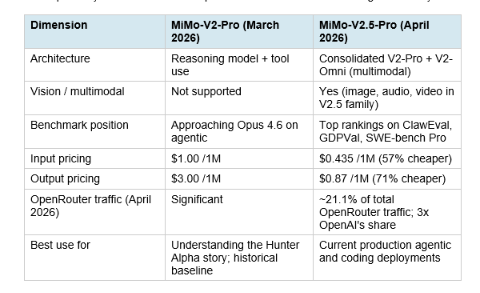
The short version: if you are building something new today and MiMo is on your shortlist, start with V2.5-Pro. It is cheaper, more capable, and adds the multimodal support that V2-Pro lacks. V2-Pro matters for understanding the history of how Xiaomi broke into the frontier AI market, for comparative analysis against the model benchmarks that were current in March 2026, and for anyone specifically evaluating the original Hunter Alpha launch story. For the complete MiMo-V2.5-Pro review including the V2.5 benchmark table and the SWE-bench Pro competitive analysis, the Xiaomi MiMo-V2.5-Pro review on Build Fast with AI covers the successor model in full detail.
12. Who Should Use MiMo-V2-Pro
For New Deployments
Use MiMo-V2.5-Pro instead. It is cheaper, multimodal, and has stronger benchmarks. The only reason to specifically use V2-Pro today is if you tested it during the Hunter Alpha period and have workflow-specific prompts or integrations already calibrated to its behavior.
For Historical Context and Competitive Analysis
MiMo-V2-Pro's Hunter Alpha launch is the most important case study in AI go-to-market strategy from early 2026. Any team building an AI product, evaluating market entry strategies, or thinking about how to validate a model before public launch should study the Hunter Alpha approach in detail. Seven days of anonymous production exposure produced more real-world validation data than most AI companies collect in their first month of operation.
For Agent Framework Developers Using OpenClaw or Cline
If you are building specifically on OpenClaw, the PinchBench and ClawEval fine-tuning in MiMo-V2-Pro is directly relevant. The model was optimized specifically for OpenClaw's evaluation framework, which means the tool-call patterns and workflow structures of OpenClaw match what MiMo-V2-Pro was trained on. This is a meaningful advantage over models that are general-purpose fine-tuned. Consider testing MiMo-V2-Pro and V2.5-Pro both if you are deeply embedded in the OpenClaw ecosystem. For the developer tools context where OpenClaw, Cline, and similar frameworks sit, the 7 AI developer tools that changed workflow in August 2026 covers the complete developer AI tools landscape
For Cost-Sensitive Teams Benchmarking Chinese Models
If you are evaluating the Chinese AI model ecosystem specifically for cost-performance reasons, MiMo-V2-Pro is the model that established the price-performance benchmark that every subsequent Chinese model (including MiMo-V2.5-Pro at an even lower price) has been measured against. Testing V2-Pro gives you the baseline for understanding how far the category has moved since March 2026.
Frequently Asked Questions
What is Xiaomi MiMo-V2-Pro and why did it trend?
MiMo-V2-Pro is Xiaomi's flagship foundation model, launched officially on March 18, 2026. It trended because of the Hunter Alpha stealth launch: from March 11 to March 18, 2026, Xiaomi deployed it anonymously on OpenRouter with no branding, let the developer community test it for free, and watched it top the daily usage charts before revealing its identity. The model processed over one trillion tokens before anyone knew it was a Xiaomi product. The reveal that a phone company had built a frontier-tier AI model and validated it in production before the competition could respond was the most significant AI launch story of early 2026.
What was Hunter Alpha and how does it relate to MiMo-V2-Pro?
Hunter Alpha was the internal codename for an early test build of MiMo-V2-Pro that Xiaomi deployed anonymously on OpenRouter on March 11, 2026. It was described as 'not the final performance' version. Despite being a pre-production build, it topped OpenRouter's daily usage charts for multiple consecutive days and processed over one trillion tokens before Xiaomi revealed its identity on March 18. The community assumed it was DeepSeek V4 based on its architecture and performance profile. Luo Fuli, MiMo's research head, confirmed the reveal on social media on March 18.
How does MiMo-V2-Pro compare to Claude Opus 4.6?
Xiaomi's own framing is 'approaching' Claude Opus 4.6, not matching or exceeding it. On agentic benchmarks (PinchBench, ClawEval), MiMo-V2-Pro achieves globally leading results that are close to Opus 4.6. On coding, MiMo-V2-Pro surpasses Claude 4.6 Sonnet but trails Opus 4.6 on the hardest tasks. On general intelligence and complex reasoning, Opus 4.6 maintains a meaningful lead. The critical context: MiMo-V2-Pro achieves this performance at $1/$3 per million tokens versus Opus 4.6's $15/$75, a 15x input and 25x output price gap.
What is the MiMo-V2-Pro pricing?
$1.00 per million input tokens and $3.00 per million output tokens. Context is tiered at 256K and 1M token windows; the 256K tier is cheaper for queries that fit within that window. MiMo Cache Write was temporarily free at launch. Access is via OpenRouter (xiaomi/mimo-v2-pro) or Xiaomi's own developer platform at platform.xiaomimimo.com.
Who is Luo Fuli and what is his connection to MiMo?
Luo Fuli is the head of Xiaomi's MiMo research division and a former leading researcher at DeepSeek. His DeepSeek background explains the architectural resemblance that led the community to assume Hunter Alpha was DeepSeek V4, and the efficiency-first model philosophy that produced frontier-tier performance at mid-range pricing. He confirmed the Hunter Alpha reveal publicly on March 18, 2026.
How does MiMo-V2-Pro differ from MiMo-V2.5-Pro?
MiMo-V2.5-Pro launched April 22, 2026, five weeks after V2-Pro. The key differences: V2.5-Pro consolidates the V2-Pro reasoning model and V2-Omni multimodal model into a single architecture (V2-Pro has no vision support). V2.5-Pro is significantly cheaper at $0.435/$0.87 per million tokens versus V2-Pro's $1.00/$3.00. V2.5-Pro achieves higher benchmark scores including top rankings on ClawEval, GDPVal, and SWE-bench Pro. For new deployments, use V2.5-Pro.
Is MiMo-V2-Pro safe to use for enterprise applications?
For general developer and commercial applications, MiMo-V2-Pro is safe to use with standard API security practices. For enterprises handling regulated data (healthcare, finance, government, legal), the model runs on Chinese-operated servers subject to Chinese data law. Xiaomi has not published detailed data handling policies for international users as of the March 2026 launch. Teams in regulated industries need explicit legal review before production deployment. The absence of major cloud platform availability (AWS Bedrock, Azure, Google Cloud) also limits enterprise adoption for organizations with existing cloud-native AI infrastructure.
Recommended Blogs
- Xiaomi MiMo-V2.5-Pro Review: The Successor Model Explained (April 2026)
- GLM-5.2 vs Claude Opus vs GPT-5.6 vs Kimi: Best Coding AI Model (2026)
- Best AI Models of July 2026: Full Ranking by Use Case, Benchmarks, and Price
- Grok 4.5 Review: xAI's 1.5 Trillion Parameter Beta Model Explained
- 7 AI Tools That Changed Developer Workflow (August 2026)
- Open-Source LLMs Collection: Every Major Open-Weight Release Tracked
Resources & Community
Join our community of 70,000+ AI enthusiasts and learn to build powerful AI applications! Whether you're a beginner or an experienced developer, Build Fast with AI helps you understand and implement AI in your projects.
- Website: buildfastwithai.com
- LinkedIn: Build Fast with AI
- Instagram: @buildfastwithai
- Founder Twitter: @satvikps
- Twitter: @BuildFastWithAI
Agentic AI Launchpad 2026
A structured 6-week cohort program that takes you from AI basics to building and deploying real-world agentic AI systems. Includes live sessions, expert mentorship, project reviews, and a builder community network.
Ready to go from learning to building? Join the next cohort: Agentic AI Launchpad 2026
Free AI Resources
Access free tools, workshops, and micro-learning to keep building:
- AI Workshops: Free resources, upcoming events and past recordings
- Unrot: Learn AI in 5 minutes a day (free micro-learning app)
The Chinese AI model ecosystem is moving faster than any other regional AI market in 2026. Follow @BuildFastWithAI on X to stay ahead of every MiMo release, OpenRouter leaderboard shift, and benchmark update that matters for developers and teams building with frontier AI.
References
- Xiaomi MiMo Official Page: MiMo-V2-Pro
- OpenRouter: MiMo-V2-Pro Model Card, Benchmarks, and Pricing
- OpenRouter: MiMo-V2-Pro Performance Metrics
- ComputerTech: Xiaomi MiMo-V2-Pro Review 2026: The Stealth Model That Fooled the AI Community
- Design for Online: Xiaomi MiMo-V2-Pro Review, Pricing, Benchmarks
- Build Fast with AI: Xiaomi MiMo-V2.5-Pro Review 2026
- Tosea.ai: How to Use MiMo-V2.5-Pro: Complete Guide
- OpenRouter: MiMo-V2.5-Pro Model Card

