
buildfastwithaibuildfastwithai
AI WorkshopsAll blogsAgentic AI Launchpad
Agentic AI Launchpad
Download Unrot App
Free AI Workshop
Mentorship

Agentic AI Launchpad

Go from user to builder in 6 weeks.

Explore Program
Share
Back to blogs
Reviews
Tutorials
LLMs
Coding

Grok 4.5 Review: xAI's 1.5T V9 Model Explained (Beta, June 2026)

June 29, 2026
46 min read
Share:
Grok 4.5 Review: xAI's 1.5T V9 Model Explained (Beta, June 2026)
Share:

Grok 4.5 Review: xAI's 1.5 Trillion Parameter Beta Model Explained

On June 28, 2026, Elon Musk confirmed on X that Grok 4.5 has entered private beta testing exclusively at SpaceX and Tesla. The model is built on xAI's V9 foundation, carries 1.5 trillion parameters, incorporated Cursor coding data during supplemental training, and is still being actively improved through reinforcement learning using the Grok Build coding harness. Early internal evaluations, per Musk's own characterization, show performance close to or potentially exceeding Claude Opus. That is a significant claim for a model that has not reached public access, but xAI is using a deliberate strategy here: test on the two most technically demanding engineering organizations Musk controls before unleashing it on the world. This review covers everything known about Grok 4.5 as of June 28, 2026: the V9 architecture, the Cursor training integration, what the Grok Build harness actually does, why SpaceX and Tesla specifically, what the competitive picture looks like against Claude Opus 4.8 and GPT-5.6, and when the public launch is likely to happen.

1. What Is Grok 4.5? The V9 Foundation Model Explained

Grok 4.5 is xAI's latest frontier language model, built on the V9 foundation model architecture. The V9 is a ground-up redesign of xAI's model foundation, not a fine-tune or variant of the previous v8-small architecture that currently handles production Grok traffic on X. The V9 completed its primary training run on May 26, 2026. The June 28 private beta represents the post-training and deployment phase of that base model. The V9 name is not just a version number. It signals a distinct architectural generation at xAI. The v8-small model, which has been serving Grok's public users throughout early 2026, runs at approximately 500 billion parameters. V9 runs at 1.5 trillion, a 3x scale increase across architectural generations. That scale jump, combined with Cursor supplemental training and active RL improvement via the Grok Build harness, is what separates Grok 4.5 from the 4.x variants that preceded it on V8 architecture.

For context on the Grok family that led to this point, the trajectory runs: Grok 4 (July 2025, V8, 256K context), Grok 4 Fast (V8, 2M context window), Grok 4.1 (coding-focused agentic release), Grok 4.20 (multi-agent 4-agent council, native 2M context, the current public flagship), Grok 4.3 (500B parameters, V8 architecture, available via $300/month heavy tier), and now Grok 4.5 (1.5T V9, private beta). Each generation has added something structurally new. 4.5's structural addition is the V9 foundation combined with Cursor-tuned supplemental training. For the full picture of the current Grok model lineup available to public users, the Best AI Models and Leaderboards collection tracks where every frontier model sits on current independent benchmarks.

2. The 1.5 Trillion Parameter Leap: Scale in Context

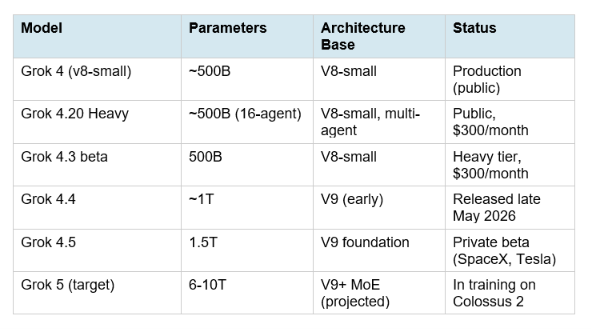
Parameter count alone does not determine capability, but it matters for understanding what xAI is attempting with 4.5. Here is the honest scale comparison:
Grok 4.5, xAI, Grok beta, V9 model, Cursor data, Grok Build, SpaceX Tesla, 1.5 trillion parameters

The 1.5 trillion parameter figure represents a 50% increase over Grok 4.4 (1 trillion) and a 3x increase over the v8-small architecture that runs public Grok today. In terms of raw scale, Grok 4.5 is the largest model xAI has deployed to any production environment, by a significant margin.

The important nuance: parameter count scales compute requirements and training cost, not output quality in a linear way. The 1.5T V9 base is meaningfully larger than the competition at the same tier: GPT-5.6 Sol's parameter count has not been disclosed, and Claude Opus 4.8 runs on a parameter count Anthropic has not published. What xAI has published is the training completion date (May 26, 2026), the supplemental training type (Cursor data), and the ongoing training method (RL via Grok Build). That is more transparency than most labs provide on in-progress models.

3. Cursor Training Data: Why Coding Got a Major Upgrade

The Cursor training addition is the most practically significant technical detail in the Grok 4.5 announcement. Cursor is an AI-powered code editor used by millions of professional developers for real-world coding workflows. When xAI says they added Cursor data in supplemental training, they mean Grok 4.5 has been exposed to and trained on a large volume of actual development sessions from Cursor users: real bugs, real debugging patterns, real architecture decisions, real refactoring passes, real tests. This is different from training on code repositories. Code repositories contain the artifact of development. Cursor data contains the process of development: the back-and-forth between a developer and an AI assistant, the accepted suggestions, the rejected edits, the follow-up queries, the context accumulated across a session. Training on this process teaches the model how good coding assistance actually behaves in practice, not just how good code looks in the abstract. The connection here is structural: SpaceX reportedly acquired Cursor in early 2026, with engineering leads from the Cursor team brought directly into xAI to work on Grok's coding capabilities. The Cursor training data in Grok 4.5 is therefore not a licensing arrangement. It is an integration of the Cursor team's institutional knowledge about what makes AI coding assistance genuinely useful into the Grok model's training pipeline.

For developers building on top of AI coding tools, the practical implication is straightforward: if Grok 4.5's Cursor-tuned supplemental training holds up under independent evaluation, it should meaningfully improve the model's performance on the tasks that developers actually care about in real sessions. Pair that with 1.5T V9 scale, and the coding benchmark gap between Grok and Claude Code or GPT-5.6 Sol becomes a real contest rather than a foregone conclusion. For developers building AI coding tools and workflows, the gen-ai-experiments coding and agentic workflow notebooks have practical implementations of model-agnostic agent patterns that work across Grok, Claude, and GPT model families.

4. The Grok Build Harness and Reinforcement Learning

Musk's X post referenced two things alongside the Cursor data that deserve unpacking: ongoing reinforcement learning and the Grok Build harness. The tweet was cut off before completing the Grok Build thought, which is an unusual piece of information that adds weight rather than subtracting from it. The Grok Build harness is xAI's internal coding infrastructure: the system that allows Grok to write, test, and iterate on code autonomously as part of its own training and evaluation loop. It functions as an automated software engineering environment where Grok can execute code, observe results, identify failures, revise implementations, and learn from that cycle. The practical effect is that the model is being evaluated and improved against real execution outcomes, not just human preference scores. Code either runs or it does not. Tests either pass or they fail. This is a form of reinforcement learning grounded in objective rather than subjective signals, which is why xAI can claim the model is improving measurably rather than directionally.

The reinforcement learning aspect is ongoing. Musk stated RL continues to significantly improve the model, present tense, during the private beta. This is meaningful: the model being tested at SpaceX and Tesla right now is not a frozen artifact of the May 26 training completion. It is an actively improving system being shaped by real-world engineering tasks at two of the most technically demanding companies in the world. xAI is using the private beta as a live RL training environment, not just a quality assurance phase.

Hot take: the Grok Build harness plus live RL during deployment is a development philosophy borrowed from systems engineering, not from the typical AI lab release playbook. Most AI models are frozen at a training checkpoint and deployed. Grok 4.5 is being improved at the same time it is being evaluated. That approach carries risk (you cannot cleanly attribute performance changes to specific improvements) but also produces faster iteration cycles than checkpoint-based development. Whether the output quality is better or worse than frozen-model deployment strategies will only be evident at public launch.

šŸš€ Cohort Waitlist Open
Go From AI User to AI Builder

Don't just use ChatGPT. Learn to build custom LLM agents, RAG pipelines, and full-stack Agentic AI apps in our intensive 6-week program.

6 Weeks Live Mentorship
Deploy 5+ Real-world Apps
Weekly App Templates & Code
No Coding Experience Required
Explore Program
Join 1,000+ graduates•Free Registration

5. Why SpaceX and Tesla First?

The choice of SpaceX and Tesla as the private beta environments is not random. It is the most strategically interesting detail of this launch, and it says something important about xAI's approach to model evaluation that differs from how OpenAI, Anthropic, and Google operate. OpenAI previews models with approximately 20 trusted partner organizations under government coordination, as seen with GPT-5.6. Anthropic runs Project Glasswing with approximately 50 vetted security and enterprise organizations. Both approaches use external organizations as evaluators but maintain separation between the model developer and the deployment environment. xAI's approach collapses that separation entirely. SpaceX and Tesla are not independent evaluators. They are Elon Musk's own companies. The private beta at these organizations means xAI can observe exactly how the model behaves on actual rocket trajectory analysis, vehicle software development, manufacturing process optimization, and related engineering tasks, with full access to the outputs and the ability to feed that data back into RL training.

The data flywheel this creates is unique in the current AI landscape. Most AI companies train on data produced by others and fine-tune on human preference ratings from contractors. xAI trains on data produced by some of the world's most technically demanding engineering organizations and fine-tunes using execution outcomes from those same organizations' real work. Whether this produces a materially better model for the public consumer use cases that most developers care about is a genuinely open question. But for industrial AI that needs to perform on aerospace and automotive engineering tasks, the training signal quality is genuinely differentiated.

Musk also revealed that xAI plans to release completely trained from scratch models through SpaceX every month for the rest of 2026. This is an aggressive cadence. Monthly frontier model releases from scratch training are not something any other AI lab has committed to publicly. Whether this is achievable at 1.5T parameter scale or whether it implies smaller, faster models trained within that cadence alongside the flagship releases is not yet clear. For context on how xAI's infrastructure supports this pace, the AI Industry News and Trends collection tracks Colossus capacity expansions, xAI funding rounds, and the broader compute infrastructure story as it develops.

6. Early Performance Evaluation: The Opus Comparison

Musk's claim: early evaluations show performance close to, perhaps exceeding Opus. "Opus" here refers to Anthropic's Claude Opus model family, with Opus 4.8 being the current public flagship. This claim requires significant unpacking before treating it as a benchmark result. First: these are internal evaluations conducted by xAI at SpaceX and Tesla, not independent third-party benchmarks. The model has not been submitted to Artificial Analysis, Chatbot Arena, or any publicly auditable evaluation framework. The evaluation tasks, scoring methodology, and comparison conditions are all undisclosed. Historically, xAI has made benchmark claims at announcement that held up under independent testing and others that did not. Both categories exist in the record.

Second: the Grok 4.5 being evaluated is an actively improving model under RL training. The version that enters public access will likely perform differently from the version that generated these early evals. Whether that difference is better or worse depends on how well the RL signal from SpaceX and Tesla engineering tasks generalizes to the broader distribution of public user queries.

Third: Musk's framing is deliberately hedged. 'Close to, perhaps exceeding' is not 'clearly better than.' This is not the aggressive benchmark-topping language Musk typically uses for models he is confident about. The hedge suggests xAI's internal evaluation showed competitive performance rather than a clean win. That is a meaningful signal to read carefully.

What we can say with confidence from the information available: Grok 4.5 at 1.5T parameters with Cursor-tuned supplemental training and ongoing RL improvement via Grok Build is a substantially more capable model than anything xAI has deployed publicly before. Whether it is competitive with Claude Opus 4.8 and GPT-5.6 Sol on the benchmarks that matter to developers and enterprises will be answered at public launch. The Best AI Models and Leaderboards collection will track independent benchmark results for Grok 4.5 as they become available after public access opens.

7. The xAI 2026 Roadmap: Monthly Model Releases

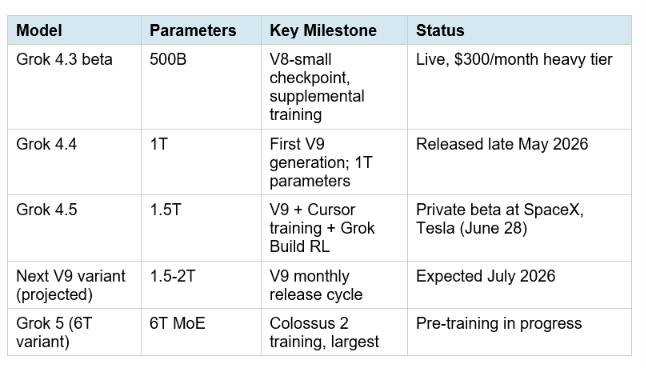
Musk's June 28 post contained a roadmap claim that is as significant as the Grok 4.5 announcement itself: xAI intends to release completely new, from-scratch-trained models through SpaceX every month for the rest of 2026. Here is the model sequence that has led to this point and what comes next:
1. What Is Grok 4.5? The V9 Foundation Model Explained
Grok 4.5 is xAI's latest frontier language model, built on the V9 foundation model architecture. The V9 is a ground-up redesign of xAI's model foundation, not a fine-tune or variant of the previous v8-small architecture that currently handles production Grok traffic on X. The V9 completed its primary training run on May 26, 2026. The June 28 private beta represents the post-training and deployment phase of that base model. The V9 name is not just a version number. It signals a distinct architectural generation at xAI. The v8-small model, which has been serving Grok's public users throughout early 2026, runs at approximately 500 billion parameters. V9 runs at 1.5 trillion, a 3x scale increase across architectural generations. That scale jump, combined with Cursor supplemental training and active RL improvement via the Grok Build harness, is what separates Grok 4.5 from the 4.x variants that preceded it on V8 architecture.

For context on the Grok family that led to this point, the trajectory runs: Grok 4 (July 2025, V8, 256K context), Grok 4 Fast (V8, 2M context window), Grok 4.1 (coding-focused agentic release), Grok 4.20 (multi-agent 4-agent council, native 2M context, the current public flagship), Grok 4.3 (500B parameters, V8 architecture, available via $300/month heavy tier), and now Grok 4.5 (1.5T V9, private beta). Each generation has added something structurally new. 4.5's structural addition is the V9 foundation combined with Cursor-tuned supplemental training. For the full picture of the current Grok model lineup available to public users, the Best AI Models and Leaderboards collection tracks where every frontier model sits on current independent benchmarks.

2. The 1.5 Trillion Parameter Leap: Scale in Context
Parameter count alone does not determine capability, but it matters for understanding what xAI is attempting with 4.5. Here is the honest scale comparison:

Model	Parameters	Architecture Base	Status
Grok 4 (v8-small)	~500B	V8-small	Production (public)
Grok 4.20 Heavy	~500B (16-agent)	V8-small, multi-agent	Public, $300/month
Grok 4.3 beta	500B	V8-small	Heavy tier, $300/month
Grok 4.4	~1T	V9 (early)	Released late May 2026
Grok 4.5	1.5T	V9 foundation	Private beta (SpaceX, Tesla)
Grok 5 (target)	6-10T	V9+ MoE (projected)	In training on Colossus 2

The 1.5 trillion parameter figure represents a 50% increase over Grok 4.4 (1 trillion) and a 3x increase over the v8-small architecture that runs public Grok today. In terms of raw scale, Grok 4.5 is the largest model xAI has deployed to any production environment, by a significant margin.

The important nuance: parameter count scales compute requirements and training cost, not output quality in a linear way. The 1.5T V9 base is meaningfully larger than the competition at the same tier: GPT-5.6 Sol's parameter count has not been disclosed, and Claude Opus 4.8 runs on a parameter count Anthropic has not published. What xAI has published is the training completion date (May 26, 2026), the supplemental training type (Cursor data), and the ongoing training method (RL via Grok Build). That is more transparency than most labs provide on in-progress models.

3. Cursor Training Data: Why Coding Got a Major Upgrade
The Cursor training addition is the most practically significant technical detail in the Grok 4.5 announcement. Cursor is an AI-powered code editor used by millions of professional developers for real-world coding workflows. When xAI says they added Cursor data in supplemental training, they mean Grok 4.5 has been exposed to and trained on a large volume of actual development sessions from Cursor users: real bugs, real debugging patterns, real architecture decisions, real refactoring passes, real tests. This is different from training on code repositories. Code repositories contain the artifact of development. Cursor data contains the process of development: the back-and-forth between a developer and an AI assistant, the accepted suggestions, the rejected edits, the follow-up queries, the context accumulated across a session. Training on this process teaches the model how good coding assistance actually behaves in practice, not just how good code looks in the abstract. The connection here is structural: SpaceX reportedly acquired Cursor in early 2026, with engineering leads from the Cursor team brought directly into xAI to work on Grok's coding capabilities. The Cursor training data in Grok 4.5 is therefore not a licensing arrangement. It is an integration of the Cursor team's institutional knowledge about what makes AI coding assistance genuinely useful into the Grok model's training pipeline.

For developers building on top of AI coding tools, the practical implication is straightforward: if Grok 4.5's Cursor-tuned supplemental training holds up under independent evaluation, it should meaningfully improve the model's performance on the tasks that developers actually care about in real sessions. Pair that with 1.5T V9 scale, and the coding benchmark gap between Grok and Claude Code or GPT-5.6 Sol becomes a real contest rather than a foregone conclusion. For developers building AI coding tools and workflows, the gen-ai-experiments coding and agentic workflow notebooks have practical implementations of model-agnostic agent patterns that work across Grok, Claude, and GPT model families.

4. The Grok Build Harness and Reinforcement Learning
Musk's X post referenced two things alongside the Cursor data that deserve unpacking: ongoing reinforcement learning and the Grok Build harness. The tweet was cut off before completing the Grok Build thought, which is an unusual piece of information that adds weight rather than subtracting from it. The Grok Build harness is xAI's internal coding infrastructure: the system that allows Grok to write, test, and iterate on code autonomously as part of its own training and evaluation loop. It functions as an automated software engineering environment where Grok can execute code, observe results, identify failures, revise implementations, and learn from that cycle. The practical effect is that the model is being evaluated and improved against real execution outcomes, not just human preference scores. Code either runs or it does not. Tests either pass or they fail. This is a form of reinforcement learning grounded in objective rather than subjective signals, which is why xAI can claim the model is improving measurably rather than directionally.

The reinforcement learning aspect is ongoing. Musk stated RL continues to significantly improve the model, present tense, during the private beta. This is meaningful: the model being tested at SpaceX and Tesla right now is not a frozen artifact of the May 26 training completion. It is an actively improving system being shaped by real-world engineering tasks at two of the most technically demanding companies in the world. xAI is using the private beta as a live RL training environment, not just a quality assurance phase.

Hot take: the Grok Build harness plus live RL during deployment is a development philosophy borrowed from systems engineering, not from the typical AI lab release playbook. Most AI models are frozen at a training checkpoint and deployed. Grok 4.5 is being improved at the same time it is being evaluated. That approach carries risk (you cannot cleanly attribute performance changes to specific improvements) but also produces faster iteration cycles than checkpoint-based development. Whether the output quality is better or worse than frozen-model deployment strategies will only be evident at public launch.

5. Why SpaceX and Tesla First?
The choice of SpaceX and Tesla as the private beta environments is not random. It is the most strategically interesting detail of this launch, and it says something important about xAI's approach to model evaluation that differs from how OpenAI, Anthropic, and Google operate. OpenAI previews models with approximately 20 trusted partner organizations under government coordination, as seen with GPT-5.6. Anthropic runs Project Glasswing with approximately 50 vetted security and enterprise organizations. Both approaches use external organizations as evaluators but maintain separation between the model developer and the deployment environment. xAI's approach collapses that separation entirely. SpaceX and Tesla are not independent evaluators. They are Elon Musk's own companies. The private beta at these organizations means xAI can observe exactly how the model behaves on actual rocket trajectory analysis, vehicle software development, manufacturing process optimization, and related engineering tasks, with full access to the outputs and the ability to feed that data back into RL training.

The data flywheel this creates is unique in the current AI landscape. Most AI companies train on data produced by others and fine-tune on human preference ratings from contractors. xAI trains on data produced by some of the world's most technically demanding engineering organizations and fine-tunes using execution outcomes from those same organizations' real work. Whether this produces a materially better model for the public consumer use cases that most developers care about is a genuinely open question. But for industrial AI that needs to perform on aerospace and automotive engineering tasks, the training signal quality is genuinely differentiated.

Musk also revealed that xAI plans to release completely trained from scratch models through SpaceX every month for the rest of 2026. This is an aggressive cadence. Monthly frontier model releases from scratch training are not something any other AI lab has committed to publicly. Whether this is achievable at 1.5T parameter scale or whether it implies smaller, faster models trained within that cadence alongside the flagship releases is not yet clear. For context on how xAI's infrastructure supports this pace, the AI Industry News and Trends collection tracks Colossus capacity expansions, xAI funding rounds, and the broader compute infrastructure story as it develops.

6. Early Performance Evaluation: The Opus Comparison
Musk's claim: early evaluations show performance close to, perhaps exceeding Opus. "Opus" here refers to Anthropic's Claude Opus model family, with Opus 4.8 being the current public flagship. This claim requires significant unpacking before treating it as a benchmark result. First: these are internal evaluations conducted by xAI at SpaceX and Tesla, not independent third-party benchmarks. The model has not been submitted to Artificial Analysis, Chatbot Arena, or any publicly auditable evaluation framework. The evaluation tasks, scoring methodology, and comparison conditions are all undisclosed. Historically, xAI has made benchmark claims at announcement that held up under independent testing and others that did not. Both categories exist in the record.

Second: the Grok 4.5 being evaluated is an actively improving model under RL training. The version that enters public access will likely perform differently from the version that generated these early evals. Whether that difference is better or worse depends on how well the RL signal from SpaceX and Tesla engineering tasks generalizes to the broader distribution of public user queries.

Third: Musk's framing is deliberately hedged. 'Close to, perhaps exceeding' is not 'clearly better than.' This is not the aggressive benchmark-topping language Musk typically uses for models he is confident about. The hedge suggests xAI's internal evaluation showed competitive performance rather than a clean win. That is a meaningful signal to read carefully.

What we can say with confidence from the information available: Grok 4.5 at 1.5T parameters with Cursor-tuned supplemental training and ongoing RL improvement via Grok Build is a substantially more capable model than anything xAI has deployed publicly before. Whether it is competitive with Claude Opus 4.8 and GPT-5.6 Sol on the benchmarks that matter to developers and enterprises will be answered at public launch. The Best AI Models and Leaderboards collection will track independent benchmark results for Grok 4.5 as they become available after public access opens.

7. The xAI 2026 Roadmap: Monthly Model Releases
Musk's June 28 post contained a roadmap claim that is as significant as the Grok 4.5 announcement itself: xAI intends to release completely new, from-scratch-trained models through SpaceX every month for the rest of 2026. Here is the model sequence that has led to this point and what comes next:

Model	Parameters	Key Milestone	Status
Grok 4.3 beta	500B	V8-small checkpoint, supplemental training	Live, $300/month heavy tier
Grok 4.4	1T	First V9 generation; 1T parameters	Released late May 2026
Grok 4.5	1.5T	V9 + Cursor training + Grok Build RL	Private beta at SpaceX, Tesla (June 28)
Next V9 variant (projected)	1.5-2T	V9 monthly release cycle	Expected July 2026
Grok 5 (6T variant)	6T MoE	Colossus 2 training, largest public model if launched	Pre-training in progress
Grok 5 (10T variant)	10T	Ultimate 2026 target	In training, no public timeline

The monthly release cadence is notable for two reasons. First, it implies xAI believes the V9 foundation model is a platform it can iterate on rapidly, shipping improved variants of the same base architecture with different supplemental training, RL, and fine-tuning on a monthly cycle. This is closer to how software companies release product updates than how AI labs have traditionally shipped models. Second, the SpaceX delivery channel is an unusual mechanism for AI model distribution. What exactly constitutes 'releasing a model through SpaceX' is not fully clarified. Whether SpaceX acts as a production environment, an evaluation pipeline, a distribution partner, or some combination is ambiguous. The most likely interpretation is that SpaceX's engineering teams continue to serve as the primary evaluation environment for each monthly release, giving xAI live RL signal from real engineering work at scale. For builders who want to prepare their infrastructure for rapidly evolving model APIs, the AI Automation and No-Code collection covers model-agnostic architecture patterns that allow switching between model providers without rebuilding workflows.

8. Grok 4.5 vs GPT-5.6 Sol and Claude Opus 4.8
This comparison is necessarily incomplete because Grok 4.5 has no public benchmark data. But based on what is known, here is the most accurate picture available:
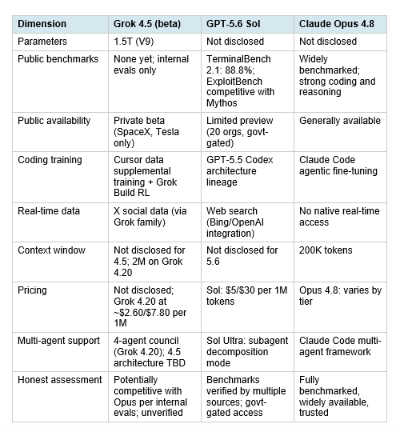
Dimension	Grok 4.5 (beta)	GPT-5.6 Sol	Claude Opus 4.8
Parameters	1.5T (V9)	Not disclosed	Not disclosed
Public benchmarks	None yet; internal evals only	TerminalBench 2.1: 88.8%; ExploitBench competitive with Mythos	Widely benchmarked; strong coding and reasoning
Public availability	Private beta (SpaceX, Tesla only)	Limited preview (20 orgs, govt-gated)	Generally available
Coding training	Cursor data supplemental training + Grok Build RL	GPT-5.5 Codex architecture lineage	Claude Code agentic fine-tuning
Real-time data	X social data (via Grok family)	Web search (Bing/OpenAI integration)	No native real-time access
Context window	Not disclosed for 4.5; 2M on Grok 4.20	Not disclosed for 5.6	200K tokens
Pricing	Not disclosed; Grok 4.20 at ~$2.60/$7.80 per 1M	Sol: $5/$30 per 1M tokens	Opus 4.8: varies by tier
Multi-agent support	4-agent council (Grok 4.20); 4.5 architecture TBD	Sol Ultra: subagent decomposition mode	Claude Code multi-agent framework
Honest assessment	Potentially competitive with Opus per internal evals; unverified	Benchmarks verified by multiple sources; govt-gated access	Fully benchmarked, widely available, trusted

The honest competitive picture as of June 28, 2026: xAI is the only lab where the most capable current model is not yet publicly accessible at all. GPT-5.6 Sol is limited to 20 government-approved partners but has a clear path to broad availability in July 2026. Claude Opus 4.8 is generally available and extensively benchmarked. Grok 4.5 has no public access path, no benchmark data, and no confirmed general availability date. That context does not diminish Grok 4.5's potential significance. But it does mean the comparison above is a forward-looking projection, not a present-tense competitive analysis. The race is real, but it has not been run yet. The moment Grok 4.5 enters public evaluation is when the Opus comparison becomes meaningful. The GPT-5.6 review on Build Fast with AI covers the competitive landscape from OpenAI's side with full benchmark data for reference.

9. The Grok Ecosystem Before 4.5: What Users Have Now
While Grok 4.5 is in private beta, the publicly accessible Grok ecosystem in late June 2026 is already competitive on several dimensions most users care about. Grok 4.20 is the current public flagship, available via grok.com, X Premium, and the xAI API. Key capabilities of the current public ecosystem: a native 2M token context window on Fast variants (larger than GPT-5.4, Gemini 3.1 Pro, and Claude Opus 4.8 combined), real-time X social data access that no other public model offers, a 4-agent collaborative architecture where Grok (coordinator), Harper (research), Benjamin (math and code), and Lucas (synthesis and creativity) work in parallel and debate conclusions before synthesizing final answers, and a Voice Agent API that launched with sub-one-second time-to-first-audio, the lowest latency of any commercial voice agent and the top scorer on Big Bench Audio at launch.

Grok 4.20 holds a Chatbot Arena Elo of approximately 1,493 as of April 2026, competitive with Gemini 3.1 Pro and positioned just below GPT-5.4 at the time. On Humanity's Last Exam, the hardest available reasoning benchmark, the Grok 4 series scored 50.7%, leading frontier models on that specific evaluation. On generation speed, Grok leads the frontier at 235 tokens per second versus approximately 80 for comparable models.

The public API offers solid developer ergonomics: structured outputs, Files API for document upload and knowledge base search, remote MCP tools support for tool calling from MCP servers, and Text-to-Speech and Speech-to-Text APIs both generally available in 25 languages. The batch API supports image and video generation alongside chat completions. For developers building on the Grok API today, the gen-ai-experiments API integration notebooks have working examples for Grok API usage patterns including streaming, tool calling, and multi-turn agent sessions.

10. When Will Grok 4.5 Be Publicly Available?
No public release date has been confirmed by xAI as of June 28, 2026. The original internal timeline had targeted a late May 2026 launch for the V9 medium model, which appears to correspond to what became Grok 4.5. The private beta deployment at SpaceX and Tesla on June 28 means the model is already running on real-world data, which is the last major stage before broader access.

Realistic timeline based on available information:

•	July 2026 (most likely): xAI has committed to a monthly release cadence. The private beta at SpaceX and Tesla typically precedes broader release by weeks, not months. A July 2026 public launch for Grok 4.5 or a V9-based model is the most plausible window.
•	Access tier at launch: based on the Grok 4.3 precedent (heavy tier at $300/month), 4.5 may launch to paid heavy tier subscribers first before broader access. The Grok 4.20 pattern (beta launch to all, full API access several weeks later) is also possible.
•	API access: xAI has been consistent about API parity with consumer access on recent releases. Expect grok-4-5 or grok-v9 model identifiers in the API shortly after or alongside public consumer launch.
•	Benchmark data: independent benchmark results will appear within days of public access. Artificial Analysis, Chatbot Arena, and independent researchers typically evaluate new frontier models within the first week of access.

The honest answer is that xAI has not disclosed a date and has a recent history of launching behind originally projected timelines. The V9 medium model was originally expected in mid-June. It became Grok 4.5 in private beta at the end of June. Public access may follow quickly or may slip further depending on what the SpaceX and Tesla beta reveals.

11. What Grok 4.5 Means for Enterprise AI Teams
For Engineering and Development Teams
The Cursor training angle is the most directly relevant capability signal for software development teams. If Grok 4.5's supplemental training on real developer workflows translates into better code completion, better bug diagnosis, and better architectural reasoning, it becomes a serious contender in the AI coding tools category currently dominated by Claude Code, GPT-5.6 Sol/Terra, and Cursor's own built-in models. The Grok Build RL harness gives xAI an ongoing improvement mechanism that does not require new training runs to get better at coding tasks. For engineering teams evaluating AI coding tools in mid-2026, Grok 4.5 deserves a spot on the evaluation list alongside Claude Code and GPT-5.6, pending public access. The AI Coding Tools collection on Build Fast with AI tracks benchmark comparisons for AI coding assistants as new model versions ship.

For Teams Using X Data and Real-Time Signals
Grok's native X integration remains a unique capability that 4.5 will inherit. For teams building social intelligence tools, news monitoring systems, trend detection, or real-time sentiment analysis, no other frontier model offers the same live data pipeline. If the underlying model capability of 4.5 reaches public-access parity with GPT-5.6 and Opus on reasoning benchmarks, Grok becomes the default choice for any enterprise workflow that needs frontier reasoning plus real-time X data in a single API call.

For Budget-Conscious Teams
Grok 4.20 today offers a Chatbot Arena Elo competitive with Gemini 3.1 Pro at approximately $2.60 per million input tokens and $7.80 per million output tokens. That is cheaper than GPT-5.6 Sol at $5/$30, cheaper than Claude Opus 4.8, and significantly cheaper than Fable 5 at $10/$50. If Grok 4.5 launches at similar or slightly higher pricing while delivering Opus-competitive performance, the cost-quality ratio becomes very difficult for competing labs to match at the frontier tier.


Frequently Asked Questions
What is Grok 4.5 and when did it enter beta?
Grok 4.5 is xAI's latest frontier language model, built on the V9 foundation model with 1.5 trillion parameters. It entered private beta testing at SpaceX and Tesla on June 28, 2026, as confirmed by Elon Musk on X. The model completed primary training on May 26, 2026, and is currently being improved through reinforcement learning using xAI's internal Grok Build coding harness during the beta period. No public access date has been confirmed.

What is the V9 foundation model powering Grok 4.5?
The V9 is a ground-up redesign of xAI's model foundation, distinct from the v8-small architecture that currently handles production Grok traffic on X. V9 runs at 1.5 trillion parameters for Grok 4.5, approximately three times larger than the 500 billion parameter v8-small. The V9 completed training on May 26, 2026. xAI plans to continue releasing V9-based model variants on a monthly cadence through the rest of 2026, with Grok 5 targeting 6 to 10 trillion parameters on an extended timeline.

Why is Grok 4.5 only available at SpaceX and Tesla?
xAI uses SpaceX and Tesla as the primary real-world evaluation environments for new frontier models before broader release. Both organizations provide access to demanding engineering tasks: SpaceX uses the model for aerospace engineering analysis, and Tesla uses it for vehicle software development and manufacturing workflows. This deployment strategy gives xAI live reinforcement learning signal from real-world technical tasks, allowing ongoing model improvement during the beta period rather than requiring a separate post-deployment fine-tuning phase.

How does Grok 4.5 compare to Claude Opus 4.8?
Per Elon Musk's June 28 X post, early internal evaluations show Grok 4.5 performance close to or potentially exceeding Claude Opus 4.8. These are internal xAI evaluations conducted at SpaceX and Tesla, not independent third-party benchmarks. No publicly auditable benchmark data exists for Grok 4.5 as of the announcement. The comparison will be verifiable when Grok 4.5 reaches public access and enters independent evaluation on Artificial Analysis, Chatbot Arena, and similar platforms.

What is the Grok Build harness?
The Grok Build harness is xAI's internal coding infrastructure: an automated software engineering environment where Grok can write code, execute it, observe outcomes (tests pass or fail, code runs or crashes), and learn from that execution cycle via reinforcement learning. It provides objective rather than subjective training signals because code execution produces deterministic pass or fail outcomes. Musk stated that the Grok Build harness gets better every day during the beta period, meaning the RL improvement signal is being refined continuously alongside model deployment.

How does Cursor training data improve Grok 4.5 coding performance?
Cursor is an AI-powered code editor with millions of professional developer users. Cursor training data includes real development sessions: actual bugs, debugging patterns, architectural decisions, refactoring passes, and the back-and-forth between developers and AI coding assistants in real workflows. This teaches the model how good coding assistance behaves in practice, not just what good code looks like. xAI integrated Cursor data via supplemental training after the V9 base model completed pre-training, allowing targeted coding capability improvement without full retraining.

When will Grok 4.5 be publicly available?
No public release date has been confirmed by xAI. The model entered private beta at SpaceX and Tesla on June 28, 2026, which is typically the last major phase before broader access. Based on xAI's stated monthly release cadence and the private beta timing, a July 2026 public launch is the most plausible window. Access will likely start with paid heavy tier subscribers before expanding to all users and the public API.

What is xAI's model roadmap for 2026?
xAI's 2026 roadmap, per Musk's statements, includes: Grok 4.4 (1T, released late May 2026), Grok 4.5 (1.5T V9, private beta June 28, 2026), additional monthly V9-based releases through SpaceX throughout 2026, Grok 5 at 6T using a Mixture-of-Experts architecture (in pre-training on Colossus 2), and a 10T Grok 5 variant as the ultimate 2026 target. The monthly release cadence for the V9 family is the most unusual commitment, implying xAI plans to ship meaningfully improved variants every 30 days for the rest of the year.


Recommended Blogs
•	Best AI Models and Leaderboards: Cross-Model Rankings July 2026
•	GPT-5.6 Review: Sol, Terra, Luna Features, Benchmarks, and Pricing
•	AI Industry News and Trends: Model Releases and Enterprise AI Updates
•	AI Coding Tools Collection: Claude Code, Codex, Cursor and the Best Developer AI
•	Best AI for Coding 2026: GPT Codex, Claude Code, Grok and More Compared
•	Agentic AI Launchpad 2026: Build Real AI Systems in 6 Weeks


Resources & Community
Join our community of 70,000+ AI enthusiasts and learn to build powerful AI applications! Whether you're a beginner or an experienced developer, Build Fast with AI helps you understand and implement AI in your projects.
•	Website: buildfastwithai.com
•	LinkedIn: Build Fast with AI
•	Instagram: @buildfastwithai
•	Founder Twitter: @satvikps
•	Twitter: @BuildFastWithAI

Agentic AI Launchpad 2026
A structured 6-week cohort program that takes you from AI basics to building and deploying real-world agentic AI systems. Includes live sessions, expert mentorship, project reviews, and a builder community network.
Ready to go from learning to building? Join the next cohort: Agentic AI Launchpad 2026

Free AI Resources
Access free tools, workshops, and micro-learning to keep building:
•	AI Workshops: Free resources, upcoming events and past recordings
•	Unrot: Learn AI in 5 minutes a day (free micro-learning app)


xAI is moving faster than any other AI lab in 2026. Follow @BuildFastWithAI on X to stay ahead of every Grok release, benchmark result, and xAI infrastructure update that matters for builders and enterprise teams.

References
•	Elon Musk on X: Grok 4.5 private beta announcement (June 28, 2026)
•	CryptoBriefing: xAI Unveils Grok 4.5, Significant Upgrade Powered by 1.5T V9 Model
•	CryptoBriefing: Grok 4.5 Enters Private Beta at SpaceX and Tesla
•	Basenor: Grok 4.5 Enters Private Beta at Tesla and SpaceX
•	TechnoSports: Grok 4.5 Enters Private Beta at SpaceX and Tesla, Musk Says It Rivals Opus
•	Whalesbook: Elon Musk Grok 4.5 Enters Private Beta at SpaceX and Tesla
•	Sangri Today: Elon Musk Reveals Grok 4.5 Powered by 1.5T Parameters, Private Beta Begins
•	The Hans India: Grok 4.5 Enters Private Testing at SpaceX, Tesla: Elon Musk
•	MEXC News: Grok 4.5 Enters Private Beta (June 28, 2026)
•	AI/ML API Blog: Grok 4.20 Review 2026 (Grok family context and benchmarks)
•	Suprmind: Grok by xAI Complete Guide to Models, Features and Pricing
•	MindStudio: xAI Grok Roadmap: 7 Models in Training Now, Grok 5 at 10T Parameters
•	xAI Docs: Release Notes (API changelog for Grok model family)

The monthly release cadence is notable for two reasons. First, it implies xAI believes the V9 foundation model is a platform it can iterate on rapidly, shipping improved variants of the same base architecture with different supplemental training, RL, and fine-tuning on a monthly cycle. This is closer to how software companies release product updates than how AI labs have traditionally shipped models. Second, the SpaceX delivery channel is an unusual mechanism for AI model distribution. What exactly constitutes 'releasing a model through SpaceX' is not fully clarified. Whether SpaceX acts as a production environment, an evaluation pipeline, a distribution partner, or some combination is ambiguous. The most likely interpretation is that SpaceX's engineering teams continue to serve as the primary evaluation environment for each monthly release, giving xAI live RL signal from real engineering work at scale. For builders who want to prepare their infrastructure for rapidly evolving model APIs, the AI Automation and No-Code collection covers model-agnostic architecture patterns that allow switching between model providers without rebuilding workflows.

8. Grok 4.5 vs GPT-5.6 Sol and Claude Opus 4.8

This comparison is necessarily incomplete because Grok 4.5 has no public benchmark data. But based on what is known, here is the most accurate picture available:

. Grok 4.5 vs GPT-5.6 Sol and Claude Opus 4.8

The honest competitive picture as of June 28, 2026: xAI is the only lab where the most capable current model is not yet publicly accessible at all. GPT-5.6 Sol is limited to 20 government-approved partners but has a clear path to broad availability in July 2026. Claude Opus 4.8 is generally available and extensively benchmarked. Grok 4.5 has no public access path, no benchmark data, and no confirmed general availability date. That context does not diminish Grok 4.5's potential significance. But it does mean the comparison above is a forward-looking projection, not a present-tense competitive analysis. The race is real, but it has not been run yet. The moment Grok 4.5 enters public evaluation is when the Opus comparison becomes meaningful. The GPT-5.6 review on Build Fast with AI covers the competitive landscape from OpenAI's side with full benchmark data for reference.

9. The Grok Ecosystem Before 4.5: What Users Have Now

While Grok 4.5 is in private beta, the publicly accessible Grok ecosystem in late June 2026 is already competitive on several dimensions most users care about. Grok 4.20 is the current public flagship, available via grok.com, X Premium, and the xAI API. Key capabilities of the current public ecosystem: a native 2M token context window on Fast variants (larger than GPT-5.4, Gemini 3.1 Pro, and Claude Opus 4.8 combined), real-time X social data access that no other public model offers, a 4-agent collaborative architecture where Grok (coordinator), Harper (research), Benjamin (math and code), and Lucas (synthesis and creativity) work in parallel and debate conclusions before synthesizing final answers, and a Voice Agent API that launched with sub-one-second time-to-first-audio, the lowest latency of any commercial voice agent and the top scorer on Big Bench Audio at launch.

Grok 4.20 holds a Chatbot Arena Elo of approximately 1,493 as of April 2026, competitive with Gemini 3.1 Pro and positioned just below GPT-5.4 at the time. On Humanity's Last Exam, the hardest available reasoning benchmark, the Grok 4 series scored 50.7%, leading frontier models on that specific evaluation. On generation speed, Grok leads the frontier at 235 tokens per second versus approximately 80 for comparable models.

The public API offers solid developer ergonomics: structured outputs, Files API for document upload and knowledge base search, remote MCP tools support for tool calling from MCP servers, and Text-to-Speech and Speech-to-Text APIs both generally available in 25 languages. The batch API supports image and video generation alongside chat completions. For developers building on the Grok API today, the gen-ai-experiments API integration notebooks have working examples for Grok API usage patterns including streaming, tool calling, and multi-turn agent sessions.

10. When Will Grok 4.5 Be Publicly Available?

No public release date has been confirmed by xAI as of June 28, 2026. The original internal timeline had targeted a late May 2026 launch for the V9 medium model, which appears to correspond to what became Grok 4.5. The private beta deployment at SpaceX and Tesla on June 28 means the model is already running on real-world data, which is the last major stage before broader access.

Realistic timeline based on available information:

  • July 2026 (most likely): xAI has committed to a monthly release cadence. The private beta at SpaceX and Tesla typically precedes broader release by weeks, not months. A July 2026 public launch for Grok 4.5 or a V9-based model is the most plausible window.
  • Access tier at launch: based on the Grok 4.3 precedent (heavy tier at $300/month), 4.5 may launch to paid heavy tier subscribers first before broader access. The Grok 4.20 pattern (beta launch to all, full API access several weeks later) is also possible.
  • API access: xAI has been consistent about API parity with consumer access on recent releases. Expect grok-4-5 or grok-v9 model identifiers in the API shortly after or alongside public consumer launch.
  • Benchmark data: independent benchmark results will appear within days of public access. Artificial Analysis, Chatbot Arena, and independent researchers typically evaluate new frontier models within the first week of access.

The honest answer is that xAI has not disclosed a date and has a recent history of launching behind originally projected timelines. The V9 medium model was originally expected in mid-June. It became Grok 4.5 in private beta at the end of June. Public access may follow quickly or may slip further depending on what the SpaceX and Tesla beta reveals.

11. What Grok 4.5 Means for Enterprise AI Teams

For Engineering and Development Teams

The Cursor training angle is the most directly relevant capability signal for software development teams. If Grok 4.5's supplemental training on real developer workflows translates into better code completion, better bug diagnosis, and better architectural reasoning, it becomes a serious contender in the AI coding tools category currently dominated by Claude Code, GPT-5.6 Sol/Terra, and Cursor's own built-in models. The Grok Build RL harness gives xAI an ongoing improvement mechanism that does not require new training runs to get better at coding tasks. For engineering teams evaluating AI coding tools in mid-2026, Grok 4.5 deserves a spot on the evaluation list alongside Claude Code and GPT-5.6, pending public access. The AI Coding Tools collection on Build Fast with AI tracks benchmark comparisons for AI coding assistants as new model versions ship.

For Teams Using X Data and Real-Time Signals

Grok's native X integration remains a unique capability that 4.5 will inherit. For teams building social intelligence tools, news monitoring systems, trend detection, or real-time sentiment analysis, no other frontier model offers the same live data pipeline. If the underlying model capability of 4.5 reaches public-access parity with GPT-5.6 and Opus on reasoning benchmarks, Grok becomes the default choice for any enterprise workflow that needs frontier reasoning plus real-time X data in a single API call.

For Budget-Conscious Teams

Grok 4.20 today offers a Chatbot Arena Elo competitive with Gemini 3.1 Pro at approximately $2.60 per million input tokens and $7.80 per million output tokens. That is cheaper than GPT-5.6 Sol at $5/$30, cheaper than Claude Opus 4.8, and significantly cheaper than Fable 5 at $10/$50. If Grok 4.5 launches at similar or slightly higher pricing while delivering Opus-competitive performance, the cost-quality ratio becomes very difficult for competing labs to match at the frontier tier.

Frequently Asked Questions

What is Grok 4.5 and when did it enter beta?

Grok 4.5 is xAI's latest frontier language model, built on the V9 foundation model with 1.5 trillion parameters. It entered private beta testing at SpaceX and Tesla on June 28, 2026, as confirmed by Elon Musk on X. The model completed primary training on May 26, 2026, and is currently being improved through reinforcement learning using xAI's internal Grok Build coding harness during the beta period. No public access date has been confirmed.

What is the V9 foundation model powering Grok 4.5?

The V9 is a ground-up redesign of xAI's model foundation, distinct from the v8-small architecture that currently handles production Grok traffic on X. V9 runs at 1.5 trillion parameters for Grok 4.5, approximately three times larger than the 500 billion parameter v8-small. The V9 completed training on May 26, 2026. xAI plans to continue releasing V9-based model variants on a monthly cadence through the rest of 2026, with Grok 5 targeting 6 to 10 trillion parameters on an extended timeline.

Why is Grok 4.5 only available at SpaceX and Tesla?

xAI uses SpaceX and Tesla as the primary real-world evaluation environments for new frontier models before broader release. Both organizations provide access to demanding engineering tasks: SpaceX uses the model for aerospace engineering analysis, and Tesla uses it for vehicle software development and manufacturing workflows. This deployment strategy gives xAI live reinforcement learning signal from real-world technical tasks, allowing ongoing model improvement during the beta period rather than requiring a separate post-deployment fine-tuning phase.

How does Grok 4.5 compare to Claude Opus 4.8?

Per Elon Musk's June 28 X post, early internal evaluations show Grok 4.5 performance close to or potentially exceeding Claude Opus 4.8. These are internal xAI evaluations conducted at SpaceX and Tesla, not independent third-party benchmarks. No publicly auditable benchmark data exists for Grok 4.5 as of the announcement. The comparison will be verifiable when Grok 4.5 reaches public access and enters independent evaluation on Artificial Analysis, Chatbot Arena, and similar platforms.

What is the Grok Build harness?

The Grok Build harness is xAI's internal coding infrastructure: an automated software engineering environment where Grok can write code, execute it, observe outcomes (tests pass or fail, code runs or crashes), and learn from that execution cycle via reinforcement learning. It provides objective rather than subjective training signals because code execution produces deterministic pass or fail outcomes. Musk stated that the Grok Build harness gets better every day during the beta period, meaning the RL improvement signal is being refined continuously alongside model deployment.

How does Cursor training data improve Grok 4.5 coding performance?

Cursor is an AI-powered code editor with millions of professional developer users. Cursor training data includes real development sessions: actual bugs, debugging patterns, architectural decisions, refactoring passes, and the back-and-forth between developers and AI coding assistants in real workflows. This teaches the model how good coding assistance behaves in practice, not just what good code looks like. xAI integrated Cursor data via supplemental training after the V9 base model completed pre-training, allowing targeted coding capability improvement without full retraining.

When will Grok 4.5 be publicly available?

No public release date has been confirmed by xAI. The model entered private beta at SpaceX and Tesla on June 28, 2026, which is typically the last major phase before broader access. Based on xAI's stated monthly release cadence and the private beta timing, a July 2026 public launch is the most plausible window. Access will likely start with paid heavy tier subscribers before expanding to all users and the public API.

What is xAI's model roadmap for 2026?

xAI's 2026 roadmap, per Musk's statements, includes: Grok 4.4 (1T, released late May 2026), Grok 4.5 (1.5T V9, private beta June 28, 2026), additional monthly V9-based releases through SpaceX throughout 2026, Grok 5 at 6T using a Mixture-of-Experts architecture (in pre-training on Colossus 2), and a 10T Grok 5 variant as the ultimate 2026 target. The monthly release cadence for the V9 family is the most unusual commitment, implying xAI plans to ship meaningfully improved variants every 30 days for the rest of the year.

Recommended Blogs

  • Best AI Models and Leaderboards: Cross-Model Rankings July 2026
  • GPT-5.6 Review: Sol, Terra, Luna Features, Benchmarks, and Pricing
  • AI Industry News and Trends: Model Releases and Enterprise AI Updates
  • AI Coding Tools Collection: Claude Code, Codex, Cursor and the Best Developer AI
  • Best AI for Coding 2026: GPT Codex, Claude Code, Grok and More Compared
  • Agentic AI Launchpad 2026: Build Real AI Systems in 6 Weeks

Resources & Community

Join our community of 70,000+ AI enthusiasts and learn to build powerful AI applications! Whether you're a beginner or an experienced developer, Build Fast with AI helps you understand and implement AI in your projects.

  • Website: buildfastwithai.com
  • LinkedIn: Build Fast with AI
  • Instagram: @buildfastwithai
  • Founder Twitter: @satvikps
  • Twitter: @BuildFastWithAI

Agentic AI Launchpad 2026

A structured 6-week cohort program that takes you from AI basics to building and deploying real-world agentic AI systems. Includes live sessions, expert mentorship, project reviews, and a builder community network.

Ready to go from learning to building? Join the next cohort: Agentic AI Launchpad 2026

Free AI Resources

Access free tools, workshops, and micro-learning to keep building:

  • AI Workshops: Free resources, upcoming events and past recordings
  • Unrot: Learn AI in 5 minutes a day (free micro-learning app)

xAI is moving faster than any other AI lab in 2026. Follow @BuildFastWithAI on X to stay ahead of every Grok release, benchmark result, and xAI infrastructure update that matters for builders and enterprise teams.

References

  • Elon Musk on X: Grok 4.5 private beta announcement (June 28, 2026)
  • CryptoBriefing: xAI Unveils Grok 4.5, Significant Upgrade Powered by 1.5T V9 Model
  • CryptoBriefing: Grok 4.5 Enters Private Beta at SpaceX and Tesla
  • Basenor: Grok 4.5 Enters Private Beta at Tesla and SpaceX
  • TechnoSports: Grok 4.5 Enters Private Beta at SpaceX and Tesla, Musk Says It Rivals Opus
  • Whalesbook: Elon Musk Grok 4.5 Enters Private Beta at SpaceX and Tesla
  • Sangri Today: Elon Musk Reveals Grok 4.5 Powered by 1.5T Parameters, Private Beta Begins
  • The Hans India: Grok 4.5 Enters Private Testing at SpaceX, Tesla: Elon Musk
  • MEXC News: Grok 4.5 Enters Private Beta (June 28, 2026)
  • AI/ML API Blog: Grok 4.20 Review 2026 (Grok family context and benchmarks)
  • Suprmind: Grok by xAI Complete Guide to Models, Features and Pricing
  • MindStudio: xAI Grok Roadmap: 7 Models in Training Now, Grok 5 at 10T Parameters

xAI Docs: Release Notes (API changelog for Grok model family)

Enjoyed this article? Share it →
Share:
    You Might Also Like
    7 AI Tools That Changed Development (December 2025 Guide)
    Tools
    7 AI Tools That Changed Development (December 2025 Guide)

    7 AI tools reshaping development: Google Workspace Studio, DeepSeek V3.2, Gemini 3 Deep Think, Kling 2.6, FLUX.2, Mistral 3, and Runway Gen-4.5.

    Claude Design: Complete Guide for Non-Designers (2026)
    Tutorials
    Claude Design: Complete Guide for Non-Designers (2026)

    Anthropic launched Claude Design on April 17, 2026. Turn text prompts into prototypes, pitch decks & UI mockups — no Figma needed. Full guide inside.