



Every AI demo is a pitch for work that has not been done yet. The demo runs on ten clean documents, the model answers perfectly, the room nods, and everyone feels the future arriving. Then six months pass, the demo is dead, and nothing shipped. If that story sounds familiar, you are not alone, and you did not fail on the model. You failed on the 80 percent of the work that nobody scoped, costed, or owned. This is the blueprint for the part that actually matters.
I have watched sharp teams build a proof of concept in two weeks and then spend a year unable to put it in front of a single real user. The pattern is always the same, and it has almost nothing to do with accuracy. It has everything to do with the gap between a demo and a system. This post breaks down why AI POCs fail, the hidden 80 percent, and a field-tested path from a working demo to a live system that survives March.
The POC-to-Production Gap: What Nobody Tells You
The POC-to-production gap is the distance between an AI demo that works in a controlled setting and an AI system that runs reliably for real users, and most AI projects die inside it. Industry trackers have long reported that a large majority of AI projects never make it into production, with figures often cited in the range of 70 to 85 percent depending on the study. The exact number matters less than the pattern: building the demo is not the hard part, and pretending it is sets every project up to stall.
Here is the uncomfortable truth. A proof of concept is designed to prove a model can do a task. Production is designed to do the task, every day, for people who did not build it, on data nobody cleaned, inside systems nobody documented. Those are different projects with different budgets, and treating the second as a small extension of the first is exactly why so many pilots become expensive graveyards.
This is also why the Forward Deployed Engineer role has become the most important hire in applied AI. The FDE exists to close this gap, to take the messy 80 percent seriously from day one. If you want the market context for the role, our guide on the forward deployed engineer salary in India covers who does this work and what they are paid to do it.
The Demo Is the Easy 20%. Here Is the Other 80%.
The demo is the easiest 20 percent of an AI project, and the other 80 percent is the list nobody costs. A demo needs a model, a prompt, and a few clean examples. A production system needs live data, permissions, the four other systems it talks to, a plan for when one of them is down, someone who approves the output, and someone who fixes it in March. That list is where the budget, the timeline, and the risk actually live.
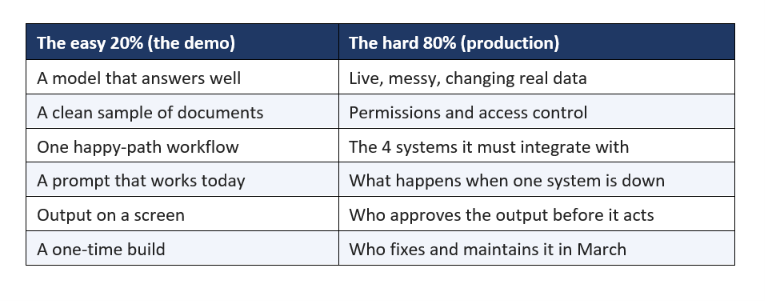
Read that right column again, because it is the real project. None of it shows up in a demo, and all of it shows up in production. The teams that ship are the ones that put a rupee figure and an owner against every row before they start, not after the pilot stalls. The teams that fail are the ones that budgeted for the model and forgot the system around it.
Why AI POCs Fail: The 6 Real Reasons
AI POCs fail for six recurring reasons, and none of them is model accuracy. After enough dead demos, the pattern is clear, and every reason is a version of the same mistake: mistaking the demo for the system.
No production data. The POC ran on clean, hand-picked documents. Production data is messy, inconsistent, and full of edge cases the demo never saw.
No owner. The demo had a champion. Production has nobody accountable for it on Monday morning, so it quietly rots.
No integrations. The demo stood alone. Production has to read from and write to systems that may have no clean API.
No failure plan. The demo assumed everything works. Production has to handle the day a dependency is down or the input is garbage.
No approval boundary. The demo showed output on a screen. Production has to decide what the AI may do alone and what needs a human.
No evals. The demo was judged by vibes in a meeting. Production needs measurable checks, or you have a lucky demo, not a system.
My blunt take: if your AI project stalled, look at this list and you will find the cause in the first three items nine times out of ten. The model was never the problem. The organisation around the model was.
The Ownership Problem: Nobody Runs It on Monday
The single biggest reason AI pilots fail is organisational, not technical: nobody owns the system on Monday morning. A pilot has a champion who wills it into existence for the demo. Production needs a named person accountable for it running, for the exceptions, and for the fix when it breaks. Without that person, even a technically perfect system decays, because software that nobody owns is software that nobody maintains.
This reframes the whole category, and it is the version of the problem a CTO actually has the authority to fix. You cannot fix a foundation model, but you can assign an owner, define who approves the output, and decide what the system is allowed to do alone. That is a governance decision, and it is what boards are really asking about when they ask about AI risk. Draw the line between what the agent may do alone and what needs a human, and draw it early, because most teams draw it far too late.
The practical fix is to make ownership a line item before the build starts. Who runs it, who approves it, who fixes it, and what is the escalation when it fails. If you cannot name those people, you do not have a production plan, you have a demo with ambitions. To ground the team in how modern AI agents actually behave before you assign that ownership, our beginner guide to agentic AI is a solid primer.
The Data Reality: Hinglish, Scanned PDFs, 14 Date Formats
The fastest way an AI POC dies in an Indian company is the data it meets on day one: Hinglish, scanned PDFs, and fourteen different date formats. Your demo tested on clean, typed, English documents. Real business data is a mix of languages in a single sentence, photographed or scanned paper instead of digital text, handwriting, inconsistent number formats, and dates written every way a human can invent. The model that aced the demo meets this reality and stumbles.
This is not a corner case, it is the norm, and it is exactly the part a demo hides. A RAG system works beautifully because it was tested on the clean documents. Point it at the actual archive, with its scans and its Hinglish and its 12 percent of files that are simply unreadable, and the accuracy you promised evaporates. The proof of a real system is what it does with the messy 12 percent, not the clean 88 percent, because anyone can handle the happy path and every technical buyer knows it.
The edge case is the proof. A system that only works on clean data is a demo. A system that handles Hinglish, scans, and unreadable files with a sensible fallback is production.
The blueprint here is to test on the ugly data first, not last. Pull a real, representative sample, including the failures, and design the pipeline around what actually arrives: OCR for scans, language handling for Hinglish, normalisation for the date and number chaos, and a clear path for the documents the system cannot read. Design for the 12 percent, and the 88 percent takes care of itself.
The Integration Trap: When the System Has No API
The most common production blocker in the Indian mid-market is a system with no API, and the demo never had to touch it. Your AI can be perfect and still be useless if it cannot read from and write to the tools the business actually runs on: an old ERP, a desktop application, a portal with no integration, a process where four people move data between systems by hand. Those four people, not the legacy software, are usually the real problem the AI has to solve.
There are three patterns that actually work when a system has no clean API, and a real deployment uses whichever fits: a proper integration where one exists, a robotic or browser-automation layer where it does not, and, as the honest last resort, a human-in-the-loop step that the system is designed around rather than pretending away. The mistake is assuming a clean API exists, budgeting for it, and discovering in month three that the core system is a 15-year-old application nobody can extend.
The lesson for the blueprint is to map the integrations before you build, not after. List every system the workflow touches, confirm how the AI will read and write each one, and cost the ugly ones honestly. Legacy systems are rarely the reason a project fails. The failure comes from not planning for them. For teams choosing the tools that sit on top of these integrations, our roundup of the best AI coding agents of 2026 and our explainer on the Model Context Protocol are useful references.
No Evals, No System, Just a Lucky Demo
If your AI agent has no evaluations, you do not have a system, you have a lucky demo. An eval is a repeatable test that measures whether the AI does its job correctly on real cases, and it is what turns a one-time impressive output into something you can trust in production. Without evals, you cannot tell whether a change made things better or worse, you cannot catch regressions, and you cannot prove to anyone that the system works. You are just hoping.
This is the line that separates engineering from theatre. A demo is judged by how it feels in a meeting. A system is judged by numbers: how often it is right, how it fails, how it behaves on the hard cases. Building an eval suite is not glamorous, which is exactly why most stalled pilots never did it, and it is the first thing a serious deployment sets up. Eleven things separate a system from a demo, and evals is the one buyers use to fail their own project the moment they hear it.
The blueprint move is simple: before you scale a POC, build a small set of real test cases, including the failures, and score every version against them. It is unglamorous work, and it is the difference between a system you can defend and a demo you can only cross your fingers over.
The Blueprint: How to Take an AI POC to Production
Taking an AI POC to production is a five-step discipline that front-loads the hard 80 percent instead of discovering it too late. Follow this and the gap becomes crossable.
- Scope the 80 percent first. Before writing code, list the real data, the permissions, the integrations, the failure modes, the approval boundary, and the owner. Put a cost against each.
- Assign an owner on day one. Name the person accountable for running it, approving it, and fixing it. No owner, no production.
- Test on the ugly data. Build the pipeline around the messy real sample, including the unreadable 12 percent, not the clean demo set.
- Wire in real systems and failure handling. Integrate the actual tools, and design what happens when one is down or the input is bad.
- Add evals and an approval line. Measure correctness on real cases, and decide what the AI may do alone versus what needs a human.
Notice that only one of these five steps is about the model. The other four are about the system, the data, and the organisation, which is exactly where the 80 percent lives. This is the work a Forward Deployed Engineer does, and it is the work the DEPLOY program is built to deliver, so a demo becomes a live system in weeks instead of a pilot that dies in a quarter.
A POC That Shipped: What They Did Differently
Here is an illustrative contrast that shows the whole argument in one place. Two companies build the same thing: an AI system to read incoming vendor invoices and post them to their accounting tool. Company A demos it in two weeks on twenty clean sample invoices, everyone is thrilled, and eight months later it has never processed a real invoice. Company B spends the first week on the boring 80 percent and ships to production in six weeks.
What did Company B do differently? They pulled a real sample of 500 invoices, including the scanned ones, the Hinglish ones, and the 12 percent that were unreadable, and designed for all of it. They confirmed how the AI would write into the accounting tool before building, discovering it had no clean API and planning a browser-automation fallback. They named the finance-ops lead as the owner, defined that anything above a value threshold needs human approval, and built a small eval set of real invoices to score every change. None of that is glamorous, and all of it is why one shipped and one did not.
The moral is not that Company B was smarter. It is that they treated the 80 percent as the project from day one instead of discovering it after the demo. That single choice is the difference between a system running in production and a demo gathering dust, and it is exactly the discipline a Forward Deployed Engineer brings to a build.
Signs Your AI POC Will Never Reach Production
You can usually tell a POC will never ship long before it stalls, because the warning signs are organisational, not technical. If you recognise more than two of these in your own project, you are heading for the graveyard, and the fix is to address them now rather than after another quarter of drift.
- Nobody can name the person who owns it on Monday.
- It was only ever tested on clean, hand-picked data.
- The integration plan is a slide, not a working connection.
- There is no answer for what happens when a dependency is down.
- Success is judged by how the demo felt, not by any measured score.
- The approval boundary between AI and human is undefined.
Each of these maps directly to one of the six failure reasons, and each is fixable, but only if you treat it as part of the project rather than a detail to sort out later. The teams that ship do the unglamorous work of closing these gaps early. The teams that fail keep polishing the demo and hope the gaps close themselves. They never do.
How Long Should It Take to Ship?
A focused AI workflow should move from POC to a live, owned system in weeks, not the many months most stalled projects take. The reason a real deployment is fast is not that the work is small, it is that the hard 80 percent is scoped and owned from day one, so there is no mid-project discovery of the integration nobody planned for or the data nobody tested. Speed comes from front-loading the hard part, not from skipping it.
When a project drags past a few months with no production date, the cause is almost never the model. It is an unresolved 80 percent: an integration that turned out harder than the slide suggested, data that broke the pipeline, or an owner who was never assigned. A project that has been six months in staging is not close to done, it is stuck on the part that was always the real work, and no amount of extra demo polish will move it. This is exactly the gap a Forward Deployed Engineer is hired to close in weeks.
Build, Buy, or Deploy: The Honest Choice
Once you accept that the 80 percent is the real project, the build-buy-deploy decision gets clearer. Building in-house means hiring the rare people who can do this work and accepting a long ramp. Buying a generic tool means bending your messy, specific workflow to fit someone else's happy path. Deploying with a specialist team means someone owns the 80 percent from day one and hands you a live system, not a demo.
For a company with twenty engineers and no AI engineer, the honest math usually favours a focused deployment over a long in-house build, because the scarce skill is not writing prompts, it is closing the production gap on your real systems. That is the whole premise of a Forward Deployed Engineer and of a fixed-scope DEPLOY build: take the messy 80 percent off your plate and ship the thing that runs.
Whatever you choose, choose with the 80 percent in view. The single most expensive mistake in applied AI is budgeting for the demo and discovering the system. Scope the hard part first, own it, and the POC-to-production gap stops being where your projects go to die. For the wider model landscape behind these builds, our best AI models of 2026 ranking keeps you current.
FAQ
Why do AI POCs fail to reach production?
AI POCs fail because the demo is the easy 20 percent of the work and the other 80 percent, the real data, permissions, integrations, failure handling, approval, and ownership, is never scoped or costed. The model is rarely the problem. The system and the organisation around the model are where projects stall.
What percentage of AI projects never make it to production?
Industry studies commonly report that roughly 70 to 85 percent of AI projects never reach production, depending on the survey and definition. The exact figure varies, but the consistent finding is that most pilots stall in the gap between a working demo and a reliable live system.
How do you move an AI POC to production?
Move an AI POC to production by scoping the hard 80 percent first: assign an owner, test on real messy data, wire in the actual systems with failure handling, add evaluations, and define the approval boundary between the AI and a human. Only one of these steps is about the model itself.
What is the difference between an AI POC and production?
A POC proves a model can do a task on clean data in a controlled setting. Production does the task every day for real users, on messy real data, inside real systems, with someone accountable for it. They are different projects with different budgets, which is why treating production as a small extension of the POC fails.
Who should own an AI project after the demo?
A named person must own the system on Monday: accountable for running it, approving its output, handling exceptions, and fixing it when it breaks. Ownership is the single biggest predictor of whether a pilot reaches production, because software nobody owns is software nobody maintains.
How long should it take to move an AI POC to production?
A focused single-workflow system should reach production in weeks when the hard 80 percent is scoped and owned from the start. Projects that drag on for many months are almost always stuck on an unresolved integration, messy data, or a missing owner, not on the AI model. Long staging times signal an unscoped 80 percent, not a hard model problem.
Why do most AI pilots fail on organisation, not technology?
Most AI pilots fail organisationally because the model usually works while the system around it has no owner, no integration plan, no failure handling, and no approval boundary. These are decisions a CTO can make and a demo cannot reveal. Fixing the organisation around the model, not the model, is what turns a pilot into a production system.
Can AI work with legacy systems that have no API?
Yes, using one of three patterns: a proper integration where an API exists, a robotic or browser-automation layer where it does not, or a designed human-in-the-loop step as an honest last resort. The failure comes from assuming a clean API exists, not from the legacy system itself.
What is the difference between a demo and a production AI system?
A demo shows a model producing good output on clean data in a controlled setting. A production system does the job reliably every day on real messy data, inside real systems, with permissions, failure handling, evals, an approval boundary, and an owner. Roughly eleven concrete things separate the two, and none of them is the model itself.
Recommended Blogs
- Forward Deployed Engineer Salary India 2026 (Bands)
- What Is Agentic AI? Complete Beginner's Guide
- Best AI Coding Agents 2026: Claude Code vs Codex vs Cursor
- What Is MCP (Model Context Protocol)? Complete 2026 Guide
- Best AI Models 2026: Full Ranked Analysis and Benchmarks