



Nano Banana 2 Lite Review: Fastest AI Image Generator? Benchmarks, Pricing and Worth It (2026)
On June 30, 2026, Google shipped Nano Banana 2 Lite, officially designated gemini-3.1-flash-lite-image, the fastest and cheapest model in the Nano Banana family. It generates a 1K-resolution image in under four seconds, costs $0.034 per 1,000 images, achieves a Text-to-Image Arena Elo score of 1,251 that beats Nano Banana Pro's 1,245, and is available immediately through Google AI Studio, the Gemini API, and the Gemini Enterprise Agent Platform. It is simultaneously rolling out inside Google consumer products including AI Mode in Search, the Gemini app, NotebookLM, Google Photos, Google Stitch, Google Flow, and Google Ads. The launch came alongside Gemini Omni Flash, a new video generation and editing model priced at $0.10 per second of output, and Google explicitly frames the two as a paired pipeline: generate an image rapidly with Nano Banana 2 Lite, then animate it with Gemini Omni Flash. That pairing is the strategic context this review is really about. This review covers everything you need to know before integrating Nano Banana 2 Lite: what it is, where it fits in the family, what the benchmarks actually say, how pricing works across different access paths, where it is clearly the right choice, and where you should reach for Nano Banana 2 standard or Pro instead.
1. What Is Nano Banana 2 Lite?
Nano Banana 2 Lite is Google's fastest and most cost-efficient AI image generation model, built on the Gemini 3.1 Flash Lite architecture. The model ID for API access is gemini-3.1-flash-lite-image. It is the newest and lightest member of Google's Nano Banana image generation family, designed specifically for high-volume, latency-sensitive workflows where speed and cost per image matter more than maximum output resolution. The name "Nano Banana" originated as a community shorthand for Google's Gemini Flash Image models. AI Video Bootcamp, a community of over 20,000 creators, popularized the term because the model punches well above its weight class for a free-to-access tool. The nickname stuck across creator communities and Google has now adopted it as the official product family name. Lite is positioned as an upgrade and replacement for the original Nano Banana (gemini-2.5-flash-image), which Google now classifies as a legacy model. Google's own developer blog explicitly recommends that developers currently using the first-generation model swap to Nano Banana 2 Lite for immediate improvements across key performance dimensions: better quality, faster speed, and lower cost simultaneously.
The launch also marks an important positioning shift: Nano Banana 2 Lite is not just targeting individual creators and developers. It is rolling out directly into Google's enterprise products and consumer surfaces simultaneously, making it the backbone of AI image generation across Google's entire product ecosystem from day one. For context on how this fits the broader AI image and video landscape in 2026, the AI Image and Video Generation collection on Build Fast with AI covers all major model releases, pricing updates, and competitive developments in this category.
2. The Nano Banana Family: Where Lite Fits
Google now ships four distinct image generation models under the Nano Banana banner, each targeting a different point on the speed-quality-cost curve. Understanding where Lite sits is essential before deciding whether it is right for your workflow.
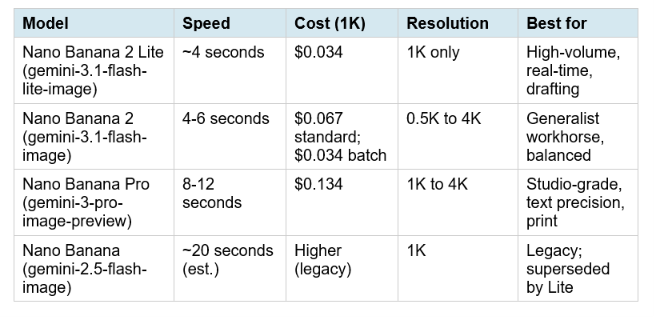
The strategic distinction between Lite and Nano Banana 2 standard deserves careful attention. At the same $0.034 per image price, Nano Banana 2 standard and Nano Banana 2 Lite appear to cost the same when you use the Batch API. However, Nano Banana 2 standard's $0.034 batch rate requires asynchronous delivery within 24 hours, while Nano Banana 2 Lite delivers synchronously in 4 seconds at that same flat rate. For real-time interactive applications, Lite is not just faster — it is the only economically viable option at this price point.
3. Benchmarks: Elo Scores and Speed Data
The benchmark headline that makes Nano Banana 2 Lite genuinely surprising is its Text-to-Image Arena Elo score of 1,251, which beats both the legacy Nano Banana (Elo 1,151) and Nano Banana Pro (Elo 1,245) on the same text-to-image track. This is a meaningful result: the fastest, cheapest model in the family scores higher in blind human-preference evaluations than the premium tier. Google's explanation for this counterintuitive result is in the architecture. Nano Banana 2 Lite was not just stripped-down Nano Banana 2. It received targeted capability enhancements specifically tuned for the 1K canvas at speed: upgraded world knowledge for contextual scene generation, enhanced character consistency for sequential image streams, and improved localized typographic rendering. These improvements compound into a higher Elo score because text-to-image arena evaluators are asking the kinds of questions Lite was specifically trained to handle.
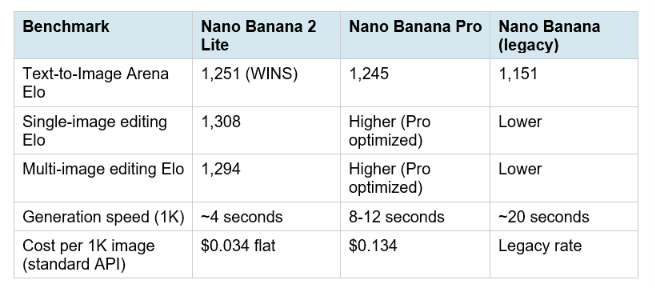
The editing Elo scores deserve independent attention. Single-image editing at 1,308 and multiple-image editing at 1,294 establish Nano Banana 2 Lite as a competitive editing model even before considering its speed advantage. These scores are internally published by Google, not yet independently verified by Artificial Analysis or equivalent third parties. The caveat applies: treat them as credible vendor claims that warrant validation against your specific task distribution before committing to production routing. For comparison with the broader AI image model landscape, the Krea 2 open-source review covering Raw and Turbo shows how the 2-second Krea 2 Turbo generation competes at the same speed tier with different quality characteristics.
Hot take: the Elo-1,251 result beating Nano Banana Pro at Elo-1,245 will seem paradoxical until you understand what text-to-image arena evaluations actually measure. They measure how much human evaluators prefer the output given the prompt, not absolute image quality in isolation. A faster model that better interprets conversational, real-world prompts (which is what the Lite's world knowledge enhancements targeted) can score higher even if a slow Pro model produces more technically detailed images for complex studio briefs. The right takeaway: Lite is better at typical developer and creator prompts. Pro is better at the specific hard cases it was optimized for.
4. Pricing: Every Access Path Explained
Nano Banana 2 Lite's pricing is its most unambiguous differentiator: $0.034 per 1,000 images at 1K resolution, available synchronously in real time. No other major AI image generation model offers this combination of speed and cost at this quality tier. To translate: $0.034 per 1,000 images is $0.000034 per image. At that rate, generating 10,000 images costs $0.34. Generating 1 million images costs $34.00. For e-commerce teams generating product variant imagery at scale, advertising platforms running A/B test variation generation, or consumer apps where image generation is a core interactive feature, the economics at this price point are categorically different from every alternative.
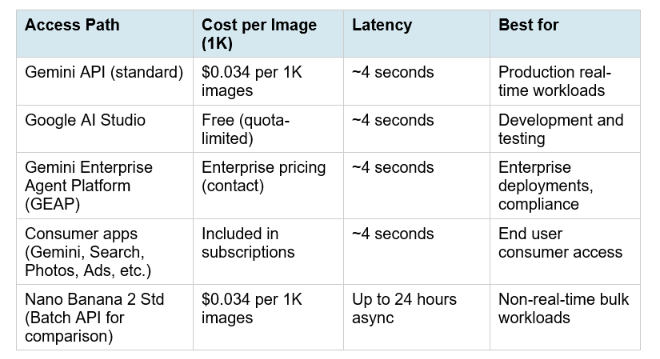
The consumer surface rollout is strategically significant for developers building on top of Google's ecosystem. Nano Banana 2 Lite is arriving simultaneously in Gemini app, AI Mode in Search, NotebookLM, Google Photos, Google Stitch, Google Flow, and Google Ads. This means the same model driving your API workloads is the same model your end users experience in Google's consumer products, which simplifies quality expectations and prompt engineering calibration. The grounding fee caveat is worth carrying forward from the Nano Banana 2 Standard pricing pattern: if you use Nano Banana 2 Lite to generate images based on real-time web data (current news events, recent product launches, live pricing), Google applies a search grounding fee of approximately $14 per 1,000 search queries beyond the free monthly allowance. This does not affect the $0.034 image generation rate itself, but adds cost to prompts that require web-grounded generation.
5. Core Capabilities: What Works Well at This Speed
World Knowledge and Contextual Generation
Google explicitly upgraded Nano Banana 2 Lite's world knowledge as part of the architectural tuning, specifically enabling it to generate accurate contextual scenes and location-specific mockups on demand. This means prompts like 'a product photo set in a Tokyo convenience store in the style of Japanese packaging design' or 'a marketing banner for a Diwali sale using regional color conventions' produce contextually accurate outputs without manual scene description. For teams producing localized content at scale, this capability eliminates a significant prompt engineering overhead that existed in earlier image generation models.
Character Consistency Across Sequential Generations
Character consistency, keeping a subject's visual identity stable across multiple images, has historically been one of the hardest problems in high-volume AI image generation workflows. Nano Banana 2 Lite received specific enhancements here, targeting digital fashion try-ons and storyboarding tools where object identity needs to remain stable across sequential image frames. The practical result: generating five or ten product images with the same character across different backgrounds, poses, or situations is significantly more reliable with Lite than with the legacy Nano Banana model.
Typographic Rendering
Legible in-image text generation is one of the capabilities that has changed the economics of AI image generation for commercial design work. Nano Banana 2 Lite maintains the typographic rendering improvements introduced in Nano Banana 2 standard, adapted for the 1K canvas. Independent testing on Nano Banana 2 standard showed 87% text accuracy (readable, correct spelling) across 100 prompts with varying fonts, sizes, and languages. Lite at 1K resolution will not match Pro for dense, fine-detail typography in complex infographics, but for social media graphics, banner ads, and interface mockups, the text rendering is sufficient for commercial use without post-generation manual correction.
Prompt Adherence
Google's positioning statement is that Lite does not trade away prompt adherence for speed. Internal benchmarks support this: the Elo scores on the text-to-image arena reflect how well the model follows the intent of the prompt, not just how quickly it generates. For typical developer and creator prompts, the model is described as delivering 'reliable prompt adherence' at 4-second generation speed. The benchmarks from Nano Banana 2 standard testing showed an 88.2% usable generation rate (11.8% failure rate) across 50-sample categories, and Lite is expected to perform in a similar range. For the broader competitive context of how AI image models compare on prompt adherence in 2026, our best AI image generation tools 2026 comparison covers head-to-head prompt adherence results across Midjourney, GPT Image 2, FLUX, and the Nano Banana family.
6. The 1K Resolution Ceiling: Is It a Real Problem?
The single most discussed limitation of Nano Banana 2 Lite is its exclusive support for 1K canvas output. This is an explicit architectural trade-off: Lite channels all its engineering budget into speed and cost, restricting output to 1K resolution and achieving 4-second generation. Whether this is a real problem or an irrelevant constraint depends entirely on what you are building. 1K resolution (approximately 1024 by 1024 pixels) is fully sufficient for: social media graphics for Instagram, Twitter, TikTok, and LinkedIn (all of which display at effectively 1K or below in feed view), e-commerce product thumbnails and category page imagery, UI mockups and wireframe iterations, banner ad generation for digital display advertising, application loading screens and in-app imagery, news article header images, email marketing graphics, and most interactive app preview generation. 1K resolution is insufficient for: print production requiring 300 DPI at a large format, 4K video thumbnail production where native resolution matters, hero imagery for high-end landing pages that zoom on fine detail, large-format billboard or out-of-home advertising, professional product photography that will be used in print catalogs, and dense infographics with small-text data visualization.
The practical rule: if your output is displayed on screens and viewed at arm's length, 1K is enough. If your output gets printed, zoomed, or used as source material for further resizing, upgrade to Nano Banana 2 standard (which supports 0.5K to 4K) or Pro (which supports 4K with maximum compositional depth).
Hot take: for the majority of commercial AI image generation workflows in 2026, 1K resolution is not a limitation. It is a precise fit. The creators and teams who will hit the resolution ceiling are a minority of the use cases that Lite serves. Framing 1K as a limitation is the same error as calling a spreadsheet application insufficient because it cannot render 3D visualizations. The question is whether it fits your specific task, not whether it matches a theoretical maximum.
7. The Gemini Omni Flash Pipeline: Image to Video
Google's most interesting product move on June 30, 2026 is not either model individually. It is the pairing of Nano Banana 2 Lite with Gemini Omni Flash into a complete image-to-video pipeline at a price point that makes high-volume creative production economically viable for the first time. The pipeline works as follows: use Nano Banana 2 Lite (gemini-3.1-flash-lite-image) to generate a base image in 4 seconds for $0.000034 per image, then pass that image as a reference to Gemini Omni Flash (gemini-omni-flash-preview) to animate it into a video at $0.10 per second of output. The Interactions API maintains session history so you can stack up to three sequential edits across the pipeline, modifying both the image and the animation in natural language.
At these prices, a 5-second e-commerce product video costs: $0.000034 (image generation) plus $0.50 (video generation). Under $0.51 for a full product video. At scale, that is $51 for 100 product videos or $510 for 1,000 product videos, each generated in minutes rather than days of production time.
Google built an Omni Product Studio demo app to demonstrate this pipeline, converting static AI-generated images into what they describe as 'cinematic e-commerce videos.' The demo pairs Nano Banana 2 Lite for rapid product image generation with Gemini Omni Flash for animation and video production. Logan Kilpatrick, Google's AI Studio and Gemini API lead, described the combination this way: "The speed of Nano Banana 2 Lite is going to enable so many new use cases where there is a high degree of latency sensitivity. Honestly feels like magic." Gemini Omni Flash is in public preview at launch (not yet generally available), so production deployment of the full pipeline requires staging for Omni Flash's availability curve. For a broader look at AI video generation tools available today, our Seedance 2.5 vs Veo 3.1 vs Kling 3.0 comparison covers the full professional video generation landscape.
8. Who Should Use Nano Banana 2 Lite?
E-Commerce and Product Teams
Product visualization at scale is the most clearly articulated use case for Nano Banana 2 Lite. Generating hundreds or thousands of product images across different backgrounds, color variants, styling options, and regional markets is exactly the workflow Lite was built for. At $0.034 per 1,000 images, a team generating 10,000 product images per month pays $0.34. Combined with Gemini Omni Flash for animation, this creates a complete e-commerce media production pipeline at a fraction of traditional photography and post-production costs.
Advertising and Marketing Teams
Programmatic advertising that generates thousands of targeted image variations for A/B testing, regional targeting, or personalized creative is Lite's second primary use case per Google's own product framing. The speed to 4 seconds enables real-time A/B test variation generation without pre-generating large static libraries. Teams running Google Ads, Meta Ads, or similar performance marketing platforms that need to iterate on creative quickly benefit directly from Lite's latency profile. The Google Ads integration that ships alongside Lite makes this workflow available inside the platform itself rather than requiring external API calls.
Developers Building Consumer Products
Any application where image generation is a core interactive feature, not an offline batch process, fits the Nano Banana 2 Lite profile. Interior design apps that generate room visualizations as users change parameters. Outfit-building apps that preview clothing on different body types in real time. Social apps that generate personalized avatar variations. Games that procedurally generate illustrated content during play. The 4-second latency is the threshold that separates 'interactive feel' from 'you are waiting for this.' Lite crosses that threshold for the first time at this cost point in the Nano Banana family.
Content Creators and Social Media Teams
Nano Banana 2 Lite is rolling out directly to the Gemini app for all users, which means every content creator with a Gemini account gets 4-second image generation as their default experience. For social media managers, bloggers, YouTubers, and newsletter publishers, the generation speed fundamentally changes the workflow from 'generate and wait' to 'generate and iterate.' If the first output is close but not right, regenerating takes four seconds rather than twenty. A session that would previously produce five or ten usable images in an hour can now produce forty or fifty. For dedicated API users building content automation pipelines, Lite at $0.034 per 1,000 images makes bulk content calendar generation genuinely practical. We previously covered how the Seedance 2.0 video generation platform reached $2B ARR by serving exactly this creator-at-scale use case for video. Nano Banana 2 Lite is Google's equivalent play for the image generation side of the same market.
9. When to Choose Nano Banana 2 Standard or Pro Instead
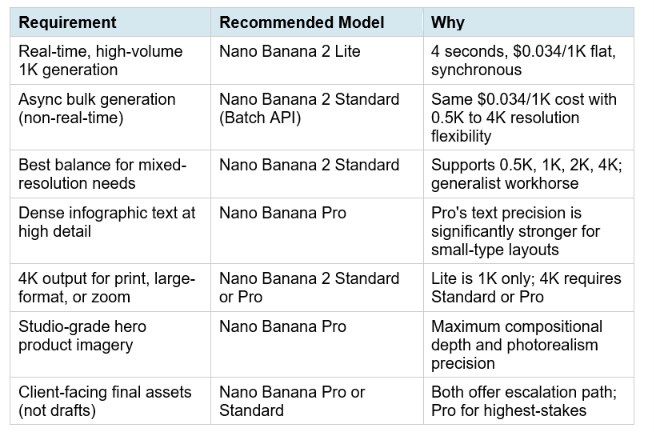
The routing logic that makes the most sense for teams building on the Nano Banana family: use Lite as your default generation tier for all volume and real-time work, then escalate to Standard when you need higher resolution outputs for the same prompts, and escalate to Pro when the task involves dense text rendering, complex brand-accurate final assets, or the specific outputs that drive client-facing decisions. Lite should be running the vast majority of your generation volume. Standard and Pro should be your exception models for specific task types.
10. Developer Quick Start: API and Code
Model ID and API Configuration
The model identifier for Nano Banana 2 Lite is: gemini-3.1-flash-lite-image
It is available through the Gemini Developer API (google.generativeai package), Google AI Studio (playground available immediately), and the Gemini Enterprise Agent Platform. The API structure is identical to Nano Banana 2 standard; only the model name changes.
Python Quick Start
from google import genai
from google.genai import types
client = genai.Client(api_key="GEMINI_API_KEY")
response = client.models.generate_content(
    model="gemini-3.1-flash-lite-image"
    contents="A product photo of a sustainable water bottle on a mountain hiking trail, morning light, clean white background option, 1K resolution",
    config=types.GenerateContentConfig(response_modalities=["IMAGE"]),
)


# Access the generated image
for part in response.candidates[0].content.parts:
    if part.inline_data:
        image_data = part.inline_data.data
        # image_data is base64 encoded
Migration from Original Nano Banana
If you are currently using the original Nano Banana (gemini-2.5-flash-image), migration to Lite requires a single model name change. No authentication, request structure, or response parsing changes are needed. Google recommends running a batch of representative prompts through both the old and new model to validate style consistency before switching your production pipeline.
Chaining with Gemini Omni Flash for Image-to-Video
The Interactions API maintains session history for multi-turn image and video workflows. Generate with Nano Banana 2 Lite, then pass the image as a reference to gemini-omni-flash-preview for animation. The API allows stacking up to three sequential edits while maintaining context, enabling iterative refinement of both the image and its animation in natural language. For comprehensive video generation API patterns including Seedance, Kling, and Veo 3.1 alongside Google's own offerings, the gen-ai-experiments video and multimodal API notebooks have working Python implementations for all major providers.
11. Is Nano Banana 2 Lite Worth It?
For high-volume, real-time, and interactive use cases: yes, clearly and without qualification. The combination of 4-second generation, $0.034 per 1,000 images, a Text-to-Image Arena Elo of 1,251 that beats Nano Banana Pro, and simultaneous rollout across Google's entire product ecosystem makes Nano Banana 2 Lite the most economically compelling AI image generation option launched in 2026. The Google developer blog's framing is precise: 'Building with generative media is often about creative iteration. With Nano Banana 2 Lite, developers can build comprehensive, end-to-end multimedia experiences that connect rapid image generation with video creation and editing.' The pairing with Gemini Omni Flash into a coherent image-to-video pipeline at $0.000034 image plus $0.10 per second video is the strategic product move that makes this launch bigger than either model individually. The honest caveat: the 1K resolution ceiling is real and will matter for a specific subset of professional use cases. If your primary output is 4K hero imagery, dense typography infographics, or large-format print production, Lite is not your model. For the 80-plus percent of commercial image generation workflows that operate at social media, web, and digital advertising dimensions, the 1K ceiling is not a ceiling. It is exactly where you were going to land anyway.
The competitive context worth noting: Krea 2 Turbo from Krea AI generates at 2 seconds and 2K resolution, with MIT-licensed open weights and commercial use for teams under 50 seats. It is faster and higher resolution than Nano Banana 2 Lite on those specific dimensions. But Nano Banana 2 Lite has Google's distribution: it ships simultaneously inside Gemini, Google Search, Google Ads, NotebookLM, and Google Photos, with enterprise deployment through GEAP. Speed and quality comparisons matter at the model level. Distribution matters at the product level. For the full open-source vs closed-source image model comparison including Krea 2 Turbo and FLUX.2, the Krea 2 open-source review covers the open-weight alternative in detail.
Frequently Asked Questions
What is Nano Banana 2 Lite and how is it different from Nano Banana 2?
Nano Banana 2 Lite (gemini-3.1-flash-lite-image) is the fastest, cheapest model in Google's Nano Banana image generation family, launched June 30, 2026. It generates 1K-resolution images in under 4 seconds at a flat rate of $0.034 per 1,000 images. The key difference from Nano Banana 2 standard (gemini-3.1-flash-image): Lite is optimized exclusively for real-time, high-volume 1K generation, while Standard supports 0.5K to 4K resolution at slightly higher cost. Lite achieves a Text-to-Image Arena Elo of 1,251, higher than Nano Banana Pro's 1,245 on the same track.
How much does Nano Banana 2 Lite cost?
Nano Banana 2 Lite costs $0.034 per 1,000 images (or $0.000034 per image) via the Gemini API at standard synchronous access. This is the same rate as Nano Banana 2 Standard's Batch API, but Lite delivers synchronously in real time rather than asynchronously over 24 hours. In Google AI Studio, access is free with quota limits for development and testing. Consumer access through Gemini app, Search, Photos, and Google Ads is included in existing Google subscription plans.
How fast is Nano Banana 2 Lite?
Google states Nano Banana 2 Lite generates a 1K-resolution image in approximately 4 seconds. For comparison, Nano Banana 2 Standard generates in 4 to 6 seconds, and Nano Banana Pro takes 8 to 12 seconds. The original Nano Banana (now legacy) took approximately 20 seconds. The 4-second latency is the threshold that enables interactive application workflows where users see results near-real-time.
Is Nano Banana 2 Lite better than Nano Banana Pro?
On the Text-to-Image Arena Elo, Lite (1,251) scores higher than Pro (1,245), which means evaluators preferred Lite outputs for typical prompts. This is because Lite received targeted enhancements for world knowledge, character consistency, and typographic rendering specifically suited to the 1K canvas. Pro is still stronger for complex professional workflows requiring dense text precision, 4K output resolution, high-stakes final asset production, and maximum compositional depth. Use Lite as your volume-and-speed default; escalate to Pro for specific high-stakes tasks.
Where can I access Nano Banana 2 Lite?
Nano Banana 2 Lite is available immediately through: Google AI Studio (free, quota-limited, playground access), the Gemini API (pay-as-you-go, $0.034/1K images), and the Gemini Enterprise Agent Platform (GEAP, enterprise pricing). Consumer rollout is simultaneous to AI Mode in Google Search, the Gemini app, NotebookLM, Google Photos, Google Stitch, Google Flow, and Google Ads
What is the Nano Banana 2 Lite API model string?
The API model string is gemini-3.1-flash-lite-image. Use this in the Google GenAI Python client, the Gemini REST API, and any platform that accepts Gemini model IDs (Google AI Studio, Vertex AI, GEAP). Migration from the original Nano Banana (gemini-2.5-flash-image) requires only changing the model name string. No other changes to authentication or request structure are needed.
What is the 1K resolution limitation and does it matter for my use case?
1K resolution (approximately 1024 pixels on the longest side) is sufficient for: social media graphics, digital advertising, web imagery, UI mockups, app screenshots, product thumbnails, banner ads, email marketing, news article images, and all digital display formats. It is insufficient for: print production requiring 300+ DPI at large format, 4K video source material, hero imagery requiring zoom/crop headroom, and dense infographic text at very small sizes. For most commercial digital workflows, 1K is not a limitation. For print or ultra-high-resolution production, use Nano Banana 2 Standard or Pro.
How does Nano Banana 2 Lite pair with Gemini Omni Flash?
Google explicitly designed Nano Banana 2 Lite and Gemini Omni Flash (gemini-omni-flash-preview) as a paired pipeline. Generate an image with Lite in 4 seconds, then pass it as a reference to Omni Flash to animate it into a video at $0.10 per second of output. The Interactions API maintains session history for multi-turn workflows, allowing up to three sequential edits across both the image and animation in natural language. At under $0.51 for a 5-second product video (image generation plus video generation), this is the most affordable AI image-to-video production pipeline currently available. Omni Flash is in public preview, not yet generally available.
Recommended Blogs
- AI Image and Video Generation Collection: Best Models and Tools 2026
- Google Veo 3.1 Review: Pricing, Lite vs Fast, API and Prompts Guide
- Krea 2 Open Source Review: Raw, Turbo, and LoRA Fine-Tuning
- Best AI Image Generation Tools 2026: FLUX, Midjourney, Seedance and More Compared
- Seedance 2.5 vs Veo 3.1 vs Kling 3.0: Best AI Video Model (July 2026)
- Seedance 2.5 Review: ByteDance's 30-Second AI Video Model
Resources & Community
Join our community of 70,000+ AI enthusiasts and learn to build powerful AI applications! Whether you're a beginner or an experienced developer, Build Fast with AI helps you understand and implement AI in your projects.
- Website: buildfastwithai.com
- LinkedIn: Build Fast with AI
- Instagram: @buildfastwithai
- Founder Twitter: @satvikps
- Twitter: @BuildFastWithAI
Agentic AI Launchpad 2026
A structured 6-week cohort program that takes you from AI basics to building and deploying real-world agentic AI systems. Includes live sessions, expert mentorship, project reviews, and a builder community network.
Ready to go from learning to building? Join the next cohort: Agentic AI Launchpad 2026
Free AI Resources
Access free tools, workshops, and micro-learning to keep building:
- AI Workshops: Free resources, upcoming events and past recordings
- Unrot: Learn AI in 5 minutes a day (free micro-learning app)
Google is reshaping the AI image and video stack fast. Follow @BuildFastWithAI on X to stay ahead of every model launch, pricing change, and API update that matters for creators and developers.
References
- Google: Start Building with Nano Banana 2 Lite and Gemini Omni Flash
- VentureBeat: Google Unveils Nano Banana 2 Lite for Low-Cost, 4-Second
- TechCrunch: Google Introduces a Faster, Cheaper Image Generator
- Apiyi: Nano Banana 2 Lite Released: Complete Analysis of the
- Digital Applied: Nano Banana 2 Lite and Gemini Omni Flash
- Simon Willison: Nano Banana 2 Lite
- BitcoinWorld: Google Launches Nano Banana 2 Lite
- AI Tool Analysis: Nano Banana 2 Review
- LaoZhang AI: Nano Banana 2 API Pricing Explained
- AVB: Nano Banana Pro Complete Guide 2026

