

Seedance 2.5 Review: ByteDance's 30-Second AI Video Model Explained
ByteDance arrived at the 2026 Volcano Engine FORCE Conference on June 23 with a product announcement that changed the most stubborn constraint in professional AI video production: clip length. Every major AI video model in 2026, from Runway Gen-4.5 to Google Veo 3.1, tops out at roughly 5 to 15 seconds per native generation pass. Longer sequences require stitching multiple clips together, and that stitching introduces visible seams, character faces that drift between shots, and lighting inconsistencies that mark the footage as AI-generated. Seedance 2.5 eliminates that constraint. It generates a full 30-second clip in a single native pass, with no stitching, no extension passes, and no consistency degradation across the duration. It also accepts up to 50 multimodal reference inputs simultaneously, up from 12 in Seedance 2.0, adds local re-draw editing that lets you change one element of a frame without regenerating the whole clip, introduces a 3D whitebox previsualization feature, and claims 20% better prompt adherence than its predecessor. Seedance 2.0 already ranks first on the Artificial Analysis Video Arena blind human-preference leaderboard, with an Elo of 1,219, ahead of HappyHorse 1.0, Kling 3.0, and Google Veo 3.1. Seedance 2.5 builds on that foundation. This review covers every announced capability in detail, what the legal and copyright context means for enterprise buyers, how to access it, and what the honest caveats look like before independent benchmarks arrive.
1. What Is Seedance 2.5 and Where Does It Come From?
Seedance 2.5 is ByteDance's next-generation AI video generation model, developed under the Volcano Engine and Seed research brand. ByteDance operates the world's largest short-form video platform in TikTok and Douyin, giving it training data advantages in video quality, motion dynamics, and what makes video content feel cinematic rather than synthetic. That institutional knowledge is baked into the Seedance architecture from the beginning. The Seedance family has moved quickly through generations: 1.0 (foundational release), 1.5 Pro (motion improvements), 2.0 (multimodal audio-video joint generation, top-1 global ranking), and now 2.5, announced before 2.0 had even completed its global rollout. Notably, ByteDance originally planned to release version 2.1 but pivoted to 2.5 at the last minute, according to sources cited in finance and industry coverage of the FORCE Conference, signaling the company made a deliberate choice to make a bigger statement. The Seedance model powers multiple consumer products simultaneously: Dreamina (international creative app), Jimeng (China), Doubao (ByteDance's AI assistant), and CapCut's video generation features. Coverage that references 'Dreamina Seedance' or 'Doubao video' describes the same underlying model, not separate products.
For full context on what Seedance 2.0 shipped and how it compares to earlier AI video generations, the Seedance 2.0 deep dive and review on Build Fast with AI covers the predecessor model's architecture, generation modes, and the multimodal audio-video pipeline that 2.5 builds on.
2. The Four Core Upgrades in Seedance 2.5
ByteDance's announcement at Volcano Engine FORCE centered on four capabilities that address the most consistent frustrations of professional AI video workflows. Each targets a specific production problem rather than being a general improvement across all dimensions.
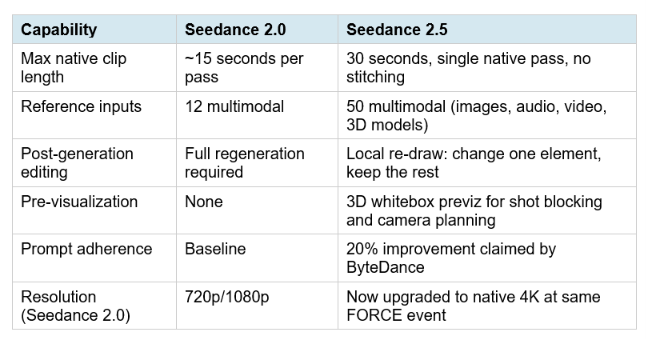
All five numbers above are vendor-stated specifications from ByteDance's June 23 keynote. No independent benchmarks for Seedance 2.5 exist as of the announcement. The credibility backing behind them is the predecessor's #1 Artificial Analysis ranking and four generations of consistent model improvement.
3. How 30-Second Native Generation Actually Works
The 30-second native clip is the headline claim of this release, and understanding what makes it technically different from stitching matters for evaluating whether it holds up in practice.
Standard AI video generation uses diffusion windows: the model generates a short sequence, then starts a new generation seeded from the end frame of the previous one. This produces visible seams because the model has no continuous representation of the entire temporal span. Character appearances drift slightly between windows because the second generation is only loosely constrained by the first. Lighting conditions shift. Camera motion is not continuous.
Seedance 2.5, according to ByteDance, generates the entire 30-second clip as a single coherent diffusion pass. The model maintains a unified spatial-temporal attention mechanism across the full 30-second duration, which means it has a continuous representation of every frame's relationship to every other frame from the first pass to the last. Object identity, scene state, character appearance, and motion style are held consistent not by handoff between clips but by a single forward pass through the model.
The demo ByteDance presented at the FORCE Conference shows a single character tracked across six rooms, each with a different art style: American comic, felt, black-and-white manga, underwater, fireworks, and blank canvas. Eight image references held the character consistent through every style transition. There were no cuts, no stitching artifacts, and no character drift across the full 30-second duration.
Hot take: if this holds up under independent testing, it is the most significant single capability improvement in AI video generation since Seedance 2.0 shipped joint audio-video generation. The stitching problem has been the primary reason AI video has struggled to move from social content into advertising and commercial production. A reliable 30-second single-pass model with strong character consistency closes that gap significantly.
4. The 50 Reference Input System: What Changes for Production Teams
The reference input increase from 12 to 50 is easy to understate. It is not just a bigger number. It represents a qualitative shift in what kind of brief you can give the model before generating.
Seedance 2.0 accepts a rich mix of up to 9 images, 3 videos, and 3 audio files as reference inputs. That is enough for a character reference and a style reference, but not enough to hand the model a full production brief. If you want to hold a specific character, in a specific environment, with specific props, a specific color palette, a specific audio track, and a specific motion style, you run out of slots before the brief is complete.
At 50 inputs, the reference system can hold:
- A full character sheet: front, back, three-quarter, and expression references for each character in the scene
- Environmental references: establishing shots, texture samples, and lighting direction for the setting
- Prop references: product shots, material samples, and scale references for any objects in the scene
- Audio tracks: voiceover timing, music bed, and sound effects that the model co-generates visuals against
- 3D greybox layouts: rough spatial models that define camera staging before full generation
- Style references: existing footage, brand campaign shots, or director reference frames
The practical result is a fundamentally different generation workflow. Instead of prompting the model and iterating because the output guessed wrong about your character's face or your product's color, you hand the model the complete brief upfront and get output that is significantly closer to what you actually want on the first pass. The claim from ByteDance is that this moves video generation from a process where you depend on luck to one where the user is in charge.
For a comparison of how Seedance's reference system differs from the approach taken by Alibaba's Happy Horse model, which took a different architectural path to consistency, the Happy Horse vs Seedance 2.0 comparison on Build Fast with AI covers the head-to-head in detail.
5. Local Re-Draw Editing and 3D Whitebox Preview
Local Re-Draw Editing
Before Seedance 2.5, fixing a single wrong element in an AI-generated clip meant regenerating the entire clip and hoping the revised output was better everywhere else too. The iteration cost was the full clip generation time and cost, every time.
Local re-draw editing lets you select a specific region of a frame, specify the change you want, and regenerate only that element while leaving everything else exactly as it was. The original actor movement, camera angles, lighting conditions, and overall composition remain intact. Only the targeted element changes.
In the FORCE demo, ByteDance showed a jungle archer clip with an existing camera path and character movement. Adding one reference image placed a glowing energy bow and arrow into the scene, keeping the character's face, the camera movement, the jungle environment, and the action rhythm exactly as they were. The energy bow was inserted as a new element without touching any other aspect of the original generation.
For production workflows where a client approves the composition and camera work but wants a product variant or a color change, this eliminates the complete regeneration loop. That is a meaningful time and cost reduction for commercial video production teams.
3D Whitebox Preview
The 3D whitebox preview feature is the most director-oriented addition in this release. It lets creators build a rough low-fidelity 3D scene layout, defining camera position, character blocking, and spatial relationships, before committing to a full high-quality generation pass.
In traditional film production, the equivalent is the animatic or previz stage: rough 3D blocking that establishes camera language before expensive production resources are committed. AI video generation has historically skipped this stage entirely, which means camera moves and spatial composition are discovered by generating and regenerating until something close to the intended shot appears.
Seedance 2.5's 3D whitebox mode brings that planning stage into the AI pipeline. You define the shot, establish the camera language, and then execute the full generation with confidence that the model understands the spatial intent. ByteDance claims this is an industry first for AI video generation, and based on the current competitive landscape, no comparable feature is live in any competing model.
For developers wanting to build video generation tools on top of the Seedance API, the gen-ai-experiments video and multimodal generation notebooks have working integrations with ByteDance's Volcano Engine APIs and cover the practical implementation patterns for reference-based generation workflows.
6. Seedance 2.0 Gets 4K: The Parallel Upgrade
Alongside the Seedance 2.5 announcement, ByteDance simultaneously upgraded the existing Seedance 2.0 model to support native 4K resolution output. This is significant for two reasons.
First, it means the model that already holds the Artificial Analysis #1 ranking is now capable of professional broadcast-resolution output without waiting for 2.5 to ship publicly. Enterprise teams that are already running Seedance 2.0 workflows get a meaningful resolution upgrade immediately.
Second, it clarifies the quality positioning of 2.5 relative to 2.0. Seedance 2.5 at launch was reported by multiple outlets as supporting native 4K, but the most reliable sourcing indicates the native 4K upgrade was applied to Seedance 2.0 at the FORCE event. Whether Seedance 2.5 also ships at native 4K, or at a resolution comparable to Seedance 2.0's upgraded output, will be confirmed at general availability in early July 2026.
7. Benchmarks and Rankings: Where the Seedance Family Stands
No independent benchmarks exist yet for Seedance 2.5. The model is in enterprise beta with general availability targeting early July 2026. What we can document precisely is the current Seedance 2.0 leaderboard position, which serves as the credibility anchor for the 2.5 claims.
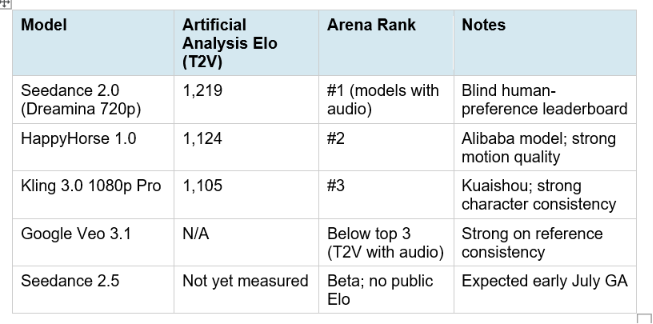
The Artificial Analysis Video Arena uses blind human-preference paired comparisons to assign Elo scores. It is the most rigorous independent ranking available for AI video models and the one most consistently cited by serious practitioners evaluating these tools.
The Seedance platform reached $2 billion ARR as of the FORCE Conference, according to ByteDance's own disclosure. That commercial scale at the enterprise tier gives ByteDance both the revenue to continue accelerating model development and the real-world deployment data to improve the model in ways that synthetic benchmarks miss.
8. Seedance 2.5 vs Veo 3.1 and Kling 3.0
Based on announced specifications and the existing Seedance 2.0 performance data, here is the honest side-by-side as of the announcement. All Seedance 2.5 figures are vendor-stated; Veo 3.1 and Kling 3.0 figures are from independent testing of their shipping versions.
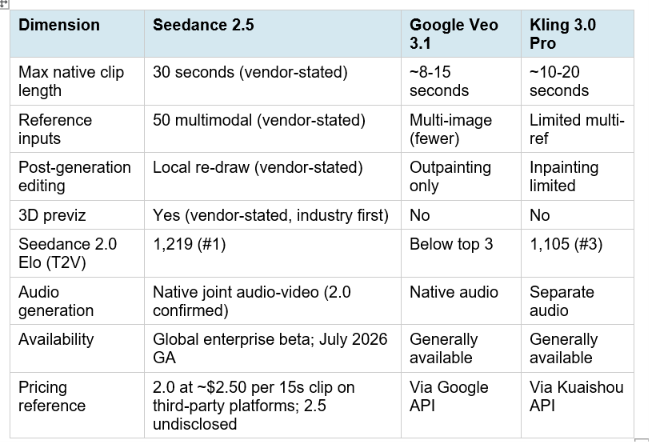
The honest framing: on clip length, Seedance 2.5 has a clear paper advantage over every competing model. On reference input volume, 50 is further ahead of the current competitive range than any other dimension. On editability and previz, both features are industry-firsts among major models. The questions that independent testing will answer: whether 30-second consistency holds as reliably as the demo suggests, whether the 50-reference system meaningfully improves output coherence or introduces generation artifacts under complex briefs, and what the per-clip cost looks like at public launch.
9. The Legal and Copyright Context
Any honest Seedance review must address the legal situation directly, because it is the most material risk for enterprise buyers evaluating this model.
In February 2026, the Motion Picture Association sent formal cease-and-desist letters to ByteDance on behalf of every major Hollywood studio, alleging that Seedance 2.0 could reproduce copyrighted characters and footage from protected works. ByteDance voluntarily paused the global API rollout of Seedance 2.0 and added content filters that block generation of recognizable real faces and copyrighted characters. Those filters remain active in the current Seedance 2.0 model.
The MPA legal disputes were not resolved before the Seedance 2.5 announcement. ByteDance has not issued a public statement confirming that 2.5 carries enhanced copyright protection beyond the existing filter layer. At the FORCE Conference, ByteDance separately announced a new AI copyright commercialization platform, described as a form of provenance tracking or licensing infrastructure for AI-generated content. Details remain sparse.
The Chinese data-access law dimension is also relevant for enterprise buyers. Any content processed by Seedance through Volcano Engine infrastructure is subject to Chinese data-access laws, which include government access provisions that differ from EU GDPR and US data-handling frameworks. Enterprises in regulated industries including healthcare, finance, and government need to assess this before processing sensitive content through any ByteDance AI product.
Hot take: ByteDance has not resolved the MPA situation and has not disclosed whether 2.5 is architecturally different enough to change the copyright risk profile. For enterprise buyers in media and entertainment specifically, the legal status of outputs remains unclear. For general commercial content production (advertising, social, marketing), the content filters currently in place meaningfully reduce the most obvious infringement vectors, but the underlying legal questions are still open.
10. Who Can Access Seedance 2.5 and When
At announcement on June 23, 2026, Seedance 2.5 is in global enterprise beta. A public launch is targeted for early July 2026, though ByteDance has not confirmed a specific date.
Based on the Seedance 2.0 rollout pattern, access for Seedance 2.5 is expected to follow this sequence:
- Enterprise beta via direct Volcano Engine partnership enrollment, which opened at the FORCE Conference and is ongoing.
- Dreamina (international) and Jimeng (China) consumer app access, expected to follow shortly after the initial public launch.
- CapCut integration, which typically follows Dreamina by a few weeks in ByteDance's rollout pattern.
- Third-party API access via platforms like Atlas Cloud, fal.ai, and others that carried Seedance 2.0, expected after the initial public release stabilizes.
Pricing for Seedance 2.5 has not been disclosed. For reference, Seedance 2.0 was priced at approximately $2.50 per 15-second clip on third-party inference platforms. The cost structure for 30-second clips will be a critical factor in enterprise evaluation: if pricing scales linearly with clip duration, 30-second clips would cost approximately $5.00 on equivalent platforms. Given ByteDance's Seedance platform ARR of $2 billion, there is clear commercial pressure to price competitively.
For the full picture of the AI image and video generation landscape, including Seedance alongside Veo 3.1, Kling 3.0, Sora, and newer entrants, the AI Image and Video Generation collection on Build Fast with AI tracks every major model release, API launch, and benchmark update as they happen.
11. Real Use Cases by Team Type
Advertising and Brand Teams
The 50-reference system is purpose-built for the advertising workflow. Brand teams arrive with extensive asset libraries: approved character sheets, product photography, campaign footage, color palettes, and audio tracks. Seedance 2.5 can ingest the complete brand brief in one generation rather than approximating it from a short prompt. The local re-draw feature means a single approved composition can be adapted across multiple product variants or regional markets without full regeneration.
Short-Form Video and Social Creators
For creators producing episodic or narrative content for TikTok, Instagram Reels, or YouTube Shorts, the 30-second native clip eliminates the most visible limitation of AI video in short-form storytelling. A 30-second clip with consistent character appearance and continuous camera motion is a complete narrative unit. Stitched 5-second clips are not. The faster iteration enabled by 20% better prompt adherence reduces the generation cycles needed before a usable output appears.
Film and TV Pre-Visualization Teams
The 3D whitebox preview feature directly addresses the pre-visualization stage of professional production. Instead of generating clips to discover whether a camera move works, directors and cinematographers can block the shot in the 3D previz stage, confirm the camera language, and then execute the full generation with spatial intent already established. For productions using AI video for pre-vis, pitching, or concept visualization, this closes the gap between the storyboard stage and the generation stage significantly.
Short Drama and Animation Studios
Short-form animated drama is a fast-growing content category particularly in China and across Southeast Asian markets. Multi-shot narrative coherence, consistent characters across a 30-second arc, and style-consistent generation across a series episode are exactly the capabilities that make Seedance 2.5 relevant for this format. The reference system can hold a cast of characters consistent across an entire episode rather than regenerating character references for each clip. For teams building complete AI video production pipelines, the AI Automation and No-Code collection on Build Fast with AI covers how to chain AI video generation with scripting, audio, and distribution tools into end-to-end production workflows.
Frequently Asked Questions
What is Seedance 2.5 and when does it launch?
Seedance 2.5 is ByteDance's next-generation AI video model, announced at the Volcano Engine FORCE Conference on June 23, 2026. It generates native 30-second clips in a single pass, accepts up to 50 multimodal reference inputs, adds local re-draw editing, introduces 3D whitebox previz, and claims 20% better prompt adherence over Seedance 2.0. It is currently in global enterprise beta, with a public launch targeted for early July 2026. No official launch date has been confirmed by ByteDance.
What are the biggest upgrades in Seedance 2.5 over Seedance 2.0?
The four headline upgrades are: native 30-second single-pass clip generation (up from approximately 15 seconds), 50 multimodal reference inputs (up from 12), local re-draw editing that allows targeted changes without full regeneration, and a 3D whitebox previz tool for shot blocking before full generation. ByteDance also claims 20% better prompt adherence in the new model. All five figures are vendor-stated and have not yet been independently verified.
How does Seedance 2.5 generate 30-second videos without stitching?
Seedance 2.5 generates the entire 30-second clip as a single coherent diffusion pass using optimized spatial-temporal attention mechanisms that maintain character appearance, scene state, and motion style across the full duration. This is architecturally different from stitching, where multiple short generation windows are concatenated. Stitching introduces visible seams and character drift at each window boundary. Single-pass generation holds everything consistent because the model has a unified representation of the entire temporal span.
What are the 50 reference inputs in Seedance 2.5?
The 50 multimodal reference inputs can include any combination of images, audio clips, video clips, 3D model files, and style references. The system is designed for production teams that arrive with complete asset libraries: character sheets, product photography, environmental references, audio tracks, and style guides. At 50 inputs, the model can ingest a complete production brief in a single generation rather than approximating the brief from a short text prompt. Seedance 2.0 accepted up to 12 multimodal inputs.
What is the 3D whitebox preview in Seedance 2.5?
The 3D whitebox preview feature lets creators build a low-fidelity rough 3D scene layout defining camera position, character blocking, and spatial relationships before committing to a full high-quality generation pass. ByteDance claims this is an industry first for AI video generation. It brings the traditional previz and animatic stage of film production into the AI workflow, so camera language and shot composition are planned rather than discovered through trial-and-error generation.
How does Seedance 2.5 compare to Veo 3.1 and Kling 3.0?
On clip length, Seedance 2.5 claims 30 seconds versus 8 to 15 seconds for Veo 3.1 and Kling 3.0. On reference volume, 50 inputs is ahead of both competitors' current limits. On editing, local re-draw is a feature neither Veo 3.1 nor Kling 3.0 offers at launch. On independent benchmark rankings, Seedance 2.0 already holds the Artificial Analysis Video Arena #1 position, ahead of both competitors. Seedance 2.5 benchmark data will be available after early July general availability.
Is Seedance 2.5 available on Dreamina and CapCut?
As of the announcement, Seedance 2.5 is in global enterprise beta. Public access through Dreamina (ByteDance's international creative app), Jimeng (China), and CapCut is expected to follow the enterprise beta, likely after the early July 2026 public launch. Third-party API access through platforms that carried Seedance 2.0 is expected to follow the initial public release. ByteDance has not confirmed specific integration timelines.
What happened legally with Seedance 2.0 and does it affect 2.5?
In February 2026, the Motion Picture Association sent formal cease-and-desist letters to ByteDance on behalf of every major Hollywood studio, alleging copyright infringement in Seedance 2.0's training data or output capabilities. ByteDance voluntarily paused the global rollout and added content filters blocking recognizable real faces and copyrighted characters. Those legal disputes have not been publicly resolved. Whether Seedance 2.5 carries enhanced copyright protections beyond the existing filter layer has not been confirmed by ByteDance. Enterprise buyers in media and entertainment should assess the legal status carefully before building Seedance 2.5 into commercial production workflows.
What is the Seedance 2.5 price?
ByteDance has not disclosed pricing for Seedance 2.5 as of the June 23 announcement. Seedance 2.0 was priced at approximately $2.50 per 15-second clip on third-party inference platforms. Whether Seedance 2.5 pricing scales linearly with the 30-second clip duration or uses a different structure will be confirmed at general availability. The Seedance enterprise platform reported $2 billion ARR at the FORCE Conference, which creates competitive pricing pressure
Recommended Blogs
- Seedance 2.0 Review: ByteDance AI Video Model, Features and Benchmarks
- Happy Horse vs Seedance 2.0: Which AI Video Model Wins in 2026?
- AI Image and Video Generation Collection: Best Models and Tools in 2026
- Best AI Video Generation Tools 2026: Veo, Kling, Seedance, Sora Compared
- Krea 2 Open Source Review: Raw, Turbo, and LoRA Fine-Tuning for Creators
- AI Industry News and Trends: Model Releases, Benchmarks, and Policy Updates
Resources & Community
Join our community of 70,000+ AI enthusiasts and learn to build powerful AI applications! Whether you're a beginner or an experienced developer, Build Fast with AI helps you understand and implement AI in your projects.
- Website — buildfastwithai.com
- LinkedIn — Build Fast with AI
- Instagram — @buildfastwithai
- Founder Twitter — @satvikps
- Twitter — @BuildFastWithAI
Agentic AI Launchpad 2026
A structured 6-week cohort program that takes you from AI basics to building and deploying real-world agentic AI systems. Includes live sessions, expert mentorship, project reviews, and a builder community network.
Ready to go from learning to building? Join the next cohort → Agentic AI Launchpad 2026
Free AI Resources
Access free tools, workshops, and micro-learning to keep building:
- AI Workshops — Free resources, upcoming events & past recordings
- Unrot — Learn AI in 5 minutes a day (free micro-learning app)
AI video is moving faster than any other category in generative AI right now. Follow @BuildFastWithAI on X to stay ahead of every model launch, benchmark result, and API update that matters for creators and builders.
References
- Digital Applied — Seedance 2.5: ByteDance's 30-Second AI Video Model
- TechTimes — ByteDance Seedance 2.5: Native 30-Second AI Video
- ExplainX — Seedance 2.5: 30-Second 4K AI Video from ByteDance (2026)
- AI Base News — ByteDance Launches Seedance 2.5: 30 Seconds + 50 Material Inputs
- Renoise — Seedance 2.5: Release, Features and What to Use Now
- Tosea AI — Seedance 2.5: Complete Guide to ByteDance's 30-Second AI Video Model
- Atlas Cloud — Seedance 2.5 vs Seedance 2: What ByteDance's Preview Really Shows
- KlingAIO — Seedance 2.5: Official Release and Features
- MindStudio — What Is Seedance 2.5? ByteDance's Next-Gen AI Video Model Explained
- KIE AI — Seedance 2.5 Release: What ByteDance Just Shipped
- BigGo Finance — ByteDance Surprise Launches Seedance 2.5: 30-S
- Artificial Analysis — Video Arena Leaderboard (Seedance 2.0 #1 ranking, June 2026)

