

Seedance 2.5 vs Veo 3.1 vs Kling 3.0: Best AI Video Model for July 2026
There are three AI video models worth serious attention in July 2026. Seedance 2.5 from ByteDance, announced June 23, 2026, generates native 30-second clips in a single pass, accepts up to 50 multimodal reference inputs, and adds 3D whitebox previsualization. Veo 3.1 from Google DeepMind, launched October 2025 and upgraded to 4K in January 2026, is the only model in the category with native 48kHz synchronized dialogue and a three-tier pricing family that starts below every competitor. Kling 3.0 from Kuaishou, released February 5, 2026, reached $300 million ARR faster than any AI video platform in history and delivers phoneme-level multi-character lip-sync that no other model currently matches. Each of these models is the right answer for a different brief. Understanding which is which matters because the wrong choice costs real money and real time. This comparison covers every dimension that actually determines which model you should use: clip length, reference handling, audio quality, benchmark rankings, pricing, platform access, privacy risk, and use-case fit.
1. The Quick Verdict: Which Model Wins What
Before the detail: if you need one sentence per model, here it is.
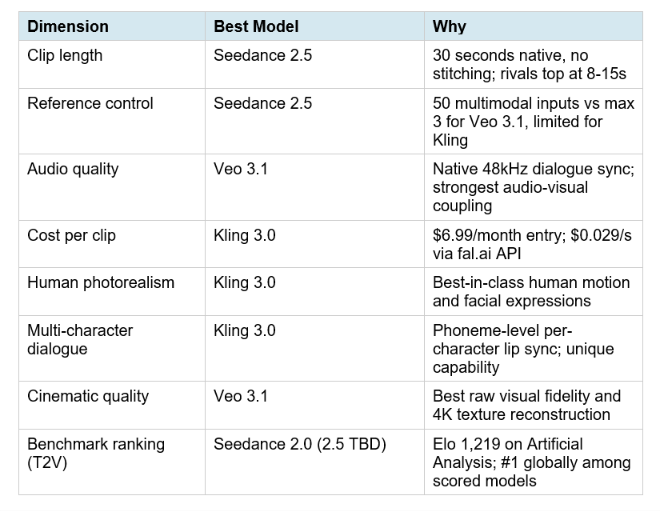
Hot take: the professional AI video workflow in July 2026 is not mono-model. The teams seeing the best output use Seedance 2.5 for long-form narrative and heavily referenced brand content, Veo 3.1 for hero clips where audio-visual quality is non-negotiable, and Kling 3.0 for social iteration volume at the lowest cost per clip. Picking one and ignoring the others is a creative and economic limitation.
2. Model Overview: Three Architectures, Three Philosophies
Seedance 2.5 (ByteDance / Volcano Engine)
Announced June 23, 2026, at the Volcano Engine FORCE Conference; in global enterprise beta with public launch targeting early July 2026. Built on a unified joint audio-video diffusion architecture with optimized spatial-temporal attention mechanisms that hold consistency across long temporal horizons. The model powers Dreamina (international), Jimeng (China), Doubao, and CapCut simultaneously. ByteDance brings TikTok-scale training data advantages: institutional knowledge of what makes video content feel cinematic, engaging, and temporally coherent at 30 frames per second. The Seedance enterprise platform hit $2 billion ARR as of the FORCE Conference. For the full Seedance 2.5 feature breakdown, the Seedance 2.5 deep review on Build Fast with AI covers every announced capability in detail.
Veo 3.1 (Google DeepMind)
Launched October 2025; 4K resolution added January 2026; Veo 3.1 Lite added March 31, 2026; Fast pricing cut April 7, 2026. The model family now has three tiers: Veo 3.1 (full quality, highest cost), Veo 3.1 Fast (70-80% quality, significantly cheaper), and Veo 3.1 Lite (less than 50% the cost of Fast at equivalent speed). All three tiers include native audio generation. Veo 3.1 is accessible via Google AI Pro at $19.99/month, AI Ultra at $249.99/month, Vertex AI API at $0.50/second (video) or $0.75/second (with audio), and Google AI Studio for developers. The model watermarks all outputs with SynthID for content provenance.
Kling 3.0 (Kuaishou Technology)
Released February 5, 2026, built on the Omni One unified multimodal framework combining 3D Spacetime Joint Attention and Chain-of-Thought scene reasoning. Kuaishou launched Kling in June 2024 and reached $240 million ARR by December 2025, crossing $300 million in early 2026, making it the fastest-commercializing standalone AI video platform on record. 60 million creators have generated over 600 million videos on the platform. A Turbo variant launched June 17, 2026 as a faster, lower-cost option within the 3.0 generation. For context on how Kling 3.0 performs against Seedance 2.0 specifically, the Happy Horse vs Seedance 2.0 comparison covers the broader competitive landscape of Chinese AI video models heading into mid-2026.
3. Clip Length and Consistency
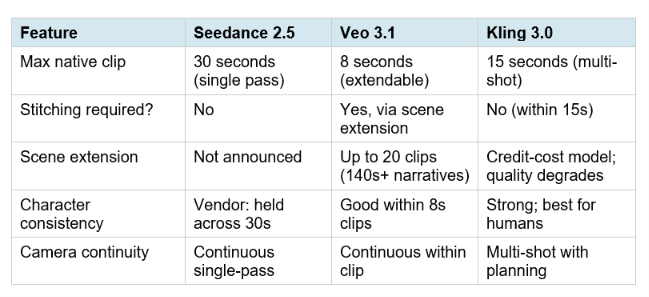
The 30-second native generation is Seedance 2.5's most decisive advantage. Every other model either caps at 8 to 15 seconds natively or requires stitching short clips together. Veo 3.1 scene extension chains up to 20 clips for 140-plus-second narratives, which is technically impressive but still introduces continuity dependencies between clips that a single 30-second diffusion pass avoids. Kling 3.0's multi-shot feature handles up to 15 seconds across multiple scenes in one generation, which is the strongest single-pass alternative to Seedance 2.5's duration claim. The caveat: Seedance 2.5's 30-second figures are vendor-stated from the June 23 keynote. No independent duration-consistency benchmark exists yet. Early July general availability will provide the first external validation. For a deeper look at how the Seedance architecture achieves temporal coherence, the Seedance 2.0 original review explains the joint audio-video generation pipeline that 2.5 builds on.
4. Reference Inputs and Brand Control
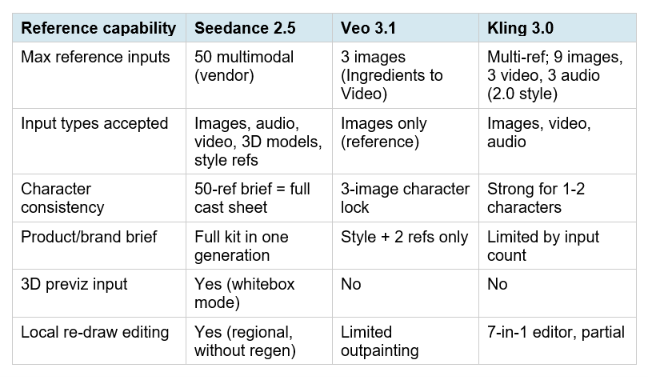
The reference input gap is the most underappreciated dimension in this comparison. Veo 3.1's Ingredients to Video accepts up to three reference images: a character, a scene, and a style guide. That is enough for a tight brief but not enough for a production workflow with a full brand kit, multiple characters, and audio direction. Kling 3.0's reference handling is stronger than Veo 3.1 but still constrained compared to Seedance 2.0's existing 12-input system, let alone 2.5's 50-input capacity.
For brand teams that work from established visual assets, the difference between three reference inputs and fifty is the difference between approximating a brief and executing it. At 50 inputs, a generation can hold an entire character roster, product photography, environment references, a voiceover track, and style direction simultaneously. That is not an incremental improvement. It is a different product category.
5. Audio Generation: The Defining Differentiator
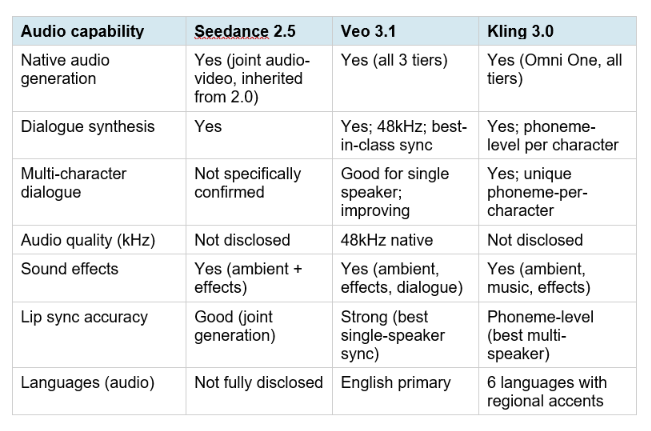
Audio is where Veo 3.1 and Kling 3.0 are most clearly differentiated from each other and from Seedance. Veo 3.1 generates native 48kHz synchronized audio in a single model pass alongside the video, including ambient environmental sounds, sound effects, and dialogue with synchronized lip movement. Google DeepMind's Demis Hassabis called this 'ending the silent film era of AI video' at launch, and the framing holds. Veo 3.1 remains the only model in the category producing 48kHz dialogue that sounds like it was recorded on set rather than synthesized. Kling 3.0 counters with a capability Veo does not match: phoneme-level lip sync for multi-character dialogue. Two characters can have a full conversation, each mouth synced to its own audio track phoneme by phoneme. For marketing content, training videos, or narrative shorts with multiple speaking characters, this is a genuinely unique capability in July 2026. Kling 3.0 also supports native audio in six languages with regional accents, which is the broadest multilingual audio coverage of any model in this comparison. For the full Veo 3.1 audio and feature breakdown, the Veo 3.1 review on Build Fast with AI covers every Veo 3.1 tier in detail.
6. Benchmark Rankings: Independent Data
This is the most important section for teams that want evidence rather than marketing claims. All figures below are from independent third-party benchmarks, not vendor self-reporting.
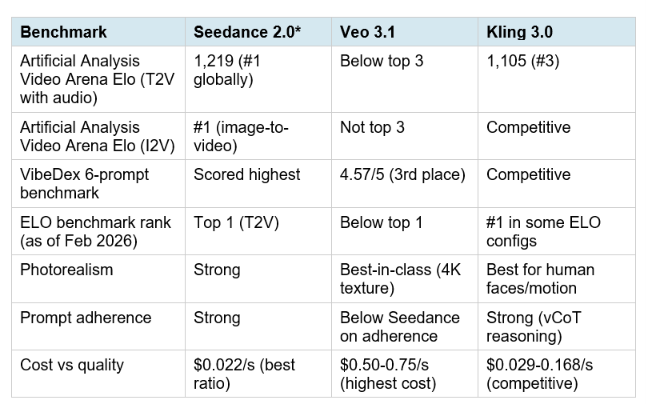
*Note: Seedance 2.5 has not yet been independently benchmarked. All Artificial Analysis rankings for Seedance refer to the shipping Seedance 2.0 model, which serves as the credibility anchor for 2.5 claims.
The Artificial Analysis Video Arena uses blind human-preference paired comparisons to assign Elo scores. It is the most rigorous independent ranking methodology available and the one most consistently cited by serious AI video practitioners. Seedance 2.0 holding the #1 position with an Elo of 1,219 ahead of HappyHorse 1.0 (1,124) and Kling 3.0 (1,105) is a meaningful data point. Veo 3.1 sitting below the top three on the overall T2V with audio leaderboard, despite being the premium-priced Google model, tells you something real about where the market has moved since late 2025.
The cost-quality ratio is where Seedance 2.0 most clearly dominates: $0.022 per second on third-party platforms versus $0.50 to $0.75 per second for Veo 3.1 and $0.029 to $0.168 per second for Kling 3.0. Veo 3.1 costs approximately 22 times more per second than Seedance 2.0 on equivalent API platforms, and scores lower on the independent quality leaderboard. That gap has been noted by every serious practitioner in the space and is the primary reason professional workflows are moving toward a multi-model approach rather than Veo-only production.
7. Pricing Comparison: Full Breakdown
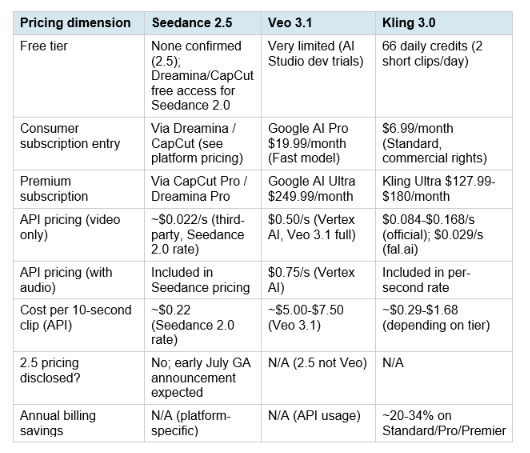
The pricing gap between Veo 3.1 and the Chinese models is extreme. A 10-second Veo 3.1 clip via Vertex AI costs $5.00 to $7.50. The same duration in Seedance 2.0 via third-party API costs approximately $0.22. Kling 3.0 lands in between at $0.29 to $1.68 depending on tier and platform. For teams running high-volume workflows, the economics are not close. The question is whether Veo 3.1's audio quality and Google ecosystem integration justify a 22x premium. For most social content, product marketing, and iterative creative work, they do not. For broadcast-quality hero content where native 48kHz synchronized dialogue is the brief requirement, the premium is defensible. Seedance 2.5 pricing has not been disclosed. Seedance 2.0 was priced at approximately $2.50 per 15-second clip on third-party inference platforms at launch. Whether 2.5's 30-second clips scale linearly (approximately $5.00) or are priced differently will be confirmed at early July general availability. For teams building AI video into production pipelines at scale, the AI Automation and No-Code collection covers cost-optimization strategies across multi-model video workflows using n8n and Make.com.
8. Platform Access and API Availability
Veo 3.1 has the most mature API ecosystem of the three models, available through Vertex AI (enterprise-grade), the Gemini API (developer access), Google AI Studio (free dev sandbox), and OpenRouter for simplified access. The SynthID watermarking on all outputs is both a safety feature and a potential workflow consideration for teams producing content that should not carry visible AI provenance markers.
Kling 3.0 is globally available and has the broadest third-party API coverage of any Chinese AI video model, with competitive pricing through fal.ai at $0.029 per second being the standout developer access point. The absence of an official MCP server is a noted gap, particularly since Runway and Pika both have MCP integrations as of mid-2026.
Seedance 2.5 access in July 2026 is gated behind enterprise beta enrollment and the early-July public launch. Until GA, Seedance 2.0 remains the accessible option via Dreamina, CapCut, and third-party API platforms. The early access path for enterprise buyers is direct enrollment through the Volcano Engine FORCE Conference beta program.
9. Privacy and Data Jurisdiction
This section is often treated as a footnote in AI video comparisons. For enterprise buyers, it is a primary evaluation criterion that belongs in Section 1, not Section 9.
Privacy dimension Seedance 2.5 Veo 3.1 Kling 3.0
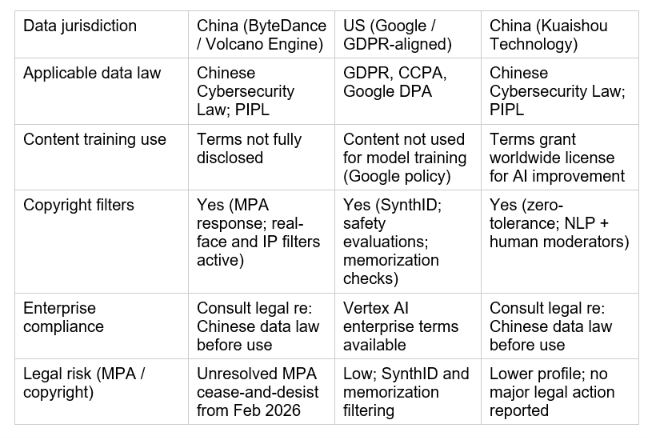
The data jurisdiction split in this comparison is stark. Veo 3.1 processes content on Google's infrastructure under US and EU data frameworks. Seedance 2.5 and Kling 3.0 process content on Chinese company infrastructure under Chinese data law, which includes government data-access provisions that differ materially from Western frameworks. For enterprises in healthcare, finance, legal, or government sectors handling regulated or sensitive content, this is not a minor concern. It requires explicit legal review before adoption. ByteDance's unresolved MPA legal situation from February 2026, involving formal cease-and-desist letters from every major Hollywood studio, remains the most significant enterprise risk specific to Seedance. Whether Seedance 2.5 carries different copyright risk compared to 2.0 has not been confirmed by ByteDance. Content filters are active but the underlying legal question is open. For Kling 3.0, the Kuaishou terms grant a worldwide royalty-free license to use generated content for AI improvement, which is a meaningful data-rights consideration before uploading proprietary brand assets or client-sensitive material.
10. Use-Case Recommendations by Team Type
Advertising and Brand Teams
Use Seedance 2.5 as the primary model. The 50-reference input system is purpose-built for the brand workflow: full character sheets, product photography, color palettes, and audio direction in one generation. The local re-draw feature allows single-element variant production without full regeneration, which is the specific workflow need for multi-market campaign production. Use Veo 3.1 for hero spots where synchronized dialogue and 4K texture quality are non-negotiable. Use Kling 3.0 for high-volume iteration and A/B testing at the lowest cost per clip.
Social Media and Content Creators
Use Kling 3.0 as the daily driver. At $6.99 per month with 66 free daily credits for testing, the cost-per-clip economics are unmatched. Kling 3.0's multi-shot scene logic, Motion Control for camera direction, and native audio in six languages cover every social format from YouTube Shorts to TikTok to Reels. Layer in Veo 3.1 for specific pieces where photorealistic 4K quality or dialogue-heavy scenes justify the per-clip cost difference.
Film Pre-Visualization and Production Teams
Use Seedance 2.5 for pre-visualization. The 3D whitebox previz feature is an industry first and directly addresses the director's planning workflow. Establish camera language, character blocking, and spatial relationships in the previz stage before committing to full generation. The 30-second native single-pass clip is the right duration for a complete pre-vis narrative sequence. Veo 3.1's scene extension (20 chained clips for 140-plus-second narratives) is the best option for longer sequence pre-visualization once Seedance 2.5's public API is available. For teams building complete AI video production pipelines from script to delivery, the Agentic AI Launchpad 2026 course covers how to chain AI video generation with scripting, audio, and distribution tools across a structured curriculum.
Enterprise Content and Training Teams
Use Veo 3.1 with Vertex AI. The Google enterprise data handling framework, GDPR alignment, SynthID watermarking for content provenance, and no model training on your content are the right starting point for regulated industry enterprise content. Kling 3.0 Avatar 2.0 is the strongest alternative for corporate communications and avatar-based training video at lower cost, but requires legal review of the Kuaishou data terms before processing sensitive employee or client content.
Developers Building Video Generation Products
For high-volume consumer-facing products: Kling 3.0 at $0.029 per second via fal.ai is the lowest-cost quality option currently available. For products requiring the best quality-to-cost ratio with audio: Seedance 2.0 at $0.022 per second is the benchmark, with Seedance 2.5 pricing to follow at GA. For products where Google ecosystem integration, SynthID watermarking, or GDPR compliance are requirements: Veo 3.1 Lite via the Gemini API at less than 50% the cost of Veo 3.1 Fast is the right developer tier. The AI Image and Video Generation collection tracks API pricing updates, new tier launches, and model access changes across all three platforms as they happen.
Frequently Asked Questions
Which AI video model is best in July 2026?
There is no single best model because each leads a different dimension. Seedance 2.5 leads on clip length (30 seconds native) and reference input volume (50 multimodal). Veo 3.1 leads on audio quality (48kHz synchronized dialogue) and cinematic visual fidelity. Kling 3.0 leads on cost-per-clip, human photorealism, and multi-character phoneme-level dialogue. Professional teams use all three for different use cases rather than committing to one exclusively.
How does Seedance 2.5's 30-second native video compare to Veo 3.1 and Kling 3.0?
Seedance 2.5 generates a full 30-second clip in a single diffusion pass with no stitching. Veo 3.1 generates clips up to 8 seconds natively and chains up to 20 clips for 140-plus-second narratives via scene extension, but each clip boundary carries consistency risks. Kling 3.0 generates up to 15 seconds with multi-shot support across 2 to 6 scenes in one generation. The 30-second native claim is vendor-stated from ByteDance's June 23 keynote and has not yet been independently verified. Early July general availability will provide the first external evaluation.
What is the cheapest AI video model in 2026?
Seedance 2.0 is the cheapest on a per-second API basis at approximately $0.022 per second on third-party platforms, with the #1 Artificial Analysis quality ranking. Kling 3.0 via fal.ai is $0.029 per second, with a genuine free tier of 66 daily credits and subscription entry at $6.99 per month. Veo 3.1 is the most expensive at $0.50 to $0.75 per second via Vertex AI, though the Lite tier reduces this significantly for high-volume developer use. Seedance 2.5 pricing has not been disclosed.
Which AI video model has the best audio generation?
Veo 3.1 produces the best single-speaker synchronized dialogue at 48kHz native audio in a single model pass, covering ambient sound, sound effects, and dialogue lip-sync simultaneously. Kling 3.0 counters with phoneme-level multi-character dialogue where each speaking character's mouth is synced individually to its own audio track, which is a unique capability no other model currently matches. Kling 3.0 also supports native audio in six languages with regional accents. Seedance 2.0 and 2.5 include joint audio-video generation but have not disclosed audio kHz specifications.
Which AI video model is best for brand consistency with many reference inputs?
Seedance 2.5 is the clear answer. At 50 multimodal reference inputs, it accepts images, audio, video, 3D models, and style references in a single generation, enabling teams to feed a complete production brief rather than approximating it from a short text prompt. Veo 3.1's Ingredients to Video accepts a maximum of 3 reference images. Kling 3.0's reference handling is stronger but still constrained relative to Seedance 2.5's announced capacity. All Seedance 2.5 reference input figures are vendor-stated from the June 2026 announcement.
What are the data privacy risks of Seedance 2.5 and Kling 3.0 for enterprise content?
Both Seedance 2.5 (ByteDance / Volcano Engine) and Kling 3.0 (Kuaishou) process content under Chinese data law, which includes government access provisions materially different from EU GDPR and US data frameworks. Kling 3.0's terms also grant Kuaishou a worldwide royalty-free license to use generated content for AI model improvement. For enterprises in regulated industries (healthcare, finance, legal, government), processing sensitive or client-facing content through either platform requires explicit legal review before adoption. Veo 3.1 operates under Google's data framework with GDPR alignment and a stated policy of not training on customer content.
Is Seedance 2.5 available yet?
As of June 25, 2026, Seedance 2.5 is in global enterprise beta. A public launch is targeted for early July 2026. ByteDance has not confirmed a specific launch date. Access during the beta period is available through direct enterprise enrollment via the Volcano Engine FORCE Conference program. Consumer access through Dreamina, CapCut, and third-party API platforms is expected to follow the initial public launch, consistent with the Seedance 2.0 rollout pattern
Recommended Blogs
- Seedance 2.5 Review: ByteDance's 30-Second AI Video Model Explained
- Seedance 2.0 Review: ByteDance AI Video Model, Features and Benchmarks
- Google Veo 3.1 Review: Pricing, Lite vs Fast, API and Prompts Guide
- Happy Horse vs Seedance 2.0: Which AI Video Model Wins in 2026?
- AI Image and Video Generation Collection: Best Models and Tools 2026
- Best AI Models and Leaderboards: Cross-Model Rankings July 2026
Resources & Community
Join our community of 70,000+ AI enthusiasts and learn to build powerful AI applications! Whether you're a beginner or an experienced developer, Build Fast with AI helps you understand and implement AI in your projects.
- Website — buildfastwithai.com
- LinkedIn — Build Fast with AI
- Instagram — @buildfastwithai
- Founder Twitter — @satvikps
- Twitter — @BuildFastWithAI
Agentic AI Launchpad 2026
A structured 6-week cohort program that takes you from AI basics to building and deploying real-world agentic AI systems. Includes live sessions, expert mentorship, project reviews, and a builder community network.
Ready to go from learning to building? Join the next cohort → Agentic AI Launchpad 2026
Free AI Resources
Access free tools, workshops, and micro-learning to keep building:
- AI Workshops — Free resources, upcoming events & past recordings
- Unrot — Learn AI in 5 minutes a day (free micro-learning app)
The AI video space is repricing and reshuffling every month. Follow @BuildFastWithAI on X to stay ahead of every benchmark update, pricing change, and model launch that matters for your workflow.
References
- Digital Applied — Seedance 2.5: ByteDance's 30-Second
- TechTimes — ByteDance Seedance 2.5: Native 30-Second AI Video
- Google DeepMind — Veo 3.1 Official Model Page
- Google Cloud Blog — Veo 3.1 Lite and Veo Upscaling
- Google Developers Blog — Build with Veo 3.1 Lite, Most Cost-Effective
- ComputerTech — Google Veo 3.1 Review 2026: Native 4K
- VibeDex — Veo 3.1 Review 2026: 6-Prompt Benchmark Results
- Build Fast with AI — Google Veo 3.1 Review: Lite vs Fast,
- Atlas Cloud — Kling 3.0 Review: Features, Pricing and AI Alternatives
- ChatForest — Kling AI Review: Kuaishou's $300M ARR Video Platform
- Max-Productive — Kling AI Review 2026: Features,
- EEsel AI — Kling AI Pricing 2026: Plans, Credits, and Real Costs
- Pexo — Kling 3.0 Turbo: Kuaishou's Faster AI Video
- Artificial Analysis — Video Arena Leaderboard

