



Three Chinese labs now make open-weight coding models good enough to replace a paid API, and they cost between 28 cents and 15 dollars per million output tokens. DeepSeek V4, Kimi K3, and GLM-5.2 are the strongest open coders of 2026, and the right one for you depends entirely on whether you are optimising for price, terminal work, or hard agentic tasks.
This is the head-to-head for developers choosing an open model to code with. Real benchmarks, real prices, real licences, and a clear winner for each job. The short version: GLM-5.2 is the best terminal coder, DeepSeek V4 is the best value, and Kimi K3 is the strongest on complex agentic work. Here is the full breakdown.
The one-line verdict: for most coding, DeepSeek V4 gives you the best quality per dollar. For heavy terminal and repo work, GLM-5.2 leads. For agentic tasks that need reasoning and web browsing, Kimi K3 is worth its higher price.
Quick Verdict: Which Wins for What
There is no single winner, because these three models optimise for different things. Here is the fast answer before the detail.
Table 1: Quick verdict
All three are open weight, so self-hosting removes per-token cost entirely if you have the hardware.
The 3 Models at a Glance
All three are Mixture-of-Experts models with 1M-token context and open weights, but they differ sharply in size and price. DeepSeek V4 and GLM-5.2 use permissive MIT licences, while Kimi K3 is the largest and most expensive of the three.
Table 2: Specifications
All four have a 1M-token context window. Kimi K3 also offers cached input at $0.30 for agent workloads.
The price spread is the first thing to notice. From DeepSeek V4-Flash at $0.28 output to Kimi K3 at $15, the top of this table costs more than 50 times the bottom. For coding, that gap only makes sense if Kimi K3 is dramatically better, and on pure coding it is not, which is the heart of this comparison.
Coding Benchmarks Compared
On coding benchmarks, DeepSeek V4-Pro leads SWE-bench Verified at 80.6%, GLM-5.2 leads Terminal-Bench at 82.7%, and Kimi K3 leads reasoning at 93.5% GPQA. Each wins a different test, so the honest comparison is by benchmark type, not a single score.
Table 3: Benchmark comparison
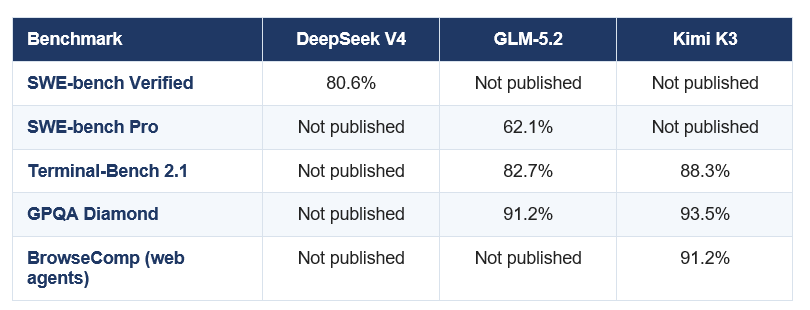
Each lab publishes the benchmarks that flatter it, so cross-model rows use different tests. Treat as directional.
HOW TO READ THIS TABLE
These are not all the same test. DeepSeek reports SWE-bench Verified, GLM reports SWE-bench Pro and Terminal-Bench, and Kimi reports Terminal-Bench, GPQA and BrowseComp. Comparing 80.6% SWE-bench Verified to 82.7% Terminal-Bench is apples to oranges. The reliable signal is that all three are frontier-adjacent on coding, and the differences are smaller than the price gaps suggest. Test on your own code before deciding.
My read: on pure coding, DeepSeek V4 and GLM-5.2 are neck and neck and both excellent, while Kimi K3's advantage shows up in agentic and reasoning-heavy work rather than raw code generation. For writing and fixing code, the cheaper two are the smart picks.
Pricing Compared
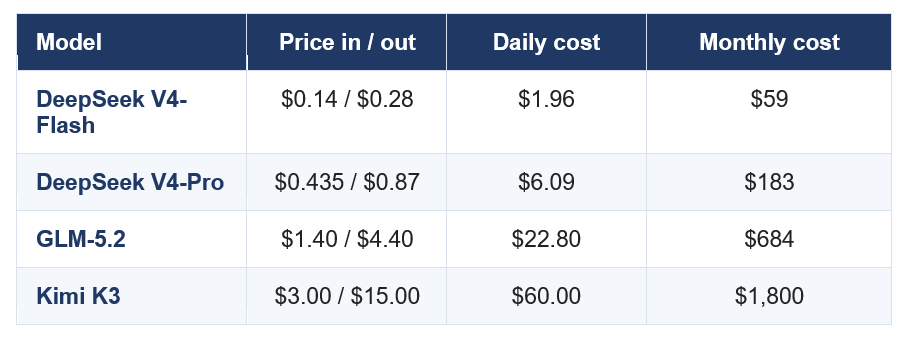
On price, DeepSeek V4 is by far the cheapest, GLM-5.2 sits in the middle, and Kimi K3 is the most expensive of the three. For high-volume coding, the difference is the whole decision.
Table 4: Monthly cost at 10M input and 2M output tokens per day
List pricing. Kimi K3 cached input at $0.30 cuts its cost for agents that reuse a large system prompt.
The gap is stark: DeepSeek V4-Flash runs a coding workload for about $59 a month where Kimi K3 costs $1,800, roughly 30 times more. Unless your work specifically needs Kimi K3's agentic and reasoning edge, DeepSeek V4 or GLM-5.2 does the coding job for a fraction of the price. And self-hosting any of the MIT-licensed models removes per-token cost entirely.
For where these prices sit against the full open field, see our best open source AI models ranking.
DeepSeek V4: The Value King
DeepSeek V4 is the best value open coding model, posting 80.6% on SWE-bench Verified, the top open-weights result, at prices no rival matches. Its V4-Flash variant handles most coding at $0.14 input and $0.28 output, while V4-Pro adds a little quality for harder tasks.
For coding specifically, DeepSeek V4 is the model I would default to. The SWE-bench Verified lead means it fixes real GitHub issues correctly at a high rate, and the price makes it viable to run on every commit, every pull request, and every routine task without watching the meter. The MIT licence means you can self-host it with no strings, which matters for teams with data-control needs.
Best for: high-volume coding, cost-sensitive teams, and anyone who wants the best coding quality per dollar in open source.
Our full DeepSeek V4 review covers the Pro versus Flash split and the benchmarks in detail.
Don't just use ChatGPT. Learn to build custom LLM agents, RAG pipelines, and full-stack Agentic AI apps in our intensive 6-week program.
GLM-5.2: The Terminal Coder
GLM-5.2 is the best open model for terminal and agentic coding, scoring 82.7% on Terminal-Bench 2.1, the strongest open result on that test, under an MIT licence at $1.40 input and $4.40 output. It shines on the multi-step, command-line work that real repositories demand.
Where DeepSeek V4 wins on isolated issue-fixing, GLM-5.2 wins on the messier reality of working inside a live codebase: running commands, chaining tools, and iterating in the terminal. It costs more than DeepSeek but far less than Kimi K3, and its Terminal-Bench score puts it within a few points of closed flagships. For a developer whose day is terminal-heavy, it is the open pick.
Best for: terminal and repository work, agentic coding, and teams that want strong command-line performance under a permissive licence.
Our GLM-5.2 review and our GLM-5.2 vs Claude vs GPT-5.6 vs Kimi coding comparison go deeper on where it leads.
Kimi K3: The Agentic Heavyweight
Kimi K3 is the strongest of the three on agentic and reasoning-heavy work, with a record 91.2% BrowseComp for web agents and 93.5% GPQA, but it is the most expensive and its edge is not in raw code generation. For coding tasks that involve research, browsing, or complex multi-step reasoning, it earns its price.
The honest framing for a coding comparison: Kimi K3 is a 2.8 trillion parameter reasoning and agent model that also codes well, rather than a coding specialist. If your work is a coding agent that browses docs, plans across a large context, and reasons through hard problems, K3 is the best of the three. If your work is writing and fixing code at volume, its $15 output price is hard to justify against DeepSeek V4 or GLM-5.2. Moonshot also offers Kimi K2.7 Code, a cheaper coding-focused sibling worth considering.
Best for: complex agentic coding, research-heavy tasks, and workflows that need top reasoning and web browsing alongside code.
Our Kimi K3 review, guide to running Kimi K3 locally, and Kimi K2.7 Code review cover the model and its cheaper coding sibling.
Which Model for Which Coding Job
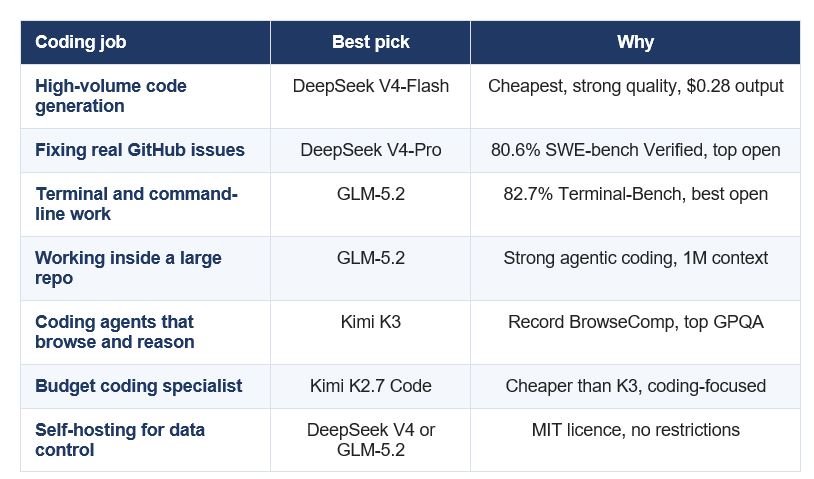
Match the model to the job and the choice is clear. Here is the pick for each common coding scenario.
Table 5: Best model by coding job
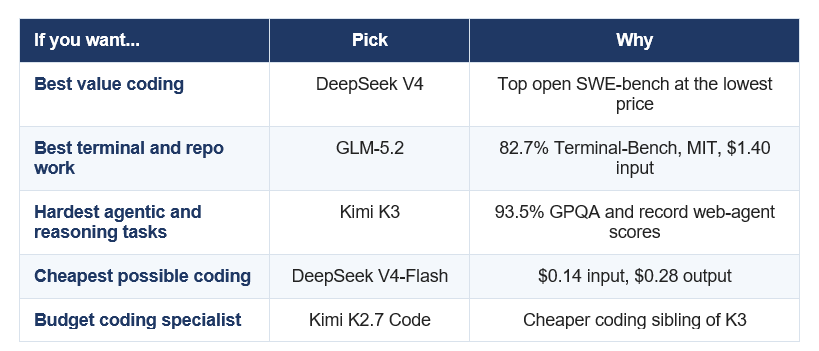
For most teams, a stack of DeepSeek V4 for volume and GLM-5.2 for terminal work covers the majority of coding.
How to Choose
Choose DeepSeek V4 if price and pure coding quality matter most, GLM-5.2 if your work is terminal and repo heavy, and Kimi K3 only if you need its agentic and reasoning edge. For most developers, the first two cover coding at a fraction of Kimi K3's cost.
The smart pattern, as with the closed models, is a routed stack rather than one model. Run DeepSeek V4-Flash for the routine 80% of coding, reach for GLM-5.2 on terminal-heavy tasks, and reserve Kimi K3 for the agentic jobs that genuinely need it. Because all three are open weight and OpenAI-compatible through most providers, switching between them is a base-URL and model-name change, so there is little reason to lock into one.
My final take: for a coding-first choice in open source right now, start with DeepSeek V4. It gives you the best coding quality per dollar, a permissive licence, and prices low enough that cost stops being a constraint. Add GLM-5.2 for terminal work, and only add Kimi K3 when a task clearly needs its reasoning muscle.
THE HONEST CAVEAT
None of these quite matches Claude Fable 5 on the very hardest coding, where it leads SWE-bench Verified near 95%. Open weights are a value, control, and self-hosting play. For the top 10% of difficulty, a closed flagship still wins, but for the other 90% these three do the job for a fraction of the price.
For how these open models compare against the closed flagships on coding, our GLM-5.2 vs Claude vs GPT-5.6 vs Kimi comparison is the companion read.
The only comprehensive program designed to take you from basic prompting to building interactive Artifacts, custom integrations, and deploying production-ready code with Claude Code.
Frequently Asked Questions
Q: What is the best open source AI for coding in 2026?
It depends on the job. DeepSeek V4 is the best value, with the top open SWE-bench Verified score of 80.6% at the lowest price. GLM-5.2 is the best for terminal and repository work at 82.7% Terminal-Bench. Kimi K3 leads on agentic and reasoning-heavy coding but costs the most. For most developers, DeepSeek V4 is the smart default.
Q: Is DeepSeek V4 better than GLM-5.2 for coding?
They lead different benchmarks. DeepSeek V4-Pro tops SWE-bench Verified at 80.6% and is much cheaper, while GLM-5.2 tops Terminal-Bench at 82.7% for command-line and repo work. DeepSeek V4 is the better value pick, and GLM-5.2 is stronger for terminal-heavy coding. Both are excellent and close in quality.
Q: Is Kimi K3 good for coding?
Yes, but it is a reasoning and agent model that also codes well, not a coding specialist. It leads on agentic and web-browsing tasks with a record 91.2% BrowseComp and 93.5% GPQA, but at $3 input and $15 output it is far pricier than DeepSeek V4 or GLM-5.2. For pure code generation, the cheaper two are better value. Moonshot's Kimi K2.7 Code is a cheaper coding-focused option.
Q: Which open model is cheapest for coding?
DeepSeek V4-Flash is the cheapest at $0.14 input and $0.28 output per million tokens, followed by DeepSeek V4-Pro at $0.435 and $0.87. GLM-5.2 costs $1.40 and $4.40, and Kimi K3 is the most expensive at $3 and $15. Self-hosting any of the MIT-licensed models removes per-token cost entirely.
Q: DeepSeek V4 vs Kimi K3: which is better?
For coding value, DeepSeek V4, which matches or beats Kimi K3 on code tasks at roughly a thirtieth of the price. For complex agentic work that needs reasoning and web browsing, Kimi K3 is stronger. Most developers coding at volume should choose DeepSeek V4 and reserve Kimi K3 for tasks that clearly need its agentic edge.
Q: Are these open coding models as good as Claude?
Close, but not on the hardest tasks. Claude Fable 5 still leads coding benchmarks near 95% SWE-bench Verified. DeepSeek V4, GLM-5.2 and Kimi K3 are frontier-adjacent and do most real coding at a fraction of the price, with open weights you can self-host. For the top 10% of difficulty, a closed flagship still wins.
Recommended Blogs
- DeepSeek V4 review
- Kimi K3 review
- GLM-5.2 review
- Best open source AI models
- GLM-5.2 vs Claude vs GPT-5.6 vs Kimi
Resources and Community
Join our community of 70,000+ AI enthusiasts and learn to build powerful AI applications. Whether you are a beginner or an experienced developer, Build Fast with AI helps you understand and implement AI in your projects.
- Website (buildfastwithai.com)
- LinkedIn (Build Fast with AI)
- Instagram (@buildfastwithai)
- Founder Twitter (@satvikps)
- Twitter (@BuildFastWithAI)
Agentic AI Launchpad 2026
A structured 6-week cohort program that takes you from AI basics to building and deploying real-world agentic AI systems. Includes live sessions, expert mentorship, project reviews, and a builder community network.
Ready to go from learning to building? Join the next cohort: Agentic AI Launchpad 2026
Free AI Resources
Access free tools, workshops, and micro-learning to keep building:
Open source coding just got genuinely good and genuinely cheap. Test DeepSeek V4 on your own repo this week, and follow Build Fast with AI for honest model comparisons every week

