



LongCat-2.0 Review: Meituan's Open-Source Coding Model Tested (2026)
For two months before June 30, 2026, an anonymous model called Owl Alpha quietly led developer charts on OpenRouter. It generated 10.1 trillion monthly tokens during its unbranded residency, averaging 559 billion tokens per day. It held the top ranking on the Hermes Agent workspace, second place on Claude Code deployments, and third place across international OpenClaw environments. Nobody knew who built it. On June 30, 2026, Meituan stepped forward to claim it. Owl Alpha was LongCat-2.0, the flagship foundation model from China's dominant food delivery and local services platform, built by a team that had been quietly operating as a serious foundation model lab without the AI world noticing. The model's specifications match what two months of production usage had already demonstrated: 1.6 trillion total parameters in a Mixture-of-Experts architecture, approximately 48 billion active per token, a native 1-million-token context window built on a custom attention mechanism called LongCat Sparse Attention, and an MIT license that makes it one of the most permissive trillion-parameter models ever released. The geopolitically significant detail: Meituan claims the entire training run, spanning more than 35 trillion tokens across millions of accelerator-hours, was completed on over 50,000 domestic Chinese AI ASICs from Huawei, Moore Threads, and MetaX, without a single Nvidia GPU. If that claim is independently verified, it is the most significant proof-of-concept for China's semiconductor export-control response yet demonstrated at frontier model scale. This review covers all of it: the Owl Alpha story, the architecture, the benchmarks with honest sourcing labels, the hardware claim, the deployment guide, and where LongCat-2.0 fits versus GLM-5.2, MiMo-V2-Pro, and the closed-source models it is being compared against.
1. The Owl Alpha Story: Two Months of Anonymous OpenRouter Domination
The pattern is becoming familiar in 2026: a Chinese AI lab deploys a model anonymously on OpenRouter, lets the developer community validate it in production, then claims it. MiMo-V2-Pro did it for seven days as Hunter Alpha. LongCat-2.0 did it for two months as Owl Alpha. The difference is scale: where Hunter Alpha crossed one trillion tokens before its reveal, Owl Alpha generated 10.1 trillion monthly tokens and 559 billion tokens per day at its peak. VentureBeat's reporting on the Owl Alpha operational data is the most specific public accounting of what happened during those two months. By the time Meituan stepped forward on June 30, LongCat-2.0 had already secured the top ranking on the Hermes Agent workspace, second place on Claude Code deployments, and third place across international OpenClaw environments. These are not synthetic benchmark positions. They are the result of real developers choosing this model over known alternatives for real agentic coding work, without knowing who built it.
The strategic calculation behind the Owl Alpha approach is identical to the Hunter Alpha approach from Xiaomi: bypass the initial skepticism that any new entrant faces, let the model speak for itself in production conditions, and arrive at the public launch with a market position already established. The difference for Meituan is that two months of operation at this token volume creates an unusually rich foundation for understanding actual production behavior. Meituan knows which workflows LongCat-2.0 handles reliably, which tasks cause failures, and what the real-world performance looks like across the range of developer use cases, because they watched it happen anonymously before the community applied the 'Meituan AI model' label and the associated prior judgments. The comparison that the AI community drew during the Owl Alpha period is the most informative signal available: developers consistently compared it to GLM-5.2 in terms of architectural approach and performance profile. Some assumed it was the next GLM generation. Others thought it was a Kimi variant. Nobody assumed it was from a food delivery company. For the GLM-5.2 competitive context that Owl Alpha was being compared to during its anonymous run, the GLM-5.2 vs Claude Opus vs GPT-5.6 vs Kimi coding comparison covers the open-weight coding model landscape that LongCat-2.0 entered.
2. What Is LongCat-2.0? Core Specs and Architecture
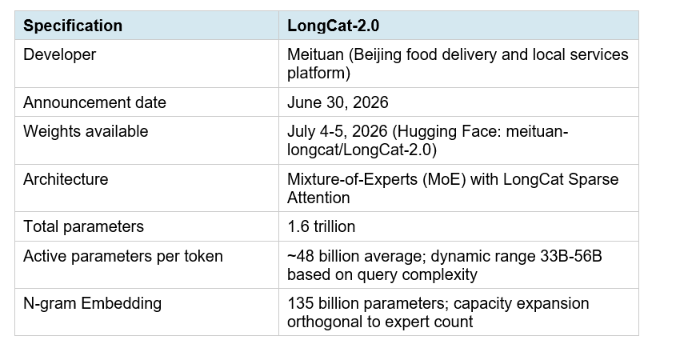
The predecessor model was LongCat-Flash, a 560B model released in 2025. LongCat-2.0 is a 2.86x scale increase in total parameters, from 560B to 1.6T, alongside the introduction of the custom attention architecture. The jump is not purely scale; the LongCat Sparse Attention and the N-gram Embedding are both architectural additions that did not exist in the Flash model, making this a generational upgrade rather than a straightforward scale increase.
3. LongCat Sparse Attention: The 1M Context Engineering
The standard attention mechanism in transformers is quadratic in context length: doubling the context quadruples the attention computation. At one million tokens, quadratic attention is computationally intractable for practical inference. Every model claiming a native 1M context window has to solve this problem architecturally. LongCat-2.0 solves it with a custom mechanism called LongCat Sparse Attention (LSA). LSA keeps complexity linear rather than quadratic through three specific design choices, all described in the Hugging Face model card: streaming-aware attention that processes tokens as they arrive rather than holding all of them in memory simultaneously; cross-layer attention sharing that allows later transformer layers to reuse attention computations from earlier layers rather than recomputing them; and hierarchical indexing that organizes the 1M token window into a nested structure, allowing the model to attend to relevant regions at different granularities rather than treating all one million tokens as equally accessible at the same level of detail.
The practical result of LSA: inference cost for LongCat-2.0 at 1M context is materially lower than what a standard attention 1M context model would require. AI Weekly's framing captures this precisely: 'a custom attention scheme called LongCat Sparse Attention with streaming-aware, cross-layer, and hierarchical indexing tricks aimed at 1M-context workloads.' The word 'tricks' is not dismissive. These are real engineering innovations that make trillion-parameter 1M-context inference economically viable without requiring proprietary hardware infrastructure.
The deployment implication: LongCat-2.0 at 1M context is deployable on 16 H20 GPUs using the FP8 variant. A model of this total parameter count with standard quadratic attention at 1M context would require significantly more hardware. LSA is what makes the Hugging Face weights actually runnable for teams with reasonable but not unlimited GPU infrastructure.
4. The N-gram Embedding: A Structural Innovation
The 135-billion-parameter N-gram Embedding component is the most architecturally unusual aspect of LongCat-2.0 and the one least covered by most reviews. AI Weekly's model card description is the most specific public source: the N-gram embedding 'expands capacity in a dimension orthogonal to expert count.' Standard MoE models have two capacity dimensions: the number of experts (how many specialized parameter sets exist) and the active parameters per token (how many experts are activated on each forward pass). The N-gram embedding adds a third dimension: fixed N-gram patterns, which are statistical regularities in token sequences that the model learns to recognize and cache. These patterns are independent of which expert is activated; they provide the model with a persistent representation of common token sequences that supplements the dynamic expert routing. The practical benefit: N-gram embeddings improve the model's ability to recognize and respond to repeated structural patterns in code, which are extremely common in real codebases. Function signatures, import patterns, variable naming conventions, and boilerplate structures all repeat with regularity in software engineering contexts. A model with fast recognition of these patterns via cached N-gram representations can spend more of its expert routing capacity on novel content rather than re-learning patterns it has seen thousands of times. This is why the N-gram embedding component is most valuable for the code and agent use cases LongCat-2.0 specifically targets.
5. The Chinese Chip Training Claim: What We Know
Meituan claims that LongCat-2.0's entire pretraining run, more than 35 trillion tokens across millions of accelerator-hours on over 50,000 domestic Chinese AI ASICs from Huawei (Ascend), Moore Threads, and MetaX, was completed without any Nvidia GPUs. If independently verified, this claim matters more than any benchmark number in the LongCat-2.0 story. The US export controls on high-performance AI chips to China have been among the most consequential technology policy decisions of the past three years. The assumption underlying those controls is that Chinese AI development requires Nvidia H100 and H800 chips to train frontier-class models, and that restricting access to those chips constrains Chinese AI progress. A verified 1.6T-parameter frontier-tier model trained entirely on domestic Chinese hardware directly challenges that assumption. Meituan specifically noted that no rollbacks or irrecoverable loss spikes occurred during the training run on this non-Nvidia hardware, which MarkTechPost specifically highlights as significant because Nvidia's CUDA ecosystem provides substantially more mature tooling than domestic Chinese alternatives. Training stability on non-Nvidia hardware at this scale would represent a genuine infrastructure achievement, not just a hardware procurement decision. The honest current status: the claim is sourced from Meituan's official announcement. SiliconAngle and VentureBeat both report it as stated by Meituan. No independent verification of the hardware composition has been published. The geopolitical significance of the claim, if true, is large enough that it will attract independent verification efforts over the coming weeks.
6. Benchmarks: Self-Reported Numbers with Honest Sourcing
ALL benchmark scores below are from Meituan's self-reported evaluations. No independent third-party benchmark verification has been published as of July 8, 2026. AI Weekly, FelloAI, and TechJackSolutions all explicitly note this. Treat these as credible vendor claims to validate against your own tasks, not as independently verified scores.
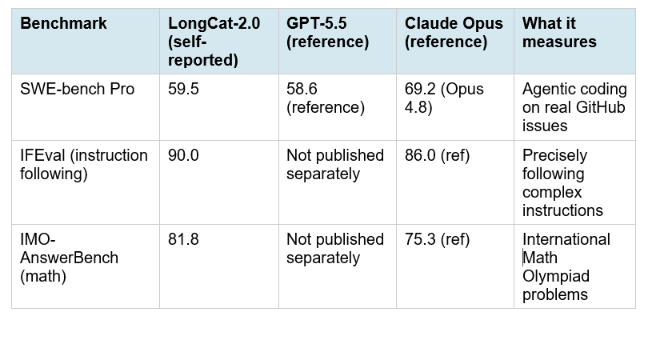
The benchmark picture requires reading in layers. On SWE-bench Pro, LongCat-2.0 edges GPT-5.5 by 0.9 points (59.5 vs 58.6). That margin is narrow enough to be within harness configuration variance on this benchmark, per the standard caution noted in the GLM-5.2 comparison work. The meaningful statement is that LongCat-2.0 is approximately in the same performance tier as GPT-5.5 on SWE-bench Pro, which is the hardest contamination-resistant coding benchmark available. The IFEval (90.0 vs 86.0 Claude Opus) and IMO-AnswerBench (81.8 vs 75.3 Claude Opus) results are more surprising and harder to contextualize. IFEval measures precise instruction following; a 4-point lead over Claude Opus on this benchmark would be a genuinely significant result. IMO-AnswerBench measures olympiad-level mathematics; an 81.8 result would put LongCat-2.0 near frontier performance on the hardest reasoning benchmark in this tier. Both results require independent verification before being treated as settled. The honest complement: on general agent benchmarks like FORTE and BrowseComp, MarkTechPost's coverage specifically notes that LongCat-2.0 'trails leading frontier systems.' The model is designed for agentic software engineering specifically, not general-purpose agentic performance. Its FORTE and BrowseComp positions are consistent with a model that was optimized for code and agent workflows over broad general-agent capability.
7. LongCat-2.0 vs GLM-5.2 vs MiMo-V2-Pro vs Kimi K2.7
The July 2026 open-weight coding model landscape now has three strong Chinese entries at approximately the same capability tier. Here is the honest comparison:
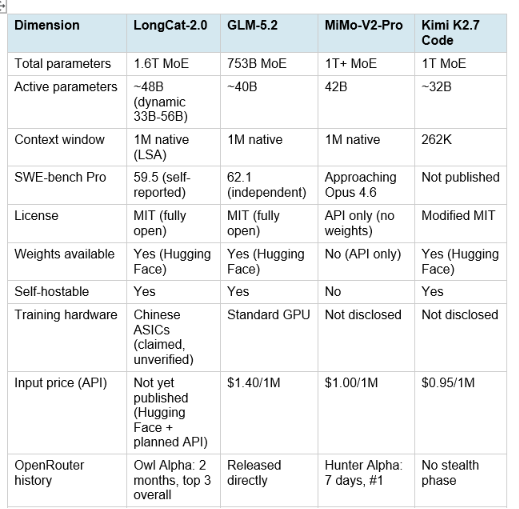
The comparison table reveals where each model has a specific advantage. GLM-5.2 holds the lead on independently verified SWE-bench Pro at 62.1%, which is the most important single benchmark number for coding model selection precisely because it is not self-reported. LongCat-2.0's 59.5% self-reported SWE-bench Pro puts it slightly below GLM-5.2 on that benchmark. MiMo-V2-Pro leads on documented OpenRouter production performance and its Opus-approaching agentic benchmark results. Kimi K2.7 leads on MCP tool-use accuracy and per-token cost. LongCat-2.0's specific advantage in this landscape is the combination of 1.6T total parameters (the largest in this comparison by a meaningful margin) with full MIT-licensed open weights, making it the largest fully open-weight model available for self-hosting in the coding category as of July 2026. For teams that need the open weight flexibility of GLM-5.2 but want access to a larger total parameter base, LongCat-2.0 is the option. For teams that trust GLM-5.2's independently verified SWE-bench Pro score more than LongCat's self-reported numbers, GLM-5.2 remains the safer coding default. For the full GLM-5.2 comparison analysis, the GLM-5.2 vs Claude Opus vs GPT-5.6 vs Kimi comparison covers the full competitive coding model picture.
8. Agent Framework Integrations
LongCat-2.0 is positioned as the brain of agent systems and has documented integrations with three specific agent frameworks where it performed well during the Owl Alpha period:
- Hermes Agent workspace: LongCat-2.0 (as Owl Alpha) achieved the top ranking on Hermes during its anonymous period. Hermes is a general-purpose agent execution environment, and the top ranking reflects consistent performance on multi-step task completion across diverse agent workflows.
- Claude Code: Second place on Claude Code deployments during the Owl Alpha period. This is particularly notable because Claude Code is Anthropic's own terminal-based coding agent, typically run with Anthropic's Claude models as the backend. A third-party model reaching second place on Claude Code deployments represents genuine adoption by developers who deliberately chose LongCat-2.0 over Claude models for their coding agent sessions.
- OpenClaw: Third place internationally during the Owl Alpha period. OpenClaw is the general-purpose agent framework most commonly used to evaluate agentic performance in Chinese model deployments; it is the framework on which MiMo-V2-Pro is also specifically optimized.
The SiliconAngle and Meituan official documentation add context: LongCat-2.0 is specifically designed to work as a brain for coding harnesses including Claude Code, OpenClaw, and Hermes. Meituan explicitly says it delivers strong performance for code understanding, repository-level edits, automated task execution, and agentic workflows. The three frameworks listed are precisely the ones where production Owl Alpha usage confirmed this. For the developer tools context where these frameworks are used in production, the 7 AI developer tools that changed developer workflow covers Claude Code, Cline, and the broader agent framework ecosystem where LongCat-2.0 is now available.
9. How to Access and Deploy LongCat-2.0
Hugging Face (Open Weights)
The model weights are available at huggingface.co/meituan-longcat/LongCat-2.0. The repository ships the full 141-shard INT8 checkpoint, BF16/F32 full precision weights, and an FP8 quantized variant. Community quantizations are also appearing in the Hugging Face ecosystem as of early July 2026. This is fully MIT-licensed, meaning no restrictions on commercial use, modification, or redistribution.
Hardware Requirements
Meituan's recommended deployment configuration for the FP8 variant is 16 H20 GPUs. At 1.6T total parameters with 48B active per token, the memory footprint during inference is closer to a 48B-active model than to a 1.6T dense model, which is the MoE architecture's primary inference cost advantage. Community reports from early deployers suggest that quantized variants can run on smaller configurations. The SGLang integration is the recommended serving framework, with SGLang-FluentLLM available for NPU-based deployment for teams running on non-GPU infrastructure.
OpenRouter API
LongCat-2.0 is available on OpenRouter. For developers who want API access without running their own inference infrastructure, OpenRouter's three routing modes apply: Balanced (price and speed), Nitro (fastest), and Exacto (highest tool-calling accuracy). Pricing has not been officially announced by Meituan for the hosted API tier; OpenRouter's pricing for LongCat-2.0 reflects the current provider rates.
Meituan's Native Platform
Access is also available at Meituan's LongCat AI site. The GitHub repository provides the inference code alongside the weights. For teams embedding LongCat-2.0 into existing OpenAI-compatible infrastructure, the API is designed to be compatible with the OpenAI message format, requiring only a base URL change and model name update.
10. Who Should Use LongCat-2.0
Teams That Need Self-Hostable Open Weights at Maximum Scale
LongCat-2.0 is the largest fully open-weight model in the coding category as of July 2026 at 1.6T total parameters under MIT license. For teams with the GPU infrastructure to run it and a requirement for self-hosted model deployment (data sovereignty, compliance, or cost at very high volume), LongCat-2.0 provides more total parameter capacity than GLM-5.2 (753B) or Kimi K2.7 (1T). If you can run it, it is the most capable fully open-weight coding model available.
Repository-Scale Code Analysis
The 1M native context window plus the LSA architecture, which keeps inference cost linear rather than quadratic, makes LongCat-2.0 the strongest available option for workflows that need to analyze entire codebases in a single context window. Feed a full mid-sized monorepo and ask the model to trace a bug across hundreds of files simultaneously. This is the workflow Meituan specifically designed for, and the Owl Alpha performance in production confirms it.
Agentic Coding Workflows on Claude Code or OpenClaw
The Owl Alpha production data is the most credible evidence available for where LongCat-2.0 performs well: second place on Claude Code deployments and first place on Hermes Agent means this is a model that developers were actively choosing for agentic coding work over better-known alternatives. Teams running Claude Code or OpenClaw workflows who want to evaluate an open-weight alternative to Claude Opus or Claude Sonnet should test LongCat-2.0 on their actual task distribution. For the broader developer tooling context, the 7 AI developer tools that changed workflow covers Claude Code and the wider agent coding ecosystem.
Independent Benchmark Validators
LongCat-2.0's self-reported benchmark claims, particularly the IFEval lead over Claude Opus and the IMO-AnswerBench result, need independent verification before being treated as settled. Researchers and developers building evaluation infrastructure should prioritize LongCat-2.0 precisely because the claims are large enough to matter and the independent confirmation is not yet available. Early independent evaluation results will be the most important data point for understanding this model's true position in the 2026 open-weight landscape.
11. Limitations: Honest Assessment
- All benchmarks are self-reported: no independent third-party verification of any LongCat-2.0 benchmark exists as of July 8, 2026. The SWE-bench Pro 59.5, IFEval 90.0, IMO-AnswerBench 81.8, and Terminal-Bench 70.8 are all from Meituan's own testing. The IFEval and IMO results in particular require independent verification before being cited as settled.
- Chinese chip training claim unverified: the claim that training ran on 50,000+ domestic Chinese ASICs without Nvidia GPUs is from Meituan's announcement. No independent third-party verification of the hardware composition has been published. TechJackSolutions specifically flags this as the weakest-sourced claim in the announcement.
- General agent benchmarks trail frontier: on FORTE and BrowseComp, LongCat-2.0 trails frontier systems. This is not a deficiency in the model's design; it was built for agentic software engineering, not general-purpose research agents. But teams evaluating it for broad agentic research tasks should expect lower performance than the coding benchmarks suggest.
- Hardware requirements are substantial: 16 H20 GPUs for the FP8 variant is a real infrastructure requirement. Not every team building on open-weight models has this available. Community quantizations will reduce this, but with quality tradeoffs.
- Data jurisdiction: LongCat-2.0 is a product of Meituan, a Chinese company. The hosted API routes through Meituan infrastructure subject to Chinese data law. For regulated industry applications handling sensitive data, the same data jurisdiction considerations that apply to GLM-5.2 and MiMo-V2-Pro apply here. Self-hosting on MIT-licensed weights eliminates this concern.
- No vision or multimodal support: LongCat-2.0 is a text and code model. No image, audio, or video input or output is supported. For multimodal agentic workflows, other models are required.
Frequently Asked Questions
What is LongCat-2.0 and who made it?
LongCat-2.0 is a 1.6 trillion-parameter Mixture-of-Experts open-source language model released by Meituan on June 30, 2026, under an MIT license. Meituan is China's dominant food delivery and local services platform. The model is specifically engineered for agentic coding: code understanding, repository-level edits, automated task execution, and long-horizon agent workflows. Weights are available on Hugging Face at meituan-longcat/LongCat-2.0.
What was Owl Alpha and how does it relate to LongCat-2.0?
Owl Alpha was the anonymous codename under which LongCat-2.0 operated on OpenRouter for approximately two months before Meituan revealed its identity on June 30, 2026. During that period, it generated 10.1 trillion monthly tokens, peaked at 559 billion tokens per day, held the top ranking on Hermes Agent, second place on Claude Code deployments, and third place on international OpenClaw. This production performance before the official reveal established LongCat-2.0's position in the market before anyone knew it was a Meituan product.
What are LongCat-2.0's benchmark scores vs GPT-5.5?
Per Meituan's self-reported benchmarks (no independent verification as of July 8, 2026): SWE-bench Pro 59.5 vs GPT-5.5's 58.6 (margin of 0.9 points, within harness variance range); IFEval 90.0 vs a Claude Opus reference of 86.0; IMO-AnswerBench 81.8 vs Claude Opus 75.3. Terminal-Bench score is 70.8. On general agent benchmarks, LongCat-2.0 trails frontier systems. All figures require independent verification.
Is LongCat-2.0 free to use commercially?
Yes. LongCat-2.0 is released under the MIT license, one of the most permissive software licenses available. You can use it commercially, modify it, redistribute it, and build products on top of it without restriction. The weights on Hugging Face are fully open. Self-hosting on your own infrastructure is permitted and eliminates any hosted API data jurisdiction concerns.
What is LongCat Sparse Attention and why does it matter?
LongCat Sparse Attention (LSA) is Meituan's custom attention mechanism that keeps context processing complexity linear rather than quadratic as the context length grows. Standard transformer attention scales quadratically with context length, making a 1M-token window prohibitively expensive. LSA achieves linear scaling through three techniques: streaming-aware processing, cross-layer attention sharing, and hierarchical indexing of the context window. The result is that deploying LongCat-2.0 at 1M context is feasible on 16 H20 GPUs, much less hardware than standard attention at that scale would require.
How was LongCat-2.0 trained without Nvidia GPUs?
Meituan claims the entire training run, more than 35 trillion tokens across millions of accelerator-hours, was completed on over 50,000 domestic Chinese AI ASICs from Huawei (Ascend), Moore Threads, and MetaX, with no Nvidia GPUs. Meituan noted no rollbacks or irrecoverable loss spikes during the run, which they highlight because non-Nvidia tooling is less mature. This claim has not been independently verified as of July 8, 2026.
How do I download and run LongCat-2.0?
Download from Hugging Face at meituan-longcat/LongCat-2.0. The repository contains BF16/F32 full weights, an FP8 quantized variant, and a 141-shard INT8 checkpoint. Recommended deployment: 16x H20 GPUs for the FP8 variant. Inference framework: SGLang with the live SGLang PR. For NPU deployment: SGLang-FluentLLM. Community quantizations are appearing for smaller GPU setups. API access is also available on OpenRouter and Meituan's native platform without self-hosting.
How does LongCat-2.0 compare to GLM-5.2?
GLM-5.2 holds the lead on independently verified SWE-bench Pro at 62.1% versus LongCat-2.0's self-reported 59.5%. GLM-5.2's MIT open weights are available and have been independently tested. LongCat-2.0's benchmarks are self-reported and not yet independently verified. LongCat-2.0 is larger (1.6T vs 753B total parameters) and makes stronger claims on IFEval and IMO-AnswerBench. Until independent evaluations of LongCat-2.0 are published, GLM-5.2 is the safer default for teams where verified SWE-bench Pro performance is the primary selection criterion.
Recommended Blogs
- GLM-5.2 vs Claude Opus 4.8 vs GPT-5.6 vs Kimi: Best Coding AI Model (2026)
- Xiaomi MiMo-V2-Pro Review: The Model That Beat Everyone on OpenRouter (2026)
- Best AI Models of July 2026: Full Ranking by Use Case, Benchmarks, and Price
- 7 AI Tools That Changed Developer Workflow (August 2026)
- Open-Source LLMs Collection: Every Major Open-Weight Release Tracked
- Krea 2 Open Source Review: Raw, Turbo, and LoRA Fine-Tuning for Creators
Resources & Community
Join our community of 70,000+ AI enthusiasts and learn to build powerful AI applications! Whether you're a beginner or an experienced developer, Build Fast with AI helps you understand and implement AI in your projects.
- Website: buildfastwithai.com
- LinkedIn: Build Fast with AI
- Instagram: @buildfastwithai
- Founder Twitter: @satvikps
- Twitter: @BuildFastWithAI
Agentic AI Launchpad 2026
A structured 6-week cohort program that takes you from AI basics to building and deploying real-world agentic AI systems. Includes live sessions, expert mentorship, project reviews, and a builder community network.
Ready to go from learning to building? Join the next cohort: Agentic AI Launchpad 2026
Free AI Resources
Access free tools, workshops, and micro-learning to keep building:
- AI Workshops: Free resources, upcoming events and past recordings
- Unrot: Learn AI in 5 minutes a day (free micro-learning app)
The open-weight coding model race is moving faster than any other AI category right now. Follow @BuildFastWithAI on X to stay ahead of every major model release, independent benchmark, and deployment update that matters for builders and developers in 2026.
References
- VentureBeat: Meituan Open-Sources LongCat-2.0, the 1.6T Near-Frontier Agentic Coding Model That's Been Leading OpenRouter
- MarkTechPost: Meituan Releases LongCat-2.0: A 1.6T-Parameter Open MoE Model with Native 1M Context and LongCat Sparse Attention
- ExplainX: LongCat-2.0: 1.6T MoE Open Model — ASIC Training
- FelloAI: LongCat-2.0: China's 1.6T Open-Source Coding Model
- AI Weekly: Meituan Open-Sources 1.6T-Parameter LongCat-2.0 MoE Mode
- CreativeAI News: LongCat-2.0: China's 1.6T Open-Weights Coding Model
- TechJackSolutions: LongCat-2.0: Meituan's Open-Source 1.6T MoE Model
- SiliconAngle: China's Meituan Open-Sources Massive LongCat-2.0 AI Model, Saying It Was Trained on Domestic Chips
- Awesome Agents: LongCat-2.0 Model Card
- Hugging Face: meituan-longcat/LongCat-2.0

