



If you feel like you fell behind on AI this week, you did, and so did everyone else. Nobody keeps up with all of it anymore. There are new models, new tools, new features, and a fresh wave of hot takes every single day, and the volume has moved past what any human can read. I stopped trying to follow everything a long time ago, and my understanding of AI got better, not worse. This guide shows you exactly how to stay updated on AI in 2026 with a routine that takes about 20 minutes a week and still leaves you genuinely informed.
Here is the promise. You will not need to open 15 tabs, join 40 newsletters, or feel guilty about an unread pile. You will build three small layers, a daily five minutes, a weekly roundup, and one deeper read, and those three layers together will keep you ahead of most people in any room. Let me walk you through the system, why it works, and the tools that make it painless.
Why Staying Updated on AI Feels Impossible in 2026
Staying updated on AI feels impossible in 2026 because the pace of releases has outrun human reading speed. In a single week you might see a new flagship model, two open source challengers, a pricing change, a fresh coding agent, and a dozen think pieces about what it all means. Stanford's AI Index and similar trackers have documented how sharply model releases and investment have climbed year over year, and the curve has not flattened.
The result is a specific kind of stress. It is not that any one article is hard, it is that the pile never stops growing, so you always feel behind. Psychologists call this information overload, and it does real damage: you skim everything, remember nothing, and end each week more anxious and no smarter. I have watched sharp people quietly give up on AI news entirely because the firehose felt hopeless. That is the wrong response, and it is avoidable.
The fix is not more willpower or a faster reading speed. The fix is a filter and a rhythm. Once you accept that you cannot and should not consume everything, the problem shrinks from impossible to easy. You are not trying to drink the ocean. You are trying to catch the few drops that matter, on a schedule you can keep.
The Real Goal: Signal, Not Everything
The real goal of staying updated on AI is to catch the signal, not to read everything, and getting this straight changes how you spend your time. Most AI news is noise for you personally. A minor feature toggle, a benchmark that shifts by half a point, a funding rumor, none of that changes what you do on Monday. The signal is the small set of ideas and shifts that actually affect your work, your industry, or your understanding.
Think about what you truly need. You need to know which models are strong right now, which tools are worth trying, and which concepts keep coming up so you are not lost in conversation. You do not need to memorize every version number or track every startup. When you aim for signal, a week of AI news collapses from hundreds of items into maybe five things worth knowing, and five things fit into a coffee break.
A useful test: before you read anything, ask whether it would change a decision or deepen an idea you will use. If the honest answer is no, skip it without guilt. This one filter removes about 90 percent of the pile and keeps the 10 percent that makes you smarter. Our AI survival guide for 2026 is a good example of signal over noise, since it focuses on the shifts that matter rather than every headline.
The 20-Minute-a-Week AI System
The whole system to stay updated on AI is three layers that add up to about 20 to 30 minutes a week. Each layer has a different job, and together they cover daily awareness, weekly context, and monthly depth without any single day feeling heavy.
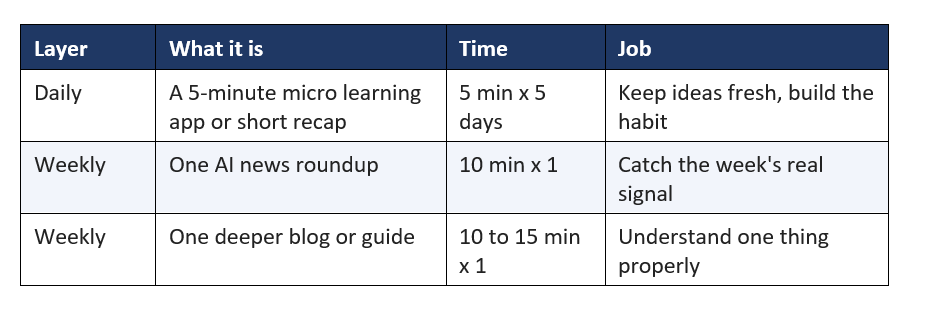
That is the entire plan. Roughly 25 to 40 minutes a week, spread so no day hurts. The daily layer is the engine, because little and often is what turns scattered facts into lasting understanding. The weekly layers give you context and depth. Miss a day and nothing breaks, since the habit is designed to be forgiving. Let me break down each layer.
Layer 1: The Daily 5 Minutes
The daily five minutes is the most important layer, because consistency beats intensity when it comes to learning. Five focused minutes a day, five days a week, is 25 minutes that compounds, and it beats a two hour Sunday cram that you forget by Wednesday. The point of this layer is not to break news, it is to keep the core ideas of AI warm in your head so nothing feels foreign.
This is exactly where a micro learning app earns its place. Instead of choosing what to read and fighting the firehose, you open one app, get one short, well made lesson or recap, and close it. No tabs, no rabbit holes, no guilt. Unrot was built for this: it turns the messy AI world into a five minute daily habit, so you learn one clear thing a day without the overwhelm. You can read more in our Unrot review and our take on learning faster in a few minutes a day.
If an app is not your style, the daily layer can be a single short newsletter or one recap post, as long as it is short and consistent. The format matters less than the rule: one small dose, every day, at the same time. Attach it to an existing habit, such as your morning coffee or your commute, and it will stick far better than any ambitious plan you abandon in week two.
Layer 2: The Weekly News Roundup
The weekly roundup is where you catch the actual news, and doing it once a week instead of every day is the single biggest overwhelm cure. Daily news reading feels productive and mostly is not, because most days do not contain anything that matters to you. A good weekly roundup does the filtering for you and hands you the five to ten things that genuinely moved.
Pick one roundup you trust and read it once, ideally on the same day each week. Our daily AI news coverage at Build Fast with AI is written so that a single recent edition catches you up on the biggest launches, model updates, and shifts, so you do not have to check every day to stay current. Reading one strong roundup weekly gives you 90 percent of the awareness of someone who doom scrolls AI news daily, at a fraction of the time and stress.
When you read the roundup, apply the signal test from earlier. Skim the headlines, stop only on the two or three items that touch your work or your curiosity, and let the rest go. You are not trying to remember the whole week. You are trying to notice the few shifts worth carrying into next week. Ten minutes, once a week, and you are genuinely informed.
Layer 3: One Deep Blog or Guide a Week
The third layer is one deeper read a week, and it is what turns awareness into real understanding. Roundups tell you what happened. A good blog or guide tells you why it matters and how it works, and that depth is what lets you actually use AI rather than just talk about it. One proper read a week, over a year, is 52 topics understood deeply, which is a serious education.
Choose the topic based on what keeps coming up in your roundups. If you keep seeing the word agent, read a solid explainer like our guide to what agentic AI is. If model comparisons keep confusing you, read a ranked breakdown like our best AI models analysis. Let your weekly news point you to your weekly deep read, so your learning always follows what is actually relevant right now.
Keep this layer to one topic. The temptation is to open five deep reads and finish none. Depth comes from focus, so pick the single most relevant topic of the week, read it properly, and stop. Next week there will be another. The compounding is in the consistency, not in cramming.
Why a Daily Habit Beats a Weekend Binge
A daily five minute habit beats a weekend binge because memory works through spacing and repetition, not through single large sessions. This is one of the oldest and most reliable findings in learning science. The forgetting curve shows that we lose most of what we learn within days unless we revisit it, and spaced repetition shows that small, spread out reviews lock information into long term memory far better than one long cram.
Apply that to AI. If you binge a dozen articles on Sunday, you feel informed for a day and forget almost all of it by midweek, which is why the binge never makes you feel caught up for long. If you learn one clear idea a day, each day quietly reinforces the last, and the concepts start to connect. Within a month you notice that AI news reads easily, because the vocabulary and the ideas are already familiar. That familiarity is the whole payoff.
This is also why micro learning apps are more than a convenience. By design they deliver small, spaced doses, which is exactly the shape learning science says works. A five minute daily lesson is not a watered down version of real learning. For retention, it is often the stronger version. The binge feels productive. The habit actually is.
How to Filter AI News So You Only See What Matters
Filtering AI news well is a skill, and a few simple rules will cut your reading by most of its volume while keeping all of the value. The aim is to let the important things reach you and let the rest pass by unread.
- Use the decision test. If an item would not change a decision or teach a lasting idea, skip it. Most news fails this test for you personally.
- Follow ideas, not every product. Track the concepts that repeat, such as agents, context, and open models, rather than each individual launch.
- Prefer summaries over sources. Let a trusted roundup do the first pass, so you only spend attention on what survived the filter.
- Batch it. Read news at set times, not continuously. Continuous checking is the real overwhelm engine.
- Unsubscribe ruthlessly. Keep one daily source and one weekly source. Every extra feed adds noise, not signal.
These rules feel almost too simple, which is why most people never apply them. They keep chasing completeness. Completeness is the trap. The moment you accept that missing most AI news is fine and even correct, staying updated becomes calm instead of frantic.
A Simple Weekly Schedule You Can Copy
Here is a weekly schedule that puts the whole system on autopilot. Adjust the days to your life, but keep the shape: daily small doses, one news day, one depth day.
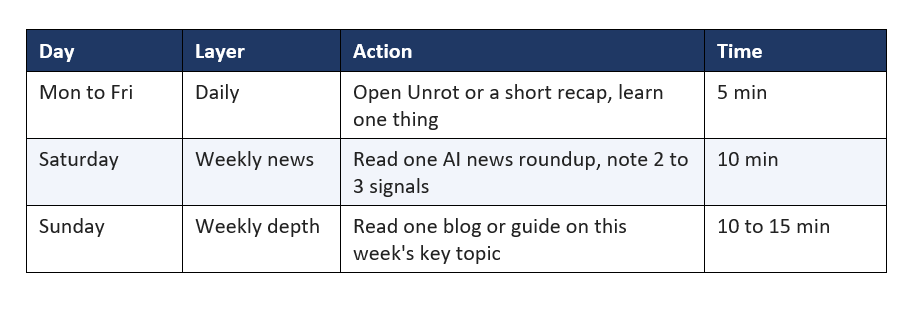
Total for the week is about 35 minutes, most of it in tiny daily pieces you will barely notice. This schedule is deliberately light, because a plan you keep beats a perfect plan you quit. If a busy week happens, protect the daily five minutes and let the weekly reads slide. The habit is the asset. Everything else is a bonus.
Tools and Sources Worth Your Time
You need very few tools to stay updated on AI, and adding more usually hurts. Here is a lean stack that covers all three layers without creating a new firehose.
- A daily micro learning app such as Unrot for the five minute habit, so your daily dose is chosen for you and easy to keep.
- One weekly AI news roundup you trust, read once on a set day.
- One blog you respect for deeper explainers, guides, and model breakdowns.
- One newsletter, at most, for a curated weekly signal in your inbox.
Notice what is missing: endless feeds, a dozen newsletters, and constant notifications. Those do not make you more informed, they make you more anxious. A single strong source per layer is enough, and the discipline of keeping the stack small is what protects your attention. If you want a starting point for depth, the Build Fast with AI blog covers daily news, model reviews, comparisons, and beginner guides in one place, so you can get both your weekly roundup and your weekly deep read without hunting across the internet.
Common Mistakes That Cause AI Overwhelm
Most AI overwhelm comes from a handful of avoidable mistakes. Fix these and the stress largely disappears.
- Trying to read everything. The volume is infinite, so completeness is impossible and chasing it guarantees burnout.
- Checking news all day. Continuous checking fragments your attention and rarely surfaces anything urgent.
- Following too many sources. Ten newsletters do not inform you ten times better, they overwhelm you ten times more.
- Bingeing instead of spacing. A weekend cram feels productive and fades fast, while a daily habit compounds.
- Consuming without ever applying. Updates that never touch real work stay shallow and forgettable.
Every one of these is a habit, and habits can be swapped. Replace all day checking with batched reading, swap ten feeds for two, and trade the binge for the daily five minutes. The system in this guide is really just these fixes turned into a routine you can follow without thinking about it.
How to Turn Updates Into Real Skills
Staying updated is only worth it if it turns into skill, and the bridge from reading to doing is small, deliberate practice. Awareness tells you a tool exists. Skill comes from opening that tool and trying it on a real task. The people who benefit most from following AI are the ones who act on one update a week, not the ones who read the most.
Build a tiny action step into your routine. When your weekly deep read introduces something useful, try it once that week. If you read about a coding agent, run it on a small task. If you read about image prompts, generate something with a copy-paste prompt pack. One small experiment a week, over a year, makes you genuinely capable, not just conversant. Reading builds vocabulary, doing builds skill, and you want both.
This is also the honest reason the daily habit matters so much. It keeps the ideas fresh enough that when an opportunity to apply one shows up at work, you recognize it and act. Cold knowledge sits unused. Warm knowledge gets used. Five minutes a day is how you keep it warm, which is the entire point of staying updated in the first place.
What Changes After 30, 60, and 90 Days
The system pays off on a predictable curve, and knowing the curve helps you stick with it through the quiet early weeks. The first month feels like almost nothing is happening, which is exactly when most people quit. Push past it, because the compounding starts right after.
By day 30, the words stop feeling foreign. Terms that once made you scroll past now make sense, because five minutes a day has quietly built a base vocabulary. This is the hardest stretch to trust, since the progress is invisible from the inside, but it is happening. Keep the daily habit alive even on busy days and let the weekly reads flex around your schedule.
By day 60, something better appears: you start connecting the dots. A model launch you read about on Monday links to a pricing shift you saw last week, and the pattern tells a story. This is spaced repetition doing its work, weaving separate facts into a mental map. You are no longer collecting trivia, you are building understanding, and understanding is what lets you predict where things are heading.
By day 90, you cross into confidence. You hold opinions you can defend, you know which tools fit which jobs, and you try new things without hesitation because the ideas are already familiar. Ninety days of about 35 minutes a week is under 8 hours of total effort, and it takes you from overwhelmed to genuinely informed. That is the quiet power of little and often, and it is why the daily five minutes is the piece to protect above all else.
FAQ
What is the best way to stay updated on AI?
The best way to stay updated on AI is a small daily habit plus a weekly roundup, not constant news checking. Spend five minutes a day on a micro learning app or short recap, read one trusted AI news roundup each week, and read one deeper blog or guide weekly. That is about 20 to 30 minutes a week and keeps you genuinely informed without overwhelm.
How do I keep up with AI without getting overwhelmed?
Stop trying to read everything and filter for signal instead. Use one daily source and one weekly source, apply the test of whether an item changes a decision or teaches a lasting idea, and batch your reading at set times. Missing most AI news is normal and correct, since the volume is far beyond what anyone can consume.
How much time do I need to follow AI properly?
About 20 to 40 minutes a week is enough to follow AI properly. Five minutes a day keeps core ideas fresh, one weekly roundup catches the real news, and one deeper read builds understanding. Consistency matters more than volume, so small daily doses beat long occasional sessions.
Is it worth reading AI news every day?
Reading AI news every day is usually not worth it, because most days contain nothing that affects you. A once a week roundup captures the important shifts with far less time and stress. Keep the daily habit for short learning, and let a weekly roundup handle the actual news.
What should a beginner follow to learn AI in 2026?
A beginner should start with one daily micro learning habit and one beginner friendly blog. A five minute a day app such as Unrot builds the habit painlessly, and explainers like our what is agentic AI guide build a foundation. Add a weekly news roundup once the habit sticks, and try one small AI task a week to turn reading into skill.
Are 5-minute AI learning apps actually effective?
Yes, short daily learning is effective because it matches how memory works. Spaced repetition and the forgetting curve both show that small, repeated doses retain far better than single long sessions. A five minute daily lesson is not a lite version of learning, for retention it is often the stronger version.
How do I remember what I read about AI?
You remember more by spacing your learning and applying it. Learn a little each day so ideas get repeated, and try one thing you read about each week on a real task. Reading builds vocabulary, doing builds skill, and the combination is what makes AI knowledge stick.
Where can I find a good AI news roundup?
Pick one roundup that summarizes the week clearly and read it on a fixed day. The Build Fast with AI blog publishes daily AI news plus weekly recaps, so a single recent edition catches you up on the biggest launches and shifts. One trusted roundup, read once a week, gives you most of the awareness of daily news readers at a fraction of the time.
Do I need to pay to stay updated on AI?
No, you can stay updated on AI for free. A free micro learning app for the daily habit, a free news roundup, and a free blog for depth cover all three layers. Paid options can save time or add polish, but the system works entirely on free sources, so cost is never the reason to fall behind.
Recommended Blogs
- Unrot Review: Learn AI in 5 Minutes a Day (2026)
- Learn Faster in 3 Minutes a Day: Unrot Micro-Learning App
- AI in 2026: Your Survival Guide to the Fourth Year of Generative AI
- What Is Agentic AI? Complete Beginner's Guide
- Best AI Models 2026: Full Ranked Analysis and Benchmarks
References
- Source: Stanford HAI, AI Index Report (hai.stanford.edu)
- Source: Spaced Repetition, overview (wikipedia.org)
- Source: The Forgetting Curve, overview (wikipedia.org)

