Gemini 4 Neon vs GPT-6.2: Which AI Model Is Better?
Google and OpenAI released their newest models within a day of each other this month, and the result is the closest head-to-head we've seen in a while. GPT-6.2 arrived on November 17 in two versions, the frontier Astra and the everyday Sol. Gemini 4 Neon went generally available on November 18. Within days, the leaderboards started disagreeing about who won, which usually means the honest answer is 'it depends'. That's frustrating if you just want a name, so I'll give you one for each kind of work. In this comparison I'll walk through what each model is, what they cost, how they score, and the detail most comparisons skip: what a finished task actually costs you, which flips the obvious conclusion.
The Short Answer
If you only read one section, read this one.
- Best for long documents and multi-step automation: Gemini 4 Neon. Its lead on long-context and automation benchmarks is large, not marginal.
- Best for the hardest problems: GPT-6.2 Astra. It tops the independent intelligence index and gets there with far fewer output tokens.
- Best value for everyday work: GPT-6.2 Sol. Roughly a dollar per task in independent testing, and good enough for most daily jobs.
- Best for coding: close call. Neon tops at least one public coding ranking, but Astra is right behind and cheaper per finished task.
Now let's look at why.
Gemini 4 Neon: What It Is
Gemini 4 Neon is the newest model in Google's Gemini 4 family, joining Argon, Carbon and Hydrogen, which we've reviewed separately. It's built as a strong all-rounder with particular strength in two areas that matter for real work: handling very long inputs and carrying out multi-step tasks.
Google's own launch table puts Neon ahead of both Claude Opus 5.5 and GPT-6.2 Sol on 8 of 10 shared benchmarks. The biggest gaps are on long-context reasoning, where it scored 95.2 on GraphWalks at 256K to 1 million tokens (versus 66.8 for Opus 5.5 and 80.1 for Sol), and on AutomationBench, where it scored 56.3 (versus 42.5 and 41.3). It does lose on some rows: Opus 5.5 beats it on FrontierCode 2.0, and Sol wins on Chartography, a chart-reading test.
Those are Google's numbers, so treat them as a best case. But independent results back up the overall picture: Neon scores 61 on the Artificial Analysis Intelligence Index and leads on the Vals Index against both GPT-6.2 versions. If you've used earlier Gemini 4 models, our Gemini 4 Argon review is a good baseline for how the family behaves.
GPT-6.2 Astra and Sol: What's New
OpenAI's release is really two models with two different jobs. Astra is the frontier model, which OpenAI pitches for 'your hardest projects'. Sol is the efficient model for everyday work. This is the first Astra release since OpenAI scrapped the planned GPT-6.1 Astra in October after it failed internal safety and alignment testing, a story we covered in why OpenAI cancelled GPT-6.1 Astra.
GPT-6.2 Astra
OpenAI says Astra leads the models it tested, scoring 6.2 percentage points higher than GPT-6 Astra while using 22 percent fewer output tokens. That second number matters more than it looks, because fewer output tokens means lower cost and faster answers for the same work. The API price also dropped about 20 percent compared with GPT-6 Astra. Independently, Astra scores 62 on the Artificial Analysis Intelligence Index, the top score in this comparison.
GPT-6.2 Sol
Sol is the workhorse. Its price is unchanged from GPT-6.1 Sol, which was already one of the best value frontier-adjacent models, and it scores 57 on the Artificial Analysis index. In independent testing it came in around $1 per task, which makes it the default choice for high-volume or everyday work. Our GPT-6.1 Sol review covers the previous version if you want to see how far it has come.
Pricing Compared
Here's how the list prices line up, per million tokens.
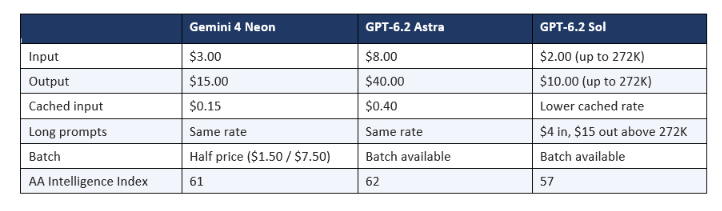
On paper, Sol is cheapest, Astra is most expensive, and Neon sits in between. Neon's half-price batch rate is also worth noting if you run large offline jobs where speed doesn't matter. One detail people miss: Sol's price doubles on the input side once a prompt goes above 272K tokens, so if you're feeding it very long documents, its price advantage over Neon shrinks.
Benchmarks Compared
Benchmarks are where the leaderboards start to disagree, so here's a cleaned-up view, separating independent results from vendor claims.
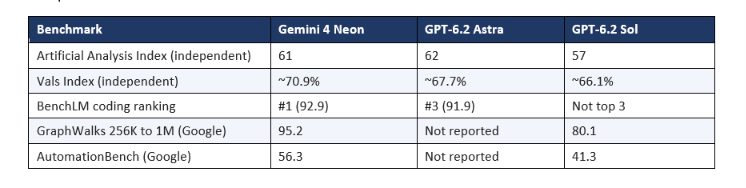
Here's how I read this. Astra and Neon are effectively tied on general intelligence, one point apart. Neon wins on the Vals Index and on the long-context and automation tests where Google published comparisons. Astra wins on the overall index. Sol is a clear step behind both, which is exactly what you'd expect from the cheaper tier. The gaps on long context are large enough that they're probably real even after you discount for vendor-reported numbers.
The Hidden Cost: Price Per Task
This is the part most comparisons skip, and it changes the answer. A model's price per token only tells you half the story. The other half is how many tokens it uses to finish a job. A cheap model that writes four times as much can easily cost more than an expensive one that gets to the point.
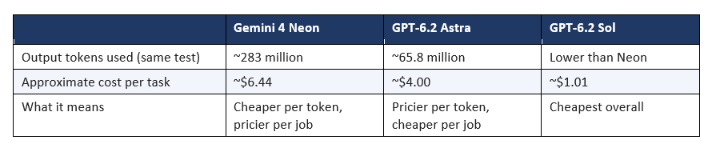
In one independent evaluation, Neon generated about 4.3 times more output tokens than Astra on the same set of tasks. So even though Astra costs more than double per token, it worked out cheaper per finished task. Sol, meanwhile, was far cheaper than both.
The lesson isn't that Neon is a bad deal. Its long reasoning is part of why it does so well on hard multi-step tasks. The lesson is that you should measure cost on your own workload, in dollars per finished job, not dollars per million tokens. Run twenty real tasks through each model and divide the bill by twenty. That one number will tell you more than any pricing page.
Coding: Which Is Better?
For coding, this is genuinely close. Neon sits at the top of BenchLM's public coding ranking with 92.9, with Astra third at 91.9, a one-point gap. On Google's own table, though, Claude Opus 5.5 still beat Neon on FrontierCode 2.0, which is a reminder that no single model wins every coding task.
In practice, I'd split it like this. For large refactors and work that spans a big codebase, Neon's long-context strength is a real advantage, because it can hold more of your project in view at once. For tricky single problems, where you want the right answer in as few attempts as possible, Astra's efficiency makes it the better pick. And for everyday coding help, quick fixes and boilerplate, Sol is plenty capable and far cheaper. GPT-6.2 also powers OpenAI's Codex for paid plans, which matters if your team already works there.
Long Context and Documents
This is Neon's clearest win. A 95.2 on GraphWalks across 256K to 1 million tokens, against 80.1 for Sol, is not a small margin. If your work involves long contracts, research papers, large codebases or piles of meeting transcripts, Neon is the model most likely to find the detail buried on page 300 and connect it to something on page 12.
Sol's pricing also works against it here: above 272K input tokens its input price doubles. So for very long documents, the cost gap between Sol and Neon narrows while the quality gap widens in Neon's favour. If long documents are a big part of what you do, this section alone probably decides it.
Speed, Access and Safety
A few practical differences matter for day-to-day use.
- Where you can use GPT-6.2: ChatGPT Work and Codex for Plus, Pro, Enterprise and Edu users, and in the API as gpt-6.2-astra and gpt-6.2-sol. OpenAI says this rollout doesn't add either model to regular Chat.
- Ultrafast mode: OpenAI introduced a new speed setting, starting with Sol for Pro 200 subscribers and covering both models for Pro 500 subscribers.
- Safety: OpenAI shipped GPT-6.2 with tighter safeguards for higher-risk cybersecurity help, saying both models meet the Critical cybersecurity threshold in its Preparedness Framework. Expect more refusals on security-sensitive requests.
- Gemini 4 Neon access: generally available through Google's API since November 18, with batch pricing at half the standard rate.
If your work touches security research or penetration testing, test both models on your actual prompts before switching, because the stricter safeguards on GPT-6.2 may affect what it's willing to help with.
Which Should You Choose?
Here's the simplest way I can put it, matched to the kind of work you do.
- Long documents, research, large codebases: Gemini 4 Neon.
- Multi-step automations and workflows: Gemini 4 Neon.
- Hard reasoning where each attempt is expensive: GPT-6.2 Astra.
- High-volume or everyday tasks: GPT-6.2 Sol.
- Teams already on ChatGPT or Codex: GPT-6.2, mostly Sol with Astra for the hard stuff.
- Batch jobs that can wait: Gemini 4 Neon at half-price batch rates.
Many teams will end up using two of these together: Sol for the bulk of everyday work, and either Neon or Astra for the hard or long jobs. That mix usually beats picking a single winner. For how these fit with other strong models like Claude, see our best AI models of October 2026 and our Claude Fable 5.2 review.
My Verdict
There's no knockout here, and anyone who tells you otherwise is reading one benchmark. Gemini 4 Neon and GPT-6.2 Astra are effectively level on general intelligence, one point apart on the independent index. Neon has a real, large advantage on long context and automation. Astra has a real advantage in efficiency, which makes it cheaper per finished task despite its higher list price. Sol is the value pick that most people should use for most things.
If I had to pick one model for a mixed workload today, I'd default to GPT-6.2 Sol for everyday work and add Gemini 4 Neon specifically for long-document and automation jobs. But the most useful thing you can do is run your own twenty-task test and compare cost per finished task. The answer that number gives you is the right one for your business.
Frequently Asked Questions
Is Gemini 4 Neon better than GPT-6.2?
It depends on the task. GPT-6.2 Astra scores slightly higher on the Artificial Analysis Intelligence Index (62 vs 61), while Gemini 4 Neon wins clearly on long-context and automation benchmarks and leads the Vals Index. For everyday value, GPT-6.2 Sol beats both on cost.
What is the difference between GPT-6.2 Astra and Sol?
Astra is OpenAI's frontier model for the hardest projects, priced at $8 per million input tokens and $40 per million output. Sol is the efficient everyday model at $2 and $10 for prompts up to 272K tokens. Astra scores 62 on the Artificial Analysis index, Sol scores 57.
How much does Gemini 4 Neon cost?
Gemini 4 Neon costs $3 per million input tokens and $15 per million output tokens, with cached input at $0.15 per million. Batch requests are half price, at $1.50 and $7.50.
Which is better for coding, Gemini 4 Neon or GPT-6.2?
They're very close. Gemini 4 Neon ranks first on BenchLM's coding ranking at 92.9, with GPT-6.2 Astra third at 91.9. Neon is better for large codebases thanks to long context, while Astra is more efficient per task. Sol is a good, cheap option for everyday coding.
Is GPT-6.2 available in ChatGPT?
Yes, in ChatGPT Work and Codex for Plus, Pro, Enterprise and Edu users, and in the API as gpt-6.2-astra and gpt-6.2-sol. OpenAI says this rollout doesn't add either model to regular Chat.
Why is Gemini 4 Neon more expensive per task?
Because it tends to generate many more output tokens. In one independent test it used about 4.3 times as many output tokens as GPT-6.2 Astra, so although its price per token is lower, its cost per finished task was higher, around $6.44 versus $4.00.
Which model is best for long documents?
Gemini 4 Neon. It scored 95.2 on Google's GraphWalks long-context test across 256K to 1 million tokens, well ahead of GPT-6.2 Sol at 80.1. Sol's input price also doubles above 272K tokens, which narrows its cost advantage on long inputs.
Recommended Blogs
- Gemini 4 Argon Review
- Gemini 4 Carbon Review
- GPT-6 Astra Review
- GPT-6 Sol and Luna Review
- GPT-6 Astra vs Gemini 4 Argon vs Claude Fable 5.1
- Claude Opus 5.5 Review
References

Founder at Build Fast with AI. AI Engineer, educator, and researcher passionate about agentic AI workflows, LLM application architecture, and training the next generation of AI builders.