



EDITORIAL NOTE: Seedream 5.0 Pro is the top tier of ByteDance's Seedream 5.0 image model family. Seedream 5.0 Lite launched February 13, 2026, and Seedream 5.0 (standard) launched February 24, 2026. Seedream 5.0 Pro was announced as the upcoming flagship tier with expanded layer-style editing and Seedance video integration. Some Pro-specific specifications are based on ByteDance's official Seed model page, Morphic's tracker, and independent testing of the 5.0 base models. Where features are confirmed from official sources, this is noted. Where Pro-specific features are reported or expected, this is clearly labeled.
ByteDance's Seedream family has moved faster than almost any other image generation product in 2026. September 2025 brought Seedream 4.0. February 2026 brought 4.5, then 5.0 Lite on February 13, then 5.0 standard on February 24. Each generation has introduced something architecturally new rather than just quality polishing: 5.0 brought deep thinking generation and real-time web search to image creation for the first time in any major model, and the Pro tier adds precision layer-style editing and reference-grade output for Seedance video integration. The result is a model family that now competes on completely different dimensions than the typical AI image generator comparison. While Midjourney and FLUX debate aesthetic quality and style range, Seedream 5.0 Pro is targeting production workflows: e-commerce catalog teams that need to swap product elements without regenerating full images, creative teams that need to anchor Seedance video to a specific still frame, and brand teams that need images grounded in real-world current context. This review covers the complete Seedream 5.0 family architecture, every confirmed capability of the Pro tier, the deep thinking and online search features that define the 5.0 generation, benchmark performance, how it compares to Nano Banana Pro and other competitors, where to access it, and which workflows it is and is not the right choice for.
1. The Seedream 5.0 Family: Three Tiers Explained
The Seedream 5.0 family follows the same tier architecture ByteDance uses across its Seed model lines: a Lite tier optimized for speed and broad access, a standard tier for balanced production use, and a Pro tier at the capability ceiling. Understanding where each tier sits prevents the common mistake of reviewing Lite features and presenting them as Pro limitations, or crediting Pro-only capabilities to the standard tier.
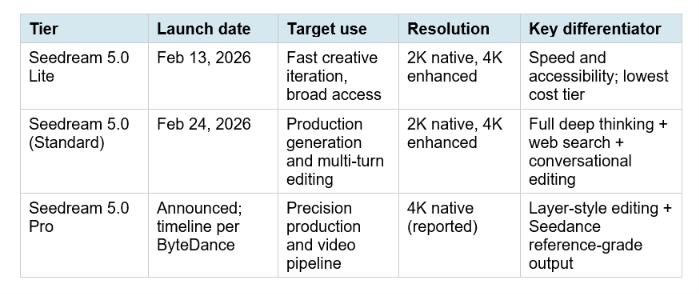
The Lite tier is where most consumer users will interact with Seedream 5.0. It launched first, is available on CapCut, Jimeng AI (Xiaoyunque), Doubao, and HailuoAI, and delivers the core 5.0 generation improvements at a price point accessible to individual creators. The standard tier adds the full conversational editing experience with multi-turn refinement. The Pro tier is positioned as the production professional tier, targeting workflows that need addressable layer control and direct video pipeline integration. An important naming note: across ByteDance's official Seed model pages, the primary publicly documented image model is described as 'Seedream 5.0 Lite,' which is the consumer-accessible version. Seedream 5.0 Pro sits above it in the family hierarchy but has a later release timeline. This guide covers the complete family with Pro-specific features clearly labeled as confirmed or reported.
2. What Is New in Seedream 5.0: The Generation-Defining Features
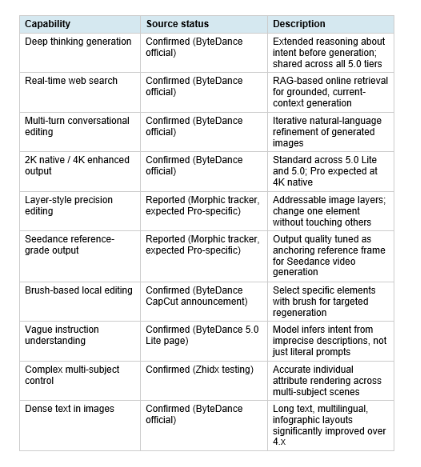
Seedream 5.0, across all tiers, represents a genuine architectural shift from 4.x. The 4.x generation was defined by quality improvements: better prompt adherence, sharper detail, more consistent multi-subject handling. The 5.0 generation is defined by capability additions that no major predecessor had combined in a single image model: deep thinking generation and real-time web search. ByteDance's official Seed model page describes Seedream 5.0 and the public Lite variant as a unified multimodal image model with deep thinking and online search capabilities, with upgrades in understanding, reasoning, and generation. The CapCut official announcement listed four core upgrade points: image generation through retrieval (online search) for the first time, enhanced accuracy of understanding prompt words, generation of images with more detailed and delicate textures, and precise image adjustment capability.
- Deep thinking generation: the model reasons about what you are trying to achieve before generating pixels, not just after reading the literal prompt. This is the same inference-time compute pattern that transformed text model quality in 2024 and 2025, now applied to image generation.
- Real-time web search (RAG): the model can retrieve current information from the web before generating. Product images stay accurate to current brand guidelines. Event posters reflect who is actually scheduled. Weather composites use real meteorological data.
- Multi-turn conversational editing: after generating an initial image, subsequent instructions modify specific elements while preserving everything else. Type 'make the lighting warmer' and the lighting changes without touching the subject, composition, or background.
- Text rendering quality: across all Seedream 5.0 tiers, in-image text generation has significantly improved. Long text strings, complex multilingual layouts, and dense infographic text are substantially more reliable than in 4.x.
- Complex multi-subject control: in the Zhidx independent testing, a 3x3 display rack with nine distinct products was correctly rendered with accurate individual attributes for each product, a task that consistently produces omissions and hallucinations in most competing models.
3. Seedream 5.0 Pro: The Flagship Tier Capabilities
The capabilities in this section combine confirmed features from ByteDance's official Seed model page with reported Pro-specific features from Morphic's model tracker and GenAIntel's guide. Where a capability is Pro-specific and not yet independently tested at GA, this is noted.
Seedream 5.0 Pro sits at the top of the image model hierarchy ByteDance is building toward. It inherits every capability of the standard 5.0 model, then adds two Pro-specific dimensions that change what the model can be used for in professional production contexts: precision layer-style editing and reference-grade Seedance video output.
4. Layer-Style Editing: What It Is and Why It Matters
Layer-style editing is the Pro-tier capability that most directly addresses the production workflow pain that has limited AI image generation in commercial contexts. In traditional design software like Adobe Photoshop or Figma, an image is not a flat render. It is a stack of addressable layers: the background is one layer, the product is another, the text overlay is a third, the shadow is a fourth. You can select any layer and modify it independently without touching the others. This is what makes professional design iterative: change the product variant, keep the background and lighting. Change the copy, keep the product. Change the color scheme, keep everything else. Standard AI image generation collapses this into a single flat output. When you want to change one element, you have several imperfect options: regenerate the whole image with a new prompt and hope the other elements stay consistent (they often do not), use inpainting to mask the area and regenerate only that region (which can produce seams and inconsistencies), or use a separate editing tool and composite the results manually. None of these are production-grade workflows.
Seedream 5.0 Pro's layer-style control is designed to solve this at the generation level. The image is built in addressable parts: background, subject, foreground elements, and text overlays are tracked as distinct components that can be modified independently. Want to swap the product on a shelf display? Address the product layer. Want to change the label on a bottle in a lifestyle shot? Address the label layer. Want to update the headline text on a poster without regenerating the illustration? Address the text layer. The rest of the image stays exactly as it was. For e-commerce, packaging, and advertising production workflows where the same composition needs to appear in dozens of variants, this is the single capability that turns AI image generation from a creative exploration tool into a production line tool. The Morphic tracker description is precise: 'Swap a product, color, or label without re-rolling the whole image, ideal for catalog and packaging work.'
For context on how layer-style control in Seedream 5.0 Pro compares to the local re-draw editing approach in Seedance 2.5, which targets the video-generation equivalent of this problem, the Seedance 2.5 review on Build Fast with AI covers ByteDance's parallel approach to targeted editing in the video domain.
5. The Seedance Video Pipeline: Images That Anchor Motion
The second Pro-tier differentiator is one that matters most for teams already using Seedance for video generation: reference-grade output tuned specifically as an anchoring frame for Seedance video. The problem this solves is character drift in AI video generation. When you generate a video from a text prompt, the AI decides what the character, product, or scene looks like. If you then generate a second video or a longer version, the same character looks slightly different, the same product has slightly different proportions, the same environment has slightly different lighting. The visual identity drifts across clips because there is no anchor. You can use reference images to reduce drift, but the quality of the anchor reference determines how well the video follows it. A reference that is 'good enough for a social post' may not be 'clean enough to anchor a commercial video.'
Seedream 5.0 Pro's reference-grade output is specifically tuned to address this. ByteDance optimized the Pro tier's output for use as a reference frame in Seedance, meaning the model targets the specific visual fidelity that Seedance needs to maintain character, product, and scene identity across a generated video sequence. On HailuoAI, users can generate with Seedream 5.0 and then animate with Seedance in the same workflow. The Pro tier's output quality closes the gap between 'image I can use on Instagram' and 'image that anchors a Seedance clip without drift.' The practical pipeline this enables: brief a product image with Seedream 5.0 Pro using layer-style control to get every element precisely right, then pass that finished frame directly to Seedance 2.5 to generate the motion version with the same character, product, and scene identity maintained throughout the animation. This collapses what was previously a two-team workflow (visual design plus video production) into a single AI-mediated pipeline. For the Seedance 2.5 capabilities that pair with this Pro-tier image pipeline, the Seedance 2.5 full review covers the 30-second native generation, 50 reference inputs, and local re-draw editing that make the Seedance end of this pipeline worth anchoring.
6. Deep Thinking Generation Explained
Deep thinking generation is the feature that most clearly separates Seedream 5.0 from all previous Seedream versions and from most current competing models. The concept is straightforward but the execution is architecturally significant. Standard image generation models receive a prompt and immediately begin the diffusion process to generate pixels. They pattern-match the prompt to learned visual patterns without reasoning about what the prompt actually means, what the intent behind it is, or what an ideal visual execution of the underlying goal would look like. This is why models fail on abstract prompts, complex compositional instructions, multi-constraint briefs, and domain-specific visual requests.
Deep thinking generation inserts a reasoning step before the generation step. The model interprets the prompt: what is the user actually trying to achieve? What are the implicit constraints they have not stated? What would a domain expert do with this brief? This reasoning step produces a more precise internal specification of what to generate before any pixels are created, which is why the output on complex, abstract, or multi-constraint prompts is substantially better. The ByteDance 5.0 Lite page documents specific examples: the model can infer the next move in a Go endgame and generate subsequent board positions; it can deduce the type of an object from scattered parts and generate a reasonable assembly of them; it can understand 'quiet and technological sense' as an aesthetic instruction rather than requiring explicit visual descriptors. Each example demonstrates reasoning about visual intent before visual generation, not just visual translation of literal words. This improvement has the most impact on: creative briefs that use abstract language ('energy,' 'tension,' 'warmth'), domain-specific requests that require knowing how a field represents itself visually, multi-constraint layouts where the instructions imply spatial relationships the model has to infer, and long complex prompt strings where earlier models lose track of constraints by the time they reach the final instruction.
7. Real-Time Web Search: Grounded Image Creation
Real-time web search in Seedream 5.0 is a retrieval-augmented generation capability that lets the model search the web for current information before generating an image. It is the first time any major image generation model has added live web retrieval as a native capability rather than relying entirely on training data. The practical applications: generate a poster for an event and the model can look up who is actually scheduled to appear. Generate a product infographic and the model can retrieve the current product photography and specifications rather than pattern-matching against training data. Generate a branded image tied to a current trend and the model has access to what the trend currently looks like rather than what it looked like when training data was collected.
The Zhidx independent test is the most informative honest assessment of where web search works and where it does not. Asked to generate an image of 'the robots that have officially announced their participation in the Spring Festival Gala,' the model correctly retrieved and rendered accurate visual elements related to robots at the Spring Festival, with no garbled text. However, it failed to understand the specific constraint of 'officially announced participation,' generating a general Spring Festival Gala robot poster rather than one specifically featuring the confirmed participants. The honest read: Seedream 5.0's online search capability is real and meaningfully improves output grounding compared to models that rely entirely on training data. But it is not yet reliably precise for queries that require nuanced understanding of specific factual distinctions. It works well for broad topic grounding and current visual context. It works less reliably for precise factual filtering within a topic. ByteDance acknowledges the search capability is still maturing, describing it as 'unstable' in some contexts.
8. Benchmarks: MagicBench, MagicArena, and Third-Party Testing
ByteDance uses two primary evaluation frameworks for the Seedream family: MagicBench, an internal benchmark measuring performance across prompt following, alignment, and aesthetics dimensions; and MagicArena, a blind human-preference competition platform that produces Elo scores from pairwise comparisons between models.
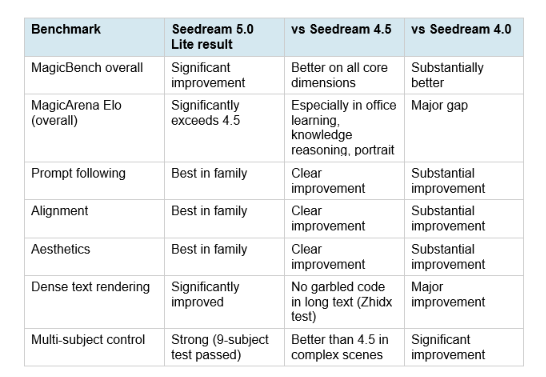
Third-party testing from Zhidx compared Seedream 5.0 against Nano Banana Pro (Gemini 3 Pro Image) and Seedream 4.5 on a complex infographic prompt about Trappist monastery beer production. The general finding was consistent with ByteDance's own benchmark claim: 5.0 understands abstract prompt words and produces more diverse and aesthetically polished outputs than 4.5. However, Zhidx noted that the improvement is 'reflected in being more beautiful and diverse' rather than a 'leap-forward improvement' in fundamental generation quality, and that the online search capability is 'still unstable.' CapCut's official positioning frames Seedream 5.0 as directly competitive with Nano Banana Pro at a lower price, which is the most direct published competitive claim available. For the Nano Banana Pro specifications and independent test results, the Nano Banana 2 Lite review covering the full Nano Banana family covers the Google model it is being positioned against.
9. Seedream 5.0 Pro vs Nano Banana Pro vs Midjourney vs FLUX
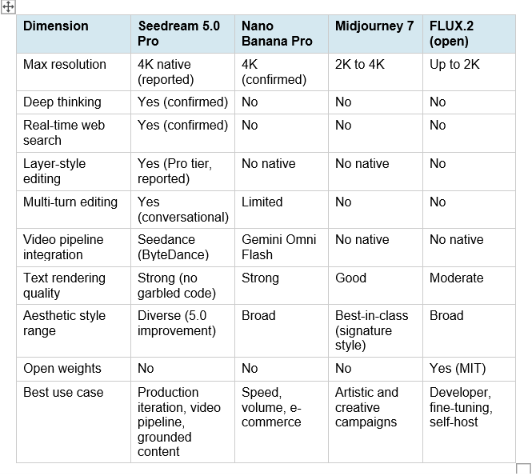
The competitive picture in July 2026: Seedream 5.0 Pro is the only major image generation model that combines real-time web search, multi-turn conversational editing, deep thinking generation, and video pipeline integration in a single offering. None of the other models in this table have all four of these capabilities simultaneously. The trade-offs: Midjourney maintains the most distinctive artistic aesthetic and remains the preferred tool for campaigns where visual artistry matters more than production precision. FLUX.2 remains the strongest open-weight option for developers who need self-hosting or fine-tuning flexibility. Nano Banana Pro has better generation speed and lower per-image cost for high-volume workloads. Seedream 5.0 Pro's value proposition is specifically for teams doing iterative production work where the combination of deep thinking, web grounding, layer editing, and video pipeline integration changes what is possible in a single workflow. For the Krea 2 open-source alternative which competes in the open-weight image space alongside FLUX, the Krea 2 Raw and Turbo review covers the strongest open-weight competitor.
10. Pricing and Access: Where to Use Seedream 5.0 Pro
The Seedream 5.0 family is accessible through multiple channels with different pricing and access conditions
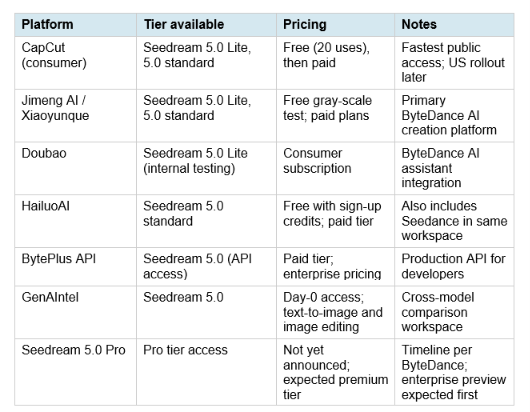
The free access note is significant: CapCut confirmed that all users can use Seedream 5.0 for 20 generations free, and HailuoAI provides sign-up credits for testing. This means the core 5.0 generation capability, including deep thinking and web search on the Lite tier, is accessible at no cost for initial evaluation. The Pro tier, with layer-style editing and Seedance reference-grade output, is expected to launch at a premium tier pricing above the standard model. ByteDance has not announced Pro-specific pricing as of the time of this writing. For a broader look at where Seedream 5.0 Pro fits in the AI image and video generation landscape, the AI Image and Video Generation collection on Build Fast with AI tracks every major model release, pricing update, and competitive development in the category.
11. Who Should Use Seedream 5.0 Pro and For What
E-Commerce and Product Teams
Layer-style editing is the specific capability that changes what is possible for e-commerce production. A product catalog team that needs to generate the same product on twelve different backgrounds, with twelve different lighting conditions, for twelve different regional markets, can now address each element independently rather than regenerating twelve full images and hoping for consistency. The brush-based local editing confirmed in CapCut extends this to individual adjustments within any single image.
Brand and Campaign Creative Teams
The combination of deep thinking generation and real-time web search makes Seedream 5.0 Pro the strongest tool for brand-accurate, trend-grounded campaign imagery. When a campaign needs to reflect a current cultural moment, current product specifications, or a current visual trend, the web search grounds the output in what is actually happening rather than what was happening at training time. Deep thinking ensures the brief's implicit constraints and brand guidelines are interpreted correctly rather than just literally translated.
Video Production Teams Using Seedance
For any team already producing video content with Seedance 2.5, Seedream 5.0 Pro's reference-grade output closes the loop between image creation and video production. Brief the character or product with Seedream 5.0 Pro's precision layer editing to get every detail exactly right, then use that output as the reference frame for Seedance generation. The result is video with character and product consistency anchored to an intentionally crafted still rather than derived from a text description that Seedance interprets independently. The Seedance 2.5 50-reference input system can hold the Pro-tier Seedream output alongside character sheets, environmental references, and audio tracks for a complete brief. For the full Seedance 2.5 capability coverage including 30-second native generation and the 50-reference input system, the Seedance 2.5 detailed review covers everything about the video generation half of this pipeline.
Content Creators and Social Teams
For creators using CapCut or HailuoAI as their primary production environment, the Seedream 5.0 standard tier (not necessarily Pro) provides a meaningfully better generation experience than 4.x. Abstract creative briefs, text-heavy social graphics, and multi-element compositions that previously required extensive prompt iteration now resolve more reliably. The multi-turn conversational editing replaces the 'generate and regenerate' loop with a 'generate and refine' conversation that feels closer to working with a designer than prompting a slot machine.
12. Limitations: Honest Assessment
- Web search reliability: Zhidx's testing found the online search capability produces accurate visual elements but can fail on nuanced factual distinctions within a topic. ByteDance itself describes the search capability as still maturing. Teams that need precise factual grounding should validate web-search-dependent outputs before production use.
- Quality leap vs 4.5: the honest third-party assessment is that Seedream 5.0 improves on 4.5 in diversity, aesthetics, and abstract prompt understanding, but does not represent a 'leap-forward improvement' in raw generation quality. If your 4.5 workflow produces acceptable outputs, the 5.0 upgrade is incremental quality improvement rather than a capability transformation for straightforward generation tasks.
- Pro tier availability: Seedream 5.0 Pro's layer-style editing and Seedance reference-grade output features are the differentiating capabilities, but the Pro tier has a later release timeline than Lite and standard. Teams that need layer editing today cannot wait; the standard tier's brush-based local editing is the nearest available alternative.
- China data jurisdiction: Seedream 5.0 processing routes through ByteDance infrastructure, which operates under Chinese data law. For enterprises in regulated industries handling sensitive content, this has the same compliance implications as other ByteDance AI products. Self-hosting is not currently available for Seedream 5.0.
- Midjourney aesthetic gap: for campaigns where the specific Midjourney aesthetic signature is the creative direction, Seedream 5.0 does not replicate that style. Its strength is production precision and workflow integration, not stylistic distinctiveness
Frequently Asked Questions
What is Seedream 5.0 Pro and how is it different from Seedream 5.0?
Seedream 5.0 Pro is the top tier of ByteDance's Seedream 5.0 image model family, positioned above Seedream 5.0 Lite (launched February 13, 2026) and Seedream 5.0 standard (launched February 24, 2026). It inherits all 5.0 capabilities including deep thinking generation, real-time web search, multi-turn conversational editing, and 4K output, and adds two Pro-specific capabilities: precision layer-style editing (addressable image components that can be modified independently) and reference-grade output optimized as an anchoring frame for Seedance video generation.
What is layer-style editing in Seedream 5.0 Pro?
Layer-style editing treats a generated image as addressable components rather than a flat render. You can select and modify a specific element (a product, a background, a text overlay, a color scheme) independently without regenerating or affecting the rest of the image. The practical result: swap a product variant on a shelf display, change a label design on a bottle, update headline text on a poster, or adjust lighting on a subject while keeping the environment unchanged. This is the capability that makes AI image generation viable for e-commerce catalog production, packaging variants, and campaign adaptation workflows.
How does Seedream 5.0 Pro integrate with Seedance video generation?
Seedream 5.0 Pro's output is specifically tuned to function as a reference-grade anchor frame for Seedance video generation. The image quality meets the fidelity threshold that Seedance needs to maintain character, product, and scene identity across a generated video sequence without drift. The workflow: use Seedream 5.0 Pro to generate a precisely controlled still of a character, product, or scene, then pass that output as a reference input to Seedance 2.5, which can accept up to 50 multimodal reference inputs. The resulting video maintains the visual identity established in the Pro-tier still.
What is deep thinking generation in Seedream 5.0?
Deep thinking generation is Seedream 5.0's extended reasoning step before image generation. Rather than immediately beginning the diffusion process from a text prompt, the model reasons about what the user is actually trying to achieve: inferring implicit constraints, understanding abstract vocabulary as visual intent, and planning the image's composition and content before generating pixels. This is why 5.0 handles abstract prompts like 'quiet and technological sense' and complex compositional instructions like '3x3 display rack with individual product attributes' more reliably than 4.x.
How does Seedream 5.0 compare to Nano Banana Pro?
Both models support up to 4K output and are positioned as production-grade image generators. CapCut's official announcement explicitly positions Seedream 5.0 as 'comparable with Nano Banana Pro and cheaper.' Seedream 5.0 adds capabilities Nano Banana Pro does not have: real-time web search, deep thinking generation, and multi-turn conversational editing. Nano Banana Pro's advantages are generation speed, tight Google ecosystem integration, and the Gemini Omni Flash video pipeline. For high-volume, speed-sensitive workflows: Nano Banana Pro or its Lite tier. For iterative production with web grounding and video pipeline integration: Seedream 5.0 Pro.
Where can I access Seedream 5.0 Pro?
As of July 2026, Seedream 5.0 Lite and standard are available on CapCut (20 free generations then paid), Jimeng AI, Doubao, HailuoAI (with sign-up credits), the BytePlus production API, and GenAIntel. Seedream 5.0 Pro with layer-style editing and Seedance reference-grade output has an announced timeline from ByteDance that may include enterprise preview access before general availability. ByteDance has not confirmed the Pro tier's general availability date or final pricing.
Is Seedream 5.0 Pro free to use?
Seedream 5.0 Lite is free on CapCut for 20 generations and on HailuoAI with sign-up credits. The standard tier has a free allowance on some platforms before transitioning to paid. Seedream 5.0 Pro pricing has not been officially announced. The pattern across ByteDance AI products suggests a credit-based or subscription model for Pro-tier access, consistent with how Seedance enterprise access is structured. For any commercial production use, verify current platform terms at point of use.
Recommended Blogs
- Seedance 2.5 Review: ByteDance's 30-Second AI Video Model Explained
- Nano Banana 2 Lite Review: Fastest AI Image Generator? Benchmarks and Pricing (2026)
- Krea 2 Open Source Review: Raw, Turbo, and LoRA Fine-Tuning for Creators
- AI Image and Video Generation Collection: Best Models and Tools 2026
- Best AI Models of July 2026: Full Ranking by Use Case, Benchmarks, and Price
- Seedance 2.5 vs Veo 3.1 vs Kling 3.0: Best AI Video Model (July 2026)
Resources & Community
Join our community of 70,000+ AI enthusiasts and learn to build powerful AI applications! Whether you're a beginner or an experienced developer, Build Fast with AI helps you understand and implement AI in your projects.
- Website: buildfastwithai.com
- LinkedIn: Build Fast with AI
- Instagram: @buildfastwithai
- Founder Twitter: @satvikps
- Twitter: @BuildFastWithAI
Agentic AI Launchpad 2026
A structured 6-week cohort program that takes you from AI basics to building and deploying real-world agentic AI systems. Includes live sessions, expert mentorship, project reviews, and a builder community network.
Ready to go from learning to building? Join the next cohort: Agentic AI Launchpad 2026
Free AI Resources
Access free tools, workshops, and micro-learning to keep building:
- AI Workshops: Free resources, upcoming events and past recordings
- Unrot: Learn AI in 5 minutes a day (free micro-learning app)
ByteDance's image and video AI stack is moving faster than any other creative AI family in 2026. Follow @BuildFastWithAI on X to stay ahead of every Seedream Pro launch, Seedance update, and ByteDance model release that matters for creators and production teams.
References
- ByteDance Seed Models Official Page: Seedream 5.0 family overview (seed.bytedance.com/en/models)
- ByteDance: Seedream 5.0 Lite Official Page (seed.bytedance.com/en/seedream5_0_lite)
- ByteDance: Seedream 4.5 Official Page with MagicBench benchmark context [PRIMARY SOURCE]
- HailuoAI: Seedream 5.0 Review: ByteDance's New AI Image Generator (February 24, 2026)
- EU 36Kr: Seedream 5.0 Launched: ByteDance Image Generation Model (February 9, 2026)
- AI Base News: ByteDance Officially Launches Seedream 5.0 Lite (February 13, 2026)
- GenAIntel: Seedream 5.0 ByteDance Release Guide (February 15, 2026)
- Morphic: Seedream 5.0 Pro Expected Specs, Release, vs 5.0 Lite
- KIE AI: Seedance 2.5 Release: What ByteDance Just Shipped (Seedream 5.0 family context at Volcano Engine 2026)

