

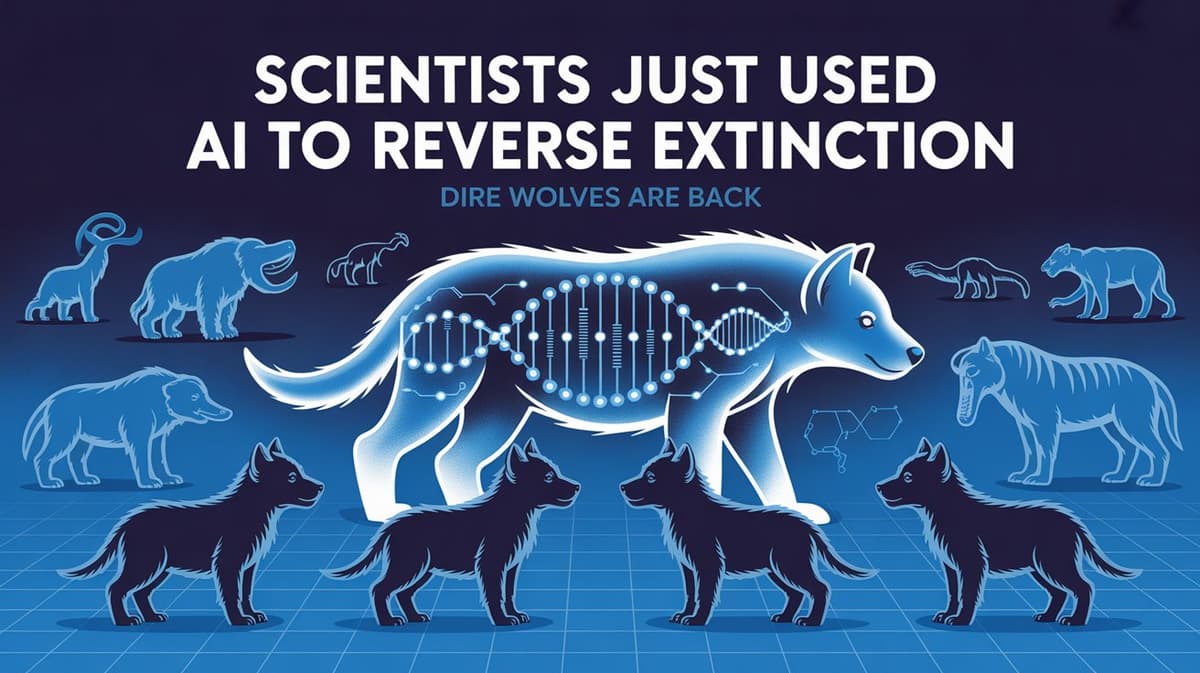
Dire wolves are back.
Not metaphorically. Literally.
Colossal Biosciences just announced three dire wolf puppies: Romulus, Remus, and Khaleesi.
Last dire wolf died 12,500 years ago.

The technical breakthrough:
Step 1: AI analyzed ancient DNA from 13,000-year-old fossils
Step 2: Identified genetic differences between dire wolves and gray wolves
Step 3: Used CRISPR to modify gray wolf cells with AI-guided precision
Result: Puppies with authentic dire wolf characteristics:
Broader heads
Thicker coats
Stronger jaw structure
Why this matters beyond biology:
This demonstrates AI's capability to solve "impossible" problems by making sense of:
Incomplete data (99% of ancient DNA degraded)
Complex biological systems
Genetic engineering precision requirements
The AI component was critical:
Without computational biology AI, analyzing 13,000-year-old genetic material would be like solving a jigsaw puzzle with 99% missing pieces and no reference image.
AI didn't just accelerate the process. It made the process possible.
What's next:
Colossal (valued at $10B) is already working on:
Woolly mammoths
Tasmanian tigers
Dodo birds
My technical take:
This showcases AI's true potential - not just automating existing processes, but enabling entirely new capabilities.
We're moving from "AI makes things faster" to "AI makes impossible things possible."
The broader implications:
If extinction becomes optional, what other "permanent" problems become temporary?
Disease
Aging
Resource scarcity
We're witnessing the birth of an era where "impossible" becomes "not yet solved."
As someone working daily with AI capabilities, I'm fascinated by how quickly the boundaries keep expanding.
What's your take? Are we moving too fast, or is this the natural evolution of AI-powered science?
Community
Website: buildfastwithai.com
LinkedIn: Build Fast with AI
X (formerly Twitter): @buildfastwithai
Telegram: Build Fast with AI Community

