



Qwen-Image-3.0 Review: Impressive Demos, Missing Proof
Alibaba's new image model can render legible text at 10 pixels and accept prompts up to 4,500 tokens long, and it launched with no benchmark score, no model card, and no downloadable weights. Both halves of that sentence are true, and the gap between them is the entire story of Qwen-Image-3.0.
Released on July 21, 2026, Qwen-Image-3.0 is Alibaba's most ambitious text-to-image model yet, pitched at real content production: newspaper layouts, UI mockups, storyboards, and e-commerce imagery. The demos are genuinely striking. The problem is that demos are all we have, because Alibaba published example images instead of the evidence that would let anyone verify the claims. This review covers what is real, what independent testers found breaking, and whether you should use it anyway.
The one-line verdict: the most capable text-in-image model Alibaba has built, released with the least transparency, and already showing cracks under independent testing. Impressive, unproven, and worth trying with your eyes open.
What Is Qwen-Image-3.0?
Qwen-Image-3.0 is Alibaba's hosted text-to-image generation model, released July 21, 2026, built for text-heavy, layout-driven content rather than pure artistic images. It accepts prompts up to 4,500 tokens, renders text as small as 10 pixels, and supports 12 languages, and it is available only through Alibaba's Qwen Chat and Qwen Studio apps plus the Alibaba API.
Table 1: Qwen-Image-3.0 at a glance
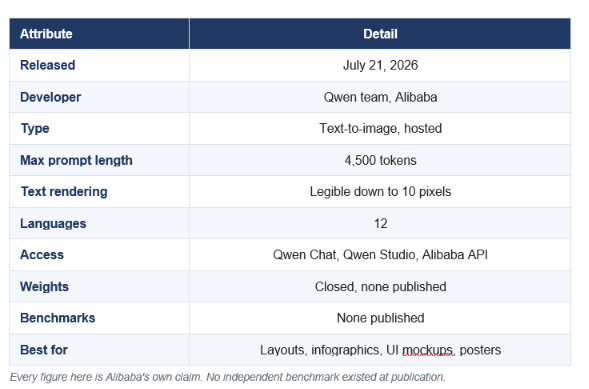
The positioning is the key to understanding it. This is not trying to be the prettiest art generator, it is trying to be the model that actually gets the text right, which is the one thing image generators have historically been worst at. If you have ever generated a poster and watched the AI spell your headline as gibberish, you already understand the problem Qwen-Image-3.0 is aiming at.
What's New: The Three Pillars
Alibaba pitches Qwen-Image-3.0 around three named capabilities: Rich Content, Authentic Details, and Deep Knowledge. Each maps to a real content-production pain point, and understanding them tells you exactly who the model is for.
Rich Content: 4,500-token prompts
The model accepts prompts up to 4,500 tokens, a large jump from the roughly 1,000 tokens Qwen-Image-2.0 handled, which lets you describe complex multi-panel layouts in a single pass. For a newspaper front page or a dense infographic where every element needs specifying, that headroom is genuinely useful, because you are no longer forced to strip your brief down to fit the prompt.
Authentic Details: 10px text and fine texture
This is the headline claim: legible text rendered as small as 10 pixels, plus micro-detail like skin pores and individual hair strands. Small-text legibility is the hardest test in the category, and it is exactly where generators look strong in curated demos, which is worth keeping in mind. The texture work in the published examples is real and impressive.
Deep Knowledge: 12 languages and world grounding
The model covers 12 languages, reproduces realistic UI mockups, and claims web-connected world knowledge for things like weather graphics with real data. Multilingual text rendering is the capability with the clearest commercial value, because global content teams have almost no good option for generating on-brand text in multiple scripts today.
My take on the pitch: these three pillars are the right three problems. Alibaba correctly identified that the money in image AI has moved from art to production, where text accuracy and layout control matter more than aesthetic wow. The pitch is smart. The evidence is the issue.
Text Rendering at 10px: Does It Really Work?
Mostly yes on Alibaba's own demos, and unevenly under independent testing. The 10-pixel text claim holds up in the curated examples, and reviewers confirmed the model is strongest on text-heavy infographics, newspaper and exam layouts, and UI mockups. This is a real capability, not pure marketing.
The cracks appear the moment testing leaves the demo reel. Independent reviewers found real errors in Korean rendering, including vowel mix-ups and misspelled words, which directly contradicts the accuracy the marketing implies. Text that is legible but wrong is arguably worse than text that is obviously garbled, because a plausible-looking misspelling can slip into a published asset unnoticed.
Data visualisation was a clearer failure. One test asking for a graph of Poland's GDP growth produced a chart whose data points did not align with the time axis. That is the difference between rendering text that looks like a chart and rendering a chart that is correct, and it is precisely the gap that decides whether a tool is usable for real work or just for screenshots.
The honest read: Qwen-Image-3.0 is the best text-rendering image model Alibaba has shipped, and it still gets text wrong in languages and layouts outside its comfort zone. Treat every generated character as a draft to proofread, especially in non-Latin scripts, and never ship an AI-generated chart without checking the numbers.
Where Qwen-Image-3.0 Falls Short
Beyond the text errors, three weaknesses stand out from independent testing and the release itself. None of them are disqualifying, but all of them matter if you are choosing a production tool.
- General image quality trails the leaders. Reviewers described its non-text image output as a subpar equivalent to proprietary models like GPT Image 2 and Nano Banana Pro. This is a text-and-layout specialist, not an all-round art model.
- Data visualisation is unreliable. Charts and graphs can look right while being numerically wrong, as the Poland GDP test showed.
- Non-Latin text has real errors. Korean rendering showed vowel mix-ups and misspellings, so multilingual claims need verification per language rather than blanket trust.
There was also an unrelated distraction at launch. The qwen.ai site was found to contain a meta-keywords HTML tag stuffed with thousands of entries mixing explicit phrases, misspellings and unrelated names, almost certainly an automated SEO tool scraping autocomplete data without human review. It says nothing about the model's quality, but it is the kind of sloppiness that undercuts a launch, and it made the rounds.
No Benchmarks, No Weights: Why It Matters
The single most important fact about Qwen-Image-3.0 is what Alibaba did not release: no benchmark score, no parameter count, no licence, no downloadable weights, and no technical report. For a company that built its reputation on open, well-documented models, that is a sharp reversal, and it is the real story of this launch.
Why does this matter beyond principle? Because image quality is subjective and text rendering is exactly the axis where models look strong in hand-picked demos and weaker under systematic testing. Without a benchmark, a model card, or weights to test independently, the only evidence for every claim is the set of images Alibaba chose to show. There is no measured way to confirm the gains are real.
Context sharpens the point. Qwen-Image-2.0 ranked fifth on Alibaba's own Qwen-Image-Bench, behind OpenAI and Google models. So the company has a benchmark it has used before, and chose not to publish one this time. Meanwhile competitors went the other way: Tencent's HunyuanImage 3.0 and Thinking Machines Lab's Inkling both shipped as open-weights models with documentation in the same window.
WHY THE SILENCE IS LOUD
A lab that beats the benchmark publishes the benchmark. When a company with a history of transparency ships its flagship image model with no scores, no report and no weights, the most likely explanation is that the numbers do not tell the story the demos do. That is not proof of weakness, but it is a reason to test before you trust.
My contrarian point: the missing benchmarks are more informative than any benchmark would have been. Alibaba is a sophisticated lab that knows exactly what transparency signals. Choosing to withhold it on a flagship launch is itself a data point, and I read it as a soft admission that 3.0 wins on demos more than on measured quality.
Alibaba is far more forthcoming with its text models, which makes the contrast notable. Our Qwen3.7-Max review covers a flagship that shipped with full benchmarks and a clear value story.
How to Access Qwen-Image-3.0
Qwen-Image-3.0 is available only through Alibaba's hosted surfaces: Qwen Chat and Qwen Studio, which run on web, iOS, Android, macOS and Windows, plus Alibaba's API. There is no open-weight download and no self-hosting option.
Getting started is simple. Sign in to Qwen Chat or Qwen Studio, choose image generation, and write your prompt. For layout-heavy work, use the full prompt headroom and specify every element explicitly, since the model rewards detailed instructions more than it rewards short creative ones. Alibaba had not disclosed per-image pricing at launch, so budget-sensitive teams should confirm the current rate in the console before planning volume work.
A practical tip: run your own text-heavy test first, in the exact language you need, before committing. The model's strength is uneven across scripts and task types, so your five-minute test on your real use case will tell you more than any review, including this one.
Qwen-Image-3.0 vs GPT Image 2, Nano Banana and Seedream
On general image quality, GPT Image 2 and Nano Banana Pro remain ahead, while Qwen-Image-3.0 competes specifically on text rendering, prompt length and multilingual layout. The right pick depends entirely on whether your work is art or text-in-image.
If you need beautiful, photorealistic or artistic images, the proprietary leaders are the safer choice, since independent testers put Qwen's general output below them. If your work is text-driven, posters, packaging, infographics, UI mockups, exam or newspaper layouts in multiple languages, Qwen-Image-3.0's 4,500-token prompts and small-text focus give it a genuine niche the art-first models do not target as directly. ByteDance's Seedream and Google's Nano Banana both offer strong multilingual text too, so this is a category to test head to head rather than assume a winner.
The category takeaway: image AI has split into art models and document models, and Qwen-Image-3.0 is firmly a document model. Judge it against that job, not against the prettiest render you have seen, and it looks far more competitive.
A Naming Warning: Qwen-Image vs Qwen-Image-3.0
Do not confuse this hosted model with the open-source Qwen-Image line. Qwen-Image-3.0 is closed and API-only. The original Qwen-Image and Qwen-Image-Edit are separate, open-weight models released under Apache 2.0, with a 20B parameter version and downloadable weights on GitHub and Hugging Face.
The distinction is practical, not pedantic. If you searched for Qwen image generation expecting to download and fine-tune weights, you want the open Qwen-Image or Qwen-Image-Edit repositories, not this 3.0 release, which offers neither. Alibaba running an open line and a closed flagship under nearly the same name is a real source of confusion, and it is worth checking which product a tutorial or article actually refers to before you build on it.
For the open, downloadable side of Alibaba's lineup generally, our Qwen3.6-27B review is a good example of the transparency Alibaba usually brings to its open models.
Verdict: Who Should Use It
Use Qwen-Image-3.0 if your work is text-heavy, layout-driven content in multiple languages, and verify every result. Avoid it if you need proven top-tier art quality, downloadable weights, or numerically reliable data visualisation. My rating is 7 out of 10 for its target use case, docked meaningfully for the transparency regression and the flaws independent testing exposed.
The clearest fit is a content or marketing team producing posters, infographics, UI mockups and multilingual layouts, where the 4,500-token prompts and small-text focus solve a real problem the art-first models do not. The clearest mismatch is anyone who needs to self-host, anyone in a compliance environment that requires knowing what a model is, and anyone generating charts or non-Latin text without a human to check every character.
Final word: Qwen-Image-3.0 is a genuinely capable document-image model wrapped in an unusually opaque launch. The capability is worth testing on your own work today. The opacity is worth remembering every time you read a claim about it, including the ones in the demos. Test first, trust second.
For how this sits in Alibaba's wider July output and the broader model field, see our July 2026 model ranking and our roundup of every major AI model in 2026.
Frequently Asked Questions
Q: What is Qwen-Image-3.0?
Qwen-Image-3.0 is Alibaba's hosted text-to-image model, released July 21, 2026, built for text-heavy layout work. It accepts prompts up to 4,500 tokens, renders text as small as 10 pixels, and supports 12 languages, available through Qwen Chat, Qwen Studio and the Alibaba API. It launched with no benchmarks, model card, or downloadable weights.
Q: Is Qwen-Image-3.0 open source?
No. Qwen-Image-3.0 is a closed, hosted model with no published weights or licence. It should not be confused with the separate open-source Qwen-Image and Qwen-Image-Edit models, which are released under Apache 2.0 with downloadable weights on GitHub and Hugging Face.
Q: How do I use Qwen-Image-3.0?
Sign in to Alibaba's Qwen Chat or Qwen Studio on web, iOS, Android, macOS or Windows, select image generation, and write a detailed prompt. It is also available through the Alibaba API. For layout work, use the full 4,500-token prompt length and specify every element, since the model rewards detailed instructions.
Q: Is Qwen-Image-3.0 better than GPT Image 2 or Nano Banana?
For general image and art quality, independent testers rated Qwen-Image-3.0 below GPT Image 2 and Nano Banana Pro. For text rendering, long prompts and multilingual layouts, it competes directly and targets that niche more specifically. Choose based on whether your work is art or text-in-image.
Q: Can Qwen-Image-3.0 render text in images?
Yes, and it is the model's headline strength, rendering legible text as small as 10 pixels across 12 languages. However, independent testing found real errors in Korean, including misspellings, so text should be proofread, especially in non-Latin scripts, before any asset is published.
Q: Does Qwen-Image-3.0 have benchmarks?
No. Alibaba released Qwen-Image-3.0 with no benchmark score, no model card, and no technical report, a departure from earlier versions. Its quality claims rest entirely on example images the company chose to publish, so there is no independent way to verify them yet.
Q: How much does Qwen-Image-3.0 cost?
Alibaba did not disclose per-image pricing for Qwen-Image-3.0 at launch. It is accessed through Qwen Chat, Qwen Studio and the Alibaba API, so check the current rate in the Alibaba Cloud console before planning high-volume use. The separate open-source Qwen-Image models carry no per-use fee when self-hosted.
Recommended Reads
- Qwen3.7-Max review
- Qwen3.6-27B beats 397B on coding
- Qwen3.7 Max Preview arena ranks
- Best AI models July 2026 ranking
- Every major LLM ranked in 2026
Test any launch on your own work before you trust the demos. Follow Build Fast with AI for honest, hands-on coverage of every major model release.

