
buildfastwithaibuildfastwithai
AI WorkshopsAll blogsAgentic AI Launchpad
Agentic AI Launchpad
Download Unrot App
Free AI Workshop
Mentorship

Agentic AI Launchpad

Go from user to builder in 6 weeks.

Explore Program
Claude Mastery Course
Share
Back to blogs
Voice AI
LLMs
Analysis
Optimization

Qwen-Audio-3.0-TTS: Pricing, Languages & Benchmarks

July 22, 2026
22 min read
Share:
Qwen-Audio-3.0-TTS: Pricing, Languages & Benchmarks
Share:

Qwen-Audio-3.0-TTS: Alibaba Launches 16-Language TTS

Alibaba's Tongyi Lab released Qwen-Audio-3.0-TTS on July 20, 2026, a hosted text-to-speech model that now sits at the top of the independent Artificial Analysis speech leaderboard while charging roughly one third of what ElevenLabs and MiniMax do. It ships in two tiers, covers 16 languages and 20 Chinese dialect regions, and is available only through Alibaba Cloud Model Studio.

The Plus tier ranks first on the Artificial Analysis Text-to-Speech arena at approximately 1,236 Elo, narrowly ahead of Simba 3.2 at 1,234 and above Gemini 3.1 Flash TTS and Sonic 3.5. Pricing is $27.59 per one million characters. The trade-off, and it is a real one, is throughput: Qwen generates roughly 16 characters per second against Simba 3.2's 30.2 and Sonic 3.5's 120.

The short version: Alibaba has the best-sounding voice model on the leaderboard at the cheapest frontier price, and it is the slowest of the group. Whether that trade works depends entirely on whether you are generating audio in advance or streaming it live.

What Is Qwen-Audio-3.0-TTS?

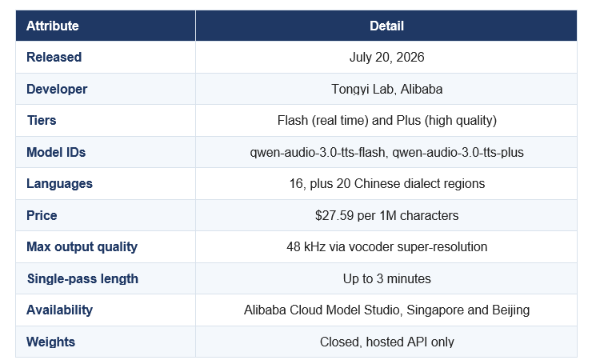
Qwen-Audio-3.0-TTS is a production text-to-speech model from Alibaba's Tongyi Lab, released July 20, 2026, delivered as a hosted API through Alibaba Cloud Model Studio with no downloadable weights. It converts text into speech across 16 languages, supports voice cloning and voice design, and accepts natural-language style instructions.

Table 1: Qwen-Audio-3.0-TTS at a glance
Screenshot 2026-07-21 203808

Figures from Tongyi Lab's release announcement and independent leaderboard reporting.

Under the hood, two design choices carry the release. A 12.5 Hz low-frame-rate speech tokenizer cuts the cost of autoregressive decoding, and a five-stage progressive training pipeline coordinates the language model and flow-matching components through pretraining, joint training, reinforcement learning and a robustness phase. The practical result is a model that can synthesise up to three minutes of audio in one pass.

Flash vs Plus: Which Tier Should You Use?

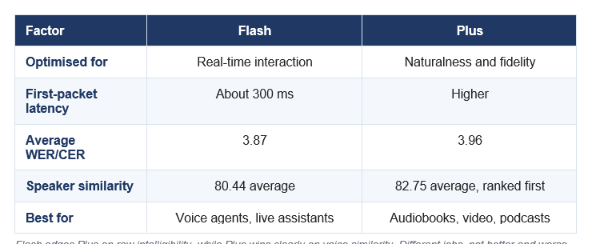
Choose Flash for anything interactive and Plus for anything pre-rendered. Flash targets real-time use with first-packet latency around 300 milliseconds, while Plus prioritises naturalness and voice fidelity over speed.

Table 2: Flash vs Plus compared
Screenshot 2026-07-21 203734

Flash edges Plus on raw intelligibility, while Plus wins clearly on voice similarity. Different jobs, not better and worse.

The scores hold a small surprise. Flash actually posts a marginally better word and character error rate than Plus, at 3.87 against 3.96. Plus earns its tier through speaker similarity, scoring 82.75 and ranking first across all 16 languages against Flash's 80.44. If your priority is being understood, Flash is already excellent. If your priority is sounding like a specific person, Plus is the one.

A practical rule: if a human is waiting for the audio, use Flash. If a human will listen to the audio later, use Plus. The 300 millisecond first-packet figure is what makes conversational agents feel responsive, and no amount of fidelity compensates for a pause that breaks the illusion of conversation.

Qwen-Audio-3.0-TTS Pricing

Qwen-Audio-3.0-TTS costs $27.59 per one million characters, which is approximately one third of what ElevenLabs and MiniMax charge for comparable output. That pricing is the commercial story of this release, because leaderboard wins are temporary and a persistent 3x cost advantage is not.

WHAT $27.59 PER MILLION CHARACTERS BUYS

One million characters is roughly 165,000 words of English text, or about 18 hours of narrated audio at typical speaking pace. At that rate, narrating a 300-page book costs a few dollars in synthesis. For high-volume applications such as e-learning, localisation or accessibility narration, this pricing changes what is economically viable.

Alibaba has run this playbook before across its model lineup, undercutting Western competitors while matching them on benchmarks. What is different here is that it is winning the quality comparison outright rather than trailing slightly, which removes the usual objection to the cheaper option.

The same aggressive value positioning shows up across Alibaba's text models. Our Qwen3.7-Max review covers the flagship that delivers near-frontier reasoning at a fraction of closed-model pricing.

All 16 Supported Languages

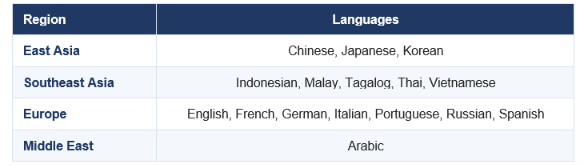
Qwen-Audio-3.0-TTS supports 16 languages, seven of which are newly added in this release, plus 20 Chinese dialect regions. The coverage leans deliberately toward Asian and Southeast Asian markets that Western TTS providers have historically underserved.

Table 3: The 16 supported languages
Screenshot 2026-07-21 203706

Plus 20 Chinese dialect regions. Seven of the 16 languages are new in this release.

The strategic read: five Southeast Asian languages and 20 Chinese dialects is not a coincidence, it is a market Western TTS vendors have largely ignored. For anyone building consumer voice products in Indonesia, Vietnam, Thailand or the Philippines, this may be the strongest option available regardless of price.

🚀 Cohort Waitlist Open
Go From AI User to AI Builder

Don't just use ChatGPT. Learn to build custom LLM agents, RAG pipelines, and full-stack Agentic AI apps in our intensive 6-week program.

6 Weeks Live Mentorship
Deploy 5+ Real-world Apps
Weekly App Templates & Code
No Coding Experience Required
Explore Program
Join 1,000+ graduates•Free Registration

Benchmarks: First on the TTS Leaderboard

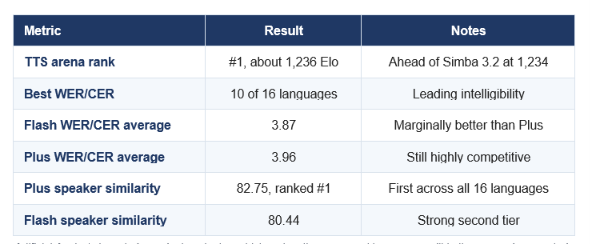
Qwen-Audio-3.0-TTS-Plus ranks first on the independent Artificial Analysis Text-to-Speech arena at about 1,236 Elo, narrowly ahead of Simba 3.2 at 1,234 and above Gemini 3.1 Flash TTS and Sonic 3.5. The model also posts the best word or character error rate in 10 of its 16 languages.

Table 4: Benchmark results
Screenshot 2026-07-21 203640

Artificial Analysis is an independent evaluator, which makes the arena ranking more credible than a vendor-reported figure.

The independent ranking matters more than the internal metrics. A vendor claiming its own model sounds best is unremarkable, while a third-party blind arena putting it first is a genuine result. The margin over Simba 3.2 is two Elo points, though, which is statistically a tie rather than a decisive win. Alibaba has drawn level with the best, not run away from them.

Voice Control: 86 Tags and Natural Language Instructions

The model offers two control layers: free-form natural-language style instructions, and 86 fine-grained inline tags for phrase and word-level direction. Tags cover emotion, such as excited and sad, and non-verbal sounds, such as laughing and gasp.

That inline tag system is the most practically useful feature in the release. Telling a model to sound cheerful across a whole paragraph is blunt, while marking a single word as a laugh or a specific phrase as hesitant gives you the kind of control that makes synthetic narration stop sounding synthetic. Voice cloning and Voice Design round out the toolkit, and a curated preset voice library spans all 16 languages so you can ship without cloning anyone.

ONE CONSTRAINT WORTH PLANNING AROUND

Emotion tags and rich-language tags work only in unidirectional streaming mode. If your architecture relies on bidirectional streaming, you lose access to the expressive tag system. Confirm your streaming mode before designing a workflow around inline emotion control.

How to Access the Qwen TTS API

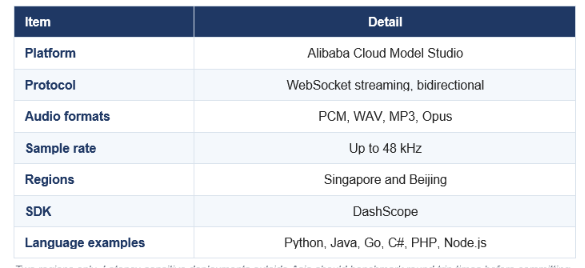
Access runs entirely through Alibaba Cloud Model Studio, using a WebSocket streaming protocol with bidirectional support. There is no self-hosting option and no weights to download.

Table 5: API and integration details
What Is Qwen-Audio-3.0-TTS?
Qwen-Audio-3.0-TTS is a production text-to-speech model from Alibaba's Tongyi Lab, released July 20, 2026, delivered as a hosted API through Alibaba Cloud Model Studio with no downloadable weights. It converts text into speech across 16 languages, supports voice cloning and voice design, and accepts natural-language style instructions.
TABLE 1: QWEN-AUDIO-3.0-TTS AT A GLANCE
Attribute	Detail
Released	July 20, 2026
Developer	Tongyi Lab, Alibaba
Tiers	Flash (real time) and Plus (high quality)
Model IDs	qwen-audio-3.0-tts-flash, qwen-audio-3.0-tts-plus
Languages	16, plus 20 Chinese dialect regions
Price	$27.59 per 1M characters
Max output quality	48 kHz via vocoder super-resolution
Single-pass length	Up to 3 minutes
Availability	Alibaba Cloud Model Studio, Singapore and Beijing
Weights	Closed, hosted API only
Figures from Tongyi Lab's release announcement and independent leaderboard reporting.
Under the hood, two design choices carry the release. A 12.5 Hz low-frame-rate speech tokenizer cuts the cost of autoregressive decoding, and a five-stage progressive training pipeline coordinates the language model and flow-matching components through pretraining, joint training, reinforcement learning and a robustness phase. The practical result is a model that can synthesise up to three minutes of audio in one pass.

Flash vs Plus: Which Tier Should You Use?
Choose Flash for anything interactive and Plus for anything pre-rendered. Flash targets real-time use with first-packet latency around 300 milliseconds, while Plus prioritises naturalness and voice fidelity over speed.
TABLE 2: FLASH VS PLUS COMPARED
Factor	Flash	Plus
Optimised for	Real-time interaction	Naturalness and fidelity
First-packet latency	About 300 ms	Higher
Average WER/CER	3.87	3.96
Speaker similarity	80.44 average	82.75 average, ranked first
Best for	Voice agents, live assistants	Audiobooks, video, podcasts
Flash edges Plus on raw intelligibility, while Plus wins clearly on voice similarity. Different jobs, not better and worse.
The scores hold a small surprise. Flash actually posts a marginally better word and character error rate than Plus, at 3.87 against 3.96. Plus earns its tier through speaker similarity, scoring 82.75 and ranking first across all 16 languages against Flash's 80.44. If your priority is being understood, Flash is already excellent. If your priority is sounding like a specific person, Plus is the one.
A practical rule: if a human is waiting for the audio, use Flash. If a human will listen to the audio later, use Plus. The 300 millisecond first-packet figure is what makes conversational agents feel responsive, and no amount of fidelity compensates for a pause that breaks the illusion of conversation.

Qwen-Audio-3.0-TTS Pricing
Qwen-Audio-3.0-TTS costs $27.59 per one million characters, which is approximately one third of what ElevenLabs and MiniMax charge for comparable output. That pricing is the commercial story of this release, because leaderboard wins are temporary and a persistent 3x cost advantage is not.
WHAT $27.59 PER MILLION CHARACTERS BUYS
One million characters is roughly 165,000 words of English text, or about 18 hours of narrated audio at typical speaking pace. At that rate, narrating a 300-page book costs a few dollars in synthesis. For high-volume applications such as e-learning, localisation or accessibility narration, this pricing changes what is economically viable.

Alibaba has run this playbook before across its model lineup, undercutting Western competitors while matching them on benchmarks. What is different here is that it is winning the quality comparison outright rather than trailing slightly, which removes the usual objection to the cheaper option.
The same aggressive value positioning shows up across Alibaba's text models. Our Qwen3.7-Max review covers the flagship that delivers near-frontier reasoning at a fraction of closed-model pricing.

All 16 Supported Languages
Qwen-Audio-3.0-TTS supports 16 languages, seven of which are newly added in this release, plus 20 Chinese dialect regions. The coverage leans deliberately toward Asian and Southeast Asian markets that Western TTS providers have historically underserved.
TABLE 3: THE 16 SUPPORTED LANGUAGES
Region	Languages
East Asia	Chinese, Japanese, Korean
Southeast Asia	Indonesian, Malay, Tagalog, Thai, Vietnamese
Europe	English, French, German, Italian, Portuguese, Russian, Spanish
Middle East	Arabic
Plus 20 Chinese dialect regions. Seven of the 16 languages are new in this release.
The strategic read: five Southeast Asian languages and 20 Chinese dialects is not a coincidence, it is a market Western TTS vendors have largely ignored. For anyone building consumer voice products in Indonesia, Vietnam, Thailand or the Philippines, this may be the strongest option available regardless of price.

Benchmarks: First on the TTS Leaderboard
Qwen-Audio-3.0-TTS-Plus ranks first on the independent Artificial Analysis Text-to-Speech arena at about 1,236 Elo, narrowly ahead of Simba 3.2 at 1,234 and above Gemini 3.1 Flash TTS and Sonic 3.5. The model also posts the best word or character error rate in 10 of its 16 languages.
TABLE 4: BENCHMARK RESULTS
Metric	Result	Notes
TTS arena rank	#1, about 1,236 Elo	Ahead of Simba 3.2 at 1,234
Best WER/CER	10 of 16 languages	Leading intelligibility
Flash WER/CER average	3.87	Marginally better than Plus
Plus WER/CER average	3.96	Still highly competitive
Plus speaker similarity	82.75, ranked #1	First across all 16 languages
Flash speaker similarity	80.44	Strong second tier
Artificial Analysis is an independent evaluator, which makes the arena ranking more credible than a vendor-reported figure.
The independent ranking matters more than the internal metrics. A vendor claiming its own model sounds best is unremarkable, while a third-party blind arena putting it first is a genuine result. The margin over Simba 3.2 is two Elo points, though, which is statistically a tie rather than a decisive win. Alibaba has drawn level with the best, not run away from them.

Voice Control: 86 Tags and Natural Language Instructions
The model offers two control layers: free-form natural-language style instructions, and 86 fine-grained inline tags for phrase and word-level direction. Tags cover emotion, such as excited and sad, and non-verbal sounds, such as laughing and gasp.
That inline tag system is the most practically useful feature in the release. Telling a model to sound cheerful across a whole paragraph is blunt, while marking a single word as a laugh or a specific phrase as hesitant gives you the kind of control that makes synthetic narration stop sounding synthetic. Voice cloning and Voice Design round out the toolkit, and a curated preset voice library spans all 16 languages so you can ship without cloning anyone.
ONE CONSTRAINT WORTH PLANNING AROUND
Emotion tags and rich-language tags work only in unidirectional streaming mode. If your architecture relies on bidirectional streaming, you lose access to the expressive tag system. Confirm your streaming mode before designing a workflow around inline emotion control.


How to Access the Qwen TTS API
Access runs entirely through Alibaba Cloud Model Studio, using a WebSocket streaming protocol with bidirectional support. There is no self-hosting option and no weights to download.
TABLE 5: API AND INTEGRATION DETAILS
Item	Detail
Platform	Alibaba Cloud Model Studio
Protocol	WebSocket streaming, bidirectional
Audio formats	PCM, WAV, MP3, Opus
Sample rate	Up to 48 kHz
Regions	Singapore and Beijing
SDK	DashScope
Language examples	Python, Java, Go, C#, PHP, Node.js
Two regions only. Latency-sensitive deployments outside Asia should benchmark round-trip times before committing.
Region availability deserves attention if you are building outside Asia. Singapore and Beijing are the only two endpoints, so a real-time voice agent serving users in Europe or the Americas will carry network latency on top of the 300 millisecond first-packet figure. Measure the real round trip from your users rather than trusting the headline number.

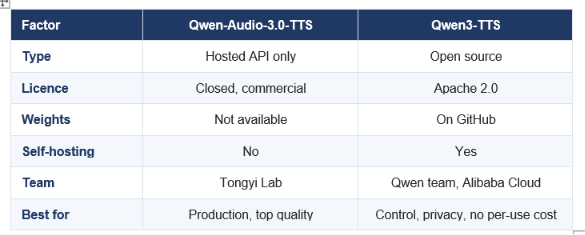
Qwen-Audio-3.0-TTS vs Qwen3-TTS: Not the Same Model
These are two different products with confusingly similar names. Qwen-Audio-3.0-TTS is the hosted, closed, API-only model released July 20, 2026. Qwen3-TTS is a separate open-source suite from the Qwen team, released under Apache 2.0 with downloadable weights on GitHub.
TABLE 6: CLEARING UP THE NAMING
Factor	Qwen-Audio-3.0-TTS	Qwen3-TTS
Type	Hosted API only	Open source
Licence	Closed, commercial	Apache 2.0
Weights	Not available	On GitHub
Self-hosting	No	Yes
Team	Tongyi Lab	Qwen team, Alibaba Cloud
Best for	Production, top quality	Control, privacy, no per-use cost
Both come from Alibaba. If you need weights on your own hardware, Qwen3-TTS is the one you want.
My opinion on the naming: shipping a closed model whose name closely echoes an existing Apache 2.0 line is a genuine own goal. Developers searching for open Qwen TTS weights will land on a hosted product they cannot download, and that confusion is avoidable. Check which product you are reading about before you plan an architecture around it.

Qwen-Audio-3.0-TTS vs ElevenLabs and Rivals
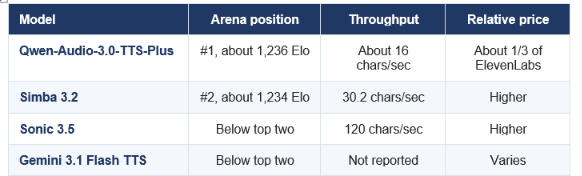
Against the competition, Qwen wins on quality ranking and price, and loses clearly on throughput. Those three facts define exactly which projects it suits.
TABLE 7: HOW QWEN COMPARES
Model	Arena position	Throughput	Relative price
Qwen-Audio-3.0-TTS-Plus	#1, about 1,236 Elo	About 16 chars/sec	About 1/3 of ElevenLabs
Simba 3.2	#2, about 1,234 Elo	30.2 chars/sec	Higher
Sonic 3.5	Below top two	120 chars/sec	Higher
Gemini 3.1 Flash TTS	Below top two	Not reported	Varies
Sonic 3.5 generates roughly 7.5 times faster than Qwen. For bulk batch synthesis, that gap matters more than Elo.
The throughput deficit is the honest caveat. At roughly 16 characters per second against Sonic 3.5's 120, Qwen takes substantially longer to produce the same audio. For a voice agent generating one reply at a time, that difference is invisible because the 300 millisecond first packet is what the user perceives. For a pipeline narrating thousands of documents overnight, it is the number that decides your architecture.

Limitations to Know Before You Build
Four constraints are worth weighing before you commit to this model.
•	Hosted only, no weights. Organisations that cannot send text to a third-party API have no path here, and should look at the open Qwen3-TTS line instead.
•	Low throughput. About 16 characters per second is well behind Simba 3.2 at 30.2 and Sonic 3.5 at 120, which matters for bulk synthesis.
•	Two regions only. Singapore and Beijing endpoints add network latency for users elsewhere, on top of the quoted 300 millisecond first packet.
•	Expressive tags need unidirectional streaming. Emotion and non-verbal tags are unavailable in bidirectional mode, which constrains some architectures.

Verdict: the best-sounding TTS API on the market right now at the most competitive price, with a throughput ceiling that rules it out for high-volume batch work. If you are building a voice agent, a localisation pipeline for Asian markets, or narration where quality per dollar decides, this is the model to test first. If you are synthesising a library overnight, benchmark Sonic 3.5 alongside it before choosing.
For the full picture of Alibaba's model lineup and where its value positioning sits against the frontier, see our July 2026 model ranking and our Qwen3.6-27B review.

Frequently Asked Questions
Q: What is Qwen-Audio-3.0-TTS?
Qwen-Audio-3.0-TTS is a hosted text-to-speech model released by Alibaba's Tongyi Lab on July 20, 2026. It comes in Flash and Plus tiers, supports 16 languages and 20 Chinese dialect regions, offers voice cloning and natural-language style control, and is available only through Alibaba Cloud Model Studio.
Q: How much does Qwen-Audio-3.0-TTS cost?
It costs $27.59 per one million characters, roughly one third of ElevenLabs and MiniMax pricing for comparable output. One million characters is approximately 165,000 words, or around 18 hours of narrated audio at a typical speaking pace.
Q: What languages does Qwen-Audio-3.0-TTS support?
Sixteen languages: Arabic, Chinese, English, French, German, Indonesian, Italian, Japanese, Korean, Malay, Portuguese, Russian, Spanish, Tagalog, Thai and Vietnamese, plus 20 Chinese dialect regions. Seven of the 16 languages are newly added in this release.
Q: What is the difference between Qwen TTS Flash and Plus?
Flash is tuned for real-time interaction with first-packet latency around 300 milliseconds and a 3.87 average WER/CER. Plus prioritises voice fidelity, scoring 82.75 on speaker similarity and ranking first across all 16 languages. Use Flash for live voice agents and Plus for pre-rendered audio.
Q: Is Qwen-Audio-3.0-TTS open source?
No. Qwen-Audio-3.0-TTS is a closed, hosted API with no downloadable weights. It should not be confused with Qwen3-TTS, a separate open-source suite from the Qwen team released under Apache 2.0 with weights available on GitHub.
Q: Is Qwen-Audio-3.0-TTS better than ElevenLabs?
On the independent Artificial Analysis TTS arena, Qwen-Audio-3.0-TTS-Plus ranks first at about 1,236 Elo, and it costs roughly one third of ElevenLabs pricing. Its weakness is throughput at about 16 characters per second, so ElevenLabs or Sonic 3.5 may suit high-volume batch synthesis better.
Q: How do I access the Qwen TTS API?
Through Alibaba Cloud Model Studio, using a WebSocket streaming protocol with the DashScope SDK. Endpoints are hosted in Singapore and Beijing, with example code in Python, Java, Go, C#, PHP and Node.js, and output in PCM, WAV, MP3 or Opus at up to 48 kHz.
Q: Does Qwen-Audio-3.0-TTS support voice cloning?
Yes. The model supports voice cloning and Voice Design, plus a curated preset voice library covering all 16 supported languages so you can deploy without cloning a voice first. It also accepts natural-language style instructions and 86 inline tags for fine-grained control.

Recommended Reads
•	Qwen3.7-Max review
•	Qwen3.6-27B beats 397B on coding
•	Qwen3.7 Max Preview arena ranks
•	Best AI models July 2026 ranking
•	Every major LLM ranked in 2026

Voice AI got cheaper and better in the same week. Follow Build Fast with AI for hands-on coverage of every major model release.


References
•	MarkTechPost, Qwen-Audio-3.0-TTS release
•	Tongyi Lab, Qwen-Audio-3.0-TTS announcement
•	Tongyi Lab, Qwen-Audio-3.0-TTS demo page
•	GitHub, Qwen3-TTS open-source suite
•	Artificial Analysis, speech arena leaderboard
•	Alibaba Cloud, Model Studio supported models

Two regions only. Latency-sensitive deployments outside Asia should benchmark round-trip times before committing.

Region availability deserves attention if you are building outside Asia. Singapore and Beijing are the only two endpoints, so a real-time voice agent serving users in Europe or the Americas will carry network latency on top of the 300 millisecond first-packet figure. Measure the real round trip from your users rather than trusting the headline number.

Qwen-Audio-3.0-TTS vs Qwen3-TTS: Not the Same Model

These are two different products with confusingly similar names. Qwen-Audio-3.0-TTS is the hosted, closed, API-only model released July 20, 2026. Qwen3-TTS is a separate open-source suite from the Qwen team, released under Apache 2.0 with downloadable weights on GitHub.

Table 6: Clearing up the naming
Screenshot 2026-07-21 203536

Both come from Alibaba. If you need weights on your own hardware, Qwen3-TTS is the one you want.

My opinion on the naming: shipping a closed model whose name closely echoes an existing Apache 2.0 line is a genuine own goal. Developers searching for open Qwen TTS weights will land on a hosted product they cannot download, and that confusion is avoidable. Check which product you are reading about before you plan an architecture around it.

🚀 Cohort Program Open
Claude Mastery: Cowork & Code

The only comprehensive program designed to take you from basic prompting to building interactive Artifacts, custom integrations, and deploying production-ready code with Claude Code.

No coding experience needed
Build interactive Artifacts & Agents
Deploy apps with Claude Code
Cohort-based learning & mentorship
Explore Program
Cohort-based training•Register Now

Qwen-Audio-3.0-TTS vs ElevenLabs and Rivals

Against the competition, Qwen wins on quality ranking and price, and loses clearly on throughput. Those three facts define exactly which projects it suits.

Table 7: How Qwen compares
Screenshot 2026-07-21 203512

Sonic 3.5 generates roughly 7.5 times faster than Qwen. For bulk batch synthesis, that gap matters more than Elo.

The throughput deficit is the honest caveat. At roughly 16 characters per second against Sonic 3.5's 120, Qwen takes substantially longer to produce the same audio. For a voice agent generating one reply at a time, that difference is invisible because the 300 millisecond first packet is what the user perceives. For a pipeline narrating thousands of documents overnight, it is the number that decides your architecture.

Limitations to Know Before You Build

Four constraints are worth weighing before you commit to this model.

  • Hosted only, no weights. Organisations that cannot send text to a third-party API have no path here, and should look at the open Qwen3-TTS line instead.
  • Low throughput. About 16 characters per second is well behind Simba 3.2 at 30.2 and Sonic 3.5 at 120, which matters for bulk synthesis.
  • Two regions only. Singapore and Beijing endpoints add network latency for users elsewhere, on top of the quoted 300 millisecond first packet.
  • Expressive tags need unidirectional streaming. Emotion and non-verbal tags are unavailable in bidirectional mode, which constrains some architectures.

Verdict: the best-sounding TTS API on the market right now at the most competitive price, with a throughput ceiling that rules it out for high-volume batch work. If you are building a voice agent, a localisation pipeline for Asian markets, or narration where quality per dollar decides, this is the model to test first. If you are synthesising a library overnight, benchmark Sonic 3.5 alongside it before choosing.

For the full picture of Alibaba's model lineup and where its value positioning sits against the frontier, see our July 2026 model ranking and our Qwen3.6-27B review.

Frequently Asked Questions

Q: What is Qwen-Audio-3.0-TTS?

Qwen-Audio-3.0-TTS is a hosted text-to-speech model released by Alibaba's Tongyi Lab on July 20, 2026. It comes in Flash and Plus tiers, supports 16 languages and 20 Chinese dialect regions, offers voice cloning and natural-language style control, and is available only through Alibaba Cloud Model Studio.

Q: How much does Qwen-Audio-3.0-TTS cost?

It costs $27.59 per one million characters, roughly one third of ElevenLabs and MiniMax pricing for comparable output. One million characters is approximately 165,000 words, or around 18 hours of narrated audio at a typical speaking pace.

Q: What languages does Qwen-Audio-3.0-TTS support?

Sixteen languages: Arabic, Chinese, English, French, German, Indonesian, Italian, Japanese, Korean, Malay, Portuguese, Russian, Spanish, Tagalog, Thai and Vietnamese, plus 20 Chinese dialect regions. Seven of the 16 languages are newly added in this release.

Q: What is the difference between Qwen TTS Flash and Plus?

Flash is tuned for real-time interaction with first-packet latency around 300 milliseconds and a 3.87 average WER/CER. Plus prioritises voice fidelity, scoring 82.75 on speaker similarity and ranking first across all 16 languages. Use Flash for live voice agents and Plus for pre-rendered audio.

Q: Is Qwen-Audio-3.0-TTS open source?

No. Qwen-Audio-3.0-TTS is a closed, hosted API with no downloadable weights. It should not be confused with Qwen3-TTS, a separate open-source suite from the Qwen team released under Apache 2.0 with weights available on GitHub.

Q: Is Qwen-Audio-3.0-TTS better than ElevenLabs?

On the independent Artificial Analysis TTS arena, Qwen-Audio-3.0-TTS-Plus ranks first at about 1,236 Elo, and it costs roughly one third of ElevenLabs pricing. Its weakness is throughput at about 16 characters per second, so ElevenLabs or Sonic 3.5 may suit high-volume batch synthesis better.

Q: How do I access the Qwen TTS API?

Through Alibaba Cloud Model Studio, using a WebSocket streaming protocol with the DashScope SDK. Endpoints are hosted in Singapore and Beijing, with example code in Python, Java, Go, C#, PHP and Node.js, and output in PCM, WAV, MP3 or Opus at up to 48 kHz.

Q: Does Qwen-Audio-3.0-TTS support voice cloning?

Yes. The model supports voice cloning and Voice Design, plus a curated preset voice library covering all 16 supported languages so you can deploy without cloning a voice first. It also accepts natural-language style instructions and 86 inline tags for fine-grained control.

Recommended Reads

  • Qwen3.7-Max review
  • Qwen3.6-27B beats 397B on coding
  • Qwen3.7 Max Preview arena ranks
  • Best AI models July 2026 ranking
  • Every major LLM ranked in 2026

Voice AI got cheaper and better in the same week. Follow Build Fast with AI for hands-on coverage of every major model release.

References

  • MarkTechPost, Qwen-Audio-3.0-TTS release
  • Tongyi Lab, Qwen-Audio-3.0-TTS announcement
  • Tongyi Lab, Qwen-Audio-3.0-TTS demo page
  • GitHub, Qwen3-TTS open-source suite
  • Artificial Analysis, speech arena leaderboard
  • Alibaba Cloud, Model Studio supported models
Enjoyed this article? Share it →
Share:
    You Might Also Like
    Latest AI Models April 2026: Rankings & Features
    Benchmarks
    Latest AI Models April 2026: Rankings & Features

    Meta Description GPT-5.4, Gemini 3.1 Ultra, Gemma 4, Muse Spark, GLM-5.1: every major AI model released March-April 2026, compared by benchmark, price, and use case.

    How to Stop Your Data From Being Used to Train AI
    Analysis
    How to Stop Your Data From Being Used to Train AI

    Some companies let you opt out of allowing your content to be used for generative AI models and other tools. Here’s how to take back (at least a little) control from LinkedIn and ChatGPT.