



NVIDIA Cosmos 3 Edge: The Complete Guide to Physical AI
A robot brain that fits on a module the size of a paperback, generates 32 actions per inference, and costs nothing to download. NVIDIA released Cosmos 3 Edge at SIGGRAPH 2026 in Los Angeles on July 20, and it is the first open world model small enough to run real-time control on edge hardware while still reasoning about what it sees.
The headline spec is 4 billion parameters, which sounds unremarkable until you understand what it is doing with them. Cosmos 3 Edge takes in text, images, video, audio and actions, reasons about the physical scene in front of it, and outputs robot actions at 15 Hz on a Jetson Thor. It ranks first on VANTAGE-Bench for vision analytics among models its size, and NVIDIA published the weights, the code and the post-training recipes under an open licence.
This guide is the reference I wanted when the model dropped: what a world model actually is, how the dual-tower architecture works, the verified benchmarks, exactly which hardware runs it, the licence terms, and how to get it running. I keep this page updated as the Cosmos family evolves.
What Is NVIDIA Cosmos 3 Edge?
NVIDIA Cosmos 3 Edge is a 4-billion-parameter open world model that helps robots, vehicles and vision agents understand their surroundings, reason in real time, and generate physical actions directly on edge devices. It was announced at SIGGRAPH 2026 on July 20 and released on Hugging Face with full weights, inference code and post-training recipes.
It ships with a companion 2-billion-parameter dense reasoning module, powered by NVIDIA Nemotron, which developers can run independently on hardware as modest as a Jetson Orin 8GB. That split matters: you can deploy just the reasoner on very constrained devices, or the full world model where you need action generation.
Cosmos 3 Edge is the smallest tier of the Cosmos 3 family, at roughly one-sixteenth the size of the 64B Super model. NVIDIA's positioning is straightforward. Train and post-train in simulation or the data centre, then distil down and deploy at the edge where the robot actually lives.
"Whether for games, cinema, robotics or factory digital twins, the goal is the same: to create virtual worlds that behave with the fidelity and realism of the physical world." Jensen Huang, NVIDIA CEO
Why this release matters: most robotics teams have been stuck choosing between a large model that reasons well but cannot run on the robot, and a small policy network that runs fast but understands nothing. Cosmos 3 Edge is a serious attempt to collapse that trade-off, and it is open, which means you can actually test the claim yourself.
Specifications at a Glance
Here is the complete specification for Cosmos 3 Edge, with every figure sourced from NVIDIA's official release materials.
Table 1: Cosmos 3 Edge specifications
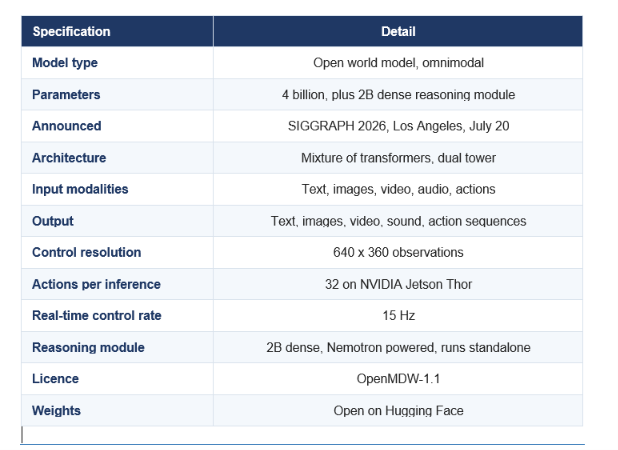
All figures from NVIDIA's Hugging Face release notes and the SIGGRAPH 2026 announcement.
What Is a World Model? (Plain English)
A world model is an AI system that learns how the physical world behaves, so it can predict what happens next and decide what to do. Where a language model predicts the next word, a world model predicts the next state of a scene, including the visual consequences of an action it is considering.
The practical difference shows up in a robot arm reaching for a cup. A vision model can tell you there is a cup. A language model can tell you how one might grasp a cup. A world model predicts what the scene will look like after the gripper closes at a specific angle, which is what you need to choose between two candidate actions before committing to either.
That predictive capability is why NVIDIA groups Cosmos under physical AI rather than generative AI. The output is not content, it is behaviour. Cosmos 3 Edge specifically operates in what NVIDIA calls policy mode, predicting both the actions to take and the visual consequences of taking them.
The quotable version: a language model finishes your sentence, and a world model finishes your movement. One predicts tokens, the other predicts physics.
Architecture: The Dual-Tower Design
Cosmos 3 Edge combines two transformer towers sharing multimodal attention layers, which is what lets one small model both reason and generate actions. Splitting these jobs across specialised towers is the core engineering idea behind the release.
Table 2: The two towers explained

Shared multimodal attention layers align information across both towers, giving unified reasoning and action generation.
The autoregressive tower behaves like the vision language models you already know, processing what the camera sees and what the instruction says. The diffusion tower generates continuous outputs, which is the right tool for smooth robot trajectories in a way that token-by-token prediction is not. Robot motion is continuous, and diffusion models handle continuous signals natively.
Actions use a common representation covering translation, rotation and manipulation state. That shared format is quietly one of the most useful design choices here, because it means a policy post-trained on one robot embodiment transfers to another far more easily than bespoke action encodings allow.
For how this fits alongside NVIDIA's broader model lineup including Nemotron, see our NVIDIA AI models 2026 guide.
The Cosmos 3 Family: Edge vs Nano vs Super
Cosmos 3 ships in three sizes: Edge at 4B for on-device deployment, Nano at 16B, and Super at 64B for data centre work. All three are available now on Hugging Face with inference and post-training frameworks on GitHub.
Table 3: Cosmos 3 family comparison
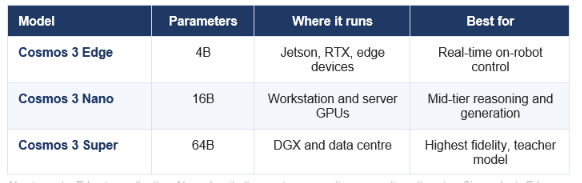
Naming note: Edge is smaller than Nano despite the naming convention suggesting otherwise. Size order is Edge, Nano, Super.
The intended workflow runs downhill. Use Super in the data centre to generate synthetic data and act as a teacher, post-train on your own robot data, then distil to Edge for deployment. NVIDIA also published Cosmos 3 Super 4-Step, a distilled checkpoint that cuts diffusion steps from 35-50 down to 4 and delivers up to 25x faster inference, which is the bridge that makes this pipeline practical.
Benchmarks and Performance
Cosmos 3 Edge ranks number one on VANTAGE-Bench for vision analytics among 4-billion-parameter models, and NVIDIA reports state-of-the-art results for robot policy learning in its size class. The performance numbers that matter most for robotics, though, are the latency figures rather than the leaderboard position.
Table 4: Verified performance figures
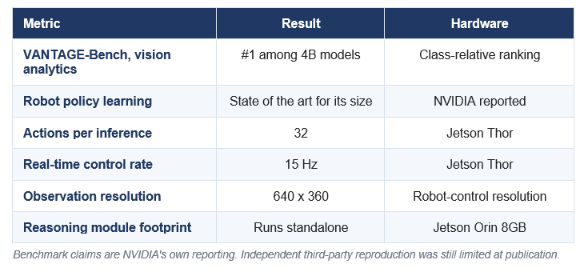
Benchmark claims are NVIDIA's own reporting. Independent third-party reproduction was still limited at publication.
Read 15 Hz carefully, because it is the number that decides whether this is usable. Fifteen control cycles per second is workable for manipulation tasks like pick and place, where the scene changes at human speed. It is not sufficient for high-speed dynamic balance or fast obstacle avoidance, which typically want 50 Hz or more. Match the control rate to your task before you commit.
My honest caveat: NVIDIA is grading its own homework here, and the VANTAGE-Bench claim is carefully scoped to models of the same size. That is a fair comparison, not a claim of beating everything. Treat the leaderboard line as directional and run your own evaluation on your own robot, because in robotics the benchmark that counts is your task success rate.
Supported Hardware
Cosmos 3 Edge runs across NVIDIA's full edge and workstation range, from Jetson modules on a robot up to DGX systems. That breadth is the point: you can prototype on a desktop RTX card and deploy the same model on an embedded module.
Table 5: Supported NVIDIA hardware
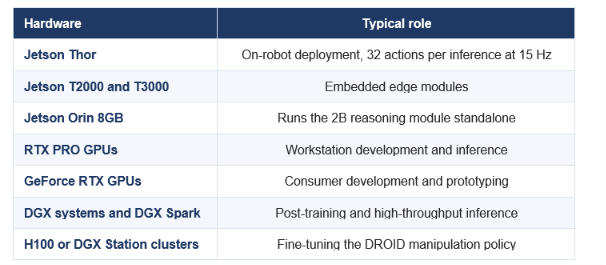
The GeForce RTX line being supported means individual developers can experiment without buying robotics-grade hardware.
THE ACCESSIBILITY STORY
The 2B reasoning module running standalone on a Jetson Orin 8GB is the most underrated detail in this release. That is a module costing a few hundred dollars, not a datacentre. Combined with open weights, it puts credible physical AI research within reach of university labs and independent developers for the first time.
Real-World Use Cases
NVIDIA targets three deployment categories with Cosmos 3 Edge: robotics, autonomous vehicles, and vision AI agents for smart infrastructure. Each uses a different subset of the model's capabilities.
Robotics and manipulation
The flagship use case. Teams post-train Cosmos 3 Edge on proprietary robot data using a DGX Station, then deploy to Jetson Thor for real-time manipulation and locomotion control. NVIDIA also released Cosmos 3 Edge Policy (DROID), a post-trained manipulation policy specialised for pick-and-place, complete with training scripts for fine-tuning on H100 or DGX Station clusters. If you are building a warehouse or assembly robot, that checkpoint is your starting point rather than training from scratch.
Autonomous vehicles
Cosmos 3 Edge supports road-scene understanding, traffic reasoning, and object-intent prediction, which is the hard part of driving. Knowing a pedestrian is present is straightforward; predicting whether they are about to step off the kerb is the world-model problem. NVIDIA also positions it for policy model distillation onto resource-constrained in-vehicle hardware.
Vision AI agents and smart infrastructure
Running on live video streams, the model powers traffic monitoring, public safety, logistics and industrial inspection. This category may generate the fastest commercial adoption, because it needs no robot at all. A camera, a Jetson, and a model that understands scenes is a complete product, and the VANTAGE-Bench vision analytics result speaks directly to this workload.
How to Get Started in 5 Steps
Everything you need is public. Weights are on Hugging Face, inference and post-training frameworks are on GitHub, and NVIDIA published reference checkpoints with training recipes.
Step 1: Check your hardware
Confirm you have a supported NVIDIA GPU or Jetson module from the table above. For a first experiment, a GeForce RTX card is enough. If you only want the reasoning module, a Jetson Orin 8GB will do.
Step 2: Download the model from Hugging Face
The model card lives at huggingface.co/nvidia/Cosmos3-Edge, and the full Cosmos 3 collection groups Edge, Nano and Super together. Pull the weights with the standard Hugging Face CLI or the transformers integration.
Step 3: Clone the Cosmos repository
The GitHub repository at github.com/nvidia/cosmos carries the inference code, post-training frameworks and recipes. Read the licence file before you build anything commercial on it.
Step 4: Run inference before you train
Start with the base checkpoint on sample data and confirm your pipeline works end to end. If your target is manipulation, load the Cosmos 3 Edge Policy (DROID) checkpoint instead, since a post-trained policy will show you far more in an afternoon than the base model will.
Step 5: Post-train on your own data
This is where the value lives. Use the published post-training recipes to fine-tune on your robot's own demonstrations, ideally on a DGX Station or H100 cluster, then deploy the result to Jetson. NVIDIA's recommended pattern is to train in simulation first, then transfer to the physical robot, which reduces both cost and risk.
If open models are your focus generally, our open-source LLM hub tracks licences and self-hosting requirements across the wider field.
Licence and Openness
Cosmos source code and models are released under the OpenMDW-1.1 licence, and NVIDIA published weights, code and post-training recipes together. That combination is meaningfully more open than a weights-only release, because recipes let you reproduce and extend the training rather than just run the artefact.
Table 6: What is actually open
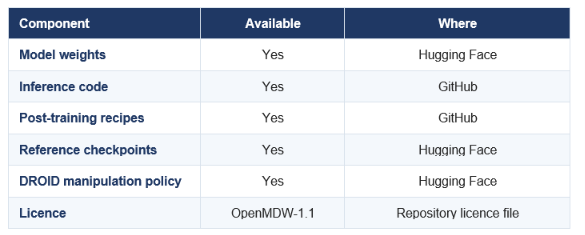
OpenMDW is an open model licence. Read the terms directly before commercial deployment rather than assuming Apache or MIT equivalence.
A caution worth stating plainly: OpenMDW-1.1 is not as widely understood as Apache 2.0 or MIT, and open model licences vary in what they permit for commercial use and redistribution. If you are building a product on this, have someone read the actual licence file. Do not assume.
Who Is Already Using It
NVIDIA named seven companies evaluating Cosmos 3 Edge across robotics, industrial and vision workflows at launch: Agile Robots, Doosan Robotics, Siemens, Skild AI, Centific, Vaidio and YUAN.
The mix tells you where NVIDIA expects traction. Agile Robots and Doosan Robotics are industrial arm manufacturers, Siemens brings factory automation at scale, Skild AI is a robot foundation model startup, and Vaidio and YUAN operate in video analytics. That spread across manufacturing and vision matches the two use cases with the clearest near-term revenue.
Read the word evaluating carefully: these are companies testing the model, not case studies of production deployment. At launch that is normal and honest, but do not mistake an evaluation list for proven results at scale.
Honest Limitations
Cosmos 3 Edge is an impressive release, and there are four constraints worth understanding before you plan around it.
- NVIDIA hardware only. Every supported target is an NVIDIA GPU or Jetson module. There is no path to AMD, Apple Silicon or generic ARM, so this is a vendor-locked stack by design.
- 15 Hz suits manipulation, not high-speed dynamics. Fast balance, agile locomotion and rapid obstacle avoidance typically need higher control rates.
- Benchmarks are NVIDIA-reported and size-scoped. The VANTAGE-Bench claim is specifically against other 4B models, and independent reproduction was limited at launch.
- OpenMDW-1.1 is less familiar than Apache or MIT. Legal review is genuinely required before commercial deployment rather than a formality.
My overall verdict: the most important open robotics release of 2026 so far, and the accessibility is the story rather than the benchmark. A 2B reasoner on a Jetson Orin plus open weights and published recipes lowers the barrier to serious physical AI work more than any single score. The vendor lock-in is real, but NVIDIA is where the robotics silicon lives anyway.
For context on how open releases like this compare across the wider model landscape, see our July 2026 model ranking and our guide to Google Gemma 4 as an open-model reference point.
Frequently Asked Questions
Q: What is NVIDIA Cosmos 3 Edge?
Cosmos 3 Edge is a 4-billion-parameter open world model from NVIDIA, announced at SIGGRAPH 2026 on July 20. It processes text, images, video, audio and actions, reasons about physical scenes in real time, and generates robot actions on edge devices such as NVIDIA Jetson. It ships with a 2B reasoning module and is available on Hugging Face.
Q: What is a world model in AI?
A world model learns how the physical world behaves so it can predict future states and choose actions. Where a language model predicts the next word, a world model predicts the next state of a scene, including the visual consequences of a candidate action. That prediction is what lets a robot evaluate a movement before performing it.
Q: Is Cosmos 3 Edge free and open source?
Yes. NVIDIA released model weights, inference code and post-training recipes publicly under the OpenMDW-1.1 licence, with weights on Hugging Face and code on GitHub. Because OpenMDW-1.1 is less established than Apache 2.0 or MIT, read the licence terms before commercial deployment.
Q: What hardware does Cosmos 3 Edge need?
It runs on NVIDIA Jetson Thor, Jetson T2000 and T3000 modules, RTX PRO GPUs, GeForce RTX GPUs, and DGX systems including DGX Spark. The 2-billion-parameter reasoning module can run independently on a Jetson Orin 8GB, which is the cheapest entry point into the family.
Q: What is the difference between Cosmos 3 Edge, Nano and Super?
Edge is 4B parameters for on-device real-time control, Nano is 16B for workstation and server deployment, and Super is 64B for data centre work and as a teacher model. Despite the naming, Edge is the smallest tier. NVIDIA's intended workflow trains on Super and distils down to Edge for deployment.
Q: Can Cosmos 3 Edge run on a Jetson?
Yes, that is its primary deployment target. On Jetson Thor it generates 32 actions per inference and achieves real-time robot control at 15 Hz using 640 x 360 observations. Jetson T2000 and T3000 modules are also supported, and the 2B reasoner runs on a Jetson Orin 8GB.
Q: What is physical AI?
Physical AI describes systems that perceive, reason about and act in the physical world, such as robots, autonomous vehicles and vision agents, rather than producing text or images. NVIDIA groups Cosmos under physical AI because the model's output is behaviour and action sequences, not content.
Q: How fast is Cosmos 3 Edge for robot control?
It achieves real-time control at 15 Hz on NVIDIA Jetson Thor, generating 32 actions per inference. That rate suits manipulation tasks such as pick and place, but is below what high-speed dynamic balance or fast obstacle avoidance typically require, which is often 50 Hz or more.
Q: How do I download Cosmos 3 Edge?
Download the weights from huggingface.co/nvidia/Cosmos3-Edge, or browse the full Cosmos 3 collection on Hugging Face for Nano and Super. Inference code, post-training frameworks and recipes are in the NVIDIA Cosmos repository at github.com/nvidia/cosmos.
Recommended Reads
- NVIDIA AI models 2026 guide
- Best open source LLMs hub
- Google Gemma 4 open model review
- Best AI models July 2026 ranking
- Every major LLM ranked in 2026
Physical AI is where the next decade of applied AI gets built. Follow Build Fast with AI for hands-on coverage of every major model release, open and closed.

