



One 3D house. Four AI models. A 45x swing in cost to build the same thing. In a viral coding test making the rounds this week, each model was asked to generate the same 3D house scene from a single prompt, and the bill ranged from four cents to a dollar eighty-two. That single spread is the whole story of the AI model market in July 2026: capability has converged, and price has not.
Four frontier models launched or updated within 32 hours of each other in early July 2026: Grok 4.5 on July 8, then GPT-5.6 Sol, Claude Fable 5, and Meta Muse Spark 1.1 all live by July 9. This is the head-to-head comparison builders actually need: same tests, same criteria, an honest winner for each use case, and a clear answer to which one you should put in production.
We have published full standalone reviews of most of these, including our GPT-5.6 Sol, Terra, and Luna review, and this piece pulls them into one scoreboard. For the broader field, our AI model coverage hub tracks every release.
The Contenders at a Glance
These four models represent four different bets on what matters most: Claude Fable 5 bets on raw intelligence, GPT-5.6 Sol on agentic speed, Grok 4.5 on intelligence per dollar, and Muse Spark 1.1 on tool use at commodity pricing. All four are proprietary, all four ship a large context window, and all four are genuinely frontier-cluster. The differences are in the trade-offs.

Look at the output-price column and the market strategy writes itself. Anthropic charges $50 per million output tokens because Fable 5 wins the benchmarks and they know it. Meta charges $4.25 because it is buying its way into the conversation. That is more than a 10x gap on output for four models that all claim the frontier. Whether Fable 5 is 10x better is the question this entire comparison exists to answer, and the short version is: only for some jobs.
The 3D House Test: What Actually Happened
In the viral test, Muse Spark 1.1 built the same 3D house for four cents while Fable 5 spent $1.82, a 45x cost difference for a broadly comparable result. Each model received an identical prompt to generate a 3D house scene (rendered in the browser), and the run was measured on three axes: tokens consumed, dollar cost, and lines of code produced. Here are the numbers exactly as reported in the test.

Three things jump out. First, Muse Spark 1.1 was both the cheapest and the most economical with tokens and code: it produced a clean, modern glass house in 627 lines for four cents. That is a genuinely striking efficiency result, and it matches what I found testing its tool-use behavior. Second, Grok 4.5 wrote the most code by far (1,431 lines) yet cost only 17 cents, which is exactly the intelligence-per-dollar pitch xAI leads with. Third, Fable 5 consumed the most tokens and cost 45x more than Muse Spark, which stings until you remember what Fable 5 is for.
The honest caveat, and it matters: this is one viral demo, not a controlled benchmark. Lines of code is a vanity metric (more code is often worse, not better), and a single 3D-house prompt does not test debugging, long-horizon reasoning, or correctness under edge cases, which is exactly where Fable 5 earns its price. Read this test as a vivid illustration of the cost spread, not as proof that the cheapest model is the best model. The rest of this comparison is where the real ranking gets decided.
Quotable version: the 3D house test proves the models have converged on easy tasks. It says nothing about the hard ones, which is the whole point of paying more.
Pricing Compared: The 45x Spread
On price, the order is unambiguous: Muse Spark 1.1 is cheapest, then Grok 4.5, then GPT-5.6 Sol, then Claude Fable 5 at the top. But raw per-token price hides the real story, which is cost per completed task, and that depends on how many tokens each model burns to finish the job.
Consider a realistic agent workload: 10 million input tokens and 2 million output tokens per day (context, tool results, and generated responses across a few thousand requests). Here is what each model costs daily at list price, ignoring caching.
That is a 9.5x monthly spread between the cheapest and most expensive, $630 versus $6,000, for the same nominal workload. Grok 4.5 sweetens its position further with $0.50 per million cached input tokens, so context-heavy agents that reuse a big system prompt can cut the input line dramatically. Muse Spark throws in $20 of free credits to get you in the door. For any high-volume, cost-sensitive deployment, the bottom two rows of that table are the only ones that make financial sense, and Muse Spark 1.1 is the clear value winner.
If your priority is squeezing the most capability per dollar, the open-weight challengers in our GLM-5.2 vs Claude vs GPT-5.6 coding comparison push this price argument even harder from below.
Benchmarks Head to Head
On published benchmarks, Claude Fable 5 is the intelligence leader, GPT-5.6 Sol wins agentic execution, Muse Spark 1.1 wins tool use, and Grok 4.5 wins efficiency. No model sweeps, and each maker benchmarked against a slightly different field, so treat cross-vendor rows as directional rather than exact.
The one number that dominates the table is Fable 5's 95.0% on SWE-bench Verified, the highest score any public model has posted, ahead of Opus 4.8 and everything OpenAI, xAI, or Meta has shipped. That is why Anthropic can charge $50 output and not blink. On the flip side, GPT-5.6 Sol takes Terminal-Bench 2.1 (88.8%) and Muse Spark 1.1 owns tool-use with 88.1 on MCP Atlas. Grok 4.5 lands at 54 on the independent Artificial Analysis Intelligence Index, ranked fourth overall, but leads several agentic tool-use rows while costing a fraction of the leaders.
A transparency note: many cells read not published because each lab reports the suites that flatter it. Anthropic leads with SWE-bench Verified, OpenAI with Terminal-Bench, Meta with MCP Atlas, and xAI with the independent Artificial Analysis index. When four labs cannot agree on which benchmark to show, the real signal is in hands-on testing, not the leaderboards.
Coding and Agentic Work
For serious coding, the ranking is Fable 5 first, GPT-5.6 Sol second, then Grok 4.5 and Muse Spark 1.1 in the competitive tier below. But for agentic tool use, that order flips, and Muse Spark 1.1 and Sol move to the front. Which model wins depends entirely on whether your workload is writing correct code or orchestrating tools.
Deep coding and debugging: Claude Fable 5
Fable 5 is the model to beat for hard coding. The 95.0% SWE-bench Verified score is not marketing: it reflects a model that fixes real GitHub issues correctly on the first try more often than anything else available. In hands-on testing across our reviews, Fable 5 consistently found root causes that other models patched around. If you are shipping a week-long refactor or debugging a nasty concurrency issue, its price is worth paying.
Agentic execution and speed: GPT-5.6 Sol
GPT-5.6 Sol is the fastest capable agent. It posts 88.8% on Terminal-Bench 2.1 (91.9% in ultra mode) and runs at up to 750 tokens per second on Cerebras hardware, which changes how agentic coding feels: it finishes multi-file execution before you finish reading its plan. Sol Pro, the heavier tier shown in the house test, is the version ChatGPT Pro and Enterprise users get. For broad, fast, multi-step execution, Sol is the best tool here.
Tool use and MCP: Muse Spark 1.1
Muse Spark 1.1 leads tool use outright with 88.1 on MCP Atlas, ahead of every competitor Meta tested. It generalizes zero-shot to new MCP servers, orchestrates parallel subagents, and reports failures honestly instead of hallucinating success. At $1.25 input, it is the cheapest serious agent brain on the market, which is why it wins the value-per-agent argument decisively.
Value coding: Grok 4.5
Grok 4.5 is the dark horse for cost-conscious builders. It ranks fourth on the independent Artificial Analysis Intelligence Index yet costs $2 input / $6 output, with $0.50 cached input, and ships built-in web and X search plus deep IDE integration through Cursor, OpenRouter, and the office add-ins. In the house test it wrote the most code for 17 cents. It will not out-reason Fable 5, but for a lot of real work it does not need to.
To reproduce these coding tests yourself, the agent and coding evaluation notebooks in gen-ai-experiments contain the harnesses we adapt for every model review.
Context, Multimodality, and Ecosystem
Three of the four ship a 1 million token context window; Grok 4.5 is the outlier at 500K. But context size is a spec, not a capability, and retrieval quality inside the window varies more than the headline numbers suggest. Muse Spark 1.1, for example, carries a 1M window but its long-context retrieval trails the GPT and Claude families in independent testing.
Muse Spark 1.1 has the widest input stack: it takes video, audio, and PDF natively through one endpoint, which none of the others fully match this month. Grok 4.5 has the deepest distribution, reachable through Cursor, OpenRouter, Vercel, Cloudflare, Snowflake, Databricks, and Microsoft Office add-ins, plus native X search that no rival can replicate. Fable 5 and GPT-5.6 Sol keep the cleanest, most mature developer platforms and the broadest third-party framework support. All four are closed-weight, so none can be self-hosted or fine-tuned, which for some teams rules out the entire group in favor of open models.
The Verdict: Best Model for Each Job
There is no single winner, and anyone who tells you otherwise is quoting one benchmark or one viral demo. After weighing price, benchmarks, and hands-on behavior, here is the model I would actually pick for each job.
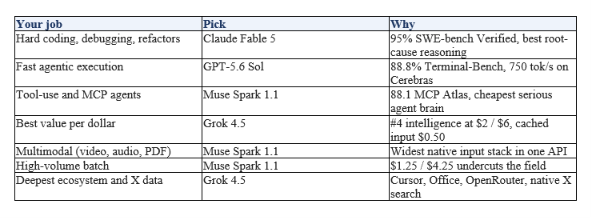
My overall take: if money is no object and correctness is everything, Fable 5 is still the best model in the world for hard problems. For most builders shipping real products, the smart play is a two-model stack: a cheap workhorse (Muse Spark 1.1 or Grok 4.5) for the 90% of calls that are routine, and Fable 5 or GPT-5.6 Sol reserved for the hard 10% where quality pays for itself. The house test is the proof: on easy work the models have converged, so paying frontier prices for easy calls is just waste.
Hot take: the real winner of July 2026 is the buyer. Four labs shipped frontier-cluster models in 32 hours, output prices span more than 10x, and switching cost is near zero because everyone is SDK-compatible. Competition this fierce means you should be routing between at least two of these models by cost and task, not marrying one.
We rank the full field, including these four, every month in our best AI models of July 2026 leaderboard, updated with fresh head-to-head evals.
Frequently Asked Questions
Which is the best AI model in July 2026?
It depends on the task. Claude Fable 5 is the best for hard coding and reasoning (95% SWE-bench Verified), GPT-5.6 Sol is fastest for agentic execution, Muse Spark 1.1 wins tool use and value, and Grok 4.5 offers the best intelligence per dollar. There is no single overall winner in July 2026.
Is Muse Spark 1.1 better than GPT-5.6 Sol?
For tool use and cost, yes: Muse Spark 1.1 leads MCP Atlas (88.1) and costs far less at $1.25 / $4.25. For agentic coding speed and long-context retrieval, GPT-5.6 Sol is stronger, posting 88.8% on Terminal-Bench 2.1 and running up to 750 tokens per second.
How much do these four AI models cost?
Per million tokens: Claude Fable 5 is $10 input / $50 output, GPT-5.6 Sol is $5 / $30, Grok 4.5 is $2 / $6 (with $0.50 cached input), and Muse Spark 1.1 is $1.25 / $4.25. That is more than a 10x spread on output price across the four.
Which AI model is cheapest for coding?
Muse Spark 1.1 is the cheapest at $1.25 / $4.25 per million tokens, followed by Grok 4.5 at $2 / $6. In the viral 3D house test, Muse Spark built the scene for $0.04 versus Fable 5's $1.82, though Fable 5 remains stronger on hard, correctness-critical coding.
Is Grok 4.5 good for coding?
Yes, for value coding. Grok 4.5 ranks fourth on the independent Artificial Analysis Intelligence Index and integrates deeply with Cursor and the xAI API, at $2 / $6 pricing. It trails Fable 5 and GPT-5.6 Sol on the hardest coding benchmarks but is highly competitive for the price.
Which AI model uses the fewest tokens?
In the 3D house test, Muse Spark 1.1 used the fewest tokens (10,170) and wrote the least code (627 lines) while producing a clean result, making it the most token-efficient of the four. Grok 4.5 used the most tokens relative to its cost but stayed cheap due to low per-token pricing.
Can any of these models be self-hosted?
No. All four (Claude Fable 5, GPT-5.6 Sol, Grok 4.5, and Muse Spark 1.1) are proprietary and closed-weight, with no local deployment or fine-tuning. Teams that need self-hosting should look at open-weight models like GLM, Qwen, or DeepSeek instead.
Recommended Blogs
● GPT-5.6 Sol Terra Luna review
Resources and Community
Join our community of 70,000+ AI enthusiasts and learn to build powerful AI applications. Whether you are a beginner or an experienced developer, Build Fast with AI helps you understand and implement AI in your projects.
● Website
● Instagram (@buildfastwithai)
● BFWAI Twitter (@BuildFastWithAI)
Agentic AI Launchpad 2026
A structured 6-week cohort program that takes you from AI basics to building and deploying real-world agentic AI systems. Includes live sessions, expert mentorship, project reviews, and a builder community network.
Ready to go from learning to building? Join the next cohort: Agentic AI Launchpad 2026
Free AI Resources
Access free tools, workshops, and micro-learning to keep building:
Found this comparison useful? Follow Build Fast with AI for hands-on coverage of every major model launch, and subscribe so the next leaderboard update lands in your inbox.
References
● Grok 4.5 benchmarks and pricing (Kingy)
● Grok 4.5 API pricing (OpenRouter)
● Claude benchmarks (MorphLLM)
● Claude Fable 5 evals (Vals AI)
● Muse Spark 1.1 release (MarkTechPost)

