



Meta picked a fight on purpose. Muse Spark 1.1 launched on July 9, 2026, the exact same day OpenAI shipped GPT-5.6, and Mark Zuckerberg ended a three-year absence from X just to announce it. When a CEO returns to a rival's platform to promote his model, you review that model carefully.
We reviewed the original Muse Spark when it arrived in April, and our Meta Muse Spark 1.0 review called it a specialist, strong on health and science, weak on coding and agents. Three months later, 1.1 is a very different animal. I have spent the past three days testing it through the new Meta Model API against the same workloads I threw at GPT-5.6 last week. This is the full 360-degree review: benchmarks, pricing, hands-on results, developer experience, and an honest verdict.
Muse Spark 1.1 at a Glance
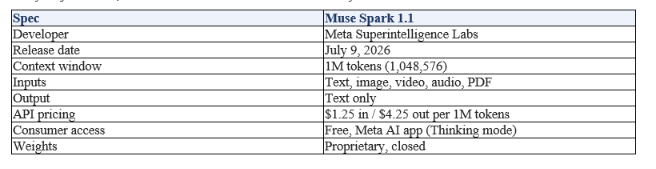
Muse Spark 1.1 is a multimodal reasoning model built for agentic tasks, released by Meta Superintelligence Labs on July 9, 2026. It accepts text, images, video, audio, and PDF inputs, produces text-only output, and carries a 1 million token context window (1,048,576 tokens in the API docs) with active context management that compacts long sessions on its own.
The headline capability is tool use. Meta trained 1.1 to generalize zero-shot to new native tools, MCP servers, and custom skills, to orchestrate parallel subagents, and to handle computer-use workflows that span several applications. It decides on its own whether writing a script is faster than clicking through an interface, and in my testing that decision-making is the most impressive thing about it.
Distribution is classic Meta: consumers get it free inside the Meta AI app in Thinking mode, while developers get it through the brand-new Meta Model API at $1.25 per million input tokens and $4.25 per million output tokens, with $20 in free credits for new accounts. The public preview is US-only for now, with no EU access at launch.
For the wider mid-2026 model landscape this launch crashed into, our OpenAI and AI model coverage hub tracks every major release, and the ranked context lives in our monthly leaderboard.
The Story Behind the Launch: Superintelligence Labs, Round Two
Muse Spark 1.1 is the second model from Meta Superintelligence Labs, the division Meta built around Chief AI Officer Alexandr Wang after the Scale AI deal, and it exists to prove the first one was not a fluke. The original Muse Spark shipped on April 8, 2026 as Meta's first ground-up rebuild after the Llama era, and it landed as a capable but lopsided specialist.
The launch theater this time was deliberate. Zuckerberg posted the announcement on X, his first post there in three years, hours after OpenAI's GPT-5.6 event. Fortune framed the release as Meta accelerating its AI push under Wang, and the same-day timing reads as a direct claim: we belong in the frontier conversation now.
The strategic shift that still stings for many builders: Muse Spark remains proprietary and closed-weight. There is no download, no local deployment, and no fine-tuning. For the company that gave the world Llama, that is a complete reversal, and 1.1 doubles down on it. My take: Meta looked at where the money is (hosted agentic APIs) and stopped subsidizing everyone else's fine-tunes. Rational, but the open-source community Meta built its AI reputation on is right to feel abandoned.
Quotable version: Meta spent four years arguing open weights were the future, then shipped its two best models behind an API.
The community reaction has split along predictable lines. Agent builders are largely thrilled: a frontier tool-use model at commodity pricing solves a real budget problem. The open-source community, the same one that built vLLM, llama.cpp, and thousands of fine-tunes on Meta's earlier generosity, sees a bait and switch. Both readings are correct at the same time, and the tension will define how much goodwill Meta can spend when this API eventually has its first pricing increase or deprecation notice.
Pricing and Availability: $1.25 Input and $20 Free Credits
Muse Spark 1.1 costs $1.25 per million input tokens and $4.25 per million output tokens, which undercuts every comparable frontier model on output price. For calibration: GPT-5.6 Terra runs $2.50 / $15, GPT-5.6 Luna runs $1 / $6, and Claude and Gemini flagships sit well above all of these. Meta is buying market share, and it is not being subtle about it.

Read that table twice. Meta priced a frontier-class agentic model below OpenAI's budget tier on output tokens. If the quality holds for your workload (and for tool-heavy workloads, my testing says it does), Muse Spark 1.1 is the cheapest serious agent brain on the market in July 2026.
Access has three doors. Consumers: free in the Meta AI app and on meta.ai, where Thinking mode quietly runs 1.1. Developers: the Meta Model API in public preview, US-only at launch, with $20 in free credits (roughly 4.7 million output tokens, enough for real evaluation). Enterprises: early partner program, which is where the frontend and design praise in Meta's launch materials comes from.
The EU absence deserves a flag. Meta has not committed to an EU availability date, and given its history of regulatory standoffs with Brussels, European builders should not architect anything around this API yet.
A worked example to make the pricing concrete. A production agent that handles 500 customer conversations a day, averaging 40,000 input tokens (context, history, tool results) and 3,000 output tokens per conversation, consumes 20M input and 1.5M output tokens daily. On Muse Spark 1.1 that is $31.38 per day, about $942 per month. The identical workload costs $145 per day on GPT-5.6 Sol, $72.50 on Terra, and $29 on Luna. Muse Spark gives you frontier-cluster tool use at within-noise distance of OpenAI's budget tier. That is the sentence that should worry OpenAI's pricing team.
If you are deciding between the three GPT-5.6 tiers and this, our GPT-5.6 Sol, Terra, and Luna review has the full pricing math from the other side of the fight.
Benchmarks Deep Dive: Where 1.1 Wins and Where It Loses
Muse Spark 1.1 leads the field on tool use and tool-augmented reasoning, and loses on raw coding, long-context retrieval, and visual understanding. Meta's own evaluation report is unusually honest about this split, and independent trackers like Vals AI broadly confirm it: 1.1 sits in the competitive cluster with Grok 4.5, Claude Opus 4.8, GPT-5.5, and GLM-5.2, with Claude Fable 5 still ahead of that whole group.
Where Muse Spark 1.1 Wins
The MCP Atlas number is the one that matters most for agent builders. An 88.1 against Opus 4.8's 82.2 and GPT-5.5's 75.3 means Meta trained this model specifically to be dropped into MCP-based agent stacks and behave, and that matches exactly what I saw hands-on.
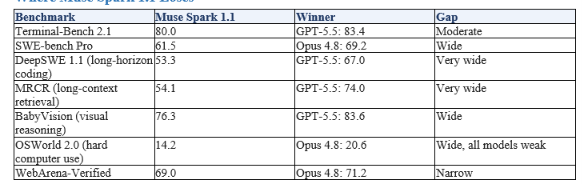
Two honest caveats before you trust any row above. First, these are Meta's own best-effort evaluations, and Meta itself notes the scaffolding may not be tuned for the proprietary competitor models, so the competitor columns deserve a grain of salt. Second, the comparison set is GPT-5.5 and Opus 4.8, both of which were superseded the very week this model launched (GPT-5.6 on the same day, and Anthropic's Fable 5 earlier). Meta benchmarked against the previous generation. That is normal launch practice, and it is also why hands-on testing matters more than usual this time.
The MRCR long-context number is my biggest concern. A 1M token window with a 54.1 retrieval score means the window is real but the recall inside it is not frontier-grade. As I keep saying in these reviews: context length is a spec, retrieval quality is a feature, and they are not the same thing.
For how these numbers slot into the full July rankings across every lab, see our best AI models of July 2026 leaderboard, which we are updating with Muse Spark 1.1 scores this week.
What Changed From Muse Spark 1.0 to 1.1
Muse Spark 1.1 is a targeted repair job on 1.0's two biggest weaknesses: coding and agentic work. On Meta's internal atomic capability suite, 1.1 jumps from 48.1% to 67.0% pass@1 (and from 65.0% to 82.5% pass@20), with the gains concentrated on the hardest problems. In three months, Meta closed most of the gap that made us call 1.0 a specialist.
What 1.0 did well, 1.1 keeps. The health and medical strength that made the original the top HealthBench model carries forward (59.3 on HealthBench Professional still leads Opus 4.8), and the natively multimodal input stack is unchanged. What is genuinely new: computer use as a first-class capability, zero-shot MCP generalization, parallel subagent orchestration, and the active context compaction that was not present in April.
What has not changed is the philosophy. Still closed-weight, still text-only output, still free for consumers. Meta is running the same playbook it ran with 1.0, just with a much better model behind it, and this time with a paid developer API attached. That last part is the real news: for the first time, Meta wants to be your model vendor, not just your model donor.
I Tested Muse Spark 1.1: Five Hands-On Workloads
I ran Muse Spark 1.1 through five workloads over three days: an MCP agent stack, a cross-application computer-use task, a real coding job, a long-context stress test, and a high-volume batch run. Same harness I used for the GPT-5.6 review last week, so these results are directly comparable. Here is what happened, including the failures.
Test 1: Zero-Shot MCP Agent (the headline claim)
The zero-shot MCP claim is real, and it is the best I have seen from any model. I pointed 1.1 at three MCP servers it had never seen (a Postgres server, a Slack server, and our internal analytics server) with no examples and no tool descriptions beyond the schemas. It introspected the schemas, planned a multi-tool workflow, and executed a nine-step task (query the database, aggregate, post a formatted summary to Slack) on the first attempt. GPT-5.6 Sol needed one retry on the same task; GPT-5.5 used to need hand-written tool guidance.
Even better: when one tool call failed on a permissions error, 1.1 rerouted around it and flagged the failure in its final summary instead of hallucinating success. That single behavior, honest failure reporting, is worth more to me in production than five benchmark points.
If you want to replicate this test, the MCP agent notebooks in gen-ai-experiments contain the exact server setup and evaluation harness I adapted for this run.
Test 2: Cross-Application Computer Use
The script-versus-click judgment is the standout. The task: pull a CSV export from a web dashboard, clean it in a spreadsheet, and email the summary. 1.1 wrote a script for the data cleaning (correctly judging it faster than clicking through spreadsheet menus) but drove the browser directly for the dashboard export, where scripting would have broken on the site's authentication. That is exactly the judgment call a human operator makes, and I have not seen another model make it this cleanly.
The ceiling is still low, though. On a harder task involving an unfamiliar desktop application with nested dialogs, it stalled twice and once confidently clicked the wrong button in a confirmation modal. The OSWorld 2.0 score of 14.2 is honest: hard computer use is not solved, by anyone, and Muse Spark 1.1 trails Opus 4.8 there. Supervised workflows only.
Test 3: Real Coding, Enterprise Flavor
Coding is competitive, not best, exactly as the benchmarks predicted. On my standard FastAPI async migration (the same 6,000-line task from the GPT-5.6 review), 1.1 completed the migration in two passes where Sol needed one, and its first pass missed a session-handling edge case that broke four tests. It found and fixed the failures when shown the test output, but the round trip cost twelve extra minutes.
Where it surprised me: frontend. Asked to rebuild a dashboard component from a screenshot (multimodal input doing real work), it produced cleaner React with better visual fidelity than either GPT-5.6 Sol or Opus 4.8 managed from the same image. Meta's early partners praised the frontend and design ability in the launch materials, and for once launch-material praise matches reality. For long-horizon backend migrations, though, the DeepSWE gap (53.3 vs GPT-5.5's 67.0) shows up in practice. I would not hand this model a week-long refactor.
Test 4: The 1M Context Window Under Stress
The context compaction is clever, and it is also the thing you need to watch most carefully. I loaded about 650,000 tokens of documentation and repository source, then asked for a dependency-upgrade plan with file-level citations. Retrieval was solid through roughly the first 400,000 tokens, then citations got vaguer. More interesting: on a four-hour agent session, I watched 1.1 compact its own context twice, summarizing earlier steps to free window space. The session survived where most models would have degraded, but one compaction silently dropped a constraint I had stated early on (do not touch the payments module), and the plan it produced violated it.
One-liner for your notes: Muse Spark 1.1 manages its own memory well enough that you will forget it is doing so, which is precisely when it will forget something you said.
Test 5: Batch Economics at $4.25 Output
My 1,000-item summarization batch (2M input tokens, 300k output) cost $3.78 on Muse Spark 1.1, almost identical to GPT-5.6 Luna's $3.80 on the same job. Quality was a notch above Luna: better instruction adherence on formatting, and zero malformed JSON across the run versus Luna's zero as well, so call format reliability a tie. The difference: Luna finished in twelve minutes, Muse Spark took nineteen. For overnight batch pipelines the speed gap is irrelevant and the quality edge wins; for latency-sensitive serving, Luna keeps the crown.
Test 6: Audio and Video Inputs (the quiet differentiator)
The audio input path is production-ready in a way I did not expect. I fed 1.1 a 47-minute recorded product meeting (raw audio, no transcript) and asked for decisions, owners, and deadlines. It returned all nine decisions with correct owner attribution, including one decision that was reversed mid-meeting, which it correctly reported in its final state rather than its first. GPT-5.6 requires a separate transcription step for the same workflow; Muse Spark eats the file directly through the Files API.
Video was more mixed. On a 10-minute screen recording of a bug reproduction, it correctly identified the UI sequence that triggered the bug, but its timestamp references drifted by 15-20 seconds in the back half of the video. Useful for triage, not yet trustworthy for precise annotation. Still, text, image, video, audio, and PDF through one API endpoint with one bill is an integration story nobody else fully matches this month.
Cross-test summary: Muse Spark 1.1 is the best tool-use and MCP model I have tested, a genuinely good multimodal frontend assistant, a competent-but-second-tier backend coder, and a long-context model whose self-management is both its superpower and its sharpest edge.
Developer Experience: The Meta Model API
The Meta Model API is the easiest frontier API migration I have done this year, and also the least documented. Both halves of that sentence matter, so here is the honest breakdown.
The good: the API is wire-compatible with both the OpenAI and Anthropic SDKs. I pointed my existing Anthropic SDK client at Meta's base URL, changed the model string, and my agent stack ran. Feature coverage is genuinely complete for a preview: structured output, parallel tool calling, a Files API, prompt caching, and built-in web search all work today. The $20 free credit is enough to run a real evaluation suite, not just a hello-world.
The bad: documentation is sparse to the point of guesswork. There is no detailed model card, rate-limit documentation is thin, error messages are generic, and several behaviors (like when context compaction triggers) are documented nowhere and discoverable only by experiment. Meta is shipping a frontier API with the documentation culture of a research preview. For a company courting enterprise builders, that is the first thing to fix.
The uncertain: it is a public preview, US-only, with no SLA. Nothing about this API is production-grade on paper yet, whatever the model quality says. Budget for that in your architecture: keep a fallback model wired in, and treat Meta Model API outages as a certainty rather than a risk.
Getting started in five steps: here is the exact path I followed, start to first agent run in under twenty minutes.
● 1. Create a Meta Model API account (US only for now) and claim the $20 free credit.
● 2. Generate an API key and note the base URL from the dashboard; there is no separate sandbox environment.
● 3. Point your existing OpenAI or Anthropic SDK client at Meta's base URL and swap the model string to muse-spark-1.1.
● 4. Re-run your existing eval suite before anything else; instruction-following differs enough from GPT-5.5-era prompts that two of my extraction prompts needed one-line fixes.
● 5. Turn on prompt caching explicitly for any system prompt over a few thousand tokens; it is not automatic, and it cut my agent costs by roughly a quarter.
For portable agent patterns that survive vendor swaps like this one, the structured output and tool-calling cookbooks show the abstraction layer I use to keep model vendors swappable.
Muse Spark 1.1 vs GPT-5.6 vs Claude vs Gemini
The honest scoreboard after testing both July 9 launches back to back: GPT-5.6 Sol is the best all-round agentic executor, Claude Fable 5 remains the best deep reasoner and debugger, Gemini 3.1 Pro keeps the multimodal crown for video, and Muse Spark 1.1 is now the best tool-use specialist and the best value in the frontier cluster. Four models, four different wins. The era of one obvious default model is over.
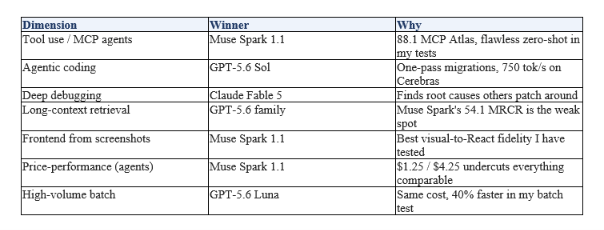
Hot take: Meta just did to agent pricing what it did to social apps, copied the category leader's feature set and made it effectively free. At $4.25 output, running a Muse Spark agent costs a seventh of running the same agent on Sol. OpenAI and Anthropic can ignore that for a quarter, not for a year.
The budget end of this fight is just as interesting: our GLM-5.2 vs Claude vs GPT-5.6 coding comparison covers the open-weight challengers pressing the same price argument from below.
Verdict: Who Should Use Muse Spark 1.1?
Use Muse Spark 1.1 if you are building tool-heavy agents, MCP-based stacks, or multimodal frontend workflows, and your users are in the US. Skip it if your workload is deep backend coding, retrieval across very long documents, or anything that needs EU availability or production SLAs today.
My scorecard: 8.5/10. Points earned for the best tool-use behavior on the market, honest failure reporting, fearless pricing, and the biggest three-month improvement I have seen from any lab this year (48.1 to 67.0 pass@1 on Meta's hardest suite). Points deducted for the MRCR long-context weakness, second-tier backend coding, preview-grade documentation, and the closed-weight reversal that Meta still has not honestly reckoned with in public.
Who should wait: teams that need EU access, anyone whose agents run unattended against irreversible actions (the computer-use ceiling is real), and builders who require a model card and documented rate limits before legal will sign off. None of those are model-quality problems. All of them are preview-maturity problems, and Meta can fix every one of them by September if it wants this API taken seriously.
The bigger picture: three months ago Muse Spark was a curiosity with a great health benchmark. Today Meta Superintelligence Labs has a frontier-cluster model, a real developer API, and the most aggressive pricing in the market. Whatever you think of the closed-weights turn, Alexandr Wang's lab is now shipping at the pace of the big three, and July 9, 2026 will be remembered as the day the frontier became a four-way race.
We will fold Muse Spark 1.1 into the next monthly AI model leaderboard update at the end of July, with head-to-head agent evals against GPT-5.6 Sol and Fable 5.
Frequently Asked Questions
What is Meta Muse Spark 1.1?
Muse Spark 1.1 is a multimodal reasoning model for agentic tasks, released by Meta Superintelligence Labs on July 9, 2026. It accepts text, image, video, audio, and PDF inputs, outputs text, has a 1 million token context window, and specializes in tool use, MCP integration, and computer use.
How much does Muse Spark 1.1 cost?
Through the Meta Model API, Muse Spark 1.1 costs $1.25 per million input tokens and $4.25 per million output tokens, with $20 in free credits for new accounts. Consumers can use it free in the Meta AI app via Thinking mode.
Is Muse Spark 1.1 better than GPT-5.6?
It depends on the workload. Muse Spark 1.1 leads on tool use (88.1 on MCP Atlas) and costs far less, while GPT-5.6 Sol is stronger on agentic coding, long-context retrieval, and raw speed. In my testing, Muse Spark won the MCP agent tasks and GPT-5.6 won the coding tasks.
Is Muse Spark open source?
No. Muse Spark 1.1 is proprietary and closed-weight, with no downloads, local deployment, or fine-tuning. This continues the strategy shift Meta began with the original Muse Spark in April 2026, moving away from the open-weight Llama approach.
What is the Meta Model API?
The Meta Model API is Meta's developer platform for accessing Muse Spark models, launched in public preview on July 9, 2026 for US developers. It is wire-compatible with the OpenAI and Anthropic SDKs and supports structured output, parallel tool calling, a Files API, prompt caching, and web search.
How big is the Muse Spark 1.1 context window?
1 million tokens (1,048,576 in the API documentation), with active context management that compacts long sessions automatically. Note that its long-context retrieval score (54.1 on MRCR) trails GPT-5.5's 74.0, so retrieval quality inside the window lags the headline size.
What changed between Muse Spark 1.0 and 1.1?
Muse Spark 1.1 jumped from 48.1% to 67.0% pass@1 on Meta's internal atomic suite, added computer use, zero-shot MCP generalization, parallel subagent orchestration, and context compaction, and launched alongside the paid Meta Model API. The health strengths and multimodal input stack carry over from 1.0.
Recommended Blogs
● GPT-5.6 Sol Terra Luna review
Resources and Community
Join our community of 70,000+ AI enthusiasts and learn to build powerful AI applications. Whether you are a beginner or an experienced developer, Build Fast with AI helps you understand and implement AI in your projects.
● Website
● Instagram (@buildfastwithai)
● BFWAI Twitter (@BuildFastWithAI)
Agentic AI Launchpad 2026
A structured 6-week cohort program that takes you from AI basics to building and deploying real-world agentic AI systems. Includes live sessions, expert mentorship, project reviews, and a builder community network.
Ready to go from learning to building? Join the next cohort: Agentic AI Launchpad 2026
Free AI Resources
Access free tools, workshops, and micro-learning to keep building:
Enjoyed this review? Follow Build Fast with AI for hands-on coverage of every major model launch, and subscribe so the July leaderboard update lands in your inbox.
References
● Muse Spark 1.1 evaluation report (Meta)
● Muse Spark 1.1 release (MarkTechPost)
● Agentic model overview (DataCamp)
● Meta AI push under Wang (Fortune)
● Benchmarks and evals (Kingy)

