

Meta Incognito Chat: WhatsApp's New Private AI — What It Is and Whether to Trust It
On May 13, 2026, Meta launched Incognito Chat with Meta AI — the first consumer AI product from a major tech company claiming that not even the company itself can read your conversations. The feature runs inside WhatsApp and the standalone Meta AI app, built on Private Processing technology that uses Trusted Execution Environments to process your prompts in an isolated hardware enclave that Meta's engineers, logging systems, and advertising infrastructure cannot access.
The announcement is technically ambitious and commercially strategic in equal measure. Technically, it extends the same end-to-end encryption architecture that made WhatsApp the world's largest private messaging app into AI interactions — something no other major AI provider has done at this scale. Commercially, it directly addresses the single biggest objection users have to sharing sensitive personal, health, or financial questions with AI: the company is watching.
But Meta is Meta. The company that paid $725 million over the Cambridge Analytica scandal and $1.4 billion in Texas for biometric data misuse is now asking you to believe that its AI cannot see your messages. The technical claim is more credible than it might sound. The trust gap it has to overcome is also more real than most launch coverage acknowledges.
This is the full analysis: what Incognito Chat is, exactly how the technical architecture works, what the legitimate skepticism is grounded in, how it compares to alternatives, and what it means for developers building private AI systems
What Is Meta Incognito Chat?
Meta Incognito Chat is a private AI conversation mode launched on May 13, 2026, that lets WhatsApp users interact with Meta AI in a temporary, server-invisible session. Conversations are processed inside a secure Trusted Execution Environment (TEE) that Meta's own infrastructure cannot access, disappear by default when the session ends, and are not used for ad targeting or AI training.
"Chatting with AI has quickly become a critical part of how people get information and ask important questions," Meta said in the launch announcement. "These questions can be deeply sensitive or personal, like health issues, loan details, or career advice." That framing captures the core use case: there are questions you want answered by an AI but would not ask if you knew a company with Meta's data practices was reading your query and adding it to a behavioral profile.
The key distinction Meta draws is sharper than the typical "incognito mode" offered by other AI platforms. Other chatbots that offer incognito or temporary sessions still process your prompts on servers their engineers can access — they just don't store the conversation history in your account. Meta's claim is stronger: the prompt never becomes visible to Meta's systems at all, because it is processed inside a hardware-enforced isolated enclave.
The feature is rolling out on WhatsApp and the Meta AI app over the coming months, starting May 13, 2026. Availability is gradual, so you may not see it yet depending on your region and app version.
This launch is part of Meta's broader pivot toward building trust in its AI ecosystem. The same week Incognito Chat launched, Meta's Muse Spark model — Meta Superintelligence Labs' first proprietary model — was positioned by Zuckerberg as "the first lab to deliver truly private AI." These two launches together signal a coherent strategy: Meta wants AI trust to be a competitive advantage, not a liability.
How Private Processing and TEE Architecture Actually Work
The technical architecture behind Incognito Chat is Private Processing — a confidential computing system Meta built specifically for WhatsApp that runs AI models inside Trusted Execution Environments on its own servers, but in a way that prevents Meta from seeing the data being processed.
Understanding what this means requires understanding what a TEE is. A Trusted Execution Environment is a hardware-enforced isolated region inside a processor — sometimes called a "secure enclave" or "digital cleanroom." Code and data inside the TEE are encrypted and inaccessible to the operating system, the hypervisor, and any system software running outside it. Even if someone compromised Meta's servers at the OS or hardware level, they could not read data inside the TEE while it is processing.
Meta's Private Processing implementation uses AMD SEV-SNP confidential virtual machines and NVIDIA H100 GPUs running in confidential computing mode. The end-to-end flow works like this:
Step 1: Authentication and anonymous routing
When you initiate an Incognito Chat, your WhatsApp client obtains anonymous credentials verifying you are an authentic client. The request is then routed through Oblivious HTTP (OHTTP) — a protocol that routes your traffic through a third-party relay, hiding your IP address from Meta's infrastructure. Even at the network level, Meta cannot link the request to your identity.
Step 2: Encrypted entry into the TEE
Your message is already end-to-end encrypted at the WhatsApp layer. A Remote Attestation + TLS (RA-TLS) session is established between your device and the TEE. Your device's WhatsApp client can cryptographically verify it is talking to a genuine, unmodified TEE running approved code — not a spoofed environment or a logging proxy. The message is decrypted inside the enclave using a key that only your device and the TEE know.
Step 3: Processing with no external exposure
Inside the enclave, the Meta AI model processes your prompt and generates a response. Nothing inside this processing step is accessible to Meta's engineers, logging systems, or commercial data pipelines. The contents cannot be read from outside the TEE during execution.
Step 4: Stateless response and erasure
The system is stateless by design — conversations are not persistently stored inside the processing environment. To support multi-turn chats (where the AI remembers what you said earlier in the same session), conversation context is sent from your device with each new request rather than retained server-side. Once your session ends, there is nothing on Meta's servers to retrieve. Even a subsequent legal demand for the conversation history would return nothing, because it does not exist.
The response travels back to your device encrypted, is decrypted locally, and you see the answer. Meta publishes a technical whitepaper detailing the cryptographic architecture and has committed to making auditable artifacts available to eligible security researchers.
What You Can and Cannot Do in Incognito Chat
Incognito Chat at launch has one significant limitation: it is text-only. You cannot upload images, share documents, or use any media in an Incognito Chat session. WhatsApp head Will Cathcart confirmed this in the launch briefing — the image-processing pipeline is not yet compatible with the Private Processing enclave architecture.
What Incognito Chat supports:
- Text-based conversations with Meta AI on any topic
- Sensitive personal questions (health, legal, financial) without data retention
- Multi-turn conversations within a session (context sent from device per turn)
- Meta AI's full language capabilities including analysis, writing, and advice
- Safety guardrails — the AI still refuses harmful requests
What Incognito Chat does not support (at launch):
- Image uploads or visual input
- Persistent conversation history (sessions do not save)
- Access to your existing Meta AI chat history
- Web browsing or tool use by Meta AI
- Enterprise or API access (consumer product only at launch)
The upcoming Side Chat feature will extend Private Processing to in-conversation AI help — letting Meta AI assist you within any WhatsApp chat, with context of what is being discussed, but keeping the AI responses invisible to other participants. This will also be text-only initially and is expected in the coming months without a specific date.
The Trust Question: Is Meta's Privacy Promise Credible?
This is the hardest part of the Incognito Chat story to assess fairly. The technology is sound. The track record is not. Both things are true simultaneously, and they create a genuine dilemma for anyone evaluating whether to use the feature.
The case for technical credibility
TEE-based confidential computing is not marketing language — it is a mature, audited technology used by Apple's Private Cloud Compute, Google's Confidential Computing services, and the hyperscalers for sensitive enterprise workloads. The architecture Meta has published for Private Processing includes AMD SEV-SNP and NVIDIA H100 confidential computing support, Oblivious HTTP routing, remote attestation for cryptographic verification, and a stateless design that does not retain conversation data. These are real engineering decisions with verifiable security properties.
The whitepaper is available for external review, and Meta has invited independent security researchers to audit and verify the architecture. Windscribe and other critics called this "marketing word soup," but that framing misses the technical specificity of what Meta has published. The system is more credible than a simple claim of "we do not look at your data" — it is architecturally designed to make looking at user data technically impossible while processing occurs.
The legitimate skepticism
Three categories of concern are real and not yet fully resolved.
First: implementation versus specification. A whitepaper describes the intended design. Whether the deployed production system faithfully implements the specification — without logging side-channels, undisclosed exceptions, or edge-case behaviors that leak data — is a separate question that requires ongoing independent audit, not one-time review. Meta has promised auditor access, but the first round of independent results is not yet published.
Second: the legal vector. The stateless design is a genuine protection against internal data misuse. It is not a complete protection against legal demands. If a court issues a subpoena for Incognito Chat conversations, Meta's engineers cannot produce them because they do not exist server-side. However, users' device-side copies may still be subpoenable, and the legal limits of TEE-based systems under court order have not been tested in US federal courts.
Third: trust debt. Meta has paid $725 million over Cambridge Analytica, $1.4 billion in Texas for biometric data misuse, faced FTC action over Instagram data practices, and launched this feature in the same week its own US employees were protesting new internal mouse-tracking software. The company's stated privacy intentions and its demonstrated behavior have diverged enough times that skepticism is not irrational — it is earned.
The most honest framing: Incognito Chat is technically the most credible privacy-preserving AI product Meta has shipped. It is not the same as trusting Meta with your data permanently. Using it for sensitive one-off questions you would not otherwise ask any AI — that use case is plausible. Assuming it means Meta has resolved its broader privacy relationship with your data — that requires more evidence than a single product launch.
For the broader context of how Meta's AI strategy has been evolving in 2026 — including the April Muse Spark launch and what Meta's shift to proprietary AI means for the open-source community — the latest AI models April 2026 guide covers the full strategic picture.
How to Enable Incognito Chat on WhatsApp
Incognito Chat is rolling out gradually starting May 13, 2026. If you already see Meta AI in your WhatsApp, here is how to find the Incognito Chat option when it reaches your account:
- Update WhatsApp to the latest version from the App Store or Google Play
- Open WhatsApp and tap on the Meta AI chat (the blue circle icon or the AI tab)
- Look for a new "Incognito Chat" option in the conversation interface — typically accessible via a toggle or a dedicated chat type selector
- Start a new session — your existing Meta AI chat history will not carry over into Incognito Chat
- When you close the Incognito Chat session, the conversation disappears by default
The feature requires the Meta AI integration to be active on your WhatsApp account, which depends on your country and account settings. WhatsApp has expanded Meta AI availability significantly in 2025-2026, but some regions remain excluded due to regulatory requirements, particularly in the European Union where data protection rules create compliance complexity for Meta's AI features.
The Meta AI app will also receive Incognito Chat on the same rollout timeline. If you use Meta AI via the standalone app rather than WhatsApp, the same toggle-based access applies — look for the incognito option in the conversation header or settings.
Meta Incognito Chat vs the Competition: ChatGPT, Claude, Signal
Meta's pointed claim at launch — "other apps have introduced incognito-style modes, but they can still see the questions coming in and the answers going out" — is correct as of May 2026. Here is the honest comparison:
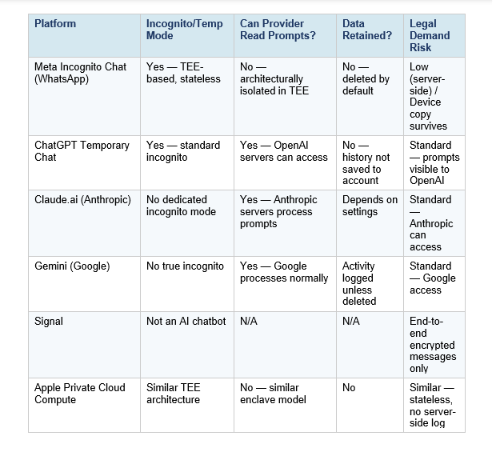
The closest architectural parallel to Meta's implementation is Apple's Private Cloud Compute, which uses a similar TEE-based model for processing Siri and Apple Intelligence requests off-device while keeping Apple unable to read the content. Apple has similarly published technical documentation and invited independent auditors. The key difference: Apple's track record on privacy is substantially cleaner than Meta's, which affects how skeptically users evaluate identical technical claims from the two companies.
Signal is worth clarifying: it is not an AI chatbot and does not provide AI capabilities. It is the privacy baseline for encrypted messaging. If your threat model is government surveillance of messages to other people, Signal is the right answer. If your threat model is whether an AI company can read your questions to its model, Incognito Chat is addressing a different and newer problem.
For a full comparison of where Meta AI's Muse Spark model stands against ChatGPT, Claude, and Gemini on benchmarks and capabilities — separate from the privacy question — the best AI models comparison for April 2026 has the full benchmark breakdown.
What's Coming Next: Side Chat and the Private Processing Roadmap
Incognito Chat is the first consumer-facing product built on Private Processing, but Meta has announced the architecture will expand to more WhatsApp features over the coming months.
Side Chat with Meta AI is the next confirmed feature. It will let you get private AI assistance within any existing WhatsApp conversation — the AI will have context of the ongoing chat, can help you respond, summarize, or answer questions, and its responses will be visible only to you, not the other participants. This adds a new dimension to AI-assisted messaging that no other platform currently offers: genuinely private AI assistance inside a group or one-on-one conversation.
The privacy architecture is the same — Private Processing, TEE-based, stateless, no server-side retention. The additional complexity is that the AI needs context from the ongoing conversation to be useful, which raises its own design challenges around how much context is sent and how that context is handled inside the enclave.
Beyond Side Chat, Meta has described Private Processing as a platform rather than a feature — infrastructure that can support future AI capabilities on WhatsApp and potentially other Meta platforms. The pattern being established: any Meta AI feature that processes sensitive content can route through Private Processing rather than standard inference infrastructure, giving users a privacy-preserving option at launch rather than as an afterthought.
For developers thinking about how to implement similar TEE-based privacy patterns in their own AI applications, the Build Fast with AI gen-ai-experiments cookbook covers API patterns and agentic workflows that can be adapted for privacy-sensitive AI use cases.
What This Means for Developers Building Private AI
The Incognito Chat launch is not just a consumer product — it is a signal about where enterprise and developer expectations for AI privacy are heading. Cameron Dennis, who analyzed the technical launch on X, described it plainly: "TEE-powered Incognito Mode for AI will become table stakes for all labs."
He is right. As AI assistants handle increasingly sensitive questions — healthcare decisions, legal advice, financial planning, confidential business strategy — the absence of verifiable privacy guarantees will become a competitive disadvantage for AI providers. Meta has bet that being first to credibly solve this at scale (2+ billion WhatsApp users) creates a durable moat in the consumer AI market.
For developers, three implications stand out:
1. Confidential computing infrastructure will be expected, not optional
The technical standards Meta has published for Private Processing — TEE-based enclaves, OHTTP for metadata protection, remote attestation for verifiability, stateless design — are going to become the baseline specification for "private AI." OpenAI, Anthropic, and Google will face pressure to match this architecture for sensitive-use AI products. Teams building enterprise AI for healthcare, legal, or financial verticals should evaluate whether their current inference infrastructure can support this model.
2. Stateless AI design has real product implications
The stateless architecture — where context is sent from the device each turn rather than retained server-side — removes personalization and memory as default behaviors. This is not just a privacy design, it is an engineering constraint that affects how you build multi-turn AI features. If you are designing a private AI product, building context management on the client side rather than the server side changes your architecture significantly. Meta's whitepaper is a useful reference for the tradeoffs.
3. Trust is now a product feature, not just a marketing statement
Meta has published its cryptographic architecture, invited external auditors, and built verifiability into the design through remote attestation. This is a higher standard than "we promise not to look at your data." For any AI product asking users to share sensitive information, the ability to verify privacy claims independently is becoming a product requirement. Developers building AI for enterprise or regulated industries should read Meta's whitepaper as a model for what "verifiable privacy" looks like in practice.
For a full landscape view of how AI security and privacy tools are evolving in 2026 — including code scanning and vulnerability detection — the Claude Security AI code scanner guide covers how AI is being applied to both building and securing software systems.
Frequently Asked Questions
What is Meta Incognito Chat?
Meta Incognito Chat is a private AI conversation mode launched on May 13, 2026, for WhatsApp and the Meta AI app. Conversations are processed inside a Trusted Execution Environment (TEE) that Meta cannot access, disappear by default when sessions end, and are not used for advertising or AI training. It is built on Meta's Private Processing technology.
Can Meta actually not read Incognito Chat conversations?
By architectural design, no. The TEE processes your prompts in a hardware-isolated enclave that Meta's engineers, logging systems, and infrastructure cannot read during processing. The stateless design means no server-side record is retained after the session. Meta has published technical documentation for independent verification, and the system uses AMD SEV-SNP and NVIDIA H100 confidential computing hardware to enforce the isolation. Whether the deployed production system faithfully matches the specification requires ongoing independent audit, which is still in progress.
How is Incognito Chat different from ChatGPT's temporary chat?
ChatGPT's temporary mode stops saving your conversation history to your account, but OpenAI's servers still process your prompts normally and engineers have access. Meta's Incognito Chat uses a TEE-based architecture where the prompts are processed in an enclave that Meta itself cannot read. This is architecturally different — not just a data retention policy change, but a system designed to technically prevent provider access during processing.
Is Incognito Chat available in my country?
Incognito Chat is rolling out gradually starting May 13, 2026. Availability depends on your region and app version. Meta AI availability on WhatsApp is already limited in some regions — notably the EU, where data protection regulations create compliance complexity. Check for the incognito option in your WhatsApp Meta AI chat after updating to the latest app version.
Does Incognito Chat support images or file uploads?
No. At launch, Incognito Chat is text-only. Image uploads are not supported because the image-processing pipeline is not yet integrated with the Private Processing TEE architecture. WhatsApp head Will Cathcart confirmed this limitation at launch. Image support is expected in future updates but no timeline has been given.
What happens to Incognito Chat if Meta receives a government subpoena?
Because Incognito Chat is stateless and conversations are not retained server-side, Meta cannot produce conversation content in response to a subpoena — there is nothing to retrieve. However, conversation context may exist on your device during an active session, and device-side copies could potentially be accessible through device seizure or device-level legal orders. The TEE protects server-side data; it does not change the legal status of data on your own device.
What is Private Processing and how is it different from end-to-end encryption?
End-to-end encryption protects messages between users in transit — WhatsApp already uses this for person-to-person chats. Private Processing is a different problem: AI processing requires that something can actually read your message to generate a response. Traditional AI runs this on accessible servers. Private Processing runs it inside a TEE — a hardware-isolated enclave — where the AI model can process your message but the contents are not accessible to Meta's infrastructure. It extends the privacy guarantee from "only the other person can read it" to "no server-side system can read it, even while generating a response."
Is Meta Incognito Chat the same as Signal for privacy?
They address different threats. Signal protects communications between people using end-to-end encryption — the strongest protection against interception and surveillance of person-to-person messages. Meta Incognito Chat addresses the specific problem of AI processing: if you want to ask an AI assistant a sensitive question without the AI company reading it, Meta's TEE architecture provides a verifiable technical guarantee. Signal does not offer AI assistance. The right choice depends on what you are trying to protect and from whom.
Recommended Blogs
- Meta Muse Spark: Benchmarks, Review & Comparison (2026)
- Every AI Model Compared: Best One Per Task (2026)
- Best AI Models April 2026: GPT-5.5, Claude & Gemini Compared
- Latest AI Models April 2026: Rankings & Features
- Claude Security: AI Code Scanner vs Snyk (2026)
- Best AI Models Leaderboard: April 2026 Update
Want to learn to build AI systems with production-grade privacy and security considerations? Join the Gen AI Launchpad 8-week program — hands-on, project-based, with 12,000+ developers building real AI products.
References
- Meta Newsroom — Introducing a Completely Private Way to Chat With AI
- WhatsApp Blog — Introducing Incognito Chat with Meta AI
- Meta Engineering — Building Private Processing for AI Tools on WhatsApp
- Meta AI — Private Processing for WhatsApp Technical Whitepaper
- The Next Web — Meta Launches Incognito Chat, the First AI Mode Meta Cannot Read
- CyberInsider — WhatsApp Launches Incognito Chat for Private AI Conversations
- Help Net Security — WhatsApp Adds Incognito Chat Meta AI
- MacRumors — Meta AI App Gets Incognito Chat as OpenAI Faces Lawsuits
- Reuters / USNews — Meta Launches Incognito Chat for WhatsApp AI
Android Headlines — WhatsApp Gets Incognito Chat Mode for Private Meta AI Conversations

