



On July 8, 2026, OpenAI launched GPT-Live, described as a new generation of voice models that make talking with AI feel much more like having a real conversation. More than 150 million people talk to ChatGPT every week using voice and dictation features. Every single one of them gets a different experience from today. GPT-Live is not an incremental improvement to ChatGPT's Advanced Voice Mode. It is an architectural replacement. Where Advanced Voice Mode was turn-based, processing one side of a conversation at a time, GPT-Live runs on a full-duplex architecture that processes input and output simultaneously. Where Advanced Voice Mode was a single model handling everything, GPT-Live is a two-layer system: a continuous interaction layer that manages the conversation, and a delegation layer that quietly hands complex tasks to GPT-5.5 in the background while keeping you talking. This review covers every confirmed detail from OpenAI's official announcement: the two architectural innovations, what GPT-Live-1 and GPT-Live-1 mini are, the four reasoning tiers, the benchmark comparisons to Advanced Voice Mode, the visual card system, the safety design including teen-specific protections, the current limitations, and what the API access timeline looks like for developers.
1. What Is GPT-Live? The Two-Layer Architecture
GPT-Live is OpenAI's third generation of ChatGPT voice technology, launched July 8, 2026. To understand what makes it different from its predecessors, it helps to understand the three architectural generations that led here.
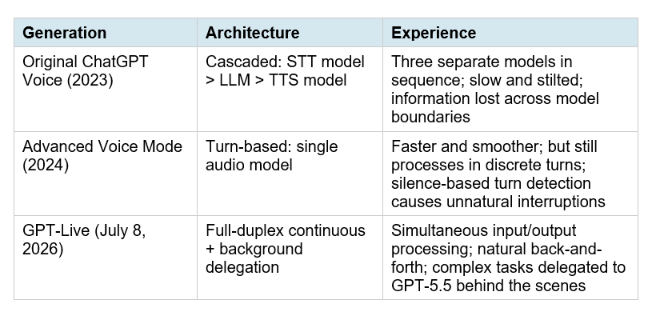
The architectural leap from Advanced Voice Mode to GPT-Live has two distinct components. The first is the move to full-duplex continuous interaction, which changes how the model processes conversation in real time. The second is the delegation layer, which decouples the conversational interface from the intelligence required for complex tasks. Both are required to produce the experience OpenAI describes. Full-duplex alone would produce a more natural conversation; delegation alone would produce smarter answers. Together they produce a voice assistant that feels natural and intelligent simultaneously, without sacrificing either quality for the other.
2. Full-Duplex: What It Is and Why It Changes Everything
Full-duplex is a communications term that means a system can transmit and receive at the same time. A telephone conversation is full-duplex: both parties can speak simultaneously, and the system handles both audio streams at once. A walkie-talkie is half-duplex: only one party can transmit at a time, and you must say 'over' to indicate you have finished. Advanced Voice Mode was half-duplex, even though it was a single audio model rather than a text pipeline. It processed audio in discrete turns: the user speaks, the model listens, the model responds, the user speaks again. The turn-detection mechanism was based on silence: when the user stopped speaking for long enough, the model assumed the turn had ended and began responding. This silence-based detection caused two specific problems: if the user paused to think, the model would interrupt; and in noisy environments, the model might mistakenly detect background noise as the end of a user's turn.
GPT-Live's full-duplex architecture eliminates both problems by making decisions many times per second about what to do: speak, listen, pause, acknowledge, interrupt, or invoke a tool. OpenAI's official announcement describes it precisely: 'Instead of processing a sequence of separate messages, GPT-Live continuously processes input while generating output. The model can therefore make interaction decisions many times per second: whether to speak, continue listening, pause, interrupt, or invoke a tool.'
The practical effects of full-duplex in GPT-Live:
- Active listening acknowledgments: GPT-Live says 'mhmm,' 'yeah,' 'got it,' and similar natural listening cues while you are talking, because it is processing your audio in real time and can respond to it without waiting for you to finish.
- Thinking pauses respected: if you pause to gather your thoughts, GPT-Live waits instead of jumping in. The system can distinguish a thinking pause from the end of a turn because it is continuously processing the audio, not waiting for a silence threshold to trigger.
- User interruption handling: you can interrupt GPT-Live mid-sentence with a question or correction. The model processes your interruption in real time and responds to it without losing the conversational thread.
- Background noise filtering: because GPT-Live is continuously processing audio rather than waiting for silence triggers, it can better distinguish the user's voice from ambient background sounds like traffic and nearby conversations.
- Live translation: the continuous input-output architecture enables real-time translation as a natural capability, since the model can process incoming audio in one language and generate output in another simultaneously.
3. Delegation for Deeper Work: The Background Intelligence Layer
The second architectural innovation in GPT-Live is conceptually simpler but equally important: the separation of the conversational interface from the intelligence required for complex tasks. In Advanced Voice Mode, the voice model was the intelligence. If you asked a question that required web search, the model stopped the conversation to search, processed the results, and then responded. If you asked something that required deep reasoning, the model reasoned before responding. The quality ceiling for complex questions was the voice model's own capability, and the conversational experience was interrupted every time a complex question was asked. GPT-Live decouples these concerns. When a question requires web search, deeper reasoning, or agentic capabilities, GPT-Live delegates the task to GPT-5.5 running in the background. While GPT-5.5 works, GPT-Live continues the conversation. You might ask a complex factual question, GPT-Live might say 'Let me look that up' and then keep talking about something related while GPT-5.5 retrieves the answer, and then GPT-Live naturally incorporates the result when it is ready. The conversation never stops. The intelligence ceiling is no longer the voice model; it is GPT-5.5.
OpenAI's official framing is precise: 'This architectural change also allows GPT-Live to continuously use the latest models and agents, combining frontier intelligence with natural interaction.' The strategic implication is that GPT-Live is not tied to any specific backend model. As OpenAI releases GPT-5.6 Sol/Terra/Luna and future models, GPT-Live's intelligence ceiling rises automatically without requiring a new voice model architecture. At launch, GPT-Live uses GPT-5.5 in the background. Future upgrades will use whatever OpenAI's current frontier model is at the time.
For context on GPT-5.5 as the current backend model, the GPT-5.6 review on Build Fast with AI covers the next-generation Sol/Terra/Luna family that will eventually power GPT-Live's delegation layer. As GPT-5.6 reaches general availability in mid-July 2026, the backend intelligence accessible to GPT-Live conversations will upgrade automatically.
4. GPT-Live-1 and GPT-Live-1 mini: The Two Model Variants
OpenAI launched GPT-Live as two variants: GPT-Live-1 and GPT-Live-1 mini. The naming convention follows the same pattern as GPT-5.5 Instant Mini and other mini-tier releases: the mini variant is faster, more cost-efficient, and capable enough for most voice interactions, while the full variant provides stronger performance on complex conversations.
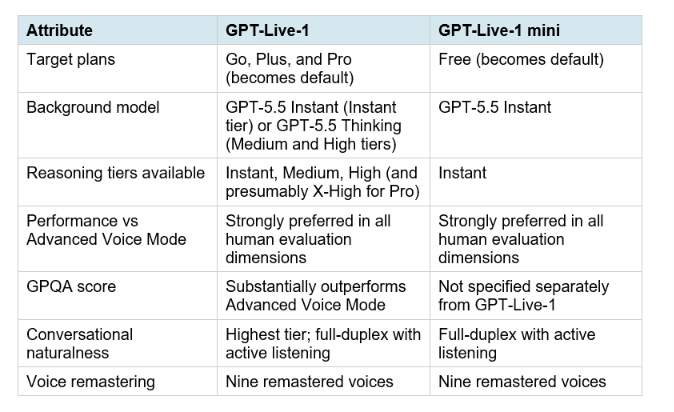
The key distinction: GPT-Live-1 mini gives Free plan users access to the full-duplex architecture and natural conversation quality of the new GPT-Live generation. They do not get the deeper reasoning tiers that Plus and Pro users can access, but they get the conversational experience upgrade, the background noise handling, the active listening acknowledgments, and the visual cards. The core natural conversation improvement is not gated behind a paid plan.
5. The Four Reasoning Tiers Explained
GPT-Live introduces four reasoning tiers that control which background model handles delegation and at what reasoning effort level. This is the most practically important configuration decision for users who want to optimize their GPT-Live experience for specific use cases.
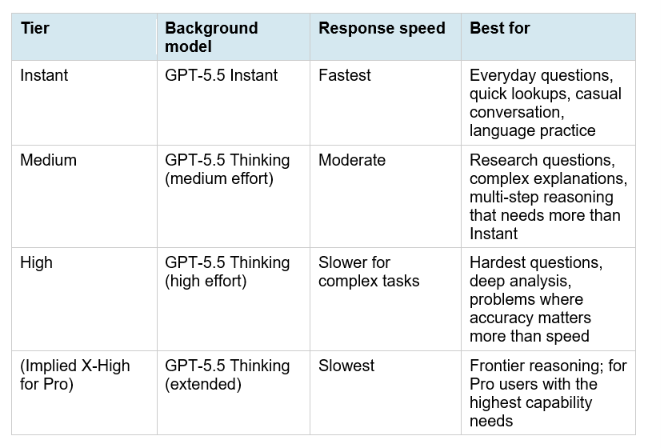
The tier selection happens within the ChatGPT interface before or during a voice conversation. OpenAI's framing: 'You can also choose the level of reasoning that fits your needs: Instant for fast responses, or Medium and High when you want ChatGPT to spend more time thinking.' The delegation architecture means that choosing Medium or High does not slow down the conversational experience. GPT-Live's continuous interaction layer keeps talking while the deeper reasoning happens in the background. You experience the natural conversation at whatever speed the voice model runs at; the reasoning tier only affects the depth and latency of answers to complex questions.
6. Benchmarks: GPT-Live vs Advanced Voice Mode
OpenAI built new human evaluation frameworks specifically for GPT-Live because existing voice benchmarks did not measure the dimensions that matter most in a full-duplex conversational system. The evaluations used matched 5 to 10 minute conversations and measured five dimensions: overall preference, turn-taking quality, interruption handling, conversational flow, and naturalness of interaction.
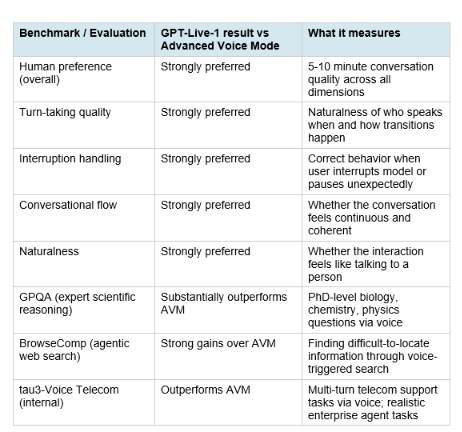
The benchmark picture is unambiguous on the conversational quality dimensions. GPT-Live-1 is strongly preferred over Advanced Voice Mode across every human evaluation measure. The GPQA improvement confirms that the delegation architecture genuinely delivers higher intelligence, not just a more natural conversational wrapper around the same capability. The tau3-Voice Telecom benchmark is the most relevant data point for enterprise voice agent deployments: it shows GPT-Live outperforms Advanced Voice Mode on realistic, multi-turn customer support tasks, which is the commercial deployment scenario most teams are building toward.
7. The New ChatGPT Voice Experience: Four Improvements
OpenAI describes four specific improvements to the ChatGPT Voice experience powered by GPT-Live:
More Natural Conversations
The conversational experience changes in three measurable ways. First, active listening: GPT-Live acknowledges you in real time with 'mhmm,' 'yeah,' 'got it,' and similar phrases while you are speaking, because the full-duplex architecture processes your audio continuously rather than waiting for you to finish. Second, natural pause handling: if you stop mid-sentence to gather your thoughts, GPT-Live waits instead of jumping in. Third, controllable pacing: you can ask ChatGPT to slow down its speech rate and it will adjust within the conversation. Nine existing ChatGPT voices have been remastered specifically for GPT-Live.
Smarter Answers
The delegation architecture means GPT-Live-1 can produce answers that were impossible from a voice model before. When your question requires web search, GPT-Live-1 sends it to GPT-5.5 in the background and incorporates the result into the conversation when it is ready. When your question requires deep reasoning, you can explicitly choose Medium or High reasoning tier to have GPT-5.5 Thinking handle the background work. The ceiling is no longer the voice model itself.
Better Listening
Three specific listening improvements: GPT-Live waits through thinking pauses rather than interrupting. It can be asked to stay quiet and listen, and it will follow that instruction. And it handles background noise better, distinguishing the user's voice from ambient sounds like passing traffic or nearby conversations. All three are products of the full-duplex continuous processing architecture rather than separate features.
Visual Answers at a Glance
While you are talking, ChatGPT can now display rich visual cards alongside the conversation for topics like weather, stocks, sports, and maps. If you ask about the weather in Denver, you see a weather card. If you ask about upcoming football matches, you see a sports schedule. If you ask for nearby locations, you see a map. Voice continues to support all existing capabilities including search, memory, images, and file uploads. The visual cards are not a replacement for voice; they are a companion layer that makes certain categories of information significantly more useful when you can see them alongside the spoken answer.
8. Visual Cards: Seeing While You Speak
The visual card system is the feature in GPT-Live's ChatGPT Voice experience that most directly changes what voice is good for. Before GPT-Live, voice was best for audio-native content: conversation, questions with verbal answers, listening to explanations. Any query that produced information better consumed visually (schedules, maps, weather forecasts, stock prices, sports results) was awkward in a voice-only interface because the answer was read aloud as text. Visual cards solve this by surfacing structured visual displays automatically when the query topic lends itself to a card format. OpenAI explicitly lists the launch categories: weather, stocks, sports, and maps. These four categories cover the most common queries where users are likely to want to see the answer rather than hear it read aloud. The implementation is contextual: you do not have to request a card; the model determines when a card would be more useful than a purely verbal response and displays it automatically.
The strategic significance of visual cards is larger than the feature itself suggests. Voice AI has historically been limited to use cases that can be served entirely through audio. Adding visual cards to voice sessions means GPT-Live is no longer a pure audio interface; it is a combined audio-visual experience where the voice handles the conversation and cards handle the structured data. This is closer to how humans actually communicate with each other, where we readily pull out our phones to show someone a map or a photo while talking. The combination of full-duplex voice and visual cards is the first time a mainstream AI product has genuinely replicated that pattern.
9. Safety: What OpenAI Built for Voice-Specific Risks
Voice introduces safety risks that do not exist in text interfaces, and OpenAI designed GPT-Live's safety layer specifically for this. The official announcement identifies the key risk categories that received expanded voice-native safety testing: self-harm, psychosis and mania, emotional reliance on AI, violence, and sexual content. These are not new categories; they are the same categories from Advanced Voice Mode's safety work. What is new is the testing methodology: audio-native evaluations that test the model's behavior when these topics arise in real-time voice conversations, not just text equivalents.
Real-Time Safeguards
Because voice conversations unfold in real time, OpenAI built safeguards that can act while the model is speaking rather than only after a response is complete. OpenAI's description: 'When the system detects potentially unsafe output, it can steer the model toward a safer response, surface additional safety messaging or resources, or end the voice conversation in higher-risk cases.' This real-time intervention capability is architecturally more difficult in voice than in text because the model is generating audio as a continuous stream, not as a discrete output. The ability to redirect mid-speech or end a session based on detected unsafe content represents meaningful safety engineering specific to the real-time audio domain.
Crisis Support for Self-Harm
For conversations involving self-harm, OpenAI adapted ChatGPT's existing expert-vetted crisis helpline support flows specifically for voice. A user raising self-harm concerns in a voice conversation will receive appropriate crisis resources delivered through the voice interface, not just a text message that a voice user might not see.
Teen-Specific Protections
GPT-Live includes dedicated teen safety features that are notably more specific than in any previous ChatGPT voice release. Three distinct protections: age-appropriate behavior trained directly into the model to reduce risk of inappropriate responses to teenage users; parent control through Parental Controls settings that let parents choose whether their teen can access ChatGPT Voice; and linked parent notification in higher-risk situations involving signs of potential self-harm or suicidal intent. The notification feature is the most significant policy change: it creates a direct safety escalation path from GPT-Live's detection systems to a trusted adult when a teen conversation involves serious risk signals.
Voice Impersonation Prevention
GPT-Live is designed for conversation, not voice cloning. It uses a set of nine predefined voices in ChatGPT with safeguards to prevent imitating a specific real person's voice. This is the same content policy that applies to Realtime API outputs, now extended to GPT-Live's consumer-facing implementation.
10. Availability: Who Gets What and When
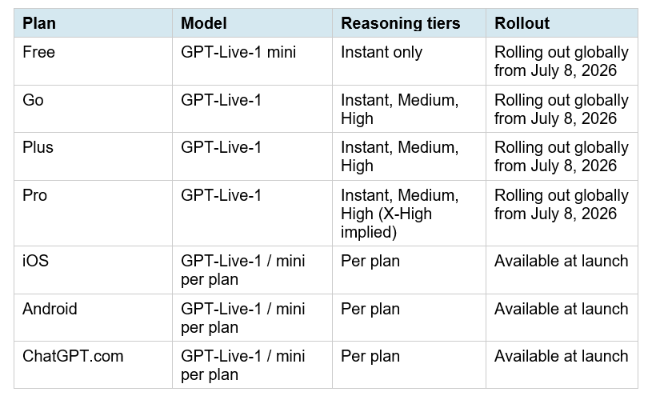
Legacy ChatGPT Voice options (Standard Voice Mode and Advanced Voice Mode) remain available where those features (video, screen sharing) are active. Users who rely on video or screen sharing in voice sessions will need to continue using Advanced Voice Mode until GPT-Live supports those features.
11. Current Limitations
OpenAI is unusually direct about current limitations in the GPT-Live announcement. Five specific limitations are confirmed:
- No video or screen sharing at launch: GPT-Live does not support voice with video or screen sharing in ChatGPT at the July 8 launch. Advanced Voice Mode supports these features. Legacy versions of ChatGPT Voice remain accessible for users who need video or screen sharing.
- Language coverage gaps: GPT-Live has been optimized for the most popular languages in ChatGPT. For certain languages, the model may have a non-native accent or gaps in fluency. OpenAI states they are actively working to improve cross-language quality.
- No API access at launch: GPT-Live-1 and GPT-Live-1 mini are launching to ChatGPT consumer users only. API access is planned and developers can sign up to be notified through a dedicated form at openai.com/form/gpt-live-1-in-the-api.
- Background model locked to GPT-5.5 at launch: the delegation layer uses GPT-5.5 at the July 8 launch. OpenAI states the backend model will be updated as new frontier models are released. GPT-5.6 Sol/Terra/Luna reaching general availability in mid-July will trigger a delegation layer upgrade.
- Emotional reliance monitoring ongoing: OpenAI specifically calls out that post-launch monitoring for emotional reliance patterns is a longer-term measurement project, not something fully resolved at launch. They are rolling out monitoring to identify emerging patterns and refine safeguards over time.
12. Developer Access: API Timeline
GPT-Live is not yet available in the API. OpenAI's announcement is explicit: 'We also plan to bring them to the API soon, and developers and enterprises can sign up to be notified using this form.' The form is at openai.com/form/gpt-live-1-in-the-api. This is a meaningful distinction from the Realtime API, which already provides developer access to voice models including the recently launched GPT-Realtime-2.1 and GPT-Realtime-2.1-mini. GPT-Live and the Realtime API are not the same product. The Realtime API targets developers building custom voice agent applications via WebRTC, WebSocket, or SIP connections. GPT-Live is the consumer ChatGPT Voice experience. When GPT-Live comes to the API, it will likely be a higher-level developer interface compared to the low-level audio streaming of the Realtime API, making it accessible to developers who want the conversational quality of GPT-Live without building the streaming infrastructure themselves.
For developers building production voice agents right now, GPT-Realtime-2.1 is the current API option. The GPT-Realtime-2.1 and 2.1-mini review covers every feature of the current developer voice API, including the 25% p95 latency reduction and configurable reasoning effort that launched alongside GPT-Live on July 7, 2026.
13. GPT-Live vs GPT-Realtime-2.1: Two Different Products
The simultaneous launch of GPT-Live (July 8, 2026) and GPT-Realtime-2.1 (July 7, 2026) creates confusion about how these two products relate. They are architecturally separate products targeting different use cases, and it is worth being precise about the distinction.
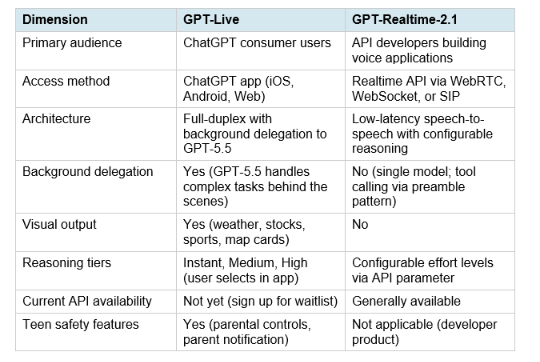
The simplest framing: GPT-Live is what consumer ChatGPT users experience in the app. GPT-Realtime-2.1 is what developers use to build their own voice applications. GPT-Live will come to the API, at which point developers will be able to build applications with GPT-Live's full-duplex architecture and delegation capabilities through an API interface. Until that happens, GPT-Realtime-2.1 is the developer voice product and GPT-Live is the consumer product. For the full GPT-5.5 Instant Mini story that launched the same week as GPT-Live, the GPT-5.5 Instant Mini review covers the parallel consumer ChatGPT model update that happened alongside the GPT-Live launch.
Frequently Asked Questions
What is GPT-Live and how is it different from Advanced Voice Mode?
GPT-Live is OpenAI's third-generation ChatGPT Voice model, launched July 8, 2026. It replaces Advanced Voice Mode as the default voice experience for Go, Plus, and Pro plan users, and GPT-Live-1 mini replaces it as the default for Free users. The two key architectural differences: GPT-Live uses full-duplex continuous processing (can listen and speak simultaneously) instead of turn-based processing (wait for user to stop, then respond), and it delegates complex tasks to GPT-5.5 running in the background while keeping the conversation going. Advanced Voice Mode was a single model handling everything in discrete turns.
What does full-duplex mean in GPT-Live?
Full-duplex means GPT-Live processes audio input and generates audio output at the same time, rather than in sequence. It makes interaction decisions many times per second: whether to speak, listen, pause, acknowledge what you said, interrupt, or invoke a tool. The practical effects are active listening cues ('mhmm,' 'yeah'), respectful handling of thinking pauses rather than jumping in, ability to handle user interruptions naturally, better background noise filtering, and support for live translation. Advanced Voice Mode was turn-based, meaning it waited for you to stop speaking before processing your input.
What are GPT-Live-1 and GPT-Live-1 mini?
GPT-Live-1 is the full-capability variant of GPT-Live, becoming the default for Go, Plus, and Pro plan users. It supports all four reasoning tiers (Instant, Medium, High, and implied X-High for Pro) and uses GPT-5.5 Thinking in the background for Medium and High reasoning requests. GPT-Live-1 mini is the faster, more efficient variant that becomes the default for Free plan users. It supports the Instant reasoning tier only with GPT-5.5 Instant in the background. Both variants use the same full-duplex architecture and provide the natural conversational experience improvements over Advanced Voice Mode.
How does GPT-Live delegate to GPT-5.5 for complex tasks?
When a question in a GPT-Live conversation requires web search, deeper reasoning, or agentic capabilities, GPT-Live sends the task to GPT-5.5 running in the background. While GPT-5.5 works on the answer, GPT-Live's continuous interaction layer keeps the conversation going. When GPT-5.5 completes the task, GPT-Live incorporates the result naturally into the conversation. The user experiences no gap or pause; the conversation continues seamlessly while the intelligent work happens behind the scenes. At launch, the backend model is GPT-5.5; OpenAI will update it as newer frontier models are released.
Is GPT-Live available via the API?
No. At launch on July 8, 2026, GPT-Live is available only through the ChatGPT consumer interface on iOS, Android, and ChatGPT.com. API access is planned and developers can sign up to be notified at openai.com/form/gpt-live-1-in-the-api. For developers who need voice agent API access now, GPT-Realtime-2.1 is available in the Realtime API via WebRTC, WebSocket, or SIP connections.
Which ChatGPT plans get GPT-Live?
All ChatGPT plans get GPT-Live from July 8, 2026. Free plan users receive GPT-Live-1 mini as the default voice experience. Go, Plus, and Pro plan users receive GPT-Live-1 as the default. The reasoning tiers differ by plan: Free users get Instant only. Go, Plus, and Pro users can choose Instant, Medium, or High reasoning effort. Pro users may have access to additional extended reasoning.
What safety features does GPT-Live have?
GPT-Live includes: expanded audio-native safety evaluations covering self-harm, psychosis, mania, emotional reliance on AI, violence, and sexual content; real-time safeguards that can steer, add safety messaging, or end a conversation while the model is speaking; voice-adapted crisis helpline support for self-harm conversations; age-appropriate behavior trained into the model for teen users; parental controls that let parents enable or disable ChatGPT Voice for their teen; and linked parent notification in higher-risk situations involving potential self-harm or suicidal intent. The model also has safeguards to prevent imitating real people's voices.
What does GPT-Live not support at launch?
Two specific limitations at the July 8, 2026 launch: no video or screen sharing in voice sessions (Advanced Voice Mode still supports these; users can switch to legacy voice for these features), and no API access (developers can sign up for a waitlist). GPT-Live has also been optimized for the most popular ChatGPT languages, with potential accent or fluency gaps in less common languages that OpenAI is working to improve.
Recommended Blogs
- GPT-5.6 Review: Sol, Terra, Luna Features, Benchmarks, and Pricing
- GPT-Realtime-2.1 and 2.1-mini Review: OpenAI's Voice Agent Upgrade (July 2026)
- GPT-5.5 Instant Mini Review: ChatGPT's New Fallback Model Explained (July 2026)
- Best AI Models of July 2026: Full Ranking by Use Case, Benchmarks, and Price
- 7 AI Tools That Changed Developer Workflow (August 2026)
- GPT and OpenAI Ecosystem Collection: Every OpenAI Model and Feature Update
Resources & Community
Join our community of 70,000+ AI enthusiasts and learn to build powerful AI applications! Whether you're a beginner or an experienced developer, Build Fast with AI helps you understand and implement AI in your projects.
- Website: buildfastwithai.com
- LinkedIn: Build Fast with AI
- Instagram: @buildfastwithai
- Founder Twitter: @satvikps
- Twitter: @BuildFastWithAI
Agentic AI Launchpad 2026
A structured 6-week cohort program that takes you from AI basics to building and deploying real-world agentic AI systems. Includes live sessions, expert mentorship, project reviews, and a builder community network.
Ready to go from learning to building? Join the next cohort: Agentic AI Launchpad 2026
Free AI Resources
Access free tools, workshops, and micro-learning to keep building:
- AI Workshops: Free resources, upcoming events and past recordings
- Unrot: Learn AI in 5 minutes a day (free micro-learning app)
OpenAI is shipping voice AI improvements fast. Follow @BuildFastWithAI on X to stay ahead of every GPT-Live API update, reasoning tier expansion, and ChatGPT Voice feature launch that matters for developers and users in 2026.
References
- OpenAI: Introducing GPT-Live (official announcement, July 8, 2026)
- OpenAI: GPT-Live System Card (deployment safety hub)
- OpenAI: ChatGPT Voice Help Center (availability details)
- OpenAI: GPT-Live API Waitlist Form
- OpenAI: Strengthening ChatGPT Responses in Sensitive Conversations (emotional reliance context)
- OpenAI: Hello GPT-4o (original Advanced Voice Mode announcement for comparison context)
- OpenAI: ChatGPT Can Now See, Hear and Speak (original cascaded voice launch for comparison context)
OpenAI: Affective Use and Emotional Well-Being Research (emotional reliance monitoring context)

