


GPT-5.5 Instant Mini: ChatGPT's New Fallback Model Explained (July 2026)
In early July 2026, OpenAI quietly rolled out GPT-5.5 Instant Mini as the new fallback model in ChatGPT. It does not appear in the model picker. Most users will never select it deliberately. But it is the model that hundreds of millions of ChatGPT users receive when they hit rate limits on GPT-5.5 Instant or Auto, which means it is the model that answers more questions for more people than almost any other model in the OpenAI lineup. The fallback model is not a throwaway tier. It is the last defense against a user hitting a rate limit, getting a degraded response, and churning. OpenAI knows this, which is why the upgrade from GPT-5.3 Instant Mini to GPT-5.5 Instant Mini is a deliberate quality improvement across three specific dimensions: intent tracking across multi-turn conversations, tone calibration to match the conversational context, and factual accuracy. It ships at the same cost as its predecessor for API users and adds no charge to consumer plans. This review covers what GPT-5.5 Instant Mini actually is, how it compares to the full GPT-5.5 Instant model, what the three specific improvements mean in practice, the role of the fallback model in OpenAI's broader ChatGPT architecture, what this means for developers building on the API, and the complete GPT model family picture as of July 2026.
1. What Is GPT-5.5 Instant Mini?
GPT-5.5 Instant Mini is OpenAI's updated fallback model for ChatGPT, rolled out in early July 2026. It replaces GPT-5.3 Instant Mini in that role. The word 'Mini' in this context does not refer to a publicly selectable model variant like GPT-5.4 mini in the reasoning model lineup. It refers to a smaller, more efficient distillation of the GPT-5.5 generation that is specifically optimized for low-latency, cost-efficient responses in the fallback context, where users have already exhausted their primary model allocation. The model is invisible to users in the normal flow of ChatGPT. It does not appear in the model picker under any plan. Users can select GPT-5.5 Instant, Auto, and reasoning models from the picker; they cannot select GPT-5.5 Instant Mini. When a user hits the rate limit on GPT-5.5 Instant or when Auto routing falls through due to capacity constraints, the conversation continues on GPT-5.5 Instant Mini without interruption, with a notification that the model has changed.
What it is not: GPT-5.5 Instant Mini is not a reduced-intelligence placeholder that users are supposed to notice and find frustrating. OpenAI's approach has been to make the fallback model good enough that most users in most conversations do not perceive a meaningful quality drop. The three improvements in the July 2026 update (intent tracking, tone calibration, factual accuracy) are precisely calibrated to address the specific failure modes that are most noticeable when a user is mid-conversation and the model switches.
2. The Fallback Model Architecture: Why It Exists and Why It Matters
Every major AI consumer product needs a graceful degradation path. When millions of users simultaneously try to use a high-quality frontier model, capacity constraints mean not everyone can get the primary model at the same time. The choices are: queue the user and make them wait, reject the request entirely, silently serve worse output without disclosure, or route to a purpose-built fallback model that maintains quality within capacity constraints. OpenAI chose the fourth option. The fallback model is specifically important because it is the model that most frequently serves the highest-volume users. People who hit rate limits on GPT-5.5 Instant are, by definition, people who use ChatGPT intensively. They send many messages, they engage in long conversations, and they have expectations about quality formed by the full model. When the fallback model degrades significantly from the primary model, those power users notice and complain. When the fallback model is close enough to the primary that the difference is subtle, the degradation experience is tolerable.
The predecessor GPT-5.3 Instant Mini had documented weaknesses on exactly the dimensions that matter most in the fallback context: it struggled to track intent that had evolved across multiple turns in a long conversation (because users who hit rate limits are typically in the middle of multi-turn sessions), it could miscalibrate tone when switching into a conversation that had established a specific register with the primary model, and it had higher factual error rates that were noticeable precisely because users were comparing to the primary model's recent outputs in the same conversation. GPT-5.5 Instant Mini addresses all three. For the full picture of the July 2026 ChatGPT model lineup including GPT-5.6 Sol/Terra/Luna in preview, the best AI models July 2026 guide covers the complete hierarchy.
3. What Changed: Three Specific Improvements Over GPT-5.3 Instant Mini
OpenAI explicitly documents three improvements in GPT-5.5 Instant Mini over GPT-5.3 Instant Mini. Each one is worth understanding precisely because each one addresses a specific failure mode in the fallback context:
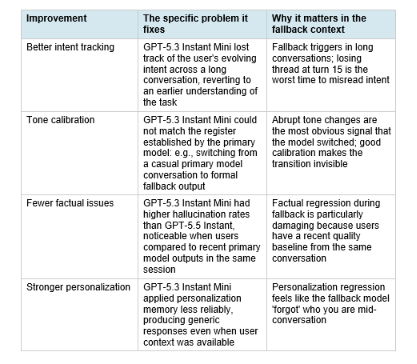
The framing across all four improvements points to the same root concern: seamlessness. A fallback model that users can detect because it behaves differently from the primary model damages trust in the product. A fallback model that maintains the conversation's context, register, and factual standard invisibly is product engineering done right.
4. GPT-5.5 Instant Mini vs GPT-5.5 Instant: The Capability Gap
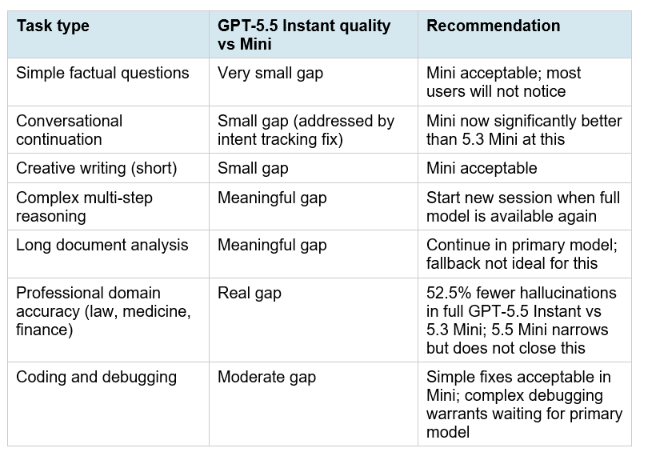
The honest picture: GPT-5.5 Instant Mini is not GPT-5.5 Instant. It is a smaller, more efficient model distilled from the GPT-5.5 generation to optimize for the fallback use case. The capability gap is real and OpenAI does not pretend otherwise by offering the fallback as a selectable alternative to the primary model. The gap matters most on: complex multi-step reasoning tasks (where the Mini tier's reasoning depth is lower), tasks that require sustained attention over very long contexts (where the full model's context handling is stronger), and specialized professional domains where fine-grained accuracy is critical. The gap is smallest on: everyday conversational tasks (greetings, simple questions, short factual lookups), creative writing that does not require frontier-level reasoning, and instruction-following on well-scoped, single-turn requests. These are also the tasks that dominate the tail end of long ChatGPT sessions, when users are wrapping up or transitioning between topics. The fallback model hitting these tasks is not a meaningful quality regression.
For context on how GPT-5.5 Instant compares to competing models at the frontier level including Claude Sonnet 5 and Claude Fable 5, the Claude Fable 5 vs Claude Sonnet 5 comparison covers the cross-vendor benchmark landscape that frames where GPT-5.5 Instant sits competitively.
5. The ChatGPT Model Hierarchy in July 2026
Understanding GPT-5.5 Instant Mini requires understanding where it sits in the complete ChatGPT model architecture as of July 2026:
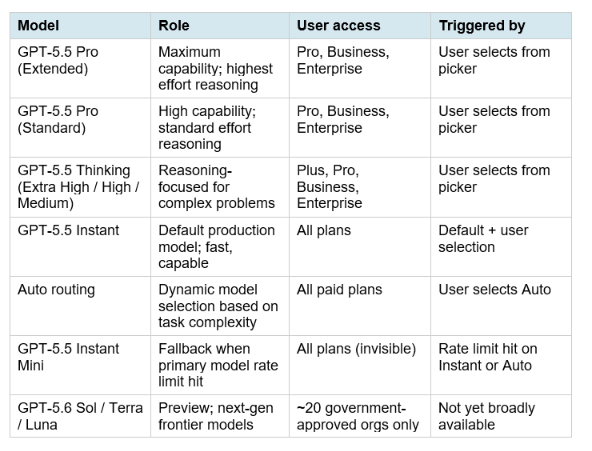
The ChatGPT model picker was also updated in early July 2026 for Business and Enterprise users. The picker now shows: Instant, Medium (formerly Thinking Standard), High (formerly Thinking Extended), Extra High (formerly Thinking Heavy), Pro Standard, and Pro Extended. Thinking Light has been removed. This simplification of the reasoning tier naming is independent of the fallback model change but happened simultaneously, contributing to the sense of a coherent July 2026 model architecture refresh across the ChatGPT product. For the full analysis of what GPT-5.6 Sol/Terra/Luna means for the broader OpenAI model ecosystem, the GPT-5.6 review on Build Fast with AI covers the next-generation model family in detail.
6. Does This Affect API Users?
OpenAI's release notes are explicit: this update does not affect the API or Codex. For API developers, the GPT-5.5 Instant Mini is not available as a callable model string. API users get the full GPT-5.5 Instant (or whichever model they specify) on every call within their rate limits. When API rate limits are hit, calls fail with a rate limit error rather than being transparently rerouted to a fallback model. The fallback routing is a ChatGPT consumer product feature, not an API feature. API developers who want a cheaper, faster tier of GPT-5.5-generation capabilities should use models like GPT-5.5 or the upcoming GPT-5.6 Terra and Luna once they reach general availability. Those models offer different price-performance trade-offs through the API without the hidden-fallback architecture that exists in the consumer product. There is no API model string for GPT-5.5 Instant Mini.
7. What Triggers the Fallback: ChatGPT Rate Limits Explained
To understand when GPT-5.5 Instant Mini kicks in, you need to understand ChatGPT's rate limit structure. OpenAI does not publish the exact message-per-period limits publicly, but the pattern is consistent across plans: each plan includes a number of messages with the primary model per time window (typically per 3 hours or per day). When that window is exhausted, subsequent messages are served by the fallback model until the window resets.
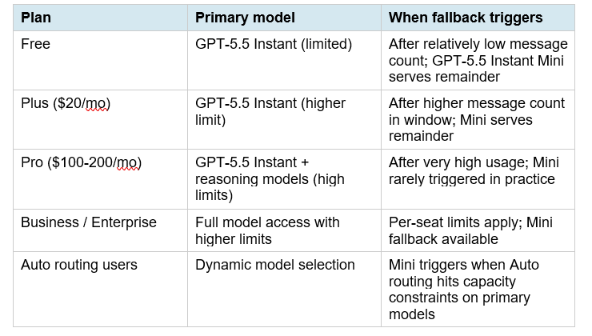
The practical implication: Free and Plus users are the most likely to encounter GPT-5.5 Instant Mini in daily use, because their primary model message limits are hit most frequently. This makes the quality of GPT-5.5 Instant Mini disproportionately important for the experience of the most price-sensitive users, who simultaneously have the least ability to upgrade their plan if they find the fallback experience unsatisfactory.
Hot take: the fallback model is one of the most under-discussed product decisions in consumer AI. It directly determines the experience for the users who get the most value from the product but have the least headroom for quality degradation. OpenAI's continuous investment in improving GPT-5.5 Instant Mini reflects awareness that 'good enough' at the fallback tier is a meaningful competitive differentiator, not just an engineering detail.
8. Implications for Businesses and Enterprise Users
For businesses and enterprise teams using ChatGPT at scale, the fallback model affects a specific operational question: what do team members experience when they reach their per-seat usage limits mid-workday? The upgrade from GPT-5.3 Instant Mini to GPT-5.5 Instant Mini improves the answer to that question meaningfully. Before: a team member in the middle of a complex research thread who hit their daily limit would transition to GPT-5.3 Instant Mini, which could lose track of the intent they had established across the previous fifteen turns and might produce factually wrong information that they were not expecting. After: GPT-5.5 Instant Mini's intent tracking improvement means the conversation thread is more likely to continue coherently, the tone stays calibrated to the established register, and factual errors are less frequent. For businesses evaluating whether to upgrade their team to higher-limit plans or accept the fallback experience, this improvement may shift the calculus. The better the fallback model, the more acceptable it becomes to tolerate occasional rate limits rather than paying for unlimited primary model access. OpenAI has an incentive to keep the fallback good enough that it does not drive immediate plan upgrades, while keeping it different enough from the primary model that there is still a value proposition in upgrading.
9. Context: The GPT-5.5 Instant Family History
GPT-5.5 Instant Mini's launch is the latest step in a consistent OpenAI pattern: a major model launch followed by targeted improvements to both the primary and fallback variants, with the fallback upgrade typically lagging the primary launch by weeks or months. Understanding this pattern helps predict what comes next. The GPT-5.5 Instant main model launched on May 5, 2026, replacing GPT-5.3 Instant as the default ChatGPT model. The May 5 launch included: 52.5% fewer hallucinated claims than GPT-5.3 Instant on high-stakes prompts in medicine, law, and finance; 37.3% reduction in inaccurate claims in challenging factual conversations; an AIME 2025 score of 81.2 versus GPT-5.3 Instant's 65.4; an MMMU-Pro multimodal reasoning score of 76.0 versus 69.2; improved context management with memory sources transparency; and stronger instruction following across multi-constraint requests. The June 9, 2026 follow-on update extended personalization improvements to the Free tier and made responses tighter and less verbose. GPT-5.5 Instant Mini arriving in early July represents the completion of that launch cycle: the primary model launched in May, improved in June, and the fallback model was upgraded in July to bring its quality closer to the primary.
For comparison, Claude Sonnet 5 represents Anthropic's equivalent positioning: a model that is materially better than its predecessor and meaningfully cheaper than the flagship (Fable 5 or Opus 4.8), serving as the default for most users and the right choice for most production workflows. The Claude Sonnet 5 full review covers the Anthropic equivalent in detail.
10. What This Release Signals About OpenAI's Strategy
The timing and nature of the GPT-5.5 Instant Mini launch tells us something about where OpenAI is directing its attention in July 2026. The company is simultaneously managing: a major frontier model release in gated preview (GPT-5.6 Sol/Terra/Luna), the production hardening of its voice API (GPT-Realtime-2.1), and a series of quiet but consequential improvements to the consumer-facing model stack that most users experience. The GPT-5.5 Instant Mini update falls into that third category. Three things this signals: first, OpenAI views the fallback model experience as a retention mechanism, not an afterthought. Improving GPT-5.5 Instant Mini reduces the likelihood that power users defect to competitors when they hit rate limits. Second, the three specific improvements (intent tracking, tone calibration, factual accuracy) are precisely the dimensions where ChatGPT faces the most direct competitive pressure from Claude Sonnet 5, which leads on knowledge work quality metrics and has a strong personalization story via its memory system. Third, the invisible-model-picker design choice is a product bet: OpenAI believes that a seamless fallback experience is worth more than giving users explicit control over the fallback model. This is a different bet from Anthropic's approach of making every Claude tier selectable.
For the full competitive context of how OpenAI's model family competes with Anthropic's Claude lineup in July 2026, the GPT-Realtime-2.1 review covering OpenAI's voice API parallel launch shows the scope of OpenAI's simultaneous July improvements across text, voice, and infrastructure.
Frequently Asked Questions
What is GPT-5.5 Instant Mini and what is its purpose?
GPT-5.5 Instant Mini is OpenAI's updated fallback model for ChatGPT, rolled out in early July 2026. It replaces GPT-5.3 Instant Mini in the fallback role. Its purpose is to serve as the model that ChatGPT uses when users hit their rate limits on GPT-5.5 Instant or Auto, maintaining conversation quality during periods when the primary model is not available. It does not appear in the model picker and cannot be selected directly.
Why does ChatGPT switch to GPT-5.5 Instant Mini?
ChatGPT switches to GPT-5.5 Instant Mini when a user reaches their message limit for the primary model (GPT-5.5 Instant or Auto) within a given time window. This is a rate limiting mechanism that allows ChatGPT to serve the primary model to all users within capacity constraints, while continuing to serve conversations that have exhausted their primary allocation through the fallback model. The switch happens automatically without requiring any user action.
What improvements does GPT-5.5 Instant Mini have over GPT-5.3 Instant Mini?
OpenAI documents four improvements: better tracking of evolving user intent across multi-turn conversations (so the model does not lose the thread of a long conversation), improved tone calibration to match the register established with the primary model (making the transition less noticeable), fewer factual issues including lower hallucination rates, and stronger personalization based on user memory and context.
Can I select GPT-5.5 Instant Mini from the model picker?
No. GPT-5.5 Instant Mini does not appear in the ChatGPT model picker on any plan. It is an infrastructure model that serves as an automatic fallback, not a user-selectable option. OpenAI made this design choice deliberately to maintain a seamless user experience rather than requiring users to manage fallback model selection.
Does GPT-5.5 Instant Mini affect API users?
No. OpenAI's release notes explicitly state that this update does not affect the API or Codex. API calls use whichever model the developer specifies and fail with a rate limit error when limits are hit, rather than being transparently rerouted to a fallback model. There is no API model string for GPT-5.5 Instant Mini, and it cannot be called directly through the API.
Is GPT-5.5 Instant Mini the same quality as GPT-5.5 Instant?
No. GPT-5.5 Instant Mini is a smaller, more efficient distillation of the GPT-5.5 generation, optimized for the fallback use case rather than maximum capability. The quality gap is smallest on everyday conversational tasks, creative writing, and simple factual questions. The gap is more meaningful on complex multi-step reasoning, long document analysis, and tasks in specialized professional domains (law, medicine, finance) where GPT-5.5 Instant's 52.5% lower hallucination rate over its predecessors matters. The July 2026 update narrows the gap in the specific dimensions most relevant to mid-conversation fallback transitions.
What are the rate limits that trigger the GPT-5.5 Instant Mini fallback?
OpenAI does not publish exact rate limit numbers for ChatGPT consumer plans. The general pattern: each plan includes a message allocation with the primary model per time window (typically 3 hours or per day). Free users have lower allocations and hit the fallback more frequently. Plus users have higher allocations. Pro users have the highest primary model limits and encounter the fallback model least often. When the primary model allocation is exhausted within the window, GPT-5.5 Instant Mini serves subsequent messages until the window resets.
What does the model picker update mean for Business and Enterprise users?
In the same July 2026 update window, OpenAI simplified the ChatGPT Business and Enterprise model picker. The picker now shows: Instant, Medium (formerly Thinking Standard), High (formerly Thinking Extended), Extra High (formerly Thinking Heavy), Pro Standard, and Pro Extended. Thinking Light was removed. Instant can automatically switch to Medium when the model determines a request would benefit from more reasoning. These are naming changes; the underlying models and usage limits for each plan are unchanged.
Recommended Blogs
- GPT-5.6 Review: Sol, Terra, Luna Features, Benchmarks, and Pricing
- Best AI Models of July 2026: Full Ranking by Use Case, Benchmarks, and Price
- GPT-Realtime-2.1 and 2.1-mini Review: OpenAI's Voice Agent Upgrade (July 2026)
- Claude Sonnet 5 Review: Benchmarks, Pricing and Is It Worth It? (2026)
- Claude Fable 5 vs Claude Sonnet 5: Which Model Should You Actually Use? (July 2026)
- GPT and OpenAI Ecosystem Collection: Every OpenAI Model and Feature Update
Resources & Community
Join our community of 70,000+ AI enthusiasts and learn to build powerful AI applications! Whether you're a beginner or an experienced developer, Build Fast with AI helps you understand and implement AI in your projects.
- Website: buildfastwithai.com
- LinkedIn: Build Fast with AI
- Instagram: @buildfastwithai
- Founder Twitter: @satvikps
- Twitter: @BuildFastWithAI
Agentic AI Launchpad 2026
A structured 6-week cohort program that takes you from AI basics to building and deploying real-world agentic AI systems. Includes live sessions, expert mentorship, project reviews, and a builder community network.
Ready to go from learning to building? Join the next cohort: Agentic AI Launchpad 2026
Free AI Resources
Access free tools, workshops, and micro-learning to keep building:
- AI Workshops: Free resources, upcoming events and past recordings
- Unrot: Learn AI in 5 minutes a day (free micro-learning app)
OpenAI is shipping consumer ChatGPT improvements weekly. Follow @BuildFastWithAI on X to stay ahead of every model update, rate limit change, and feature launch that matters for ChatGPT users and API developers in 2026.
References
- OpenAI ChatGPT Release Notes: GPT-5.5 Instant Mini fallback model rollout (July 2026)
- Releasebot: ChatGPT Updates by OpenAI July 2026 (GPT-5.5 Instant Mini and model picker update entries)
- Releasebot: OpenAI Release Notes July 2026 (cross-product view of the July 7, 2026 changes)
- OpenAI: GPT-5.5 Instant Launch (May 5, 2026 official announcement with benchmark data)
- OpenAI: Introducing GPT-5.5 (April 23, 2026 full GPT-5.5 launch with hallucination reduction data)
- TechCrunch: OpenAI Releases GPT-5.5 Instant, a New Default Model for ChatGPT (May 5, 2026)
- Axios: OpenAI Updates ChatGPT Instant with GPT-5.5 (May 5, 2026 analysis with memory and personalization context)
- The Daily Star: OpenAI Releases GPT-5.5 Instant as New Default ChatGPT Model (benchmark context)
- OpenAI Model Release Notes Help Center: GPT-5.4 mini fallback pattern (historical context for Mini fallback architecture)

