



What Is Corporate AI Training ROI?
Corporate AI training ROI is the measurable financial return your business gets from teaching employees to use AI tools well, shown as a percentage or a multiple of what the program cost. The value comes from three places: time saved on existing tasks, higher output quality such as fewer errors and less rework, and new revenue or avoided costs that AI enabled work unlocks. The cost side is easy to gather: trainer fees, software licenses, and the hours employees spend learning instead of doing. What trips teams up is the value side, because they never assign a rupee figure to the hours AI gives back.
Think of it as a bridge between two numbers your leadership already understands. On one side sits the invoice for the program. On the other sits the capacity your team gets back and the outcomes that capacity produces. The training only earns its place when the second number clearly beats the first, and when you can show the working. Put a real value on both sides and ROI stops being an opinion and starts being a line item you can defend.
If you are still choosing a vendor or a budget, pair this with our corporate AI training cost guide for India, so your cost inputs are realistic before you calculate return. Underquote the cost and your ROI looks fake. Overstate the value and finance will catch it. Honest inputs are what make the final number persuasive.
Why AI Training ROI Matters More in 2026
AI training ROI matters more in 2026 because AI budgets have grown large enough that finance teams now demand proof, not promises. Spend used to hide inside innovation line items nobody scrutinized. Those days are over. When a program reaches every department, its cost becomes visible, and visible cost invites hard questions about return.
Two shifts drive the pressure. First, adoption of AI at work has moved from early experiments to standard operating practice across marketing, operations, sales, support, and engineering, so training is no longer optional polish. Second, the skills gap is real and expensive. Reports from the World Economic Forum and McKinsey have consistently pointed to a large share of the workforce needing reskilling this decade, and the roles that use AI well command a clear pay premium, which you can see in our breakdown of the 56 percent salary gap between AI skills and degrees. When skilled people are scarce and costly, the return on building those skills in house climbs.
Here is the part leaders miss. The cost of not training is also an ROI input. Every week a team drafts, researches, and reworks the slow way is capacity you are paying for and throwing away. A no training scenario is not a zero cost baseline. It is a steady leak. Measuring corporate AI training ROI properly means comparing the trained future against that leaking present, not against a tidy zero.
The Corporate AI Training ROI Formula
The core formula is simple, and every input is something you can actually collect:
ROI (%) = (Net Value Gained minus Total Program Cost) / Total Program Cost x 100
Break each side down so nothing hides:
Net Value Gained = (hours saved x loaded hourly cost) + quality gains + revenue impact
Total Program Cost = training fees + software and license costs + employee time spent in training
A word on loaded hourly cost, because most people get it wrong. Loaded cost is not just salary divided by hours. It includes benefits, taxes, tools, and overhead, which typically add 25 to 50 percent on top of base pay. If you price saved hours at bare salary, you undercount the return and hand finance an easy reason to doubt you. Use the fully loaded figure your finance team already applies to headcount.
Now the math on a small example. A 50 person team saves 4 hours each per week after training, at an average loaded cost of 800 rupees per hour. That is 50 x 4 x 800 = 160,000 rupees per week, or about 20.8 lakh across a 13 week quarter. If the full program cost 6 lakh all in, then ROI = (20.8L minus 6L) / 6L x 100, which is roughly 247 percent, a 3.5x return in one quarter. The numbers are illustrative, so plug in your own loaded cost and hours. The point stands: once you price an hour, the return writes itself.
Two guardrails keep this formula honest. First, only count hours that get redeployed to real work, not hours that vanish into longer coffee breaks. Second, phase in the savings. People do not hit peak time savings on day one, so use a ramp, for example 40 percent of the target in month one, 75 percent in month two, and full savings by month three. A ramped model is more defensible and still lands well above break even.
Hard ROI vs Soft ROI
Corporate AI training ROI splits into hard ROI and soft ROI, and you should report both, but lead with the hard number. Hard ROI is cash you can trace: hours saved converted to money, rework eliminated, tickets deflected, and revenue influenced. Soft ROI is real value that resists a clean rupee figure: faster onboarding, better morale, stronger retention, and higher confidence with new tools.
The mistake is treating soft ROI as the headline. Leadership discounts anything that smells like a feeling, so a deck that opens with morale scores gets a polite nod and a budget cut. Open with the hard number, show the math, then present soft ROI as the compounding upside that hard numbers alone miss. That order wins rooms.
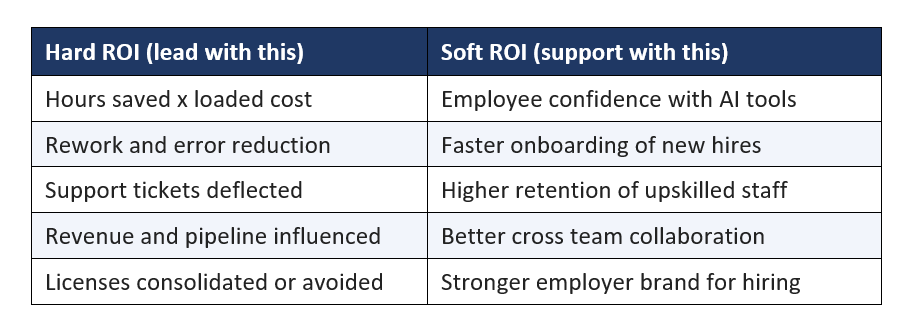
One caution on soft ROI. Do not ignore it just because it is harder to price. Retention alone can dwarf the time savings, since replacing a skilled employee often costs a large multiple of their monthly salary once you count hiring, ramp, and lost output. Assign even a conservative value to retention and the soft column starts carrying real weight.
6 Metrics That Prove AI Training ROI
Six metrics turn a training program into a defensible ROI number. Track these from day one, not after the fact, because you cannot reconstruct a baseline you never captured
A note on each. Time saved is the engine of most ROI, so measure the same task before and after with a stopwatch, not a guess. Adoption is the multiplier, because value only exists when people use the tools, and it is the metric most programs never track. Output quality captures the money hidden in rework, which is often larger than the raw time savings. Cycle time is what your customers actually feel, since a faster deal cycle or a quicker ticket resolution shows up in revenue and satisfaction. Revenue or cost impact is the number your leadership cares about most, so connect the reclaimed hours to a business outcome wherever you can. Confidence and retention protect the whole investment, because skilled people who feel invested in tend to stay.
How to Measure AI Training ROI in 5 Steps
Measuring corporate AI training ROI takes five steps, and step one happens before anyone sits in a session.
- Baseline first. For two weeks before training, record time, quality, and cycle time on the exact workflows you plan to change. No baseline, no ROI. This is the single step teams skip, and skipping it means you can never prove improvement, only claim it. Use a simple time log and pull whatever your tools already report.
- Price every hour and error. Assign a loaded hourly cost per role and a rupee value to each quality gain, so hours and rework convert into money. Get these numbers from finance so nobody can argue with them later. If a role saves an hour, everyone should agree on what that hour is worth before the program starts.
- Train against real workflows. Use the team's own tasks, tools, and documents in the training. Generic demos do not transfer to Monday morning. If sales learns on made up scenarios instead of real accounts, the skills evaporate by the next call. Real workflow training is the difference between a fun day and a lasting habit.
- Track adoption weekly for 90 days. A short usage log or tool analytics is enough. Watch the 40 percent weekly adoption line closely, because below it your return leaks no matter how good the content was. Weekly tracking also lets you catch a stall early and fix it while it still matters.
- Calculate at 90 and 180 days. Report the number in money, not satisfaction scores, and compare the two windows to show the trend. Early 30 day numbers look modest while habits form, so the 90 and 180 day marks are where the real story appears. Present both so leadership sees momentum, not a single snapshot.
If you are rolling this out at scale, our guide on how to train 1,000 employees on AI covers the logistics that keep adoption high across large teams, which is exactly where most measurement plans fall apart.
A Worked Example: 3.7x Return in 90 Days
This example is illustrative, but the structure is exactly what you should copy. A 120 person services company trains its operations and sales teams on AI for document drafting, research, and client replies. Here is how the value adds up when you price it honestly.
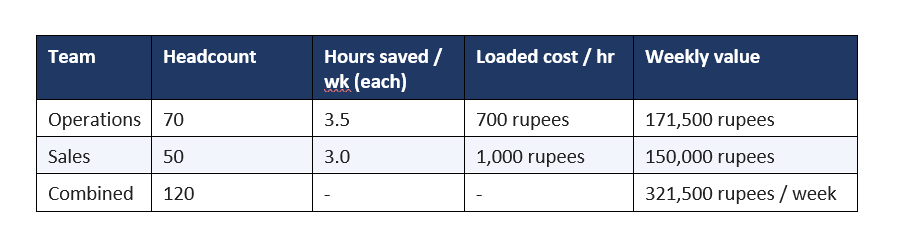
Across a 13 week quarter, 321,500 rupees per week is about 41.8 lakh in recovered capacity. If the program cost 11.3 lakh all in, then ROI on the time savings alone = (41.8L minus 11.3L) / 11.3L, roughly 2.7x on paper. Add the pipeline that sales closed with their reclaimed hours, and the effective return moves closer to 3.7x. That last part is exactly why revenue impact belongs in the formula and not in a footnote.
Notice what makes this credible. Adoption reached 68 percent, comfortably above the 40 percent cliff, so the savings were real rather than theoretical. The hours were priced at loaded cost, not bare salary. And the revenue contribution was traced to specific deals, not assumed. Strip any one of those and the number would deserve the skepticism it gets. Keep all three and a finance team will sign off.
ROI Benchmarks by Team and Function
AI training ROI is not uniform across a company, so set expectations by function before you start. Some teams show cash returns in weeks, while others build slower but deeper value. The table below is a planning guide, not a promise, and your real numbers depend on baseline maturity and adoption.
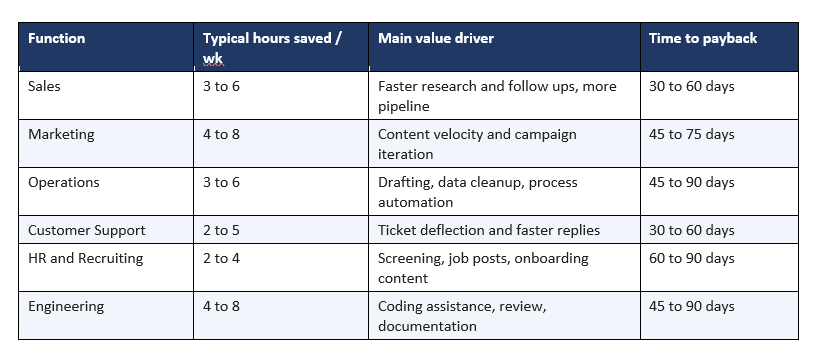
Two patterns are worth calling out. Sales and support tend to pay back first because their value ties directly to revenue and deflection, which are easy to trace. Marketing and engineering often show the largest total value but take a little longer to compound, because quality and velocity gains build over several cycles. Sequence your rollout with this in mind: start where payback is fastest to fund confidence, then expand into the higher ceiling teams. Our playbook on AI training for sales teams goes deep on the fastest paying function.
Why Most Companies Measure AI Training ROI Wrong
Most companies measure the wrong thing, which is why so many AI training budgets get cut after one round. Here is where they go wrong, and my blunt take on each.
- They count attendance, not adoption. A full room proves nothing. Weekly usage 30 days later is the only signal that matters, and it is the one nobody checks.
- They rely on satisfaction scores. People enjoy a good session and still change nothing on Monday. Happiness is not return, and a smile sheet has never survived a budget review.
- They train tools, not workflows. A tour of a chatbot's features does not move a real process. Train the job, not the app, or the skills leak within a week.
- They measure once and stop. ROI at 30 days looks weak because habits are still forming. The 90 and 180 day numbers tell the truth, so a single early snapshot undersells a good program.
- They ignore the adoption cliff. Under 40 percent weekly use, even a great program shows a poor return, and leadership blames the training instead of the rollout.
- They forget the no training baseline. Comparing against a zero cost present pretends the slow way is free. It is not, so the real comparison is trained versus the leaking status quo.
My contrarian point: a cheaper program with disciplined weekly adoption tracking beats an expensive one time event almost every time. The follow through is worth more than the fancy slides. I would rather run a modest program with a serious measurement plan than a premium workshop that nobody reinforces, because the first one compounds and the second one fades.
The 40 Percent Adoption Cliff
The 40 percent adoption cliff is the point below which AI training ROI collapses, and understanding it will save you more money than any vendor choice. When fewer than roughly 40 percent of trained staff use AI weekly, the value simply is not there in enough places to cover the program cost, and the return goes negative no matter how strong the content was.
Adoption fails for predictable reasons. The training used generic examples, so nothing transferred. Managers did not model the behavior, so it felt optional. The tools were not wired into daily systems, so using them meant extra steps. Or there was no follow up, so early enthusiasm faded by week three. Each of these is fixable, and each is far cheaper to fix than to re run the whole program.
The practical rule is simple: treat rollout as seriously as the training itself. Budget for follow up clinics, give managers a one line adoption dashboard, and make the AI path the easy path inside existing tools. Cross the cliff and every other ROI metric moves with you. Stay below it and you will spend the next review defending a number that was never going to work.
How to Improve Your AI Training ROI
You can lift corporate AI training ROI without spending more, because most of the return lives in reinforcement, not in the original session. These tactics move the number the most.
Train on real work. Swap generic demos for the team's own tasks, documents, and tools, so skills transfer the same day.
Run short follow up clinics. A 45 minute session at week two and week six rescues adoption right when it tends to sag.
Give managers a dashboard. A simple weekly view of usage and hours saved turns managers into owners of the outcome.
Wire AI into daily systems. The less friction between the work and the tool, the higher the weekly usage.
Name internal champions. One enthusiastic peer per team spreads practical habits faster than any external trainer.
Sequence by payback. Start with sales and support to bank fast wins, then expand into marketing and engineering.
Set a weekly usage target. A clear number, such as three AI assisted tasks per person per week, gives adoption something to aim at.
Review ROI out loud. Share the running return with the whole team, because visible progress reinforces the habit.
None of these require a bigger invoice. They require intent and a small amount of structure. That is the quiet truth about AI training ROI: the program buys you the potential, and the reinforcement is what converts potential into money.
Tools and Cadence for Tracking ROI
You do not need a fancy platform to track corporate AI training ROI. A light, consistent stack beats a heavy one nobody updates.
- A baseline survey and a simple time log at week zero.
- Weekly adoption tracking from tool analytics or a one line usage check in.
- A shared ROI sheet with hours saved, loaded cost, and running return.
- A 90 day review with finance in the room, then a 180 day follow up.
The tools matter less than the rhythm. A spreadsheet updated every Friday will out measure an expensive analytics suite that gets opened once a quarter. Pick the lightest stack your team will actually maintain, and protect the weekly cadence like a standing meeting.
A 90-Day ROI Measurement Plan
A 90 day plan turns all of this into something you can run on Monday. Here is the sequence I recommend, phase by phase.
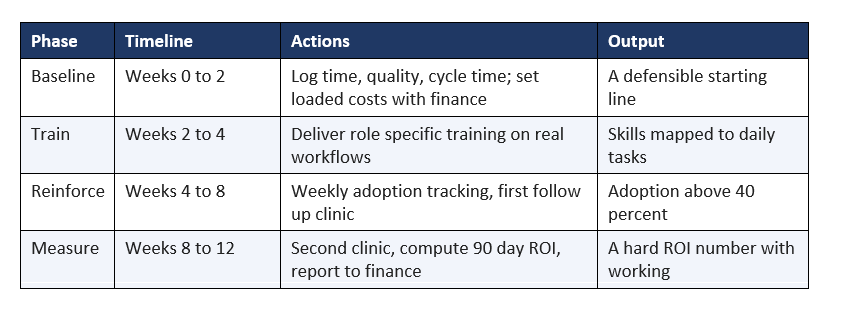
At day 90 you should have a real return, a trend line, and a clear list of what to fix before the 180 day review. Repeat the measure step at 180 days, and you will have two data points that show whether the return is compounding, which is the story that renews budgets. Teams that are brand new to the underlying concepts should start staff on what agentic AI actually is so the training lands on a solid base.
Common Mistakes to Avoid
A few mistakes quietly wreck otherwise good AI training ROI. Avoid these and your number holds up under scrutiny.
- Skipping the baseline, which leaves you claiming improvement you cannot prove.
- Pricing saved hours at bare salary instead of loaded cost, which undersells the return.
- Counting hours saved that never get redeployed to real work.
- Measuring at 30 days and giving up before habits mature.
- Treating adoption as a nice to have rather than the multiplier it is.
- Reporting soft ROI first and losing the room before the hard number lands.
Every one of these is avoidable with a little discipline up front. The programs that survive budget season are rarely the flashiest. They are the ones that measured honestly and reported clearly.
FAQ
How do you calculate ROI on corporate AI training?
Use ROI (%) = (net value gained minus total program cost) / total program cost x 100. Net value gained is hours saved times loaded hourly cost, plus quality gains, plus revenue impact. Total program cost is training fees, license costs, and employee time in training. Measure over a fixed 90 to 180 day window and price hours at loaded cost, not bare salary.
What is a good ROI for AI training?
A strong corporate AI training program commonly returns 2x to 5x its cost within two quarters. Anything above break even in 90 days is healthy, because returns compound as adoption and habits grow through the 180 day mark. Sales and support functions often reach the high end first.
How long does AI upskilling take to pay back?
Most teams reach payback in 60 to 120 days when training is tied to real workflows and weekly adoption stays above 40 percent. Early 30 day numbers look modest while habits form, so judge the return at 90 and 180 days rather than in the first month.
What metrics prove AI training worked?
Time saved per employee, adoption rate, output quality, cycle time, revenue or cost impact, and retention of upskilled staff. Time saved and adoption are the two that drive most of the return, and adoption is the one most programs forget to track.
How much does corporate AI training cost in India?
It varies by team size, format, and depth. See our detailed corporate AI training cost breakdown for India and the 2026 buyer's guide for current pricing bands, then use the formula above to turn that cost into an expected return.
How do you keep AI training ROI high after the workshop ends?
Train on the team's own tasks, run short follow up clinics at weeks two and six, track weekly usage, and give managers a simple dashboard. Adoption below 40 percent is the single biggest reason ROI looks weak, so treat rollout as seriously as the training itself.
Is AI training worth it for small teams?
Yes, and often the payback is faster, because small teams adopt quickly and the hours saved are easy to trace. The same formula applies. Even a five person team saving a few hours each per week usually clears the program cost within a quarter.
Should I measure soft ROI too?
Yes, but lead with hard ROI. Report the cash return first with the math, then present soft ROI such as retention, faster onboarding, and confidence as the compounding upside. Retention alone can outweigh the time savings once you price the cost of replacing skilled staff.
Recommended Blogs
- Corporate AI Training Cost in India: 2026 Pricing
- Corporate AI Training in India: 2026 Buyer's Guide
- AI Upskilling: How to Train 1,000 Employees
- AI for Sales Teams: Corporate Training That Lifts Pipeline
- What Is Agentic AI? Complete Beginner's Guide
References
- Source: McKinsey, The State of AI (mckinsey.com)
- Source: LinkedIn Learning, Workplace Learning Report (learning.linkedin.com)
- Source: World Economic Forum, Future of Jobs Report 2025 (weforum.org)
Source: PwC, AI and Workforce Insights (pwc.com

