



GPT-5.6 Just Got Up to 80% Cheaper: What the Price Cut Means (2026)
OpenAI just cut the price of GPT-5.6 Luna by 80%, three weeks after launching it. On July 30, 2026, the company dropped Luna from $1 to $0.20 per million input tokens and cut Terra by 20%, while leaving the flagship Sol untouched. A price cut this fast, this deep, on a model this new, does not happen because a lab feels generous. It happens because the competition made it necessary.
This is a short read on a fast-moving story: the exact new prices, why OpenAI moved, the pressure from DeepSeek and other cheap open models behind it, and what the cut actually means if you are building on AI. The short version is that the AI price war just got real, and the winner is anyone paying for tokens.
The headline: GPT-5.6 Luna now costs $0.20 input and $1.20 output per million tokens, down from $1 and $6. That is near-free for a capable OpenAI model, and it changes the math on high-volume AI work overnight.
What Happened
On July 30, 2026, OpenAI cut the prices of two GPT-5.6 models: Luna by 80% and Terra by 20%. The flagship Sol was left unchanged at $5 input and $30 output per million tokens. The move came just three weeks after the GPT-5.6 family launched on July 9, which is an unusually fast repricing for a frontier lab.
OpenAI framed the cuts as passing on efficiency gains, saying improvements made while building GPT-5.6, including the model helping rewrite and optimize its own production inference code, lowered its serving costs. That explanation is true and incomplete. Labs pass on efficiency gains when they have a reason to, and the reason this time is sitting one row below GPT-5.6 on every pricing table: a wave of cheap, capable open models.
For what these models actually do, our GPT-5.6 Sol, Terra and Luna review covers the full family, and this piece is the pricing update.
The New GPT-5.6 Pricing
GPT-5.6 Luna now costs $0.20 input and $1.20 output per million tokens, Terra costs $2 and $12, and Sol is unchanged at $5 and $30. Here is the before and after in one view.
Table 1: GPT-5.6 pricing, before and after
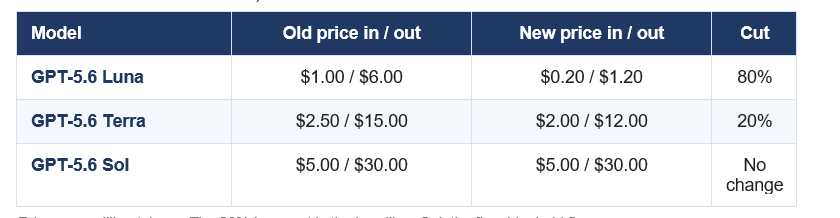
Prices per million tokens. The 80% Luna cut is the headline; Sol, the flagship, held firm.
The pattern tells the story: OpenAI cut the cheap models hard and left the flagship alone. That is exactly what you do when the pressure is coming from the low end. Nobody is undercutting Sol on frontier reasoning, but plenty of models are undercutting Luna on price, so Luna is where OpenAI had to respond.
Why OpenAI Cut Prices
OpenAI cut GPT-5.6 prices because cheap open-weight models, led by DeepSeek, made the old prices uncompetitive at the low end. Efficiency gains gave OpenAI the room to cut, but competition gave it the reason.
The timing is the tell. Just days before this cut, DeepSeek V4 was sitting at $0.14 input and $0.28 output for a model that scores 80.6% on SWE-bench Verified, the top open-weights coding result. Against that, GPT-5.6 Luna at $1 input looked expensive for a lot of routine work. OpenAI could either watch high-volume workloads drift to open models, or drop Luna to fight for them. It chose to fight.
My read: this is the first clear sign that even OpenAI cannot hold premium pricing on its cheap tier while Chinese open models exist at a fifth of the cost. The frontier still commands a premium, which is why Sol did not move. The commodity tier does not, which is why Luna fell 80%.
The model doing the pressuring is worth understanding. Our DeepSeek V4 review covers the open-weight model that reset the price floor this summer.
What Luna at $0.20 Actually Enables
At $0.20 input and $1.20 output per million tokens, GPT-5.6 Luna makes high-volume AI work cheap enough to stop counting. Whole categories of always-on AI that were borderline at the old price become obviously worth it at the new one.
WHAT THE NEW LUNA PRICE MEANS IN PRACTICE
At $0.20 per million input tokens, processing a million support tickets, product descriptions or documents costs a few dollars in input, not tens. For classification, extraction, tagging, summarization and routing at scale, Luna just went from a considered expense to a rounding error. If you shelved an idea because the token cost did not pencil out, it is worth re-checking the math today.
The practical effect is that the floor for OpenAI-quality AI dropped hard. Startups building on a budget, teams running large batch jobs, and anyone doing high-volume classification now get a materially cheaper option from OpenAI without leaving its ecosystem. That is the whole point of the cut: keep the volume users who were eyeing the exit.
Don't just use ChatGPT. Learn to build custom LLM agents, RAG pipelines, and full-stack Agentic AI apps in our intensive 6-week program.
Which GPT-5.6 Model to Use Now
Use Luna for high-volume and routine work, Terra as your balanced default, and Sol only for the hardest tasks, because the price gaps now make routing between them more rewarding than ever. The 80% Luna cut widened the distance between the tiers, which is a good thing if you route by task difficulty.
- Luna at $0.20 / $1.20: classification, extraction, summarization, tagging, routing, and any large batch job.
- Terra at $2 / $12: everyday production work, coding, and knowledge tasks that need more than Luna.
- Sol at $5 / $30: the hardest agentic coding, deep reasoning, and cases where quality beats cost.
The takeaway for builders: if you were running everything on Sol out of habit, the cut is a nudge to route. Send the routine 80% of calls to Luna at its new price, keep Terra as the workhorse, and reserve Sol for the hard 20%. Your bill drops sharply and quality barely moves.
The Bigger Picture: The AI Price War
The GPT-5.6 cut is one move in a broader shift where AI competition is moving from capability to cost. With frontier models now clustered close on quality, price has become the battleground, and open-weight models from China set the pace at the bottom.
July 2026 made this obvious. DeepSeek V4 made a permanent 75% price cut, Meta priced Muse Spark at $1.25 input, and now OpenAI has slashed Luna 80%. The direction is one way: down. For the labs, this is margin pressure they cannot fully escape while capable open models exist. For everyone building on AI, it is the best environment in the technology's history, cheaper and better at the same time.
Quotable version: the AI price war is not coming, it is here, and OpenAI just fired an 80% shot at its own cheap tier to stay in it. When the market leader cuts prices this fast, the pricing power of the whole industry has shifted to the buyer.
For the full field and where each model lands on price and capability, see our best AI models July 2026 ranking and our roundup of the best open source AI models driving the pressure.
Frequently Asked Questions
Q: How much did GPT-5.6 prices drop?
On July 30, 2026, OpenAI cut GPT-5.6 Luna by 80% and Terra by 20%. Luna dropped from $1 to $0.20 per million input tokens and from $6 to $1.20 output. Terra fell from $2.50 to $2 input and from $15 to $12 output. The flagship Sol was unchanged.
Q: What is the new GPT-5.6 Luna price?
GPT-5.6 Luna now costs $0.20 per million input tokens and $1.20 per million output tokens, down from $1 and $6. That 80% cut makes it one of the cheapest capable models from a major lab and well suited to high-volume work.
Q: Why did OpenAI cut GPT-5.6 prices?
OpenAI attributed the cuts to efficiency gains from building GPT-5.6, but the timing points to competition from cheap open-weight models, especially DeepSeek V4 at $0.14 input. Efficiency gave OpenAI room to cut, and the low-end price war gave it the reason to actually do it.
Q: Did GPT-5.6 Sol get cheaper?
No. GPT-5.6 Sol, the flagship, remained unchanged at $5 per million input tokens and $30 output. OpenAI cut only the cheaper Luna and Terra tiers, because the pricing pressure is at the low end where open models compete, not at the frontier where Sol still leads.
Q: Is GPT-5.6 cheaper than DeepSeek V4?
Not quite, even after the cut. GPT-5.6 Luna at $0.20 input and $1.20 output is close, but DeepSeek V4-Flash is still cheaper at $0.14 input and $0.28 output, and it is open weight. The cut narrows the gap sharply but does not close it, which is the point of the ongoing price war.
Q: Which GPT-5.6 model should I use now?
Use Luna at its new $0.20 price for high-volume and routine tasks, Terra at $2 as a balanced default, and Sol at $5 only for the hardest reasoning and agentic coding. The wider price gaps after the cut make routing by task difficulty more valuable than running everything on the flagship.
Q: Is the GPT-5.6 price cut permanent?
OpenAI announced the new prices as its standard pricing rather than a temporary promotion, framing them as sustainable efficiency-driven reductions. As with any fast-moving market, verify the current rate in the OpenAI pricing page before planning a large deployment.
Recommended Blogs
The only comprehensive program designed to take you from basic prompting to building interactive Artifacts, custom integrations, and deploying production-ready code with Claude Code.
Resources and Community
Join our community of 70,000+ AI enthusiasts and learn to build powerful AI applications. Whether you are a beginner or an experienced developer, Build Fast with AI helps you understand and implement AI in your projects.
- Website (buildfastwithai.com)
- LinkedIn (Build Fast with AI)
- Instagram (@buildfastwithai)
- Founder Twitter (@satvikps)
- Twitter (@BuildFastWithAI)
Agentic AI Launchpad 2026
A structured 6-week cohort program that takes you from AI basics to building and deploying real-world agentic AI systems. Includes live sessions, expert mentorship, project reviews, and a builder community network.
Ready to go from learning to building? Join the next cohort: Agentic AI Launchpad 2026
Free AI Resources
Access free tools, workshops, and micro-learning to keep building:
Cheaper AI is good news for everyone building it. Re-check your token math this week, and follow Build Fast with AI for fast, honest coverage of every major AI move.

