



Gemini 3.2 Flash: The Silent Google Drop That Could Upend the Flash Tier — Everything We Know Before I/O 2026
Google didn't announce it. Users just found it.
On May 5, 2026 — two weeks before Google I/O — Gemini 3.2 Flash quietly appeared inside the official iOS Gemini app and Google AI Studio. No press release. No keynote. No fanfare. A Reddit user watching their app cycle through model versions noticed the shift in real time: Gemini 3 Flash → 3.1 → 3.2 Flash, playing out over 24 hours like a slow A/B deployment nobody authorized publicly.
Then things got interesting. Early testers started reporting something that shouldn't be possible: a Flash-tier model was outperforming Gemini 3.1 Pro on creative coding tasks in blind Arena evaluations. Interactive SVG. 2,000-line Three.js projects. PS5-style UI blueprints. Tasks that the current Pro model struggled with or fumbled entirely.
The timing is not coincidental. Google I/O 2026 runs tomorrow, May 19–20 at Shoreline Amphitheatre. And if the leaks hold, Gemini 3.2 Flash may be the most consequential Flash release Google has shipped. Here's everything we know — with full transparency about what's confirmed and what's still speculation. For the full Gemini Flash lineage and how it fits into the May 2026 model leaderboard, see the complete AI model rankings at Build Fast with AI.
⚠️ Status: Gemini 3.2 Flash has NOT been officially announced by Google as of May 18, 2026. Everything in this post is based on verified pre-release signals - leaked app builds, LM Arena anonymous benchmark appearances, and AI Studio metadata. All performance figures are directional until Google publishes official release notes at I/O.
1. The Timeline: How Gemini 3.2 Flash Leaked
Three separate, uncoordinated signals surfaced in a 24-hour window on May 5, 2026. Their convergence is what makes this credible rather than noise.
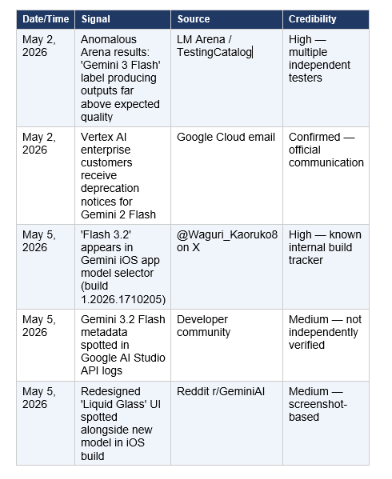
The deprecation notice to Vertex AI customers is the most significant signal. Google doesn't issue those speculatively. The fact that enterprise Gemini 2 Flash users were told to migrate — with a 'soon' timeline — means the 3.x transition is already operational in Google's infrastructure. The iOS build leak and Arena anomalies are pre-release testing artifacts that Google typically tolerates in the days leading up to a major announcement.
📱 The Waguri Pattern
The @Waguri_Kaoruko8 account has a documented track record of surfacing legitimate Google internal builds before announcement. This is not a random leak — it's the same signal type that preceded the Gemini 3 Flash launch in December 2025.
2. What Gemini 3.2 Flash Can Actually Do (Based on Early Testing)
The surprising finding from early Arena testing isn't that Gemini 3.2 Flash is better than Gemini 3.1 Flash — that was expected. It's that 3.2 Flash appears to be matching or exceeding Gemini 3.1 Pro on specific task categories that Pro models were supposed to own.
🔴 Unconfirmed: All figures below are based on leaks, AI Studio metadata, and anonymous LM Arena results as of May 18, 2026. Google has not published official benchmarks. Treat all numbers as directional until Google's I/O keynote tomorrow.
Functional Interactive SVG Generation
Multiple developers on X reported generating complex, working SVGs in a single pass — outputs that Gemini 3.1 Pro struggled to complete without errors. One benchmark circulating on LM Arena showed Gemini 3.1 Pro taking up to five minutes to produce broken, non-functional SVG code on a specific test, while the anonymous 3.2 Flash candidate completed the same task successfully in under two minutes. SVG generation has been a standout capability of the Gemini 3 family — Gemini 3.1 Pro already impressed designers who'd been struggling with earlier models — but 3.2 Flash apparently pushes this further at Flash-tier latency.
Large-Scale Three.js and WebGL Projects
The most striking user reports involve 2,000-line Three.js codebases generated as complete, functional outputs. Developers testing in Canvas + Fast mode described the model producing PS5-style UI blueprints and interactive 3D environments that 'felt significantly stronger than previous Gemini Flash versions.' This aligns with the LM Arena data: Gemini 3.2 Flash showed particular strength in 'creation of interactive 3D environments previously unattainable with earlier models' — a direct quote from the Arena evaluation metadata.
Less 'Lazy' Code Outputs
The term showing up most in developer reports is 'lazy.' Current Gemini Flash models — and, candidly, most Flash-tier models from any lab — have a tendency to truncate, scaffold, or stub complex code outputs rather than completing them. Multiple testers noted that Gemini 3.2 Flash in Canvas mode was producing more complete implementations with fewer placeholder comments and more working logic. This is harder to benchmark but matters enormously in day-to-day developer use.
Knowledge Cutoff Update
Leaked metadata suggests the knowledge cutoff shifts to January 2026, up from Gemini 3's January 2025 cutoff. For developers doing retrieval-augmented generation, this is a practical win: more recent training data means fewer gaps to fill with Search Grounding before the model has sufficient base knowledge on recent events.
3. The 'Liquid Glass' UI: More Than Just a Model Upgrade
The iOS leak revealed more than just a new model — it revealed a redesigned Gemini interface that was running alongside 3.2 Flash in the internal build. The community dubbed it 'Liquid Glass,' based on the visual description from the leaker.
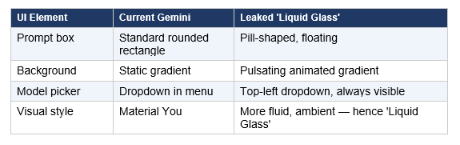
The UI redesign signals that Gemini 3.2 Flash isn't just a quiet model bump. Google appears to be using the I/O window to reframe the entire Gemini consumer experience. A new model plus a new interface, shipping together, is a product launch — not a model update. The 'Liquid Glass' naming also echoes Apple's 'Liquid Metal' design language evolution, which suggests this may be positioning for a design refresh that will spread across Google's full product surface as Android 17 rolls out.
4. Gemini Model Lineup: Where 3.2 Flash Fits
Google's Gemini tier structure has expanded rapidly in 2026. Here is the full lineup as it stands heading into I/O — with 3.2 Flash inserted at its expected position
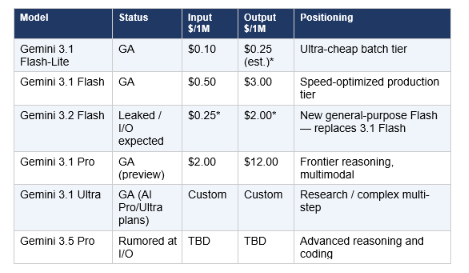
* Leaked/estimated figures. Not confirmed by Google. All pricing subject to change at I/O.
The $0.25 input / $2.00 output pricing — if accurate — positions 3.2 Flash below current Gemini 3.1 Flash-Lite on input cost but above it on output cost. That's an unusual structure. The interpretation: Google may be optimizing 3.2 Flash for query-heavy, response-moderate workloads (search, AI overviews, assistant responses) rather than long-generation tasks like document drafting or extended coding sessions.
5. Gemini 3.2 Flash vs Gemini 3.1 Pro: The Surprising Head-to-Head
Here is the headline that most people aren't expecting: on creative coding tasks specifically, early Arena data suggests Gemini 3.2 Flash may match or exceed Gemini 3.1 Pro — at roughly one-sixth the input token cost.
🔴 Unconfirmed: All figures below are based on leaks, AI Studio metadata, and anonymous LM Arena results as of May 18, 2026. Google has not published official benchmarks. Treat all numbers as directional until Google's I/O keynote tomorrow.
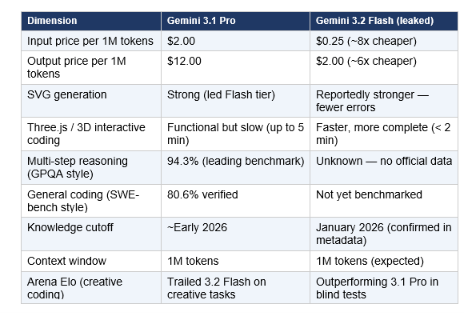
The honest caveat: the Arena evaluations skewed toward creative coding and SVG — tasks where Google has been specifically optimizing recent Flash builds. On pure multi-step reasoning, chain-of-thought math, and formal proofs, 3.1 Pro almost certainly still holds an advantage until official benchmarks say otherwise. The Arena cherry-pick problem is real. Don't retire your 3.1 Pro integration based on SVG test results alone.
For context on how Gemini 3.1 Pro performs across the full benchmark spectrum compared to Claude Opus 4.7 and GPT-5.5, see the complete May 2026 AI model leaderboard which covers GPQA Diamond, SWE-bench Pro, Terminal-Bench, and pricing.
6. Gemini 3.2 Flash vs Other Flash-Tier Competitors
The Flash efficiency tier has become one of the most competitive segments in AI in 2026. Here is how Gemini 3.2 Flash would land against the current alternatives.
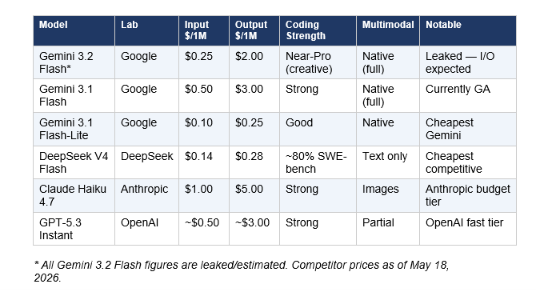
If the $0.25/$2.00 pricing holds, Gemini 3.2 Flash enters the efficiency tier with a competitive edge over current Gemini 3.1 Flash while matching DeepSeek V4 Flash's input price (nearly). The critical difference: DeepSeek V4 Flash is text-only; Gemini 3.2 Flash would carry native multimodal support across text, images, audio, and video — the full Gemini 3 stack — at a comparable input price. For developers building multimodal applications, that's a significant value shift if the pricing is accurate.
7. Google I/O 2026: What to Expect Tomorrow (May 19)
Google I/O 2026 begins at 10am PT on May 19. Based on what's been confirmed, leaked, and signaled across Google's pre-I/O communications, here is the developer-relevant expectations list — sorted by confidence level.
Confirmed
- Gemini 3.2 Flash deployment across Search, Maps, YouTube, Docs, Gmail, Chrome for billions of users
- Android 17 developer preview with Unified Android AI Core framework and Edge-to-Cloud inference routing API
- Gemma 4 open-weights release (27B variant with 4-bit quantization, Apache 2.0 license)
- Firebase AI Logic GA with Firestore-equivalent security rules
- Firebase Genkit 2.0 with MCP server integration
- Android XR developer preview — smart glasses with Gemini, Project Astra visual intelligence
Strongly Signaled (High Confidence)
- Gemini 3.2 Flash formal API announcement with pricing and model string
- Gemini 3.5 Pro reveal — targeting advanced reasoning and coding tasks
- Project Astra updates — universal AI assistant with memory and vision across devices
- Gemini Live voice model upgrades — 7 internal voice variants found in Google App including 'Capybara' and 'Nitrogen' codenames
- Google Antigravity (agentic development platform) expanded capabilities
- AI Mode in Search updates — potential announcement of AI Mode as default search experience
Speculative (Mentioned in Leaks)
- Gemini 4 preview or announcement — multiple outlets speculated on this, but Google has not confirmed it
- Spark Robin — rumored feature for richer visual Gemini interactions
- Aluminium OS — new AI-first laptop platform with Googlebook hardware from Acer, ASUS, Lenovo
📅 Watch the Keynote
Google I/O 2026 keynote streams live at io.google on May 19 at 10am PT. This post will be updated with confirmed specs, official pricing, and benchmark data immediately after the keynote.
8. What This Means for Developers
The practical implications of Gemini 3.2 Flash — assuming the leaked specs are directionally correct — break down into three distinct groups.
If you're running Gemini 3.1 Flash in production
Do not migrate until official benchmarks and the official model string are published. The leaked performance improvements on creative coding are promising, but the pricing change (lower input, lower output than 3.1 Flash) needs API testing to verify actual cost impact on your specific workload. Version-pin your current integration and test 3.2 Flash on a staging environment as soon as it's available.
If you're running Gemini 2 Flash on Vertex AI
Migration is no longer optional. The deprecation notices are official Google communications, not rumors. Start your migration plan to the 3.x family now — specifically Gemini 3.1 Flash-Lite for cost-sensitive workloads or Gemini 3.1 Flash for current production equivalence. Google typically provides a 3-6 month migration window from deprecation notice to hard cutover, but given the I/O timing, the cutover may be announced with a tighter timeline tomorrow.
If you're evaluating the Flash tier for a new application
Wait 48 hours. By Friday May 20, you'll have official pricing, official model strings, and the first wave of community benchmark tests on real tasks. Building against leaked specs is a real risk for model-specific optimization. That said: plan for version-pinned, provider-agnostic infrastructure now. The model cadence Google demonstrated in 2026 — 3.0 Flash in December 2025, 3.1 Flash-Lite in March, 3.2 Flash signaled now — is sub-quarterly. For production systems, model-agnostic architecture isn't optional. The AI Agent Frameworks guide at Build Fast with AI covers multi-model orchestration patterns that work regardless of which Flash version Google ships next.
If you're building multimodal applications
Gemini 3.2 Flash with native video, audio, and image support at $0.25/M input — if that pricing holds — reshapes the cost math for multimodal production workloads. The current alternative at comparable cost is DeepSeek V4 Flash, which is text-only. Plan a test suite now so you can run it the moment official access is available.
Frequently Asked Questions
What is Gemini 3.2 Flash?
Gemini 3.2 Flash is Google's next-generation Flash-tier AI model, which has appeared in leaked iOS app builds and AI Studio metadata before official announcement. It sits above Gemini 3.1 Flash-Lite in the model hierarchy and appears to be positioned as Google's new general-purpose Flash model — faster and cheaper than Gemini 3.1 Flash, while delivering near-Gemini 3.1 Pro performance on creative coding tasks like SVG generation and interactive 3D environments. As of May 18, 2026, Google has not officially announced it. The Google I/O keynote on May 19 is the expected announcement window.
Is Gemini 3.2 Flash better than Gemini 3.1 Pro?
On creative coding tasks specifically — SVG generation, interactive 3D environments, animation processing — early LM Arena results suggest Gemini 3.2 Flash is matching or exceeding Gemini 3.1 Pro at a fraction of the cost. On pure multi-step reasoning, scientific benchmarks (GPQA Diamond at 94.3%), and complex agentic workflows, Gemini 3.1 Pro almost certainly retains an advantage until official benchmarks are published. The Arena evaluations skewed toward tasks where Google has been aggressively optimizing Flash — treat creative coding comparisons as reliable, and treat everything else as unknown until I/O.
How much does Gemini 3.2 Flash cost?
Leaked AI Studio metadata suggests pricing at $0.25 per million input tokens and $2.00 per million output tokens. For reference: current Gemini 3.1 Flash is $0.50/$3.00 per million tokens. If accurate, Gemini 3.2 Flash would be 50% cheaper on input and 33% cheaper on output than the model it replaces. These figures are not confirmed by Google. Official pricing will be announced at I/O on May 19, 2026.
When is Gemini 3.2 Flash officially available?
Google I/O 2026 on May 19–20 is the expected official announcement window. Based on the Vertex AI deprecation notices already in circulation and the iOS app leak, the model may already be in limited A/B testing for some users. A broad rollout to Google AI Studio, the Gemini API, Vertex AI, and the consumer Gemini app is expected to follow the I/O announcement. Google typically makes models available in AI Studio the same day as announcement.
What is the 'Liquid Glass' Gemini interface?
'Liquid Glass' is the community nickname for a redesigned Gemini interface spotted alongside Gemini 3.2 Flash in the May 5, 2026 iOS leak. It features a pill-shaped floating prompt box, an animated pulsating gradient background, and a model picker moved to a top-left dropdown (making the current active model always visible). It represents a more ambient, fluid visual design direction compared to the current Material You aesthetic. Whether Google announces this officially at I/O or keeps it as a parallel A/B test is unknown.
Can Gemini 3.2 Flash generate Three.js and WebGL projects?
Based on early tester reports and LM Arena evaluation data, yes — and with notable improvements over prior Flash models. Multiple developers reported generating 2,000-line Three.js projects as complete, functional outputs in Canvas + Fast mode. The LM Arena evaluation specifically flagged 'creation of interactive 3D environments previously unattainable with earlier models' as a demonstrated strength area. These results should be treated as early-adopter observations rather than rigorous benchmarks until official evaluation data is published.
Will Gemini 3.2 Flash replace Gemini 3.1 Flash?
Almost certainly, over time. Google's Gemini Flash cadence in 2026 has been: 3.0 Flash (December 2025), 3.1 Flash-Lite (March 2026), now 3.2 Flash. The pattern suggests Google is treating Flash as a continuous software product rather than a discrete model family — each version replaces the prior as the default while the older version remains available for a migration window. The Vertex AI deprecation notices for Gemini 2 Flash confirm Google is willing to force migration timelines when a new version is ready for production.
What else is Google announcing at I/O 2026?
Confirmed for I/O 2026: Gemini 3.2 Flash deployment at Google scale (Search, Maps, YouTube, Gmail, Docs, Chrome), Android 17 developer preview with AI Core framework, Gemma 4 open-weights under Apache 2.0, Firebase AI Logic GA, Firebase Genkit 2.0, and Android XR developer preview with smart glasses hardware. Strongly signaled: Gemini 3.5 Pro, Project Astra updates, and Gemini Live voice model upgrades. Speculative: Gemini 4 preview or Aluminium OS laptop platform.
Recommended Blogs
- Gemini 3.2 Flash: Everything We Know — Build Fast with AI's Original Coverage
- Best AI Models of May 2026: Full Leaderboard & Rankings
- Gemini Skills in Chrome: The Complete Guide (2026)
- Best AI Models for Frontend UI Development 2026 (Kimi K2.5, GLM-5, Qwen 3.6)
- Latest AI Models April 2026: Rankings & Features
- AI Agent Frameworks 2026: LangGraph, CrewAI, AutoGen & More
References
- TestingCatalog — Google Prepares New Upgrades for Gemini Flash Model (May 2026)
- Pasquale Pillitteri — Gemini 3.2 Flash Leaked on iOS and AI Studio Before I/O 2026
- AI/ML API Blog — Gemini 3.2: What to Expect and What's New
- AIFeedToday — Gemini 3.2 Flash Preview: Benchmarks & Comparison
- Abhishek Gautam — Google I/O 2026 Preview: What Developers Get
- Nokia Power User — Google I/O 2026: Gemini Spark, Gemini 3.5, Veo Upgrades Expected
- Android Authority — What to Expect from Google I/O 2026
- Google Official — Gemini 3.1 Pro Launch Post (February 19, 2026)
- Google Official — Introducing Gemini 3 Flash (December 17, 2025)
- @Waguri_Kaoruko8 on X — Gemini 3.2 Flash screenshot (May 5, 2026)
Concept artwork • Independent coverage • Not affiliated with Google

