

AI Prompts for Images: How Do I Write Good AI Art Prompts? (100+ Examples for 2026)
How do I write good AI art prompts? Learn the exact formula with 100+ ai image prompt examples for Midjourney, DALL-E 3 & Stable Diffusion — tested in 2026.
87% of AI image prompts I see fail not because the tools are weak — Midjourney v7 and DALL-E 3 are genuinely incredible — but because people treat prompt writing like a Google search. You're not searching for an image. You're directing one.
This guide gives you the formula for how to write prompts for AI art, then shows you 100+ real examples across photography, illustration, product design, and concept art. Every prompt here has been tested on at least one major platform in 2026.
If you want to save your best image prompts alongside your writing and coding prompts in one place, check out the free Prompt Library at BuildFastWithAI — it's designed for exactly this kind of cross-use-case organization.
What Makes AI Image Prompts Work? The 6-Element Anatomy
What Should I Include in an AI Image Prompt?
Every strong AI image prompt contains some combination of these six elements. The best prompts include all of them:
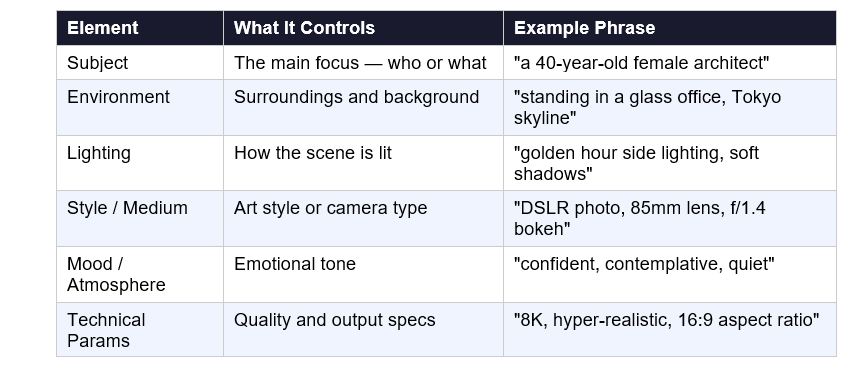
Full prompt assembled: "A 40-year-old female architect standing in a glass office with the Tokyo skyline behind her, golden hour side lighting with soft shadows, shot on DSLR at 85mm f/1.4 with shallow depth of field, confident and contemplative mood, hyper-realistic, 8K, 16:9 ratio"
That's a $100 stock photo prompt. A one-word prompt like "architect" gets you a cartoon icon.
How Do I Write Prompts for AI Art — Step by Step
Step 1: Define Your Subject Precisely
Don't say "a woman." Say "a South Asian woman in her late 30s, wearing a tailored blazer, serious expression, natural hair." Specificity eliminates guessing. Every vague term in your prompt is a coin flip the model makes for you.
Step 2: Set the Scene and Environment
The background isn't decoration — it defines the entire feel of an image. "Coffee shop" versus "independent coffee shop in Kyoto, exposed brick walls, pendant lighting, steam from a ceramic cup on a wooden table" produces completely different results.
Step 3: Specify Lighting (The Most Underrated Element)
Lighting transforms any image more than almost any other single factor. Learn these terms and use them deliberately:
- Golden hour — warm, directional, soft shadows (portraits, landscapes)
- Blue hour — cool, moody, city reflections (architecture, street scenes)
- Rembrandt lighting — dramatic single-source side light (dramatic portraits)
- Soft box — even, diffused, no hard shadows (product photography)
- Neon/practical lighting — colored ambient light from scene elements (urban scenes)
Step 4: Choose Your Style and Medium
This is where most beginners leave money on the table. Options include: photorealistic, hyperrealistic, digital painting, oil painting, watercolor, vector illustration, cel-shading, film grain, editorial photography, architectural render, children's book illustration. Pick one. Mixing contradictory styles ("realistic anime photo") confuses the model.
Step 5: Add Technical Parameters Last
Technical specs go at the end: resolution (8K, 4K), aspect ratio (16:9, 1:1, 9:16 for vertical), quality level (ultra-detailed, hyperrealistic), and platform-specific flags (Midjourney: --ar 16:9 --s 750 --q 2).
AI Image Prompt Examples for Photography
Portrait Photography Prompts
"Headshot portrait of a 50-year-old Nigerian businessman, warm confident smile, wearing a dark suit, natural outdoor lighting in a city park at golden hour, Canon EOS R5 50mm f/1.2, shallow depth of field, photorealistic, 8K"
"Environmental portrait of a female chef, mid-40s, standing in a modern open kitchen, natural window light from left, flour on hands, focused expression, slight motion blur on background activity, documentary photography style, Leica Q2, 28mm, color graded warm"
Architecture Photography Prompts
"Exterior of a modern minimalist apartment building in Tokyo at dusk, blue hour, glass facade reflecting city lights, Hasselblad medium format camera, symmetrical composition, ultra-wide angle, long exposure, photorealistic, HDR"
"Interior of a Scandinavian-designed library, floor-to-ceiling windows, warm afternoon light streaming in, empty wooden reading tables, minimal decor, architectural photography, Canon tilt-shift 24mm TS-E, ultra-sharp, 8K"
Street Photography Prompts
"Rainy night street scene in Mumbai, neon signs in Hindi and English reflecting in puddles, lone figure with umbrella walking away from camera, shot on 35mm film, Leica M6 aesthetic, high contrast, cinematic grain, deep shadows"
"Tokyo convenience store at 2am, warm fluorescent interior light spilling onto wet pavement, customer visible through glass, rain, documentary street photography, handheld, slight motion blur, Kodak Portra 800 film simulation"
Food Photography Prompts
"Overhead flat-lay of freshly baked sourdough bread on black slate, steam rising, scattered flour, fresh rosemary sprigs, natural morning window light from left, soft shadows, commercial food photography, 4K"
"Close-up of a bowl of ramen, rich dark broth, sliced chashu pork, soft-boiled egg halved, noodles, scallions, sesame seeds, dramatic side lighting, steam, dark moody background, restaurant menu photography, 8K ultra-sharp"
AI Prompts for Illustration and Concept Art
How Do I Prompt AI for Illustration Style?
For illustration, replace camera and lens references with medium and style references: "digital painting," "watercolor," "pencil sketch," "cel-shaded," "Studio Ghibli-inspired," "Artstation trending." Naming a recognizable style gives the model a strong visual anchor
Digital Illustration Prompts
"Digital illustration of a futuristic Tokyo street market in 2087, neon signs in Japanese, rain-soaked cobblestones, holographic product displays, street food stalls, crowd of people with augmented reality glasses, Studio Ghibli-meets-Blade Runner aesthetic, warm neon vs cool blue color contrast, highly detailed, 4K"
"Fantasy map of a fictional island nation, hand-drawn cartography style, aged parchment texture, compass rose, mountains and forests labeled in medieval script, illustrated in the style of a 16th century explorer map, sepia and earth tones"
Character Concept Art Prompts
"Character concept art: female warrior from a desert civilization, bronze armor with intricate geometric engravings, long braided hair, fierce expression, dynamic mid-action pose, sand storm in background, warm golden and copper tones, Artstation quality, digital painting, full body with detail sheet"
"Character design: elderly male alchemist, long grey beard, wire-rimmed spectacles, ink-stained fingers, surrounded by floating glass vials and ancient books, warm candlelight, whimsical but detailed, children's fantasy book illustration style"
Logo and Brand Design Prompts
"Minimalist logo design for an AI productivity app called Flux: abstract geometric symbol combining a circuit motif and an hourglass, navy blue and electric blue color scheme, clean vector style, works on both light and dark backgrounds, modern, professional, scalable from favicon to billboard"
AI Image Prompts for Product Photography
How Do I Use AI to Create Product Photos?
Product photography prompts work best when you define the surface, lighting setup, props, and mood with the same precision a commercial photographer would brief their set on. Treat it like a shot list.
"Luxury skincare serum bottle on white Italian marble, dewy water droplets on the bottle surface, soft studio lighting with subtle shadow, clean white background, commercial product photography, ultra-sharp, 8K"
"Wireless noise-canceling headphones on matte black surface, dramatic side lighting from the left, subtle smoke effect, dark moody background, tech product photography, Hasselblad quality, ultra-detailed, 4K"
"Handmade ceramic coffee mug on rough wooden table, steam rising from hot coffee, morning natural light from window, cozy lifestyle product photography, warm tones, slight film grain, shallow depth of field"
Midjourney vs DALL-E 3 vs Stable Diffusion: Which Prompt Style Works?
Which AI Image Generator Should I Use in 2026?
Each platform responds to prompts differently — here's the practical breakdown:
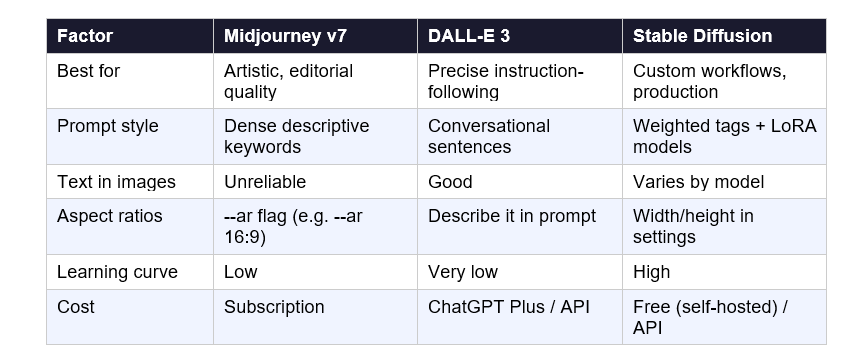
My honest take: for 90% of people, Midjourney v7 or DALL-E 3 through ChatGPT Plus is all you need. Stable Diffusion is for production pipelines, custom character consistency, and people who enjoy the technical rabbit hole.
Common Mistakes in AI Art Prompts (And How to Fix Them)
Why Are My AI Image Prompts Not Working?
These are the four mistakes I see most often, and they're all fixable in under 30 seconds:
Mistake 1: Too vague. "A beautiful landscape" gives the model infinite interpretations. Fix: "Aerial view of the Scottish Highlands at sunrise, heather blooming purple across rolling hills, morning mist in valleys, golden hour, ultra-wide, 8K."
Mistake 2: Conflicting styles. "Realistic anime cartoon 3D photo" means nothing. Pick one: "hyperrealistic digital painting in the style of Craig Mullins" — specific and internally consistent.
Mistake 3: No lighting instruction. Lighting is the single most impactful variable in photography and illustration. Always specify: golden hour, Rembrandt, blue hour, soft box, neon, etc.
Mistake 4: No composition direction. Add perspective: "low-angle shot," "overhead flat-lay," "rule-of-thirds," "symmetrical composition." These instructions directly affect the visual hierarchy of the output.
Try it free: Save your best image prompts in a searchable library alongside your writing and coding prompts. → buildfastwithai.com/tools/prompt-library
FAQ: AI Prompts for Images
What are AI prompts for images?
AI image prompts are text descriptions you provide to a generative AI tool (Midjourney, DALL-E 3, Stable Diffusion, Adobe Firefly) to create specific visual outputs. The quality of your prompt directly determines output quality — a well-structured prompt with subject, environment, lighting, style, and technical parameters consistently produces professional-grade results.
How do I write a good prompt for AI art?
Write a good AI art prompt by structuring it around 6 elements: subject (who/what), environment (where), lighting (how it's lit), style/medium (art style or camera type), mood/atmosphere, and technical parameters (resolution, aspect ratio). Combine them in descriptive sentences rather than random comma-separated keywords.
What are the best AI image prompts for beginners?
Beginners should start with photography-style prompts since they're most forgiving: "Portrait of a [description of person] in [location], [lighting type], shot on [camera/lens], [mood], photorealistic, 8K." Add elements incrementally — start with subject and lighting, then add style and technical params once you understand how each affects the output
Which AI image generator gives the best results?
In 2026, Midjourney v7 produces the highest aesthetic quality, DALL-E 3 follows complex instructions most precisely, and Stable Diffusion offers maximum customization. For most users, Midjourney or DALL-E 3 via ChatGPT Plus provides the best results-to-effort ratio.
Can I use the same prompts for Midjourney and DALL-E 3?
The same prompt works on both but rarely produces identical results. Midjourney responds better to dense descriptive keywords and style references. DALL-E 3 prefers conversational, instruction-style language. A prompt optimized for one may need rephrasing for the other to achieve the same quality.
What words improve AI image quality?
Lighting terms (golden hour, Rembrandt lighting, blue hour), camera specs (85mm f/1.4, DSLR, Hasselblad medium format), quality modifiers (8K, hyperrealistic, ultra-detailed), and style anchors (Artstation trending, cinematic, photorealistic, editorial photography) consistently improve output quality across all major platforms.

