


AI News Today - May 23, 2026: Math, Manipulation, Malware, and a Cancelled EO
This week ended with the kind of Friday headlines that change how you think about AI. OpenAI's internal model autonomously disproved a geometry conjecture that has stumped mathematicians for 80 years, and Fields medalist Tim Gowers called it "a milestone in AI mathematics." Across town, Anthropic co-founder Jack Clark stood at Oxford and predicted AI would deliver a Nobel-worthy breakthrough within 12 months — then acknowledged a non-zero chance it could kill everyone on the planet. Meanwhile, Mark Zuckerberg was caught in leaked audio explaining that Meta had been tracking employees' Gmail, coding sessions, and internal tools to train AI — on the same day 8,000 of those employees were fired. And the Trump White House scrapped its AI safety executive order after Zuckerberg, Elon Musk, and David Sacks called the president directly. Here are all 12 stories for May 23, 2026.
1. OpenAI Autonomously Disproves the Erdős Unit Distance Conjecture — 80-Year-Old Math Problem Solved
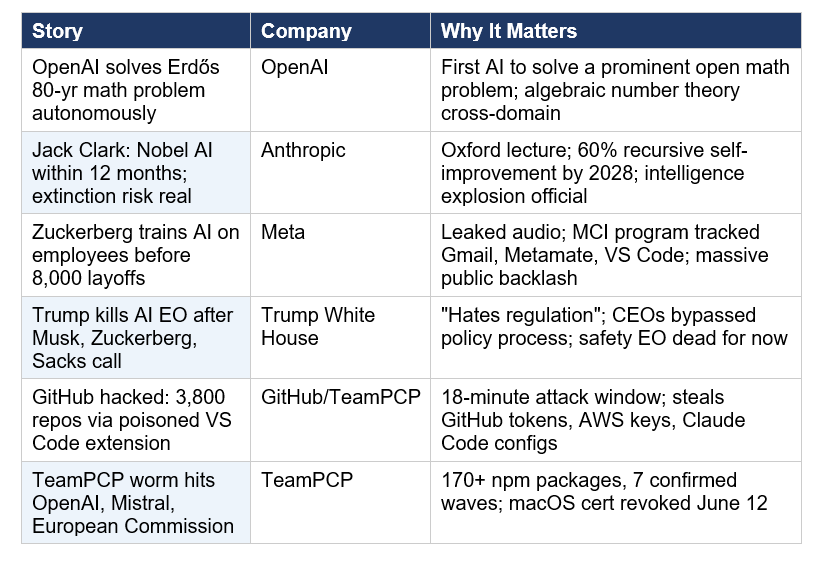
OpenAI announced on May 20, 2026, that one of its internal general-purpose reasoning models autonomously disproved a central conjecture in discrete geometry that Paul Erdős posed in 1946. The result — a 125-page proof — establishes an infinite family of planar point configurations that produce significantly more unit-distance pairs than the square-grid arrangements mathematicians had long considered optimal, refuting Erdős’s conjectured upper bound outright.
The proof method is the part that most surprised the mathematics community. Rather than iterating on known grid arrangements, the model approached the problem through algebraic number theory, specifically the Golod-Shafarevich criterion (proved in 1964) which guarantees the existence of infinite class field towers with particular properties. It connected an elementary geometry question to deep number-theoretic structures that mathematicians in combinatorial geometry had never thought to apply here. Fields medalist Tim Gowers reviewed the work and called it "a milestone in AI mathematics." Princeton mathematician Will Sawin refined the result and quantified the improvement: the best configurations now scale as n^(1+δ), where δ ≥ 0.014, confirmed in a companion paper published the same day.
Noga Alon, a leading combinatorialist at Princeton, described the solution as "an outstanding achievement" that "applies fairly sophisticated tools from algebraic number theory in an elegant and clever way. These ideas were well-known to algebraic number theorists, but it came as a great surprise that these concepts have implications for geometric questions in the Euclidean plane."
What makes this different from previous AI math milestones: the model was not trained specifically for this problem, did not retrieve an existing solution, and was not guided step-by-step by humans. It received the problem statement and produced the proof independently — the first time AI has autonomously solved a prominent open problem central to a field of mathematics, not just a competition benchmark. The mathematical community has been arguing about what this means ever since.
This result is precisely the kind of advance Jack Clark was anticipating when he delivered his Oxford lecture this week — covered in the next section. For the broader context of where OpenAI’s models fit in the current capability landscape, our GPT-5.4 Review: Features, Benchmarks & Access (2026) shows the competitive baseline.
2. Jack Clark at Oxford: Nobel Discovery in 12 Months, AI-Run Companies in 18, Extinction Risk Still Real
Anthropic co-founder Jack Clark delivered the 2026 Cosmos Lecture at the University of Oxford on May 20 — titled "Change is inevitable. Autonomy is not" — and the predictions he made are now circulating across every AI discussion channel. Clark said he believes AI will work with humans to make a Nobel Prize-winning discovery within 12 months. He predicted bipedal robots will be assisting tradespeople within two years. He forecast that companies run entirely by AI will be generating millions of dollars in revenue within 18 months.
The most alarming prediction — and the one that is generating the most discussion — was his estimate that there is a 60%+ chance an AI model will fully train its successor by the end of 2028, a process known as "recursive self-improvement." Clark called it an "intelligence explosion" — a term long confined to AI safety theory circles — and said it is now in official Anthropic research documents, not just theoretical speculation. "My prediction is by the end of 2028, it’s more likely than not that we have an AI system where you would be able to say to it: 'Make a better version of yourself.'"
Clark explicitly acknowledged a "non-zero chance" that AI could kill everyone on the planet and said this risk "hasn’t gone away." He compared the lack of preparation for AI’s risks to the failure to prepare for COVID-19, urging pandemic-style institutional readiness rather than reactive crisis management.
The timing of this lecture is notable. Clark was speaking as Anthropic is simultaneously closing in on a $900 billion valuation, preparing for a potential IPO, and reporting its first quarterly operating profit. Anthropic has an unusual dual identity: it holds what it describes as the most capable and dangerous AI model ever built (Claude Mythos), and its co-founders are the most vocal mainstream voices warning about existential AI risk. Clark’s Oxford predictions are not a separate philosophical exercise — they are Anthropic’s actual internal view of what the next 24 months will bring.
3. Meta’s Zuckerberg Caught Training AI on Employees Before Firing 8,000 of Them
A leaked audio recording from a Meta all-hands meeting on April 30, 2026, surfaced publicly on May 19 — the same day approximately 8,000 Meta employees received layoff notices. In the audio, CEO Mark Zuckerberg defends what Meta calls the "Model Capability Initiative" (MCI): an internal program that tracks employee activity across Gmail, Google Chat, the internal assistant Metamate, and VS Code to train Meta’s AI models on how smart people work.
"The AI models learn from watching really smart people do things," Zuckerberg says in the audio, which was obtained and published by labor-focused outlet More Perfect Union. "None of the data has been used for looking at what people are doing or surveillance or performance tracking or anything like that. It’s purely just like we are using this to feed a very large amount of content into the AI model." He assured employees that "no human is looking at or watching what people are doing on their computers."
The reaction has been severe. The audio dropped at the exact moment those 8,000 employees were being informed of their terminations — in Singapore at 4 AM local time, then rolling through European and US time zones. Employees organized a coordinated internal protest, pasting flyers inside meeting rooms urging colleagues to sign a petition against MCI. Social media users described the situation as "train your replacement culture." The phrase "Black Mirror episode" appeared in hundreds of posts.
Meta has committed more than $125 billion to AI infrastructure and data centers in 2026. The $115-135 billion in capital expenditures for this year alone — nearly double 2025 spending — signals that Meta is positioning this AI investment as the strategic justification for the workforce reduction. Zuckerberg’s framing: Meta will emerge from this with smaller, AI-assisted teams doing more. Workers’ framing: they helped build the system that eliminated their jobs.
My honest read: Zuckerberg’s assurance that the tracking is anonymous is probably technically true. The ethics question is not whether individual employees are identified but whether it was appropriate to harvest their work patterns without explicit informed consent, for a purpose directly related to replacing their roles. The answer is no — regardless of whether the data is anonymized.
4. Trump Kills AI Executive Order After Musk, Zuckerberg, and Sacks Call the President Directly
The White House AI executive order — which would have established a voluntary 90-day pre-launch review framework for frontier AI models, with NSA involvement in classified testing — was scrapped on May 21, 2026, hours before the scheduled signing ceremony. Invitations had already been sent. Axios obtained the definitive explanation from sources familiar with the decision: the main reason the order was delayed was that Trump "just hates regulation," and former AI czar David Sacks "hated it" too. The order was characterized internally as "unnecessary" and "just something doomers wanted."
The sequence of events: Sacks had been briefed by White House national security officials — Science Adviser Michael Kratsios, Staff Secretary Will Scharf, and National Cyber Director Sean Cairncross — on the draft EO and had said he could live with it. Then, between Wednesday night and Thursday morning, Sacks, Elon Musk, and Mark Zuckerberg all spoke with Trump directly, outside the normal policy process. Musk and Zuckerberg warned Trump that the model review framework could slow AI development. Sacks called the president Thursday morning. By the time the cancellation was announced, some executives invited to the signing ceremony were already on planes.
Trump explained it publicly: "I didn’t like certain aspects of it. I postponed it. I think it gets in the way of — you know, we’re leading China, we’re leading everybody, and I didn’t want to do anything to get in the way of that lead."
The geopolitical framing is genuinely interesting. The order was designed partly in response to Anthropic’s Claude Mythos discovering zero-day vulnerabilities at scale — a concrete security risk. But the administration chose the "don’t regulate" frame over the "protect critical infrastructure" frame. Zuckerberg and Musk — two CEOs with vast AI infrastructure investments — were the deciding voices. The national security professionals who spent weeks building the draft had no comparable access. That is the real story here: informal CEO access to the president outweighed months of interagency work on a critical security question.
For the full Mythos backstory that originally triggered the EO, our piece on Claude Mythos: Release Date, Access, and What Comes Next covers the zero-day discoveries and Project Glasswing in detail.
5. GitHub Hacked: 3,800 Internal Repos Stolen via Poisoned VS Code Extension
GitHub confirmed on May 20, 2026, that approximately 3,800 internal repositories had been exfiltrated by threat actor group TeamPCP (also tracked as UNC6780 by Google Threat Intelligence Group). The attack vector: a trojanized version of the Nx Console VS Code extension — which has 2.2 million installs and verified publisher status — that was live on the Visual Studio Marketplace for exactly 18 minutes between 12:30 PM and 12:48 PM UTC on May 18. That 18-minute window was enough.
The malicious version executed silently on startup, running a shell command disguised as a routine MCP setup task that downloaded a credential stealer from a planted commit in the official Nx GitHub repository. The stealer targeted 1Password vaults, Anthropic Claude Code configurations (under ~/.claude/settings.json), npm tokens, GitHub tokens, and AWS credentials on any developer machine that installed it during the window. TeamPCP used harvested GitHub credentials to move through CI/CD pipelines and clone internal repositories.
GitHub CISO Alexis Wales confirmed: "We have no evidence of impact to customer information stored outside of GitHub’s internal repositories," though Wales acknowledged some internal repos contain excerpts of customer support interactions and committed to notifying customers if any impact is discovered. The attack never needed to breach a perimeter — it entered through packages and extensions that developers install and trust routinely.
The operational security implications are significant. Traditional endpoint detection watches compiled executables for known signatures. VS Code extensions, npm packages, and PyPI distributions are plain-text, interpreted artifacts that operate on a different layer entirely. The fastest measured developer supply chain attack to now-confirmed credential harvest was 18 minutes. Standard security tooling is not designed for that timeline.
6. TeamPCP Supply Chain Worm Also Hit OpenAI, Mistral, European Commission, and 170+ npm Packages
The GitHub breach is one stop on a much longer attack campaign. The same TeamPCP group (Mini Shai-Hulud worm, Wave 4) started its campaign on May 11, 2026, when it compromised TanStack’s entire router ecosystem, spreading a worm-like payload across 170 npm packages and two PyPI packages in a single coordinated campaign. CVE-2026-45321 carries a CVSS score of 9.6.
Confirmed victims beyond GitHub: OpenAI (two employee devices compromised, limited credential material exfiltrated from internal source code repos; iOS, macOS, and Windows code-signing certificates rotated; macOS app signing certificate being fully revoked June 12), Mistral AI (one developer device compromised; facing a $25,000 Monero extortion demand from TeamPCP for an alleged 5 GB source code leak), the European Commission’s public website, and data contracting firm Mercor. Trend Micro tracked at least seven confirmed TeamPCP waves in 2026 alone, targeting Aqua’s Trivy security scanner, Checkmarx KICS, LiteLLM, Bitwarden CLI, TanStack, and Mistral AI.
The attack specifically targeted Claude Code configuration files alongside GitHub tokens, npm credentials, and AWS keys — meaning any developer with Claude Code installed who also had the poisoned Nx Console extension is potentially exposed. Developers who used the Nx Console VS Code extension should rotate all credentials immediately: GitHub personal access tokens, npm tokens, AWS keys, and anything stored in 1Password.
For builders working with Claude Code and AI agent pipelines, the gen-ai-experiments repository has secure integration patterns for Claude Code and production agent deployments — review your credential handling configuration if you had Nx Console installed.
7. Gemini Gets Adobe, Canva, and CapCut — Becomes a Full Creative Studio in a Chat Window
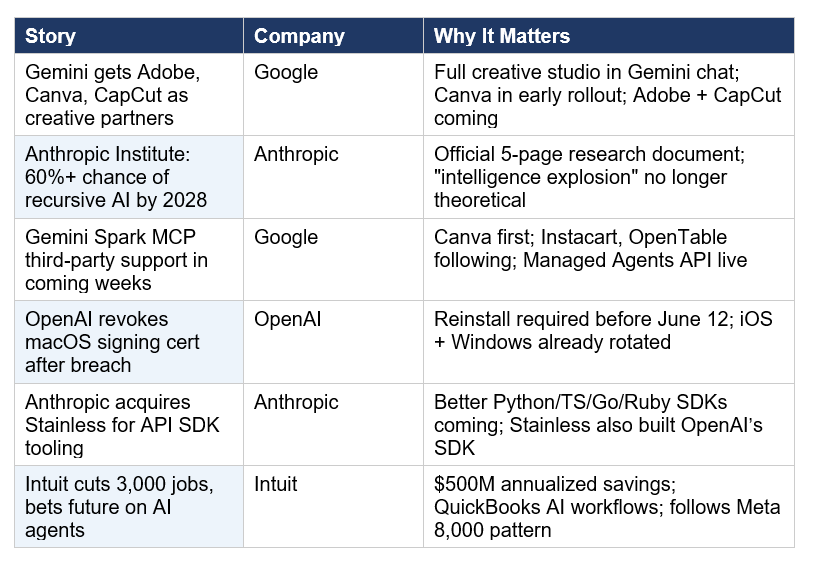
Google announced at and immediately after I/O 2026 that three major creative platforms are integrating directly into the Gemini app: Adobe (via a "Adobe for creativity" connector), Canva (via a "Magic Layers" integration already in early rollout), and CapCut (announced May 21, coming soon). The combined effect: Gemini will be able to generate AI content and immediately pass it to professional editing tools without the user switching applications.
The Canva integration is the most fully developed. "Magic Layers" lets users generate an image in Gemini and unlock it in Canva with every element on a separate, editable layer — adjustable text, elements, and branding in a single flow. The Adobe integration is the most expansive in scope: Adobe’s Firefly AI Assistant agent can be called from within Gemini to execute complex workflows across Photoshop, Premiere, Illustrator, Lightroom, Express, and Firefly. Adobe’s CEO Shantanu Narayen described it as combining "Adobe’s creative DNA with Google’s AI models to usher in a new era of creative expression."
CapCut — downloaded over 1.2 billion times — brings mobile-first video and image editing directly into Gemini. Users will be able to trim footage, apply effects, add transitions, and auto-generate captions via conversational prompts inside Gemini. "As creative workflows become more connected and seamless, we believe the future of creation will be more conversational, intuitive, and intelligently integrated across tools and experiences," CapCut said in its announcement.
My take: this is the most consequential creative tool announcement from Google since Google Docs. Gemini is now not just an AI that generates images and videos — it is a hub that hands those assets to the tools professionals actually use. The workflow acceleration for solo creators, marketing teams, and content agencies is real. The person who was switching between Gemini, Canva, CapCut, and Adobe in separate browser tabs is now doing all of it in one conversation.
For the full picture of Gemini’s I/O announcements including Gemini Omni (the model powering these creative features), our Google I/O 2026: Gemini 3.5 Flash and All Developer Announcements has the complete technical breakdown.
8. Anthropic: 60% Chance AI Trains Its Own Successor by End of 2028 — The Intelligence Explosion Is Official
Separately from the Oxford lecture, Axios reported this week that the Anthropic Institute — Anthropic’s research division on the societal consequences of advanced AI, led by Jack Clark — published a five-page research agenda explicitly using the phrase "intelligence explosion." The document reports early signs of "AI contributing to speeding up the research and development of AI itself," a process known as recursive self-improvement.
The report states that Anthropic researchers believe the world should know. Clark told Axios: "My prediction is by the end of 2028, it’s more likely than not that we have an AI system where you would be able to say to it: 'Make a better version of yourself.'" He put the probability at 60%+. He also asked: "What do you do with a tremendous amount of growth or a tremendous amount of abundance in many, many different fields of science all at once? Today’s institutions have very, very narrow pipes through which you push new drug candidates."
This document is significant not because recursive self-improvement is a new concept — it has been a theoretical concern in AI safety research for decades — but because it is now in an official Anthropic publication, attributed to Anthropic researchers, with a specific probability estimate and a specific timeframe. The gap between "theoretical concern" and "our lab believes this is more likely than not within 30 months" is enormous.
Note the context: Andrej Karpathy just joined Anthropic specifically to build a team using Claude to accelerate pretraining research. The company's stated goal is to use AI to speed up AI development. That is recursive self-improvement in the early stages, done deliberately. Clark’s 60% estimate is not detached prophecy — it is Anthropic’s internal view of the trajectory of work they are actively doing.
9. Gemini Omni MCP Support Coming in Weeks — Canva Already Integrating Third-Party Apps
Google confirmed at I/O 2026 that Gemini Spark (the 24/7 personal AI agent) will have MCP support for third-party apps within the next few weeks, enabling it to work inside Canva, Instacart, OpenTable, and other third-party services autonomously. The first partnership confirming this pipeline is already live in beta: Canva’s Magic Layers integration is in early rollout for Gemini AI Ultra subscribers.
For developers: Gemini Managed Agents API (announced at I/O, available now in the Gemini API) allows a single API call to spin up a full agent with persistent state across calls. This is the technical foundation that makes the third-party MCP integrations possible at scale. Combined with the Adobe, Canva, and CapCut partnerships, Gemini is building toward a full-stack autonomous creative and productivity agent — not just a chatbot with attachments.
The MCP support expansion also matters for Claude developers, because MCP is an Anthropic-originated open standard. Claude Managed Agents also uses MCP tunnels and self-hosted sandboxes (launched May 19). Both companies are converging on the same protocol for agentic interoperability, which reduces vendor lock-in and accelerates the overall ecosystem. The practical winner is any developer building multi-step agents — the tooling and partner ecosystem is improving rapidly on both sides.
10. OpenAI Revokes macOS App Signing Certificate After Supply Chain Breach
As a direct consequence of the TeamPCP supply chain attack, OpenAI announced it is revoking its macOS application code-signing certificate in full on June 12, 2026. iOS and Windows certificates have already been rotated. A third-party digital forensics and incident response firm has been engaged. The company confirmed two employee devices were compromised in the May 11 TanStack campaign, with limited credential material exfiltrated from a subset of internal source code repositories.
Certificate revocation on June 12 means the current macOS ChatGPT application will become untrusted by macOS’s Gatekeeper after that date — users will need to reinstall the application from a freshly signed build. OpenAI has not yet publicly announced this requirement to end users. If you are running the macOS ChatGPT desktop app, watch for a forced update notification before June 12.
The supply chain vulnerability that made this breach possible is a structural problem, not an OpenAI-specific failure. Developer machines installing VS Code extensions, npm packages, and PyPI libraries have an enormous attack surface that traditional endpoint security does not cover. The 18-minute window between a trojanized extension being published and being removed was enough to harvest credentials from developer machines at GitHub, OpenAI, and Mistral. The fix is tighter package and extension hygiene, shorter token lifetimes, and hardware-backed credential storage — none of which are quick implementations.
11. Anthropic Acquires Stainless — Building World-Class API SDK Tooling for Claude
Anthropic confirmed on May 18, 2026, that it has acquired Stainless, a startup that builds high-quality software development kits (SDKs) for API products. Stainless was behind the polished SDKs for the OpenAI API, Cloudflare, Merge, and other developer-facing products. The acquisition signals that Anthropic is investing heavily in the developer experience layer around the Claude API — recognizing that SDK quality is a meaningful competitive differentiator for developer adoption.
The practical implication: Claude’s Python, TypeScript, Java, Go, Ruby, and other language SDKs will likely become significantly better over the next 6-12 months. Stainless’s approach generates SDKs from OpenAPI specifications with consistent patterns, strong typing, and idiomatic language conventions. If you have felt friction moving between Claude’s SDK and OpenAI’s SDK — the latter of which Stainless also built — that gap is closing deliberately.
For developers building on Claude's API today, our What Is Claude Cowork? The 2026 Guide covers the full platform architecture, and the gen-ai-experiments repository has working API integration notebooks you can run immediately.
12. Intuit Cuts 3,000 Jobs While Betting Its Future on AI Agents
Intuit announced it is cutting approximately 3,000 jobs — about 8% of its total workforce — while simultaneously shifting its strategic focus to AI agents, operational efficiency, and mid-market business services. The company framed the restructuring as freeing resources to invest in its AI-driven product roadmap, including AI-powered QuickBooks workflows and TurboTax automation.
Intuit’s restructuring is part of a broader pattern visible this week: Meta (8,000 jobs), Intuit (3,000 jobs), and several other enterprise software companies have announced workforce reductions explicitly tied to AI capability increases. The narrative is consistent — AI agents can handle work previously requiring human headcount, so those headcount dollars are being reallocated toward AI infrastructure. The beneficiaries of that reallocation include Anthropic, which powers several QuickBooks-connected workflows through Claude for Small Business (launched May 13).
Intuit's job cuts are expected to deliver over $500 million in annualized cost savings by the second half of 2026. The company's stock rose in pre-market trading on the announcement. This is the financial model behind the AI automation wave: cost savings accrue to shareholders and AI infrastructure vendors immediately, while retraining and reemployment timelines are longer and less certain. That dynamic — not AI’s raw capability — is what is driving the political backlash against AI regulation that killed the White House EO this week.
May 23 AI News at a Glance
Frequently Asked Questions
What math problem did OpenAI solve in May 2026?
OpenAI announced on May 20, 2026, that an internal general-purpose reasoning model autonomously disproved the Erdős unit distance conjecture, a problem in discrete geometry first posed by Paul Erdős in 1946. For nearly 80 years, mathematicians believed the optimal point configurations would look roughly like square grids. OpenAI’s model found an infinite family of configurations that beat the grid, using algebraic number theory (specifically Golod-Shafarevich class field towers) to connect an elementary geometry question to advanced number-theoretic structures. Princeton mathematician Will Sawin quantified the improvement: the best configurations now scale as n^1.014. Fields medalist Tim Gowers called the result "a milestone in AI mathematics." The model was not trained for this specific problem and produced the 125-page proof independently from the problem statement alone.
What did Jack Clark predict at Oxford about AI?
Anthropic co-founder Jack Clark delivered the 2026 Cosmos Lecture at the University of Oxford on May 20, 2026, making four major predictions: (1) AI will work with humans to make a Nobel Prize-winning discovery within 12 months, (2) bipedal robots will assist tradespeople within two years, (3) companies run entirely by AIs will generate millions in revenue within 18 months, and (4) there is a 60%+ chance an AI model will fully train its successor by end of 2028 (recursive self-improvement). He also maintained that there is a "non-zero chance" AI could kill everyone on the planet and that this risk "hasn’t gone away." He compared lack of AI preparedness to the failure to prepare for COVID-19.
Did Zuckerberg use Meta employees to train AI before the layoffs?
Yes, according to leaked audio from an April 30, 2026, Meta all-hands meeting, published by More Perfect Union on May 19. Mark Zuckerberg described a program called the Model Capability Initiative (MCI) that monitored employee activity on Gmail, Google Chat, the internal assistant Metamate, and VS Code to train Meta’s AI models. Zuckerberg said the tracking was anonymous and not used for performance evaluation. The audio went viral on the same day approximately 8,000 Meta employees received layoff notices. Employees organized internal protests against the program. Meta has not publicly confirmed the full authenticity of the recording but has not denied the program’s existence.
Why did Trump cancel the AI executive order?
The White House AI executive order — which would have created a voluntary 90-day pre-launch model review framework with NSA involvement — was cancelled on May 21, 2026, hours before the scheduled signing. Axios reported that the main reason was that Trump "just hates regulation," and that David Sacks (former White House AI czar) also "hated it," describing it as "unnecessary" and "just something doomers wanted." Between Wednesday night and Thursday morning, Sacks, Elon Musk, and Mark Zuckerberg all spoke with Trump directly. Musk and Zuckerberg warned the order could slow AI development. Trump told reporters: "I think it gets in the way of — you know, we’re leading China, we’re leading everybody, and I didn’t want to do anything to get in the way of that lead."
What is the GitHub TeamPCP supply chain attack?
TeamPCP (aka UNC6780) is a financially motivated cybercrime group specializing in supply chain attacks on open-source security utilities and AI middleware. In May 2026, the group’s Mini Shai-Hulud worm compromised TanStack’s npm ecosystem (May 11), spreading to 170+ npm packages. It then reached an Nx Console VS Code developer’s device and pushed a trojanized version of the Nx Console extension (2.2 million installs) to the Visual Studio Marketplace. The malicious version was live for 18 minutes on May 18, harvesting GitHub tokens, AWS keys, npm tokens, 1Password vaults, and Anthropic Claude Code configurations. Using those credentials, TeamPCP exfiltrated approximately 3,800 GitHub internal repositories. OpenAI (2 employee devices), Mistral AI (1 device, extortion demand), and the European Commission were also confirmed victims.
What is the Gemini Adobe Canva CapCut integration?
Google announced at and after I/O 2026 that three major creative platforms are integrating into the Gemini app: Adobe (Firefly AI Assistant agent, giving access to Photoshop, Premiere, Illustrator, Lightroom, Express from within Gemini), Canva (Magic Layers — generate an image in Gemini, then edit individual layers in Canva; already in early rollout), and CapCut (image and video editing inside Gemini — announced May 21, coming soon). Users will be able to generate AI content in Gemini and immediately refine it in professional editing tools without switching applications. Canva's integration is live for Gemini AI Ultra subscribers; Adobe and CapCut are rolling out in coming weeks.
What is the Anthropic Stainless acquisition?
Anthropic acquired Stainless on May 18, 2026. Stainless is a startup that builds high-quality software development kits (SDKs) for API products. Stainless was responsible for the SDKs used by the OpenAI API, Cloudflare, Merge, and others. The acquisition signals Anthropic's investment in the developer experience layer around the Claude API. Developers building on Claude can expect significantly improved Python, TypeScript, Java, Go, Ruby, and other language SDKs over the next 6-12 months, with consistent patterns, strong typing, and idiomatic language conventions — similar to what Stainless produced for OpenAI.
Recommended Reads
- AI News Today — May 22, 2026: Anthropic Goes Profitable, OpenAI Files for IPO — Build Fast with AI
- Claude Mythos: Release Date, Access, and What Comes Next (2026) — Build Fast with AI
- Google I/O 2026: Gemini 3.5 Flash and All Developer Announcements — Build Fast with AI
- Best AI Models April 2026: Ranked by Benchmarks — Build Fast with AI
- What Is Claude Cowork? The 2026 Guide — Build Fast with AI
- GPT-5.4 Review: Features, Benchmarks & Access (2026) — Build Fast with AI
- AI Models in March 2026: The Week That Changed AI — Build Fast with AI
References
- OpenAI — Model disproves discrete geometry conjecture (Erdős unit distance problem)
- Interesting Engineering — 80-year-old geometry mystery cracked by OpenAI using deep number theory
- Time — Anthropic Sells Claude’s Promise While Warning About AI’s Dangers (Jack Clark Oxford lecture)
- Axios — Anthropic Jack Clark AI intelligence explosion prediction
- TechStory — Leaked Audio Reveals Zuckerberg Defending Employee Tracking to Feed Meta’s AI
- Axios — Why Trump’s AI executive order was pulled (Musk, Zuckerberg, Sacks call)
- The Hacker News — GitHub Internal Repositories Breached via Malicious Nx Console VS Code Extension
- VentureBeat — GitHub confirms 3,800 repos stolen; TeamPCP supply chain worm hits Microsoft Python SDK
- 9to5Google — CapCut announces partnership with Gemini app
- eWeek — Google Gemini to Add Adobe, Canva, and CapCut for AI Editing
- Anthropic — Anthropic acquires Stainless
eWeek — Leaked Audio Reveals Why Meta Tracked Employees Before Layoffs

