



AI News Today — May 22, 2026: Anthropic Goes Profitable, OpenAI Files for IPO, and SpaceX Opens the Books
Three IPO stories exploded onto the same day. Anthropic revealed it is on track for its first quarterly operating profit ever, projecting $10.9 billion in Q2 2026 revenue. OpenAI is preparing to file a confidential S-1 with the SEC as early as today. And SpaceX's long-awaited IPO prospectus landed, containing a bombshell: Anthropic is paying SpaceX $1.25 billion every month through May 2029 for GPU compute. Meanwhile, the White House AI executive order was postponed again, CNBC published a detailed warning that cheap AI could derail both $800B+ IPO valuations, and Chinese models hit 60% of all AI usage on OpenRouter. Here are the 12 freshest stories for May 22, 2026.
1. Anthropic Q2 2026 Projection: $10.9 Billion Revenue and First-Ever Quarterly Profit
Anthropic shared financial projections with investors this week that represent the most dramatic single-quarter revenue story in AI history: $10.9 billion in revenue for the quarter ending in June 2026, up 130% from $4.8 billion in Q1. At the same time, the company expects operating income of approximately $559 million — its first-ever quarterly operating profit, defying its own guidance from last summer that suggested full-year profitability was unlikely before 2028.
The growth has been driven by three converging forces. First, Claude Code and its developer ecosystem have become the dominant agentic coding tools for enterprise software teams — generating recurring high-margin API revenue. Second, compute efficiency is improving dramatically: in Q1, Anthropic spent 71 cents on compute for every dollar of revenue; that ratio is projected to fall to 56 cents in Q2. Third, the enterprise customer base is compounding — the number of customers spending $1 million or more annually doubled from 500 to over 1,000 between February and April 2026.
To put the trajectory in context: Anthropic's annualized run rate at end-2025 was approximately $9 billion. By early April 2026 it was $30 billion. By the Q2 end at $10.9 billion quarterly, the run rate hits $43.6 billion. CEO Dario Amodei said at a developer conference earlier this month that revenue growth had become "too hard to handle." That is not false modesty — it is an operational supply-side constraint. The company is spending $1.25 billion per month on SpaceX compute alone.
The profitability milestone matters beyond the number. Frontier AI companies are universally assumed to be loss-making. Anthropic becoming operationally profitable in Q2 2026 — while still actively training frontier models — fundamentally changes the IPO narrative for both Anthropic and OpenAI, which has not publicly disclosed its own profitability timeline.
For a full picture of the Claude model lineup powering this revenue, our Best AI Models April 2026: Ranked by Benchmarks covers where Claude Opus 4.7, Sonnet 4.6, and Claude Code sit relative to the competitive field.
2. OpenAI Prepares Confidential IPO Filing — September Listing Targeted, $852B Valuation
OpenAI is preparing to confidentially file its IPO prospectus with the SEC as early as Friday, May 22, 2026, according to CNBC, Reuters, and Axios all reporting the same timeline. The company is working with Goldman Sachs and Morgan Stanley on the planned filing. A confidential filing allows OpenAI to begin the SEC review process without making its full financial details public — companies typically move from confidential filing to a public S-1 two months later, with an offering another month after that.
Under that sequence, a confidential filing today would point toward a public S-1 in late July or early August, with a September IPO. Axios noted that SpaceX filed confidentially in April and investors now anticipate a late June listing — giving them a live reference point for the IPO pipeline cadence. At a $852 billion private market valuation, an OpenAI IPO at $1 trillion would be the largest technology public offering in history.
The competitive dynamic is critical. Anthropic has also told investors and banks it is open to a public listing by year-end, with October 2026 the most frequently cited window. Coinbase data suggests the market-implied probability of OpenAI listing before Anthropic shot to 85% on the filing news, while Anthropic's odds fell to 28%. Both companies are racing because whoever goes first sets the valuation comparable — and whoever goes second will be measured against that baseline.
One uncomfortable tension: OpenAI's financial picture is less clear than Anthropic's. OpenAI is generating $25 billion in ARR against an $852B valuation. Anthropic is on track for $43.6B in annualized revenue at a $900B valuation — and it is approaching profitability. On revenue quality and growth rate, Anthropic's prospectus data is currently stronger than OpenAI's disclosed numbers. The race to file first is partly a race to set the narrative before the other company's numbers become the comparable.
3. SpaceX S-1 Reveals Anthropic Pays $1.25 Billion Per Month for Compute — $45 Billion Total Through 2029
The most shocking number in SpaceX's IPO filing, released May 21, 2026, has nothing to do with Starlink or Starship. It is a single line in the related-party transactions section: Anthropic has agreed to pay SpaceX $1.25 billion per month for compute access through May 2029 — totaling approximately $45 billion across the contract term. At the current rate that is $15 billion per year, nearly matching SpaceX's entire 2025 standalone revenue.
The deal covers Colossus 1 (220,000-plus NVIDIA GPUs, 300 megawatts, Memphis Tennessee) and is expanding to Colossus 2 throughout June 2026. On the same day the SpaceX S-1 dropped, Anthropic co-founder and president Daniela Amodei confirmed on X that the company is expanding to Colossus 2 to access NVIDIA GB200 (Blackwell Ultra) capacity: "We're expanding our partnership with SpaceX, and will be scaling up on GB200 capacity in Colossus 2 throughout June."
Either company can terminate with 90 days' notice, which provides limited protection for both sides. The terms for May and June are discounted as the deal ramps up to full capacity. After that, the $1.25B monthly rate is the contract price.
For context: this is not the only compute deal Anthropic has. The company has separate agreements with Amazon, Google, Broadcom, Microsoft, NVIDIA, and Fluidstack. It is assembling a multi-vendor compute strategy rather than concentrating all capacity in one provider. But the SpaceX deal is by far the largest single contract disclosed publicly, and it reveals the true infrastructure cost structure behind Anthropic's revenue growth. At $1.25B/month on compute alone — even before counting AWS, Google Cloud, and other providers — the compute spend is extraordinary. The improving 56-cent compute ratio for Q2 includes all of this.
For a full breakdown of the Claude Code and Managed Agents architecture driving the demand that requires this compute, see our guide to What Is Claude Cowork? The 2026 Guide which covers how Anthropic's platform products are structured.
4. SpaceX IPO Filing: $1.75 Trillion Target, 10.3 Million Starlink Subscribers, $4.3 Billion Q1 Loss
SpaceX filed its public IPO prospectus with the SEC on May 20, 2026, targeting a listing on Nasdaq under the ticker SPCX at a reported valuation of $1.75 trillion — which would make it the largest IPO in history if achieved. Elon Musk will retain 85.1% of combined voting power through a dual-class share structure (Class B shares carry 10 votes per share versus Class A for public investors). Musk has said he will not sell any shares.
The financials are a story of three very different businesses in one entity. The Connectivity segment (Starlink) generated $1.19 billion in operating profit in Q1 2026, with 10.3 million subscribers in 164 countries as of March 31. The Space segment (rocket launches) posted a $662 million operating loss driven by Starship R&D. The AI segment (SpaceXAI, formerly xAI) posted $818 million in revenue and a $2.47 billion operating loss in Q1 — a loss rate of approximately $3 for every $1 of revenue.
The total Q1 2026 picture: $4.69 billion in revenue, $4.28 billion net loss. For full year 2025: $18.7 billion in revenue (combined with xAI and X, retroactively), $4.9 billion net loss. The xAI merger turned a profitable company into a loss-making one.
The AI revenue in the SpaceX filing will increase materially in Q2 and Q3 as the Anthropic $1.25B/month compute deal ramps to full rate. That single contract could add roughly $2.5 billion in quarterly AI revenue — potentially turning the xAI segment toward breakeven. That is likely why SpaceX is willing to disclose these numbers now: the trajectory from here is up.
5. White House AI Executive Order Postponed Again — Internal Disagreements Behind the Delay
The White House AI executive order — which would have established a voluntary 90-day pre-launch review framework for frontier AI models, with NSA involvement in classified testing — was postponed on May 21, 2026, according to CNN and the Washington Post. The signing had already been delayed multiple times. Invitations had already been sent for the signing event before the postponement was announced.
The reasoning behind the delay was not publicly disclosed, but reporting from Axios and the Washington Post points to continued internal disagreements about the scope and enforceability of the framework. The administration is torn between its default pro-innovation, anti-regulation posture and its genuine concern — sparked by Anthropic's Mythos model discoveries — that frontier AI cybersecurity capabilities are outpacing defensive capacity.
The proposed framework would be voluntary, meaning AI labs that do not comply face no legal penalty. That weakness is precisely the disagreement: hardliners want binding rules with NSA classified access; deregulation advocates want the word "voluntary" to mean exactly that. The Claude Mythos discovery of zero-day vulnerabilities in legacy financial infrastructure is what originally forced the administration's hand. But forcing voluntary compliance from OpenAI and Anthropic when both are weeks away from confidential IPO filings is a delicate political calculation.
The Mythos backstory that triggered this entire White House effort is covered in depth in our piece on Claude Mythos: Release Date, Access, and What Comes Next.
6. Cheap AI Could Derail OpenAI and Anthropic IPOs — CNBC Investigation
CNBC published a detailed investigative report on May 20, 2026, arguing that the spread of cheap, near-frontier AI models — from Chinese labs and Western challengers — is eroding the pricing power that underpins both companies' $800B+ IPO valuations. The report cites specific per-query cost benchmarking from AI firm Artificial Analysis across 10 standard evaluations: Anthropic's Claude costs $4,811 to run through, OpenAI's ChatGPT costs $3,357, DeepSeek costs $1,071, Kimi costs $948, and Zhipu's GLM costs $544. Claude is nearly nine times more expensive than the cheapest Chinese alternative for the same workload.
The enterprise adoption data is the scariest signal. On OpenRouter, the share of Chinese models rose from approximately 1% in 2024 to more than 60% by May 2026. Databricks CEO Ali Ghodsi described the "advisor model" approach now spreading through enterprise: firms use cheap open-source or Chinese models as the default layer and call OpenAI or Anthropic only for tasks those models cannot solve. In that architecture, every frontier model improvement is immediately challenged by cheaper alternatives that "good enough" for most use cases.
Anthropic itself acknowledged the pressure in a policy paper released this month, stating that US models are only "several months ahead" of Chinese ones and that Beijing is "winning in global adoption on cost." OpenAI pushed back, with a person familiar with its thinking saying that every frontier model release, including GPT-5.5, had driven a "vertical wall" of enterprise demand. Their argument: at the frontier, quality matters enough to justify the price premium. The data on OpenRouter adoption tells a different story for the middle of the market.
The CNBC analysis is fundamentally right on the structural risk. IPO valuations at $800B+ for both companies imply sustained pricing power at the frontier for years. If Chinese models close the capability gap to within 5-10% in 12 months — which Anthropic itself implies is plausible — the addressable market paying a 9x premium for the last marginal capability improvement shrinks rapidly. The path to justifying a trillion-dollar valuation is narrower than the current revenue trajectory suggests.
7. Chinese AI Models Hit 60% of All OpenRouter Usage — From Just 1% in 2024
Databricks CEO Ali Ghodsi, citing OpenRouter marketplace data, disclosed that Chinese AI models grew from approximately 1% of usage on OpenRouter in 2024 to more than 60% by May 2026. OpenRouter is the most-used third-party AI model routing platform for developers, making its usage data one of the cleanest real-world signals of where developer dollars are actually going.
The specific models driving the shift: DeepSeek's V3.2 (currently priced at $0.28/$0.42 per million tokens), Kimi K2.6 ($0.95/M tokens, 90.5% GPQA), and Zhipu's GLM-5.1 ($544 total cost for Artificial Analysis's 10-evaluation benchmark set, versus $4,811 for Claude). These are not toy models with toy capabilities — they are competitive on most of the same benchmarks that OpenAI and Anthropic publish.
The 60% figure needs context. OpenRouter skews toward individual developers and price-sensitive startups, not the large enterprise accounts that make up the majority of Anthropic's and OpenAI's revenue. But developer adoption today is enterprise adoption in 18 months. The engineers choosing DeepSeek and Kimi for their side projects and internal tools in 2026 are the same engineers who will architect their company's AI infrastructure in 2027.
For a full cost and benchmark comparison of where the Chinese and Western models stand today, our Best AI Models April 2026 ranking covers the full competitive landscape across pricing tiers.
8. Anthropic Expands to Colossus II — GB200 Capacity Scaling Through June
Alongside the SpaceX S-1 reveal, Anthropic president Daniela Amodei confirmed that the company is expanding its SpaceX compute deal to include Colossus 2, not just Colossus 1. "We're expanding our partnership with SpaceX, and will be scaling up on GB200 capacity in Colossus 2 throughout June," she wrote on X. GB200 refers to NVIDIA's Blackwell Ultra GPUs, the current generation successor to the H100s that power most of today's frontier training runs.
Colossus 2 is SpaceX's second Memphis data center, built on a site purchased last March. It came online in January 2026. Combined with Colossus 1, the two facilities represent over one gigawatt of compute capacity and more than 220,000 NVIDIA GPUs. Getting GB200 access at Colossus 2 is significant: Blackwell Ultra offers meaningfully faster training and inference performance per GPU than previous generations, which directly translates into faster model iteration cycles and higher throughput for Claude Code and API workloads.
The practical implication for users: Claude Code rate limits, which were already doubled in early May, will continue improving as GB200 capacity comes online through June. This is not a theoretical infrastructure upgrade — it is the supply-side explanation for why Anthropic's Q2 revenue projections are credible.
9. Anthropic Acknowledges US Models Are Only "Several Months Ahead" of China
In a policy paper released in May 2026, Anthropic made a candid admission that stands in sharp contrast to the confidence of its IPO preparation: US AI models are only "several months ahead" of Chinese counterparts, and Beijing is "winning in global adoption on cost." The paper was written in the context of advocating for US government support and infrastructure investment — but the underlying acknowledgment is significant regardless of the political context.
"Several months" in AI development is an extraordinarily narrow lead. The US AI advantage in compute access, TSMC chip supply, and frontier researcher concentration was supposed to be measured in years. If Anthropic — the company operating the most capable AI cybersecurity model in the world — believes the gap is merely months, the urgency of compute infrastructure investment, export controls on AI chips, and the White House executive order make far more sense.
The framing also helps explain Karpathy's move to Anthropic's pretraining team (covered in yesterday's May 21 blog). Using Claude to accelerate pretraining research is precisely the kind of innovation Anthropic needs to extend that "several months" lead into "several years." Closing the gap from the training efficiency side, rather than just the compute spending side, is the sustainable path.
For the technical context on what Anthropic's most capable models can do, our deep dive on Claude Mythos: Release Date, Access, and What Comes Next covers the cybersecurity capabilities and Project Glasswing access model in detail.
10. How Google Plans to Win the AI War — Distribution vs Capability
Axios published a detailed strategic analysis on May 21 of Google's I/O 2026 announcements, framing the company's approach as fundamentally different from OpenAI's and Anthropic's: "Unlike OpenAI and Anthropic, Google enters the AI race with enormous scale, distribution and cash flow — but also a vast empire it has to defend." The core argument: Google's path to winning is not matching benchmark scores, but making AI unavoidable across all surfaces where it already dominates.
The evidence is in the I/O announcements: Gemini 3.5 Flash powering Google Search AI Mode for hundreds of millions of daily searches, Ask YouTube transforming the world's second-largest search engine into a conversational platform, Universal Cart creating an AI commerce layer across Amazon, Shopify, and Walmart, and Gemini Spark operating 24/7 in the background of Android and iOS devices. Every one of these is distribution, not capability.
The distribution thesis is compelling as a defense strategy. But it has an offensive limitation: if Anthropic's Claude reaches 40+ billion in quarterly revenue by winning at enterprise coding, agentic workflows, and cybersecurity — while Google wins at consumer search and mobile — the two companies end up in different markets. Distribution wins the consumer. Capability wins the enterprise. Both can be true simultaneously, and neither threatens the other's core business directly. That may be the actual resolution of the "AI war" that everyone is predicting: not one winner, but market segmentation by use case.
11. Gemini 3.5 Flash Benchmarks Clarify: It Beats Gemini 3.1 Pro on Coding and Agents, Trails on Knowledge
As developers dug into Gemini 3.5 Flash benchmarks in the 48 hours since launch, a clearer competitive picture has emerged. The Build Fast with AI analysis of Google's published benchmark table confirms: 3.5 Flash leads all reported models on five separate evaluations focused on coding and agentic tasks, including beating Claude Opus 4.7 and GPT-5.5 on those specific benchmarks. It also beats Gemini 3.1 Pro on coding and agents.
Where 3.5 Flash trails: long-context tasks (MRCR v2 at 128k tokens) and Humanity's Last Exam, where deep knowledge breadth matters more than agentic capability. The model ID is now stable (gemini-3.5-flash, no preview suffix). Inside Antigravity 2.0, the optimization runs at 12x the speed of comparable frontier models versus the 4x figure on the public API.
The pricing controversy (3x higher than Gemini 3 Flash Preview) is real but misses the product positioning: Google is not positioning 3.5 Flash as a cost efficiency tool. It is positioning it as a near-Pro model at Flash speed. At $1.50/$9 per million tokens, it is priced below Claude Sonnet 4.6 ($3/$15) and above Gemini 3.1 Flash-Lite ($0.25/$1.25). That middle-tier positioning makes sense if the benchmark claims hold — and early developer testing suggests they do for coding-heavy workloads.
For a full benchmark side-by-side including Gemini 3.5 Flash versus Claude and GPT-5.5, see our Google I/O 2026: Gemini 3.5 Flash and All Developer Announcements — updated with post-launch developer data.
12. AI IPO Race Timeline: SpaceX June, OpenAI September, Anthropic October — The Race Is On
The three most anticipated public offerings in technology history are now aligned in a six-month window. SpaceX filed its public S-1 on May 20 and is targeting a June 2026 Nasdaq listing under SPCX, with reporting suggesting pricing could happen as early as June 11–12. OpenAI is filing confidentially as early as May 22 for a September listing. Anthropic is targeting October as the most likely window.
The sequence matters strategically. SpaceX goes first and provides the market-clearing valuation for AI-adjacent infrastructure, giving investors a reference point for compute economics. OpenAI goes second and sets the valuation benchmark for frontier AI revenue models — $852 billion to $1 trillion, depending on how the market receives the S-1 numbers. Anthropic goes third, with the advantage of being able to point to: (a) superior revenue growth rate, (b) first quarterly operating profit, and (c) being valued at a discount to OpenAI on a forward revenue multiple.
The risk in this sequence: if OpenAI's S-1 shows difficult numbers — slower growth, higher compute costs, thinner margins than expected — it could make the market more skeptical of AI IPOs generally, hurting Anthropic's October listing. Conversely, if OpenAI's numbers are strong, it validates the premium AI model business as a public market category and Anthropic goes out into a warm market with better numbers.
One wildcard: the CNBC cheap AI story. If the investor community reads the OpenRouter 60% Chinese model adoption data and the DeepSeek cost comparison as evidence of pricing erosion, the entire AI IPO window could face headwinds regardless of how good each company's individual numbers are. The narrative battle around AI valuations is happening in parallel to the financial one.
If you are building on any of the models at the center of this IPO race and want to compare your stack choices, the gen-ai-experiments repository has hands-on notebooks for Claude Code, Gemini API, and OpenAI integration patterns you can run and evaluate directly.
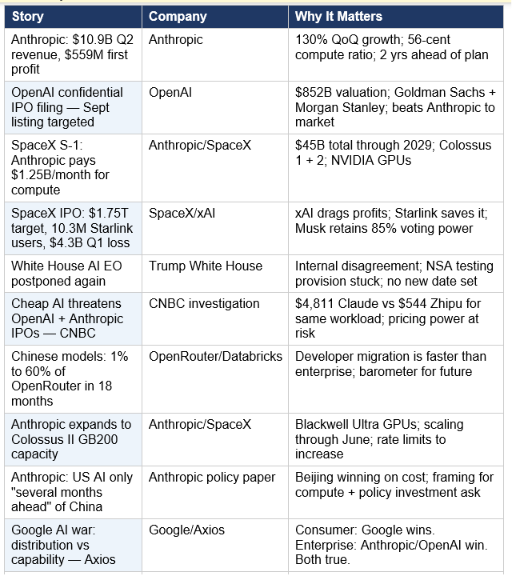
May 22 AI News at a Glance
Frequently Asked Questions
Is Anthropic profitable in 2026?
Anthropic is on track for its first quarterly operating profit in Q2 2026 (the quarter ending in June). The company projects $10.9 billion in revenue for Q2 — up 130% from $4.8 billion in Q1 — and operating income of approximately $559 million. This was shared with investors as part of an ongoing fundraising round, per Wall Street Journal reporting on May 21, 2026. Compute costs, which consumed 71 cents per revenue dollar in Q1, are projected to fall to 56 cents in Q2. Anthropic cautioned it may not sustain full-year profitability given planned infrastructure spending increases, particularly the $1.25 billion per month SpaceX compute deal.
When is the OpenAI IPO filing?
OpenAI is preparing to file a confidential IPO prospectus with the SEC as early as May 22, 2026, per CNBC, Reuters, and Axios. Working with Goldman Sachs and Morgan Stanley, OpenAI is targeting a September 2026 public listing. The confidential filing triggers a minimum SEC review period before the public S-1 can be released — typically about two months. A September listing would mean the public S-1 lands in July or early August. OpenAI is currently valued at approximately $852 billion by private investors and is generating $25 billion in annualized revenue.
How much is Anthropic paying SpaceX per month?
Anthropic is paying SpaceX $1.25 billion per month through May 2029 for compute access at SpaceX's Colossus 1 and Colossus 2 data centers in Memphis, Tennessee. The deal was disclosed in SpaceX's IPO S-1 filing with the SEC on May 20, 2026. The total contract value through May 2029 is approximately $45 billion. May and June 2026 payments are discounted as the deal ramps to full capacity. Either party can terminate the agreement with 90 days' notice. On the same day, Anthropic confirmed it is also expanding to access NVIDIA GB200 (Blackwell Ultra) capacity at Colossus 2 throughout June 2026.
What did SpaceX reveal in its IPO filing?
SpaceX filed its public S-1 IPO prospectus on May 20, 2026, targeting a $1.75 trillion valuation on Nasdaq (ticker: SPCX). Key disclosures: $18.7 billion in 2025 revenue (combined with the xAI and X acquisitions), $4.9 billion 2025 net loss, $4.3 billion Q1 2026 net loss. Starlink generated $1.19 billion in Q1 operating profit from 10.3 million subscribers in 164 countries. The xAI segment posted $818 million in Q1 revenue and a $2.47 billion operating loss. The SpaceXAI AI segment spent $7.7 billion on AI infrastructure in Q1 2026 alone, suggesting a $30 billion annual run rate. Elon Musk retains 85.1% voting power through dual-class shares and will not sell any shares in the IPO.
Why could cheap AI derail OpenAI and Anthropic IPOs?
CNBC reported on May 20, 2026, citing AI benchmarking firm Artificial Analysis, that running a standard 10-evaluation workload costs $4,811 with Anthropic's Claude, $3,357 with OpenAI's ChatGPT, $1,071 with DeepSeek, $948 with Kimi, and $544 with Zhipu's GLM. Chinese models' share of usage on developer platform OpenRouter rose from 1% in 2024 to over 60% by May 2026. Both OpenAI and Anthropic are targeting IPO valuations above $800 billion, which require sustained pricing power at the frontier. If enterprises increasingly route to cheaper models for all but the most demanding tasks — the "advisor model" pattern Databricks' CEO describes — the addressable market willing to pay premium prices shrinks, compressing the margin assumptions behind the valuations.
What happened to the White House AI executive order?
The White House AI executive order, which would have established a voluntary framework for AI companies to share frontier models with the US government up to 90 days before public release, was postponed on May 21, 2026. The signing had been announced with invitations already sent when it was called off. The order has been postponed multiple times. CNN and the Washington Post reported that internal White House disagreements — between pro-innovation factions wanting the framework to be genuinely voluntary and national security advocates wanting NSA-backed classified testing with real enforcement — are the primary cause. No new signing date has been announced.
What is the AI IPO race timeline in 2026?
Three major AI-related companies are targeting public listings in a six-month window. SpaceX filed its public S-1 on May 20, 2026, targeting a June 2026 Nasdaq listing (ticker SPCX) at a $1.75 trillion valuation. OpenAI is filing a confidential S-1 with the SEC as early as May 22, targeting a September 2026 listing at approximately $852 billion to $1 trillion. Anthropic, which has also engaged investment banks and is raising at a $900 billion valuation, is targeting an October 2026 listing. Coinbase prediction market data shows the market implies an 85% probability that OpenAI lists before Anthropic.
Recommended Reads
- AI News Today — May 21, 2026: Karpathy to Anthropic, White House AI EO, and 11 More Stories — Build Fast with AI
- Claude Mythos: Release Date, Access, and What Comes Next (2026) — Build Fast with AI
- Google I/O 2026: Gemini 3.5 Flash and All Developer Announcements — Build Fast with AI
- Best AI Models April 2026: Ranked by Benchmarks — Build Fast with AI
- What Is Claude Cowork? The 2026 Guide — Build Fast with AI
- GPT-5.4 Review: Features, Benchmarks & Access (2026) — Build Fast with AI
- AI Models in March 2026: The Week That Changed AI — Build Fast with AI
Anthropic going profitable, OpenAI filing for IPO, and SpaceX revealing a $45 billion Anthropic compute contract all on the same day is not a slow news cycle. We will have a dedicated analysis of the OpenAI S-1 implications and the Anthropic profitability breakdown this week. Subscribe to Build Fast with AI (12,000+ subscribers) to get it first.
References
- Wall Street Journal — Anthropic Projects Record Revenue and Its First Quarterly Operating Profit
- CNBC — OpenAI to confidentially file for IPO as soon as Friday
- Axios — Anthropic is paying SpaceX $15 billion per year
- TechCrunch — Anthropic will pay xAI $1.25 billion per month for compute
- Morningstar — SpaceX's IPO Filing: Big Spending, Big Losses
- CNN — White House postpones executive order on AI
- CNBC — Cheap AI could derail OpenAI and Anthropic's IPOs
- Axios — OpenAI IPO filing plan and SpaceX comparison
- Axios — How Google plans to win the AI war
- PYMNTS — Anthropic On Track for First Operating Profit as Revenue Surges
- Build Fast with AI — Google I/O 2026: Gemini 3.5 Flash and Developer Announcements

