



AI News Today - May 21, 2026: Karpathy to Anthropic, White House AI EO, and 11 More Stories
The morning after Google I/O is never quiet. Today, Andrej Karpathy — OpenAI co-founder, former Tesla Autopilot lead, and the most beloved AI educator alive — announced he is joining Anthropic to rebuild its pretraining research team from the inside. At almost the same moment, CNN and Axios reported that the Trump White House could sign an AI executive order as early as Thursday requiring frontier labs to share models with the NSA and other agencies 90 days before public launch. Claude picked up MCP tunnels and self-hosted sandboxes. Gemini 3.5 Flash pricing landed and developers already have opinions. The Oscars made its definitive AI stance. Here are all 13 stories worth reading today.
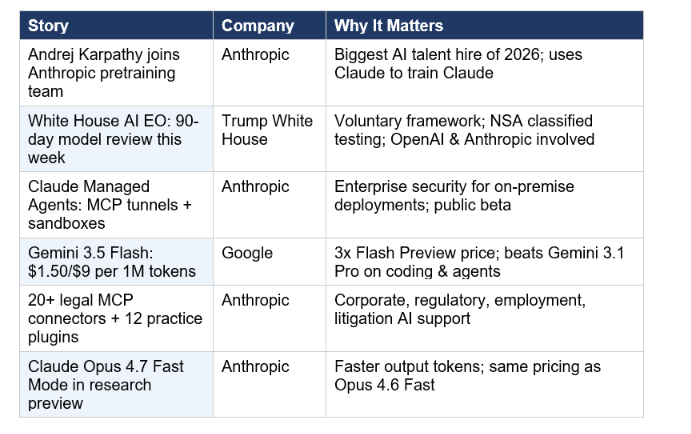
1. Andrej Karpathy Joins Anthropic to Lead Pretraining Research — The Biggest Talent Win of 2026
Andrej Karpathy announced on May 19, 2026, that he has joined Anthropic. He starts this week on the pretraining team under team lead Nick Joseph, where he will also build a new team specifically focused on using Claude to accelerate pretraining research and experimentation. "I think the next few years at the frontier of LLMs will be especially formative," he wrote on X. "I am very excited to join the team here and get back to R&D."
Who is Karpathy and why does this matter? He co-founded OpenAI in 2015, led Tesla's Autopilot and Full Self-Driving programs from 2017 to 2022, returned to OpenAI for one year in 2023, then left to start Eureka Labs — an AI-focused education startup. In that final independent phase, he spent months experimenting with using AI agents to automate AI research itself, publishing his findings openly. That is precisely the work Anthropic is hiring him to do at scale.
Pretraining is the most expensive and strategically important phase of building a frontier model — the large-scale training run that gives Claude its core knowledge and capabilities before fine-tuning begins. Karpathy's mandate to build a team using Claude to speed up pretraining is a direct bet that AI-assisted research, not just raw compute, is how Anthropic stays competitive with OpenAI and Google in 2026 and beyond.
The competitive optics could not be sharper. Karpathy left OpenAI in 2024 — and is now actively working against it from inside its most successful rival. His name carries enormous credibility in the developer community. His arrival at Anthropic is a signal to every AI researcher still deciding where to work that the talent momentum has shifted. This is the most significant AI talent hire of 2026.
For context on how Claude's current model lineup compares at the frontier, our Best AI Models April 2026: Ranked by Benchmarks covers where Claude Opus 4.7 and Sonnet 4.6 sit relative to GPT-5.5 and Gemini 3.5 Flash.
2. White House AI Executive Order: 90-Day Pre-Launch Model Review — Signing Expected This Week
CNN, Axios, and NextGov all reported on May 20–21, 2026, that the Trump White House is expected to sign an executive order as early as Thursday establishing a voluntary framework requiring AI companies to share frontier models with the US government — potentially up to 90 days before public release. Both OpenAI and Anthropic are confirmed to be engaged in discussions with the White House over the order's design.
The structure of the draft EO has two parts. First, a cybersecurity section establishing a voluntary "clearinghouse" involving the Treasury Department and other agencies — plus AI labs — to find and fix security vulnerabilities in unreleased models. Second, a "covered frontier models" section defining which AI systems fall under the voluntary pre-launch review framework.
The NSA is expected to play a key role in the classified testing component. The 90-day window is the administration's preference; industry — particularly smaller labs — is pushing for a much shorter 14-day window. The political context: Anthropic's Claude Mythos discovering zero-day vulnerabilities in legacy financial systems spooked the administration into action. The Mythos moment softened the Trump White House's default "move fast, regulate minimally" posture on AI.
This is the most significant AI regulation development in the US since the Biden-era AI Safety Executive Order of 2023 — and it is arriving under the administration that campaigned on deregulation. The word "voluntary" is doing a lot of work in this draft. If labs do not comply, the administration has limited enforcement tools. But the NSA involvement and the 90-day ask signal that the government wants real teeth here, not just optics.
For the technical context on what triggered this EO — Mythos's zero-day discovery capabilities and Project Glasswing — see our deep dive on Claude Mythos: Release Date, Access, and What Comes Next.
3. Claude Managed Agents Gets MCP Tunnels and Self-Hosted Sandboxes — Enterprise Security Leap
Anthropic shipped two major new features for Claude Managed Agents on May 19, 2026: MCP tunnels and self-hosted sandboxes. Both features are in public beta and are specifically designed for enterprise deployments where data security and compliance are non-negotiable.
MCP tunnels allow Claude agents to securely communicate with on-premise services through encrypted tunnels, without exposing internal endpoints to the internet. Self-hosted sandboxes let enterprises run the entire tool execution environment — the sandbox where the agent executes tools and the services it reaches — within their own infrastructure, under their own security and runtime controls. "Both the sandbox where an agent executes tools and the services it reaches run within the established boundaries of your enterprise, under your security and runtime controls," Anthropic stated.
The context: Claude Managed Agents launched in April 2026 with a simplified deployment framework for cloud-hosted AI agents. In early May, Anthropic added dreaming (persistent memory across sessions), outcomes (goal-based agent evaluation), and multiagent orchestration. The MCP tunnels and self-hosted sandboxes complete the enterprise security picture — addressing the main blocker for heavily regulated industries like banking, healthcare, and government adopting Managed Agents.
If you are building production agents with Claude and want to explore the full MCP integration patterns, the gen-ai-experiments repository has working notebooks for Claude Code and Managed Agent workflows.
4. Gemini 3.5 Flash Pricing Reaction: "3x the Price of Gemini 3 Flash Preview, 6x Flash-Lite"
Now that Gemini 3.5 Flash is generally available, real pricing has landed: $1.50 per 1M input tokens and $9 per 1M output tokens. Simon Willison, one of the most-read AI developer bloggers, immediately noted that this is 3x the price of Gemini 3 Flash Preview and 6x the price of Gemini 3.1 Flash-Lite. The developer community on X has been processing this gap throughout May 20–21.
The case for 3.5 Flash at this price: it beats Gemini 3.1 Pro on coding and agentic benchmarks (76.2% Terminal-Bench 2.1) while running 4x faster than comparable frontier models. Google is positioning it as a near-Pro model at a Flash-tier speed, not a budget efficiency tool. The 1M token context window is standard for this tier.
The case against: Gemini 3.1 Flash-Lite at $0.25/$1.25 per million tokens delivered substantial capability at a fraction of the cost. Developers who built cost-sensitive pipelines on Flash-Lite are now looking at a 6x price jump to stay on the latest Google model. Claude Sonnet 4.6 at $3/$15 per million tokens is now the direct competitive alternative for developers willing to switch providers. DeepSeek V3.2 at $0.28/$0.42 remains the cost-efficiency outlier for open-model deployments.
The honest developer take: Google is betting that 3.5 Flash's benchmark performance justifies the price premium. The next six weeks — before Gemini 3.5 Pro launches — will determine whether the developer community agrees or migrates to Claude Sonnet.
For a side-by-side look at Gemini 3.5 Flash benchmarks versus Claude and GPT-5.5, our Google I/O 2026: Gemini 3.5 Flash and All the Developer Announcements has the full breakdown.
5. Anthropic Launches 20+ Legal MCP Connectors and 12 Practice-Area Plugins
Anthropic released over 20 new legal MCP connectors and 12 practice-area plugins for Claude in May 2026, expanding deep workflow support for law firms and in-house legal teams. The connectors cover legal research databases, contract management platforms, matter management systems, discovery tools, and legal aid portals. The 12 plugins target specific practice areas including corporate, regulatory, employment, and litigation.
The release is part of Anthropic's vertical depth strategy — following the Claude for Small Business launch (May 13) and the legal-specific features are available natively on the Claude Platform. The legal vertical is the second highest-revenue enterprise AI category in 2026 after financial services, with several major law firms already deploying Claude for contract analysis, due diligence, and regulatory research.
The open customization angle is important: the connectors follow the Model Context Protocol standard, meaning law firms can build their own integrations on top without waiting for Anthropic to ship a specific connector. This is the right strategy for a domain as fragmented as legal — the 50 largest law firms each use different document management systems, billing platforms, and database providers.
6. Claude Opus 4.7 Fast Mode Now in Research Preview — Faster Output, Same Price
Anthropic's Claude Developer Platform added Fast mode support for Claude Opus 4.7, bringing significantly faster output token generation in research preview. To access it: set speed: "fast" with model: "claude-opus-4-7" and include the fast-mode-2026-02-01 beta header. Pricing and rate limits are the same as Opus 4.6 Fast mode; interested teams can join the waitlist.
Fast mode is particularly important for Opus 4.7 because Opus-tier models have historically been the bottleneck in agentic coding loops — their superior reasoning comes at the cost of latency. In multi-step agent tasks where Opus is the advisor model (as in the Sonnet + Opus advisor pattern), faster Opus output token generation directly accelerates the entire loop.
The Advisor Tool itself — which lets Sonnet 4.6 act as executor and Opus 4.7 as the high-level reasoner — is already in public beta with demonstrable SWE-bench gains: Sonnet 4.6 solo vs. Sonnet 4.6 with Opus advisor shows meaningful improvement across a 300-problem multilingual coding benchmark averaged over five trials.
7. Google Project Genie + Street View Integration: Build AI Worlds Anchored in Reality
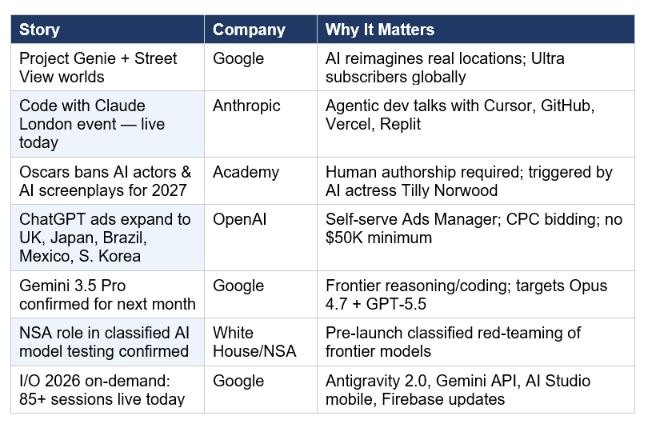
Google announced at I/O 2026 that Project Genie — its interactive world builder — now integrates with nearly 20 years of Google Street View imagery. Users can click on a real location anywhere in the US, select it in Google Maps, and ask Genie to reimagine that place with a text prompt. The demo: Chicago reimagined as a desert landscape, with photorealistic rendering grounded in the actual street-level geometry of Chicago.
The technical achievement here is substantial. Anchoring generated worlds to real-world geometry from Street View means consistent perspective, lighting, and scale — the most common visual failures in standalone AI image and world generation. Project Genie access is expanding to Google AI Ultra subscribers globally starting today.
The application space is broader than gaming or entertainment. Urban planning, architecture, disaster resilience modeling, and real estate visualization all become dramatically more accessible when you can start from real-world geometry and prompt from there. This is Google's most practically useful creative AI tool since Imagen, and it is significantly underreported compared to the Gemini Spark and Universal Cart announcements.
8. Code with Claude London — Anthropic's Developer Event Live Today (May 20–21)
Anthropic is running its Code with Claude developer event in London today and tomorrow (May 20–21), with a Tokyo edition on June 5–6. The London event features keynotes and breakout sessions streamed live, covering behind-the-scenes talks with Anthropic engineering teams and customers including Asana, Cursor, GitHub, Replit, and Vercel on how they are designing production-ready agents.
The event's focus: "pushing the boundaries of agentic development" — which, given the week's news, means the Managed Agents platform (MCP tunnels, self-hosted sandboxes, dreaming, outcomes, multiagent orchestration), Claude Code's rate limit increases, and the Advisor Tool pattern. All Day 1 keynotes and breakout sessions are being livestreamed for developers who cannot attend in person.
If you are watching remotely and want to follow along with the technical content, our What Is Claude Cowork? The 2026 Guide covers the full Claude Platform architecture that underpins the agent discussion.
9. Oscars Bans AI Actors and AI-Written Screenplays for 2027 Awards — Human Authorship Required
The Academy of Motion Picture Arts and Sciences issued final rules on May 1, 2026 for the 99th Academy Awards (2027 ceremony): only "performances demonstrably carried out by humans with their consent" are eligible for acting awards, and only "screenplays written by humans" qualify for writing categories. The Academy reserved the right to investigate the use of generative AI in any submission.
What triggered the reversal: Tilly Norwood, an entirely AI-generated actress, had been gaining attention and social media presence — including posting "Can't wait to go to the Oscars!" in March 2026 after appearing in a music video. The April 2026 version of Oscar rules had been neutral, stating AI use "neither helps nor harms the chances of achieving a nomination." Five weeks later, the Academy made an abrupt 180-degree reversal.
The practical impact: films can still use AI extensively in production (VFX, sound, set design, color grading) and remain eligible for Best Picture, Best Director, and most technical categories. What AI cannot win is Acting or Writing — the categories that directly recognize the human creative voice. This is the clearest line any major cultural institution has drawn between human creativity and machine output, and it sets a precedent that every other major awards body globally will now face pressure to match.
My take: the Academy got this right, but for the wrong reasons. The policy arrived reactively — because an AI actress was growing a following, not because of principled ethical debate. A more durable policy would have addressed the question systematically rather than as an emergency patch. Expect appeals and edge cases within 12 months.
10. ChatGPT Ads Expand Internationally — UK, Mexico, Brazil, Japan, and South Korea
OpenAI updated its advertising pilot page on May 7, 2026: in the coming weeks, ChatGPT ads will expand to the United Kingdom, Mexico, Brazil, Japan, and South Korea. This follows the May 5 launch of a self-serve Ads Manager beta for all US advertisers with CPC bidding, a Conversions API, and pixel-based measurement tools. The US self-serve platform eliminated the $50,000 minimum spend requirement, opening ChatGPT advertising to SMBs and startups.
The ad format remains consistent with the US pilot: contextual text ads at the bottom of AI responses, clearly labeled as "Sponsored," separated from the AI's actual answer, and excluded from sensitive topics (politics, health, mental health, underage profiles). OpenAI has stated that ads do not influence ChatGPT's answers and that user data is not sold to advertisers.
The international expansion is the more strategically interesting signal. Japan, South Korea, and Brazil are three of the highest-ChatGPT-penetration markets outside the US. Reaching advertisers in those markets with a self-serve platform — before competitors have a comparable paid placement offering — is a meaningful first-mover advantage. Google's AI Search ads remain the dominant benchmark, but ChatGPT's conversational placement is a structurally different format.
11. Gemini 3.5 Pro Confirmed for Next Month — Frontier Reasoning Model Incoming
Google confirmed at I/O 2026 that Gemini 3.5 Pro is currently in testing and will be available next month — approximately June 2026. It is expected to be the flagship reasoning and coding model in the 3.5 family, targeting direct competition with Claude Opus 4.7 and GPT-5.5 at the frontier tier.
What we know so far: 3.5 Pro will follow the same intelligence-first design philosophy as 3.5 Flash but with substantially higher capability ceilings. Google's benchmark table published at I/O showed 3.5 Flash already leading on five separate coding and agentic evaluations. 3.5 Pro is expected to extend those leads further while closing the gap on Humanity's Last Exam and long-context tasks where raw knowledge depth matters most.
The timing is notable. June 2026 puts 3.5 Pro on market approximately one month before Apple's WWDC 2026 (June 8), where the Gemini-powered new Siri is expected to be announced publicly for iOS 27. A flagship Gemini 3.5 Pro launch in the same window would maximize Google's narrative momentum heading into the most important Apple developer event in years.
For a preview of how 3.5 Pro will likely stack up against the current field, our GPT-5.4 Review: Features, Benchmarks & Access (2026) provides the competitive baseline we will benchmark against.
12. NSA to Play Key Role in AI Model Safety Testing Under Draft White House EO
NextGov reported on May 21, 2026, that the anticipated White House AI executive order includes a provision giving the National Security Agency a key role in classified testing of frontier AI models before public release. Under this framework, AI labs would provide models to the NSA for classified red-teaming, specifically testing offensive capabilities in cybersecurity and potential military misuse scenarios.
This is a qualitatively different type of evaluation than the AISI (UK AI Safety Institute) evaluations already conducted on models like Claude Mythos. AISI evaluations are transparent and published; NSA testing would be classified, with results available only to the government and potentially shared with critical infrastructure operators. The implication: the government wants to know what frontier AI can do in offensive contexts before the public or adversaries find out.
The civil liberties tension is real. Classified government testing of private company technology — especially when the NSA's assessment could delay or condition a commercial product launch — raises significant questions about due process and competitive fairness between labs. Labs with stronger government relationships could navigate the review faster. A 90-day classified assessment window could effectively be used to advantage one lab over another.
13. Google I/O 2026 On-Demand Sessions Available From Today — 85+ Talks for Developers
Google confirmed that all I/O 2026 sessions, codelabs, and workshops are available on demand from today, May 21, at io.google. The library includes over 85 sessions covering the developer keynote, Gemini API updates (including the new Managed Agents API, AI Studio mobile app, and native Android vibe coding support in Antigravity 2.0), Google Workspace integrations, Firebase updates, and the Gemini for Science toolkit.
The standout developer session from the developer keynote: "Build next-gen AI experiences with Google AI Studio and Google Antigravity" — covering the transition from rapid prototyping in AI Studio to production autonomous development in Antigravity, Google's agent-first IDE. Antigravity 2.0 supports parallel subagent execution, scheduled background tasks, and ecosystem integrations across AI Studio, Android, and Firebase.
For builders: the Antigravity 2.0 full developer release is globally available today for free, including parallel subagent execution, Managed Agents in the Gemini API (a single API call that spins up a full agent with persistent state), and the Gemini 3.5 Flash as the native model running at 12x speed inside Antigravity versus 4x in the public API. This is the week to go build something.
We have a full hands-on breakdown of every developer tool from I/O in our Google I/O 2026: Gemini 3.5 Flash and Developer Announcements — updated with on-demand session details today.
May 21 AI News at a Glance
Frequently Asked Questions
Why did Andrej Karpathy join Anthropic?
Andrej Karpathy announced on May 19, 2026, that he joined Anthropic to work on pretraining research under team lead Nick Joseph. His specific mandate is to build a new team focused on using Claude to accelerate pretraining research and experimentation — applying AI-assisted research methods to the most compute-intensive phase of building a frontier model. Karpathy said in his X post that "the next few years at the frontier of LLMs will be especially formative." He previously co-founded OpenAI (2015), led Tesla's Autopilot (2017–2022), returned to OpenAI (2023), and then started AI education startup Eureka Labs before joining Anthropic.
What is the White House AI executive order May 2026?
The Trump White House is expected to sign an AI executive order as early as Thursday, May 22, 2026. The draft creates a voluntary framework under which AI companies would share frontier models with the US government — including the NSA for classified red-teaming — up to 90 days before public launch. The order has two sections: a cybersecurity clearinghouse (Treasury + agencies + AI labs finding vulnerabilities in unreleased models) and a "covered frontier models" section defining which AI systems fall under the framework. OpenAI and Anthropic are both engaged in discussions with the White House. Industry is pushing for a shorter 14-day window rather than 90 days.
What are Claude Managed Agents MCP tunnels?
MCP tunnels are a new feature for Claude Managed Agents launched in public beta on May 19, 2026. They allow Claude agents to securely communicate with on-premise services (internal databases, private APIs, behind-firewall systems) through encrypted tunnels, without exposing internal endpoints to the public internet. This is a critical feature for enterprise deployments in banking, healthcare, and government where data cannot leave internal infrastructure. The companion feature, self-hosted sandboxes, lets enterprises run the entire agent execution environment within their own infrastructure under their own security controls.
How much does Gemini 3.5 Flash cost?
Gemini 3.5 Flash, launched at Google I/O 2026 on May 19 and now generally available, costs $1.50 per 1M input tokens and $9 per 1M output tokens. Developer blogger Simon Willison immediately noted this is 3x the price of Gemini 3 Flash Preview and 6x the price of Gemini 3.1 Flash-Lite. Google positions the price premium as justified by 3.5 Flash's performance — it beats Gemini 3.1 Pro on coding and agentic benchmarks, runs 4x faster than comparable frontier models, and carries a 1M token context window. Gemini 3.5 Pro is confirmed for next month at unannounced pricing.
Can AI actors win an Oscar?
No — effective with the 99th Academy Awards (2027 ceremony), only "performances demonstrably carried out by humans with their consent" are eligible for acting nominations, and only "human-authored" screenplays qualify for writing categories. AI tools can still be used in other aspects of filmmaking without disqualifying a film from Best Picture or technical categories. The rule was triggered by the growing social media presence of Tilly Norwood, an entirely AI-generated actress. The Academy reversed its April 2026 neutral position — which said AI use "neither helps nor harms" Oscar chances — in a final ruling published May 1, 2026.
What is Google Project Genie with Street View?
Project Genie is Google's interactive AI world builder. The new Street View integration, announced at I/O 2026, connects Genie with nearly 20 years of Google Street View imagery. Users can select any real location in the US via Google Maps, then use text prompts to reimagine that space — for example, reimagining Chicago as a desert. The output is photorealistic and grounded in the actual street-level geometry of the real location. Access is expanding to Google AI Ultra subscribers globally starting today, May 21, 2026.
What is the Code with Claude London event?
Code with Claude is Anthropic's developer conference series. The London edition runs May 20–21, 2026, with a Tokyo edition on June 5–6. The event features keynotes and breakout sessions from Anthropic engineering teams and major Claude integration customers including Asana, Cursor, GitHub, Replit, and Vercel — all discussing production-ready agent architecture, agentic workflows, and building on the Claude Platform. All Day 1 keynotes and sessions are being livestreamed for remote attendees.
What is the NSA's role in the White House AI executive order?
Under the draft White House AI executive order reported by NextGov on May 21, 2026, the NSA (National Security Agency) is expected to play a key role in classified testing of frontier AI models before their public release. AI labs would provide models to the NSA for red-teaming focused on offensive cybersecurity capabilities and military misuse scenarios. Unlike published AISI evaluations, NSA testing results would be classified — available to the government and potentially shared with critical infrastructure operators, but not publicly disclosed. This is the first time the NSA has been explicitly named as a primary evaluator of commercial AI models in a US government framework.
Recommended Reads
- AI News Today — May 20, 2026: Google I/O Dropped Everything, Musk Lost — Build Fast with AI
- Google I/O 2026: Gemini 3.5 Flash and All Developer Announcements — Build Fast with AI
- Claude Mythos: Release Date, Access, and What Comes Next (2026) — Build Fast with AI
- Best AI Models April 2026: Ranked by Benchmarks — Build Fast with AI
- What Is Claude Cowork? The 2026 Guide — Build Fast with AI
- GPT-5.4 Review: Features, Benchmarks & Access (2026) — Build Fast with AI
- AI Models in March 2026: The Week That Changed AI — Build Fast with AI
References
- TechCrunch — OpenAI co-founder Andrej Karpathy joins Anthropic's pre-training team
- Axios — Andrej Karpathy joins Anthropic
- CNBC — Anthropic hires OpenAI co-founder Andrej Karpathy, former Tesla AI lead
- CNN — Trump could sign AI executive order as soon as Thursday
- Axios — Scoop: Trump AI executive order seeks early government access to frontier models
- NextGov — Anticipated executive order could give NSA a role in voluntary AI model testing
- 9to5Mac — Anthropic enhances Claude Managed Agents with MCP tunnels and self-hosted sandboxes
- Releasebot — Anthropic Claude Updates May 2026
- Simon Willison — Gemini 3.5 Flash: more expensive, but Google plan to use it for everything
- NPR — New Academy Rules for 99th Oscars in 2027
- LLM Stats — LLM News Today May 2026
- Google I/O 2026 — News and Announcements
- OpenAI — Testing ads in ChatGPT (international expansion update)

