



ElevenLabs Music v2 Review: AI Music Finally Got Editable
ElevenLabs just shipped Music v2 — and the part that matters is not the model upgrade. It is the inpainting. With v2, creators can now select a single section of a generated track, regenerate just that section, and leave everything else in the song untouched. Rewrite the bridge without losing the chorus. Refine the vocals on the third verse without re-rolling the whole track. Iterate non-destructively, the way every working music producer has done in Pro Tools and Logic for the last twenty years.
That is the shift. AI music has spent two years stuck in the prompt-and-pray loop — type a description, get a 90-second clip, hate one detail, regenerate the entire thing, lose the parts you liked. v2 ends that workflow. The model is good. The inpainting is the product.
On top of that, ElevenLabs is shipping the kind of capability list that reads like a wishlist three months ago: mid-song genre transitions (opera to metal in 16 bars), fast rap with dense vocals, embedded non-musical sound effects, section-by-section composition that maintains structural continuity, and meaningful multilingual improvements. Plus a 40% price cut on ElevenCreative and a 50% self-serve cut on ElevenAPI. And every track ships with full commercial licensing — the part Suno and Udio are still fighting record labels about.
1. What is ElevenLabs Music v2?
ElevenLabs Music v2 is the second-generation release of the company's AI music generation model, launched on May 27, 2026 as a major upgrade across all three of ElevenLabs's music-related products. The original Eleven Music shipped in late 2025 with a focus on commercially licensed training data; v2 keeps that licensing foundation and adds the editing and composition controls professional creators have been asking for since the original launch.
The v1 era of AI music was the prompt-to-song era. You typed a description, the model returned a 60-second to 5-minute track, you played it, you decided whether to keep it or regenerate the whole thing. There was no middle ground. The v1 era of AI music never really felt like production software — it felt like a slot machine that occasionally returned a song you wanted.
Music v2 is a deliberate step toward the production-software model. The capabilities ElevenLabs is shipping read like the feature list of a DAW: section-level editing, structural continuity across long-form compositions, non-destructive iteration, embedded sound effects, and a programmatic API that lets developers wire all of this into custom creative pipelines. The model improvements matter — denser vocals, faster rap, mid-song genre transitions — but the production workflow story is what makes v2 a release worth paying attention to.
2. Inpainting — the feature that actually changes the workflow
Inpainting is borrowed terminology from image generation, where it has been a standard feature for years. The idea is simple: instead of regenerating an entire output when one detail is wrong, you select the specific region that needs to change, tell the model what you want there, and the rest of the output stays bit-for-bit identical.
Applied to music, this is genuinely transformative. The classic AI music failure mode is the perfect verse with a weak chorus, or vice versa. In v1, fixing the weak section meant either accepting it or rolling the dice on a full regeneration that might lose the parts you loved. With Music v2 inpainting, you select the chorus bars, give the model new direction ('make the vocals more breathy, add a counter-melody on the guitar') and only those bars change. The verses, the bridge, the outro — all preserved exactly.
Three workflows this unlocks:
- Fix a single weak section without touching what works — the most common reason creators abandon AI music tracks
- Iterate non-destructively on arrangements — try four different bridges against the same chorus, keep the best one, no quality drift
- A/B test sections for commercial sync work — same track, two ending styles, compare for the brand brief
Udio shipped inpainting earlier in 2026 and made it the centerpiece of their pitch to musicians. Suno's Studio editor offers a partial version of this. ElevenLabs's v2 inpainting closes the parity gap with Udio and, more importantly, brings inpainting to the API tier — meaning developers can now embed selective regeneration into their own creative tools, not just use it through the ElevenLabs web UI.
3. Section composition, genre transitions, and what the new model can do
Beyond inpainting, Music v2 ships with five model-level capabilities that v1 either could not do reliably or could not do at all.
Section-by-section composition
Rather than generating a complete song in one pass, v2 lets you build the track section by section — intro, verse, chorus, bridge, outro — while maintaining structural and tonal continuity across the entire piece. This is what makes long-form composition viable. The model holds the song's overall identity in context as you generate each piece, so the verse that follows your intro actually fits the intro rather than feeling like a different song stitched on.
Mid-song genre transitions
Opera to metal in 16 bars. Acoustic folk to dubstep at the drop. Jazz piano to industrial breakbeat. ElevenLabs is explicitly calling out genre transitions as a v2 capability, which means the model can hold two distinct musical aesthetics in tension within a single track and execute the transition between them with structural coherence. This is the kind of capability that used to require either a human composer or careful stem-level editing in a DAW. v2 does it from a single prompt.
Fast rap and dense vocals
This is where ElevenLabs's TTS heritage pays off. Their underlying voice synthesis stack is the most expressive in the industry, and v2 leverages it for vocal-heavy genres specifically. Rapid-fire delivery, multi-syllabic rhymes, dense harmonic stacks — all categories where v1 struggled and Suno still leads. v2 closes the gap meaningfully without claiming to overtake Suno on raw vocal warmth.
Embedded non-musical sound effects
A door slamming as the chorus kicks in. A phone ringing through the bridge. Rain layered into the outro. v2 can embed non-musical sound design directly into the generation, which is significant for narrative tracks, podcast intros, video scoring, and ambient compositions. This is the kind of capability that bridges Music v2 with ElevenLabs's existing SFX v2 product into a single creative pipeline.
Improved multilingual lyric generation
Lyrics, vocals, and arrangements now perform more reliably across a growing list of supported languages — meaning the lyrical phrasing actually scans correctly in the target language rather than reading like translated-from-English. This was a known weakness of v1 for non-English creators, and the v2 improvements directly address it.
4. The three-product structure: ElevenMusic, ElevenCreative, ElevenAPI
Music v2 is the single underlying model. ElevenLabs ships it across three distinct products, each tuned for a different buyer:
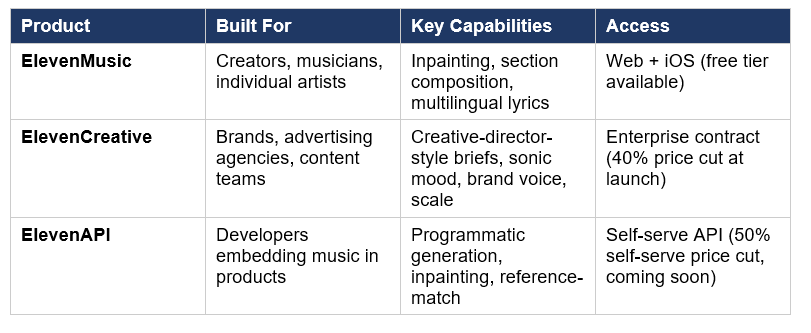
This structure is doing real work. ElevenMusic is the consumer-grade entry point — the iOS app that launched in April 2026 and the web interface, where individual creators and musicians prompt directly. ElevenCreative is built for brand and agency teams who don't want to type prompts; they want to brief the model like a creative director ('upbeat indie-folk, female lead vocal, optimistic but reflective, 90 bpm, no drums until the 30-second mark'). ElevenAPI is the developer surface that lets you embed Music v2 inside whatever product you're building — a video editor that scores itself, a podcast tool that generates intro music per episode, a game engine that composes adaptive soundtracks at runtime.
This three-product play mirrors how ElevenLabs has structured its voice products — and how every serious AI creative tool is now organizing itself. For an honest comparison of how ElevenLabs's voice pricing stacks up against newer entrants in that adjacent market, our xAI voice cloning API tutorial walks through the full ElevenLabs vs xAI cost comparison — useful context for understanding the broader pricing pressure shaping ElevenLabs's product decisions right now.
5. The licensing story — why this matters for commercial work
Here is the part most launch coverage will undersell. Music v2 is trained on licensed datasets, and every track generated through it is cleared for commercial use from day one. ElevenLabs has explicit licensing collaborations with Believe, Merlin Network, and Kobalt Music Group, among others.
For hobbyist creators, this distinction is academic. For anyone shipping commercial work, it is the whole game. The RIAA filed mass infringement lawsuits against Suno and Udio in 2024; both companies reached settlements with major labels by late 2025, but the period of disabled downloads on Udio and the unresolved legal questions still surrounding Suno's training data have made enterprise procurement teams allergic. Agencies have spent the last year quietly choosing license-clean platforms over higher-quality options because the litigation risk on Suno-generated commercial work is real and unresolved.
Music v2 hardens ElevenLabs's pitch as the procurement-safe choice. The licensing story is also the reason ElevenCreative — the enterprise tier — exists as a distinct product. ElevenLabs is explicitly courting agency and brand buyers who care about sync-fee elimination, clearance delays, and per-spot licensing more than they care about whether the AI is producing a Billboard-quality vocal.
My read: for any commercial use case — ads, branded content, sync placements, ongoing series intros, app soundtracks — ElevenLabs Music v2 is now the rational default. For experimental hobbyist work and personal projects, Suno or Udio still produce more emotionally resonant vocals. The right answer is to use both, picking based on whether the output ever sees a client invoice.
6. ElevenLabs Music v2 vs Suno v5, Udio, MiniMax 2.5
Here is the honest head-to-head across the four AI music platforms that matter most in May 2026:
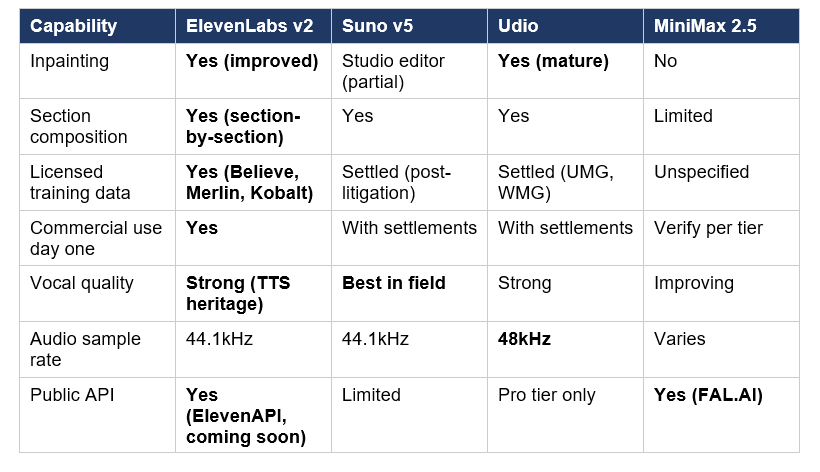
Practical translation. Suno v5 still wins on raw vocal realism — its Elo on independent benchmarks is the highest in the field, and for emotionally resonant vocals that fool casual listeners, nothing else gets closer. Udio wins on technical audio fidelity (48kHz) and has the most mature inpainting workflow. MiniMax 2.5 wins on developer economics — at $0.035 per generation via FAL.AI, it is roughly an order of magnitude cheaper than any subscription-based platform for high-volume API work.
ElevenLabs Music v2 wins on the dimensions that matter for commercial production: licensing clarity, the new inpainting capability, multilingual reliability, structured section composition, and the upcoming ElevenAPI surface with the 50% self-serve price cut. If you're picking one tool for a brand agency, an ad creative team, or a content product where licensing-clean output is non-negotiable, v2 is now the right call. If you're picking one tool for personal music projects where peak vocal quality matters more than commercial safety, Suno or Udio are still the right call.
For the broader picture of how AI creative tools are consolidating in 2026 — across music, video, voice, and image — our April + May 2026 leaderboard of every major AI model tracks the full field with use-case verdicts. And for parallel coverage of the video side of the same buyer market, our Seedance 2.0 review and Gemini Omni deep-dive cover how the same agency and brand teams are now sourcing AI video the way they're sourcing AI music.
7. Pricing and the 40–50% cuts
ElevenLabs paired the Music v2 launch with two meaningful pricing reductions — and the structure of the cuts tells you who they're trying to win.
ElevenCreative pricing dropped by up to 40%. This is the enterprise tier built for brands and agencies. The 40% cut is large enough to push ElevenCreative into direct comparison with traditional stock music libraries (Artlist, Musicbed, Audiosocket) on price as well as on licensing safety — which is the comparison that actually drives agency procurement decisions. Stock music libraries charge per-track licensing fees that compound across hundreds of placements; ElevenCreative now offers unlimited generation under a single contract at a price point closer to a mid-tier stock library subscription.
ElevenAPI self-serve pricing dropped by up to 50%. This is the developer tier and the more aggressive cut. The 50% reduction directly addresses MiniMax Music 2.5's $0.035-per-generation pricing on FAL.AI, which has been quietly eating ElevenLabs's developer mindshare since January 2026. ElevenLabs is not matching MiniMax's bottom price — they are positioning at a higher quality tier for developers willing to pay for licensing safety, but cutting the premium they charge for it. Pre-cut ElevenLabs API pricing was roughly $0.80 per minute of generated audio; the post-cut self-serve rate brings that closer to $0.40 per minute.
ElevenMusic, the consumer tier, retains its existing pricing structure: free tier with 7 songs per day on the iOS app, paid tiers starting at the standard ElevenLabs plan levels ($5/month Starter, $22/month Creator, $99/month Pro, $330/month Scale). The free tier remains a meaningful entry point for individual creators.
8. Where AI music goes next — from one-shot to workflow-aware
The Music v2 release is the clearest signal yet of where the AI music category is going. Inpainting is the headline, but the underlying pattern is broader: AI creative tools are evolving from one-shot generators into workflow-aware, editable, integrated creative pipelines. Four threads define this shift:
- Editable instead of one-shot — inpainting in music, in-fill in image, scene-level video editing. The prompt-and-pray era is over.
- Workflow-aware instead of prompt-only — creative-director briefs replace prompt engineering. The interface matches how creative work actually happens.
- Integrated directly into creative pipelines — APIs and SDKs replace web UIs as the primary distribution mode. The model becomes a component, not a destination.
- Commercially viable for ads, content, and media production — licensing clarity becomes a procurement gate. The legal review is now part of the buying decision.
For builders specifically, this is the moment to pay attention. The same patterns reshaping AI music are reshaping every adjacent creative AI category — video, voice, image, design. If you're building a creative product that uses any of these AI tools as components, the 130+ open-source GenAI cookbooks at Build Fast with AI cover the integration patterns that compose these models into real pipelines — LangChain, LangGraph, multi-agent orchestration, and API-first workflows that work cleanly with ElevenLabs's stack and with the broader frontier creative AI ecosystem.
Honest take: Music v2 is not the model that wins AI music on raw vocal quality. Suno v5 still does that. v2 is the model that wins AI music on production workflow. And in commercial creative production, workflow beats raw output quality more often than the demo videos suggest.
9. Frequently Asked Questions
What is ElevenLabs Music v2?
ElevenLabs Music v2 is the second-generation AI music generation model from ElevenLabs, launched on May 27, 2026. It adds inpainting for section-level editing, structured section-by-section composition, mid-song genre transitions, embedded non-musical sound effects, fast rap and dense vocal generation, and improved multilingual lyric performance. It ships across three products: ElevenMusic (consumer), ElevenCreative (brand/agency), and ElevenAPI (developer).
What is inpainting in AI music?
Inpainting lets you select a specific section of a generated track and regenerate only that section, leaving the rest of the song bit-for-bit unchanged. For example, you can rewrite the bridge of a song without affecting the verses, chorus, or outro. This enables non-destructive iteration similar to how musicians edit individual sections in a traditional DAW like Pro Tools or Logic, rather than re-rolling the entire track every time one detail needs to change.
Is ElevenLabs Music v2 free?
Partially. The ElevenMusic iOS app has a free tier with up to 7 songs per day, no credit card required. Web access starts on standard ElevenLabs paid plans from $5/month (Starter) up to $330/month (Scale). ElevenCreative is enterprise-only pricing. ElevenAPI uses self-serve API billing — exact post-cut pricing is approximately $0.40 per minute of generated audio after the 50% self-serve price reduction announced at launch.
Can I use ElevenLabs Music commercially?
Yes. ElevenLabs Music v2 is trained on licensed datasets through partnerships with Believe, Merlin Network, Kobalt Music Group, and other rights holders. Every track generated through the platform is cleared for commercial use from day one — no sync fees, no clearance delays, no unresolved litigation risk. This is one of the key differentiators against competitors like Suno and Udio, both of which have faced active RIAA lawsuits and required label settlements before becoming commercially safe.
ElevenLabs Music v2 vs Suno v5 — which is better?
It depends on the use case. Suno v5 leads on raw vocal realism — it produces the most emotionally resonant vocals in the field with the highest Elo score on independent benchmarks. ElevenLabs Music v2 leads on inpainting (selective section regeneration), structured composition, licensing clarity, multilingual reliability, and commercial production workflows. For personal music projects where vocal warmth matters most, Suno wins. For commercial work, agency client projects, branded content, or any use case where licensing safety is non-negotiable, ElevenLabs v2 wins.
How much does ElevenLabs Music v2 cost?
ElevenMusic web/iOS starts free (7 songs/day on iOS) and scales with standard ElevenLabs plans from $5/month to $330/month. ElevenCreative is enterprise-only, with the 40% price cut announced at launch positioning it competitively against traditional stock music libraries on a per-track basis. ElevenAPI self-serve pricing dropped by 50% at launch — approximately $0.40 per minute of generated audio, down from roughly $0.80 per minute pre-cut.
When does ElevenAPI for Music v2 launch?
ElevenAPI access for Music v2 is described by ElevenLabs as 'coming soon' at the time of the May 27, 2026 launch, with the underlying model already live in ElevenMusic and ElevenCreative. Enterprise customers can contact the ElevenLabs sales team for early API access. Self-serve developer access is expected to follow in the weeks after launch.
What languages does ElevenLabs Music v2 support?
Music v2 ships with improved multilingual reliability across a growing list of supported languages. ElevenLabs has not published a complete supported-language list for v2 specifically, but the original ElevenMusic launch in late 2025 supported English, Spanish, German, and Japanese among others. v2's main multilingual upgrade is reliability — lyrics, vocals, and arrangements now perform more consistently in the language you write the prompt in, rather than defaulting to English-influenced phrasing.
Recommended Blogs
- xAI Voice Cloning API: Custom Voices Tutorial + Pricing (2026)
- Seedance 2.0 Review: ByteDance Tops AI Video in 2026
- Gemini Omni: Google's Leaked AI Video Model Explained
- SuperGrok Video & Image Generation (2026): Speed, Pricing & Comparison
- Best AI Models: April + May 2026 Leaderboard
- AI News Today - May 20, 2026: 14 Biggest Stories
References
- ElevenLabs — Introducing Music v2 (official launch blog)
- ElevenLabs — Music product page
- TeamDay — Best AI Music Models 2026: Suno v5 vs ElevenLabs comparison
- DigitalApplied — AI Music Generation 2026: Suno, Udio, ElevenLabs Compared
- AI Magicx — Suno vs Udio vs ElevenLabs Music: The 2026 Showdown
- ElevenLabs Magazine — What is Eleven Laboratory: Complete 2026 Guide
- Chartlex — AI Music Generator Comparison 2026
- VoteMyAI — ElevenLabs Enters the AI Music War
- XYZEO — ElevenLabs Music Review 2026

