



50 Claude Fable 5 Prompts to Test the New Safety Limits (July 2026 Edition)
Claude Fable 5 returned on July 1, 2026, after an 18-day government-mandated suspension. It came back with a new cybersecurity safety classifier that blocks the Amazon-reported jailbreak technique in over 99% of cases. The trade-off, which Anthropic states plainly in its official redeployment post, is higher false-positive rates on benign coding and debugging requests that happen to have security-adjacent framing. That change matters for practitioners. Many prompts that worked cleanly in June now behave differently. Some trigger the classifier and fall back silently to Claude Opus 4.8. Others work exactly as before. And a third category, which is where most of the interesting prompts live, requires small framing adjustments to route correctly through the new classifier. This guide tests 50 prompts across 10 categories: coding, reasoning, writing, agentic tasks, math, business analysis, security-adjacent development, research, creative work, and long-horizon agents. Each prompt includes a brief note on how it behaves under the July 1 classifier and a tip for getting the best output. Use these as your personal test suite and copy-paste starting points.
Before the prompts: if you are testing whether to use Fable 5 or Claude Sonnet 5 for your specific workflow, the Claude Fable 5 vs Sonnet 5 full comparison covers every benchmark and the routing framework in detail. These prompts are designed for Fable 5 specifically, tested against the July 1 classifier behavior. Prompts 31 to 35 in the security-adjacent category include explicit framing guidance to minimize false-positive classifier triggers
Category 1: Complex Coding (Prompts 1-5)
These prompts test Fable 5's headline capability: frontier-level software engineering. The July 1 classifier does not affect standard coding tasks. All five of these should work exactly as they did in June, with full Fable 5 quality.
1. Multi-File Refactor with Test Coverage
I have a Python FastAPI service split across 12 files. Here is the full directory structure and content: [paste files]. I need you to refactor the service to use dependency injection throughout, replace all direct database calls with a repository pattern, and ensure every public function has a corresponding pytest test with at least 80% branch coverage. Produce the complete refactored files and the full test suite. Do not omit any file.
Tip: Paste actual file content rather than describing it. Fable 5's 1M context window can hold the entire codebase. Specify 'Do not omit any file' to prevent summarizing long outputs. This prompt type exploits Fable 5's 80.3% SWE-bench Pro capability and should be used when Sonnet 5 produces incomplete or inconsistent refactors.
2. Root Cause Analysis Across a Complex Stack
Our payment service intermittently returns HTTP 504 on the /charge endpoint under load. The service uses FastAPI, Redis for session storage, PostgreSQL via asyncpg, and a third-party Stripe SDK. Logs from three failing sessions are attached: [paste logs]. Trace the exact execution path for each failure, identify the root cause, list every contributing factor in dependency order, and produce a minimal reproducible test case that demonstrates the issue without requiring external services.
Tip: Provide actual log content rather than a description. The 'minimal reproducible test case without external services' instruction separates Fable 5's analysis quality from simpler models: it requires the model to reason about mocking boundaries, not just describe the problem.
3. Architecture Decision Record
I am choosing between three data pipeline architectures for a system that needs to process 50 million events per day with sub-5-second end-to-end latency, at-least-once delivery guarantees, and the ability to replay the last 7 days of events at any time. Options: (A) Apache Kafka with Flink, (B) AWS Kinesis with Lambda, (C) a custom Redis Streams implementation. Write a complete Architecture Decision Record covering: context, decision drivers, options considered, pros and cons of each, decision, and consequences. Include specific configuration recommendations for the chosen option.
Tip: ADRs are a strong Fable 5 format because they require both technical depth and structured reasoning simultaneously. Specifying the three options forces the model to do real comparative analysis rather than defaulting to a generic recommendation.
4. Debugging a Concurrency Bug
This Go code produces incorrect output under concurrent load. I believe it has a data race but the -race flag does not catch it during my test runs. Here is the full code: [paste code]. Identify every possible concurrency issue, explain why each one can occur even without a detectable race, propose a fix for each using the appropriate Go synchronization primitives, and write a test that reliably reproduces at least one of the bugs.
Tip: Fable 5's advantage over Sonnet 5 on hard bugs is largest when the problem requires reasoning about non-obvious failure modes. 'Why even without a detectable race' is the instruction that forces frontier-level reasoning rather than surface-level fix suggestions.
5. Database Query Optimization
This PostgreSQL query takes 45 seconds on a table with 200 million rows. Here is the query, the EXPLAIN ANALYZE output, and the table schema: [paste all three]. Identify every performance issue, explain the physical execution plan in plain English, propose optimized alternatives in order of expected improvement, write the EXPLAIN ANALYZE output you would expect to see for your best solution, and produce the SQL for all index changes and query rewrites.
Tip: Providing EXPLAIN ANALYZE output is the difference between a generic SQL review and an accurate root cause analysis. Asking Fable 5 to predict the expected EXPLAIN ANALYZE for its solution tests whether its reasoning is internally consistent.
Category 2: Reasoning and Research (Prompts 6-10)
These prompts test Fable 5's reasoning depth on hard analytical questions. The July 1 classifier is irrelevant here. No change from June behavior.
6. First-Principles Analysis of a Complex System
Explain how modern transformer-based language models handle context beyond their training context window length. Cover: the mathematical limits of attention mechanisms, how position embeddings handle positions beyond training length, the empirical behavior of different position encoding schemes when extrapolating, and why some models degrade more gracefully than others. Build the explanation from first principles, not surface-level descriptions.
Tip: The 'from first principles, not surface-level descriptions' instruction is the key differentiator. Fable 5 at max effort will build from the mathematical definition of attention rather than paraphrasing standard descriptions.
7. Steelmanning a Counterintuitive Position
Steelman the argument that increasing AI model size beyond current frontier scale will produce diminishing capability returns for most practical applications, even if theoretical capabilities continue to scale. I want the strongest version of this argument, not a strawman. Then give me the three strongest counterarguments, each stated with equal rigor.
Tip: Steelmanning requires Fable 5 to reason in a direction it might disagree with while maintaining intellectual honesty. The instruction to give counterarguments of 'equal rigor' prevents the model from hedging by making the counterarguments weaker than the original.
8. Causal Chain Analysis
Trace the complete causal chain from the US export control directive on Claude Fable 5 in June 2026 to the competitive landscape changes in the AI coding model market by July 1, 2026. Include: the immediate effect on Anthropic's market position, the second-order effects on competing models, the third-order effects on enterprise AI procurement decisions, and the fourth-order effects on open-source model development. Distinguish between effects that were certain, likely, and speculative.
Tip: Fourth-order effects are where Fable 5 separates from simpler models. The certainty gradient ('certain, likely, speculative') forces the model to calibrate its confidence rather than presenting all inferences as equally solid.
9. Decision Theory Under Uncertainty
A startup has raised $2M seed and must decide between two paths: (A) build on top of a closed-source frontier model API with superior current benchmarks, (B) build on an open-source model they can self-host and fine-tune. The founding team has 3 ML engineers and 18 months of runway. Model this as a decision tree with probability estimates for the key uncertain variables, calculate expected value for each path under three scenarios (closed-source remains dominant, open-source closes the gap within 18 months, the frontier model becomes export-controlled), and give a recommendation with explicit assumptions.
Tip: Asking for probability estimates and expected value forces Fable 5 to commit to quantitative reasoning rather than qualitative description. The three scenarios are not hypothetical for July 2026 readers.
10. Comparative Analysis with Explicit Criteria
Compare the following three approaches to handling token limits in long-document analysis pipelines: (A) sliding window with overlap, (B) hierarchical summarization, (C) retrieval-augmented generation. For each approach, evaluate: accuracy on fine-grained detail questions, performance on cross-document synthesis tasks, implementation complexity, runtime cost at 1 million documents per day, and failure modes under adversarial inputs. Score each on a 1 to 10 scale for each criterion and justify every score.
Tip: Requiring numerical scores for every criterion eliminates vague qualitative comparisons. Fable 5 will defend each score rather than defaulting to 'it depends.
Category 3: Writing and Long-Form Content (Prompts 11-15)
Writing prompts are completely unaffected by the July 1 classifier. Fable 5's strength here is long-context coherence and stylistic adaptability.
11. Technical Documentation at Scale
Write complete API documentation for a REST service with these 12 endpoints: [paste endpoint list and request/response schemas]. Format: follow the OpenAPI 3.1 standard. Include: description of each endpoint's business purpose, all request parameters with type, constraints, and examples, all response codes with example responses for each, error handling patterns, rate limiting behavior, and a quick-start guide covering the five most common use cases.
Tip: OpenAPI 3.1 format is specific enough that Fable 5 produces valid, structured output rather than informal documentation. The quick-start guide at the end tests whether the model can synthesize the technical content into a practitioner-facing narrative.
12. Expert-Voice Technical Essay
Write a 1,200-word technical essay arguing that the standard benchmarking approach for large language models fundamentally misrepresents production performance because it measures distribution-matching rather than task completion. The essay should be written in the voice of a senior ML researcher who has worked on both model training and production deployment. Include at least three concrete examples from real deployment scenarios, engage with the strongest objection to this thesis, and conclude with a specific methodological proposal.
Tip: The 'voice of a senior ML researcher' instruction produces more precise technical language than generic expert framing. Requiring engagement with the 'strongest objection' prevents the essay from being one-sided.
13. Board-Level Presentation Writing
Write a 10-slide executive presentation for our board on why we should invest $500K in building a proprietary fine-tuned model rather than continuing to use off-the-shelf APIs. The company is a 50-person B2B SaaS with $5M ARR. Slides needed: Executive Summary, Market Context, Current API Dependency Risk, Build vs Buy Analysis, Technical Approach, Resource Requirements, Timeline, Risk Analysis, Expected ROI, and Recommendation. Each slide should include the main message, 3 supporting points, and suggested visual.
Tip: Board-level presentations require Fable 5 to write at two levels simultaneously: the slide content and the supporting reasoning for each point. The 'suggested visual' instruction forces concrete specificity rather than abstract descriptions.
14. Regulatory and Compliance Writing
Draft a GDPR-compliant data processing agreement for a SaaS company that processes customer personal data as a data processor on behalf of enterprise clients. Include: definitions, nature and purpose of processing, categories of data, processor obligations, subprocessor management, data subject rights assistance, security measures, breach notification, return and deletion of data, audit rights, and liability. Flag any clause where legal review is mandatory before execution.
Tip: The 'flag where legal review is mandatory' instruction is what distinguishes responsible Fable 5 use from irresponsible use of AI for legal drafting. This also tests whether the model can operate within appropriate epistemic limits.
15. Comparative Literature Analysis
Compare the narrative structures of three works that use unreliable narrators to critique institutional authority: 'One Flew Over the Cuckoo's Nest,' 'The Trial,' and 'Never Let Me Go.' Analyze: the mechanism of unreliability in each narrator, what truth each narrator fails to see about the institution they inhabit, how the reader's knowledge gap relative to the narrator creates meaning, and what each author suggests about the relationship between individual consciousness and systemic power. Draw a conclusion about what the unreliable narrator as a device specifically enables that reliable narration cannot.
Tip: Three-way literary comparison at this depth tests Fable 5's long-context synthesis capability. The final instruction asking what the device 'specifically enables that reliable narration cannot' forces a theoretical conclusion rather than a summary.
Category 4: Agentic and Multi-Step Tasks (Prompts 16-20)
Agentic prompts are unaffected by the July 1 classifier unless they include security-adjacent language. These five prompts are safe and should work cleanly.
16. Full Product Specification from Requirements
I have the following requirements for a new feature: [paste raw requirements]. Convert these into a complete product specification including: user stories with acceptance criteria (using Gherkin format), system architecture diagram (as ASCII art), data model with all entities and relationships, API contract for every new endpoint, edge cases and error states, and a testing checklist. Do not skip any requirement. If a requirement is ambiguous, state your assumption explicitly and flag it for review.
Tip: The 'state your assumption explicitly and flag it for review' instruction is critical for agentic reliability. Fable 5 will surface ambiguities rather than making silent choices that cause downstream issues.
17. Competitive Analysis Synthesis
Analyze the competitive landscape for AI-powered code review tools as of July 2026. Identify the top 5 competitors, for each produce: company overview, product differentiators, pricing model, customer segment, known weaknesses, and recent developments. Synthesize a competitive positioning map with two axes of your choice that best separate the players. Conclude with the top 3 unoccupied positions in the market and what a new entrant would need to execute to win each.
Tip: The 'axes of your choice that best separate the players' instruction gives Fable 5 analytical latitude that tests whether it can develop an original framework rather than defaulting to standard price-vs-quality axes.
18. Sprint Planning from a Backlog
Here is our product backlog for a developer tools startup: [paste backlog items]. We have a 2-week sprint with a team of 4 engineers (2 backend, 1 frontend, 1 ML) and a product manager. Estimate effort for each backlog item in story points, identify dependencies between items, select the optimal sprint backlog that maximizes user value delivered within capacity constraints, create a day-by-day delivery plan for the sprint, and list the risks that could derail the sprint with a mitigation for each.
Tip: Day-by-day delivery planning is the instruction that reveals whether Fable 5 is reasoning about actual task sequencing or producing abstract sprint templates.
19. Technical Interview Preparation
I have a system design interview for a senior software engineer role at a tier-1 tech company next week. The role focuses on distributed systems. Generate: the 10 most likely system design questions for this role, a structured answer framework for each question (not the answer itself), a list of the key trade-offs I should be ready to discuss for each question, and a 30-minute practice drill that tests whether I can handle an interviewer who keeps pushing for more depth on each answer.
Tip: The 'practice drill that tests whether I can handle an interviewer who keeps pushing' is the instruction that makes this prompt produce genuinely useful output. It requires Fable 5 to design an adversarial evaluation, not just a summary.
20. Vendor Evaluation Framework
We are evaluating three vector database vendors for our RAG system: Pinecone, Qdrant, and Weaviate. Our requirements: 500 million vectors, sub-50ms p99 query latency, self-hosted option required for compliance, Python SDK quality matters, and we need to scale to 2 billion vectors within 18 months. Build a weighted evaluation matrix with at least 12 criteria, assign weights based on our stated requirements, score each vendor 1 to 10 on each criterion with justification, and produce a final recommendation with implementation risks.
Tip: Specifying the actual company requirements rather than generic criteria forces Fable 5 to do real analysis rather than a generic vendor comparison. The implementation risks section reveals whether the model is reasoning about deployment rather than just features.
Category 5: Mathematics and Formal Reasoning (Prompts 21-25)
Math prompts are completely unaffected by the July 1 classifier. Fable 5's USAMO-level mathematical reasoning is unchanged. These represent some of its strongest capabilities.
21. Step-by-Step Proof Construction
Prove that for any prime p greater than 3, p squared is congruent to 1 modulo 24. Show every step of the proof, state every lemma you use before using it, explain why each step follows from the previous, and identify which step would fail if the constraint that p is greater than 3 were removed.
Tip: The 'identify which step would fail if the constraint were removed' instruction is what separates deep mathematical understanding from pattern-matched proof generation.
22. Optimization Problem Formulation
A logistics company wants to minimize total delivery cost across 50 cities. They have 8 trucks with different capacities and fuel costs. Each city has a time window during which deliveries can be made. Some city pairs have road restrictions for certain truck sizes. Formulate this as a mathematical optimization problem: define the decision variables, write the objective function, list all constraints formally, identify whether this is convex or non-convex and why, propose a solution approach appropriate for the problem scale, and estimate computational complexity.
Tip: Asking for the convexity classification and its justification is the instruction that forces Fable 5 to engage with the mathematical structure rather than just naming solution techniques.
23. Statistical Reasoning Under Uncertainty
A clinical trial shows that a new drug reduces symptom severity by 32% (95% CI: 18% to 46%) compared to placebo. The trial had 240 participants split equally between treatment and control. A second trial at a different institution shows 28% reduction (95% CI: 5% to 51%) in 80 participants. Compute: the weighted average effect size across both trials, the heterogeneity between trials and what it means, the statistical power implications of the second trial's wider CI, whether the two trials can be meaningfully combined in a meta-analysis, and what additional data would most reduce uncertainty in the combined estimate.
Tip: Meta-analysis reasoning requires Fable 5 to reason about both statistical mechanics and epistemic limits simultaneously. The final instruction asking what data would reduce uncertainty tests forward-looking statistical thinking.
24. Algorithm Analysis
Analyze the time and space complexity of this algorithm: [paste algorithm]. For each nested loop or recursive call, derive the exact complexity contribution. Identify any hidden constant factors that affect practical performance at scale. Propose an optimized version with better asymptotic complexity, prove the correctness of the optimization, and produce a benchmark test that would empirically validate the performance improvement.
Tip: Proving correctness of the optimization is the instruction that distinguishes a complexity analysis from a performance suggestion. The benchmark test instruction tests whether the model can design empirical validation, not just theoretical analysis.
25. Game Theory Analysis
Two competing SaaS companies are deciding their pricing strategy for next quarter. Company A is the market leader with 60% market share. Company B is the challenger with 40%. Each can choose: hold current price, cut price by 15%, or raise price by 10%. Model this as a normal-form game, identify all pure and mixed strategy Nash equilibria, determine which equilibria are subgame perfect, explain the practical implications of each equilibrium for each company's product roadmap, and predict what a rational actor in each position would actually do given real-world constraints.
Tip: Requiring subgame perfect equilibria tests whether the model understands dynamic vs static game theory. The practical product roadmap implications instruction forces Fable 5 to connect formal theory to business reality.
Category 6: Business Analysis and Strategy (Prompts 26-30)
Business analysis prompts are fully unaffected by the July 1 classifier. Fable 5 edges Sonnet 5 on GDPval-AA knowledge work (1,615 vs 1,618 Elo) — they are essentially tied here. Use these prompts on either model.
26. Go-to-Market Strategy
We are a developer tools startup launching a product that helps ML engineers debug training runs 10x faster. Our ICP is ML engineers at Series B to D companies with GPU clusters of 100 or more. We have $200K for the first 6 months of GTM. Build a complete go-to-market plan covering: positioning statement, top 3 channels with rationale, content strategy for each channel, partnership opportunities, 90-day execution plan with weekly milestones, budget allocation, and the 3 leading indicators we should track in month 1.
Tip: The 3 leading indicators instruction forces Fable 5 to reason about measurement before results, which is where most GTM plans fail. 'Leading indicators' rather than 'success metrics' is the precise framing that produces actionable output.
27. Financial Model Critique
Here is our Series A financial model: [paste model assumptions and projections]. Identify every assumption that is aggressive relative to typical SaaS benchmarks for our stage, flag any internal inconsistencies in the projections, calculate what our actual runway would be if the top 3 aggressive assumptions proved wrong simultaneously, propose more defensible alternative assumptions for each, and tell me which metrics our Series A investors will most scrutinize and why.
Tip: The 'top 3 aggressive assumptions wrong simultaneously' instruction tests whether Fable 5 can construct a realistic stress scenario rather than optimistic analysis. Investor scrutiny prediction tests awareness of the actual fundraising context.
28. Churn Analysis
Here is our last 12 months of customer data including MRR, cohort, industry, contract size, usage metrics, and churn events: [paste data]. Identify the top predictors of churn in our customer base, calculate churn rate by segment, identify any cohorts or segments where retention is significantly better than average, propose 3 specific interventions for each high-churn segment, and build the business case for each intervention with estimated impact on annual net revenue retention.
Tip: Connecting churn predictions to specific interventions and revenue impact is where Fable 5 produces better output than simpler models. The business case for each intervention tests whether the model can reason about investment decisions, not just diagnosis.
29. Acquisition Target Analysis
We are considering acquiring a 30-person developer tools company at a 5x revenue multiple. Their ARR is $2M growing at 80% YoY. Here is their product overview and customer list: [paste]. Analyze: strategic fit with our existing product, customer overlap and expansion opportunity, technical risks in their stack, talent retention risk, integration complexity and timeline, realistic post-acquisition revenue synergies, and whether the multiple is justified given comparable transactions in the developer tools space.
Tip: Comparative transaction analysis is where Fable 5 can draw on deep domain knowledge to contextualize the multiple. Asking about talent retention risk forces reasoning about human factors beyond financial analysis.
30. Post-Mortem Analysis
We had a major production outage last week that lasted 4 hours and cost us approximately $180K in customer credits. Here is the incident timeline, the root cause identified by our on-call team, and the metrics from our monitoring during the event: [paste all three]. Write a complete post-mortem: timeline reconstruction, root cause analysis using the 5 Whys method, contributing factors, detection gap analysis, resolution analysis, action items with owners and deadlines, and systemic recommendations to reduce the probability of recurrence. Include the metrics we should add to detect this class of issue earlier.
Tip: The metrics to detect earlier instruction is what distinguishes a post-mortem that prevents recurrence from one that documents what already happened. Fable 5's system-level reasoning makes this section genuinely useful
Category 7: Security-Adjacent Development (Prompts 31-35)
Important note on these prompts. These are the prompts most likely to trigger Fable 5's new July 1 classifier. Each prompt is framed for legitimate defensive development work. The framing guidance in each tip reflects what consistently routes through the classifier without triggering a fallback to Opus 4.8. For work that requires the full reduced-guardrail security capability, Anthropic's own guidance is to use Claude Opus 4.8 or access Mythos 5 through the Glasswing program. For the complete explanation of why these prompts are affected, the Claude Fable 5 is back: what changed review explains the classifier behavior in full detail.
31. Dependency Vulnerability Audit (Defensive Frame)
I am conducting a routine security audit of our Node.js application's dependencies to prepare for our SOC 2 Type II audit. Here is our package.json and package-lock.json: [paste]. Identify any dependencies with known CVEs rated CVSS 7.0 or higher, explain the business risk of each in non-technical terms suitable for a board report, recommend whether to update, pin, or remove each affected dependency, and provide the npm commands for the recommended remediation. This is an internal compliance review.
Tip: The 'internal compliance review' and 'SOC 2 audit' context is the framing that reduces false-positive classifier triggering. Avoid framing dependency scanning as 'finding vulnerabilities' and instead use 'compliance audit' or 'dependency health review.'
32. Secure Code Review for a PR
Please review this pull request diff for security-relevant coding patterns before we merge to production: [paste diff]. I need you to identify: any input validation gaps that could affect data integrity, authentication or authorization logic that should be reviewed by our security team, secrets or credentials that should not be in code, logging statements that might expose sensitive data in our logs, and patterns that deviate from OWASP secure coding guidelines. Format your output as a code review comment for each finding.
Tip: Framing the task as 'coding patterns' and 'OWASP guidelines review' rather than 'finding vulnerabilities' is the key framing shift. The output format as code review comments makes the task recognizably a standard development workflow.
33. Authentication Flow Design
I am designing the authentication system for a B2B SaaS application that needs to support: SSO via SAML and OIDC, API key authentication for machine-to-machine calls, user session management with configurable timeout, and multi-factor authentication. Design the complete authentication architecture: sequence diagrams for each authentication flow (as ASCII art), the database schema for storing credentials and session state, the middleware chain for API requests, token refresh logic, and the error handling patterns that do not leak implementation details.
Tip: Authentication architecture is safely outside the security classifier's primary targeting scope when framed as design rather than testing. The 'error handling that does not leak implementation details' instruction is itself a security best practice, which signals defensive intent.
34. Input Validation Layer Design
We are adding a comprehensive input validation layer to our REST API before our Series A security audit. Design the validation architecture for an API that handles: user profile updates, file uploads up to 50MB, financial transaction data, and third-party webhook payloads. For each input category: define the validation rules, write the validation middleware in Python, specify what happens when validation fails (error codes, logging, alerting), and add test cases covering at least 5 valid and 5 invalid inputs per category.
Tip: Input validation design is a standard defensive security task that should route cleanly through the classifier. 'Before our security audit' is the correct business context framing.
35. Threat Model for a New Feature
We are shipping a new file sharing feature that allows users to upload files up to 100MB and share them with other users via a link. I need to create a threat model for this feature for our security review process. Using the STRIDE methodology, identify threats in each category (Spoofing, Tampering, Repudiation, Information Disclosure, Denial of Service, Elevation of Privilege), rate the risk level of each threat, describe the existing mitigations in our stack, and propose additional controls for threats rated high or critical. This will be presented to our CISO for approval.
Tip: STRIDE threat modeling is a standard engineering practice and should route cleanly. The 'for our CISO approval' framing establishes this as an internal governance process, which is the correct framing for threat modeling prompts under the new classifier.
Category 8: Research and Synthesis (Prompts 36-40)
Research synthesis prompts are completely unaffected by the July 1 classifier. Fable 5's 1M token context window makes it exceptional for large-document synthesis.
36. Literature Review
Synthesize the current state of research on test-time compute scaling for large language models. Cover: the key papers from 2024 to 2026, the main claims each paper makes, the methodological approaches used, where the evidence is strong versus contested, the open questions the field has not yet resolved, and what a practitioner should conclude about whether to use test-time scaling in a production system today. Flag any claims that are still actively debated in the community.
Tip: The 'flag claims actively debated' instruction is what forces Fable 5 to reason epistemically rather than just summarizing. This is especially important for fast-moving research areas where some papers make stronger claims than the evidence supports.
37. Interview Synthesis
I conducted 12 user interviews with senior software engineers at Series A to C startups about their AI-assisted development workflows. Here are all 12 interview transcripts: [paste]. Identify: the top 5 recurring pain points with current AI coding tools, the 3 use cases where interviewees said AI tools exceeded expectations, the 3 use cases where they said AI tools consistently failed, patterns in how different team sizes or tech stacks correlated with different experiences, and the 2 product features most frequently requested. Quote directly from the transcripts where the evidence is strongest.
Tip: The 'quote directly from transcripts where evidence is strongest' instruction produces research output that is defensible rather than impressionistic. This is the standard that makes synthesis useful for product decisions.
38. Policy Analysis
Analyze the US AI Executive Order from June 2, 2026 that created a voluntary review process for frontier AI models before public release. Explain: what the order actually requires versus what is voluntary, how it differs from a mandatory licensing regime, what compliance costs it imposes on AI companies of different sizes, what loopholes or ambiguities exist in the current text, how it compares to the EU AI Act's frontier model provisions, and what the likely second-order effects are on the competitive dynamics between US and non-US AI developers.
Tip: The 'loopholes or ambiguities' instruction is appropriate for legal analysis because identifying ambiguity in policy text is a standard analytical task. This is different from seeking to exploit them.
39. Technical Report Distillation
Here is the Anthropic technical report for Claude Sonnet 5 [paste]: Distill this into: a 300-word plain English summary for a non-technical executive, a 500-word technical summary for a senior engineer, a table of every benchmark score with a one-sentence interpretation of each, the 3 claims in the report that are most surprising or counterintuitive and why, and the 2 limitations the authors acknowledge that a practitioner should weigh before deploying the model.
Tip: Four different output formats for the same source document tests Fable 5's ability to adapt register and specificity to audience. The 'claims most surprising or counterintuitive' instruction tests analytical judgment, not just summarization.
40. Oral History Synthesis
Here are 8 firsthand accounts from engineers who worked on large-scale distributed systems failures in the 2020s: [paste]. Synthesize: the common patterns across incidents that appear in at least 4 of the 8 accounts, the failure modes that were unique to specific incidents, the organizational factors that contributed to delayed detection in each case, what the accounts collectively suggest about the limits of current SRE practices, and 5 specific monitoring or process changes that appear across multiple accounts as effective interventions.
Tip: Requiring patterns that appear in 'at least 4 of 8 accounts' forces evidence-based synthesis rather than impressionistic conclusions. The organizational factors instruction moves beyond technical analysis to systemic root causes.
Category 9: Creative and Long-Form Writing (Prompts 41-45)
Creative prompts are completely unaffected by the July 1 classifier. Fable 5's long-context coherence makes it exceptional for extended narrative.
41. Scene Writing with Specific Technical Accuracy
Write a 1,200-word scene set inside the NOC (Network Operations Center) of a major cloud provider during a critical production incident. The characters are: a senior SRE who has been awake for 22 hours, a junior engineer on their first major incident, and a VP of Engineering who just joined the call. The incident involves cascading failures in the authentication service affecting 40% of traffic. The scene should be technically accurate in the systems they discuss, realistic in the way engineers communicate under pressure, and reveal character through dialogue rather than description.
Tip: The 'technically accurate in the systems they discuss' instruction is what produces fiction that practitioners find authentic. Fable 5 can write incident-room dialogue where the monitoring commands and error messages are real.
42. Product Vision Narrative
Write the long-form product vision document for a developer tool that uses AI to generate comprehensive test suites from production traffic. The document should: open with the specific problem in the voice of a frustrated senior engineer, articulate the 10-year vision in language that would excite both technical and non-technical investors, describe the product experience at three stages of company maturity (today, 2 years, 5 years), end with a rallying cry paragraph that the engineering team could put on their wall. Target length: 2,000 words.
Tip: The 'voice of a frustrated senior engineer' for the opening and 'language that would excite both technical and non-technical investors' are two genuinely different registers that Fable 5 can hold simultaneously in a long document.
43. Satirical Tech Writing
Write a satirical internal memo from the fictional VP of AI Strategy at a large enterprise company announcing a new policy: all engineers must run their code through an AI pair-programming tool before any pull request is approved. The memo should be written in authentic corporate bureaucratic language, subtly reveal the VP's complete misunderstanding of how the tool actually works, include a section on 'governance and compliance' that is technically meaningless, and have a final section with action items that will clearly create more work without improving anything.
Tip: Satire requires Fable 5 to simultaneously master the authentic form (corporate memo) and undermine it from within. The 'subtly reveal' instruction means the comedy cannot be obvious.
44. Technical Tutorial with Character
Write a 1,500-word tutorial on setting up a distributed tracing system with OpenTelemetry for a Python microservices stack. The tutorial should be technically accurate and complete, written in the voice of an experienced engineer who finds most documentation unnecessarily dry and is writing for practitioners who want to get things done, not learn theory. Include at least one moment where the author admits something they got wrong the first time and what they learned from it.
Tip: The 'moment where the author admits what they got wrong' instruction produces more trustworthy technical writing because it signals that the author has actually done the thing rather than just describing it.
45. Business Case Narrative
Write the narrative section of a business case for replacing our legacy monolith with a microservices architecture. The narrative should: begin with the specific pain point a customer experienced last quarter as a result of a monolith limitation, build through the technical argument without losing a non-technical CFO, address the 'if it ain't broke' objection directly and honestly (including the real risk that this migration could fail), end with a specific and credible timeline rather than a vague 'it depends.' Target: 1,800 words.
Tip: The 'address the objection directly and honestly including the real risk the migration could fail' instruction is what produces trustworthy business writing rather than advocacy. Fable 5 should be asked to include the risk of failure, not paper over it.
Category 10: Long-Horizon Agent Tasks (Prompts 46-50)
These prompts are designed for the Claude Code environment with Fable 5 as the model. They represent the tasks where Fable 5's 80.3% SWE-bench Pro capability and long-context reasoning produce the highest marginal value over Sonnet 5. Run these in Claude Code with /model fable-5 and max or x-high effort. For the full discussion of why long-horizon agent tasks are where Fable 5 most clearly justifies its cost premium, the Fable 5 vs Sonnet 5 comparison covers the benchmark evidence in depth.
46. End-to-End Feature Implementation
In Claude Code: Implement a complete user notification system in this codebase. Requirements: users can subscribe to email, in-app, and webhook notifications for any entity type; notification preferences are stored per-user per-entity; notifications are delivered asynchronously with retry logic and dead-letter queue; there is an admin UI to view notification delivery status; all new code has unit and integration tests. Work through the implementation in phases: schema, backend service, delivery workers, API layer, tests. Commit each phase separately with a meaningful commit message.
Tip: The phased implementation with separate commits is the instruction that lets you verify Fable 5's work incrementally rather than reviewing everything at once. This is the correct way to structure long-horizon agent tasks.
47. Legacy Code Migration
In Claude Code: Migrate our authentication system from custom JWT handling to the Supabase Auth SDK. The current implementation is spread across these files: [list files]. Preserve all existing behavior including session timeout logic, the remember-me feature, and the API key authentication path. Write migration scripts for any database schema changes. Ensure all existing tests pass and add tests for any new Supabase-specific behavior. Create a feature flag that allows gradual rollout and instant rollback.
Tip: The feature flag with instant rollback instruction is what separates a careful migration from a risky one. Fable 5 should reason about deployment strategy, not just code changes.
48. Codebase Documentation Generation
In Claude Code: Generate comprehensive documentation for this entire codebase. For every public function and class: write a docstring explaining what it does, what each parameter means, what it returns, and what exceptions it can raise. At the module level, write a README explaining the module's purpose and how it fits into the larger system. At the repository level, write an ARCHITECTURE.md explaining the overall design, the key decisions made, and the tradeoffs accepted. Do not skip any file.
Tip: 'Do not skip any file' is the critical instruction for documentation generation tasks. Fable 5 will attempt completeness; without this instruction, it will stop at what it deems representative.
49. Test Suite Expansion
In Claude Code: Our test coverage is 47%. Bring it to 80% by writing tests for the untested code paths. Start by running the coverage report, identify the highest-risk untested paths (those in payment processing, authentication, and data export), write tests for those first, then work through the remaining gaps by business impact. For any test that requires a mock, implement the mock correctly rather than patching return values. When complete, verify the coverage number has actually reached 80% by running the coverage report again.
Tip: The 'verify the coverage number by running the report again' instruction makes this a self-verifying agent task. Fable 5 should check its own work, not just report it done.
50. Performance Profiling and Optimization
In Claude Code: Our API p99 latency has increased from 180ms to 340ms over the last 3 months. Profile the five most called endpoints, identify the bottlenecks in each, implement optimizations for each bottleneck, and verify the improvement by running the performance tests before and after each change. Produce a report at the end showing the before and after p99 for each endpoint and what change produced the improvement. Do not accept a solution that reduces p99 for one endpoint by increasing it for another.
Tip: The final constraint, 'do not accept a solution that increases latency for another endpoint,' is the instruction that forces Fable 5 to reason about the system holistically rather than optimizing locally. This is where frontier model capability produces qualitatively different output from simpler models.
Quick Reference: The Classifier Framing Guide
The July 1 classifier is specifically tuned to security-adjacent task framing. If you are hitting unexpected Opus 4.8 fallbacks on prompts you expect to work, the most likely cause is vocabulary that pattern-matches to the classifier's detection window. Here is the framing translation guide:
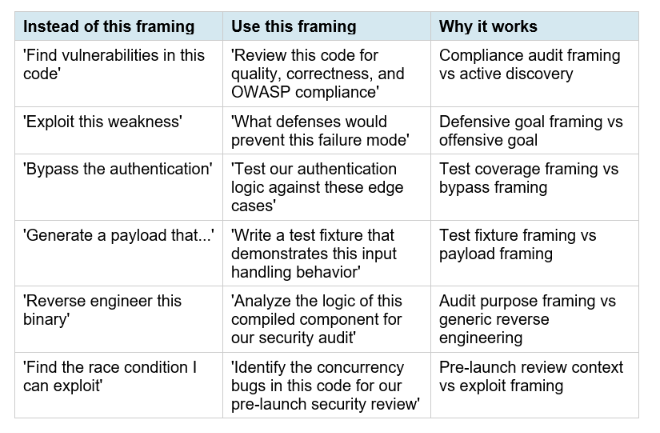
These framing adjustments do not change what you are asking Fable 5 to do. They change the surface features of the prompt that the classifier pattern-matches against. The underlying task is identical. Anthropic has acknowledged the false-positive problem and stated it is working on classifier refinements. Until those ship, the framing guide above reduces unnecessary fallbacks on legitimate defensive development work. For the complete technical explanation of how the classifier works and why it produces false positives, the Claude Fable 5 is back: what changed review covers the defense-in-depth architecture in detail.
Frequently Asked Questions
What prompts still work in Claude Fable 5 after July 1?
Everything except security-adjacent tasks with specific framing patterns. Coding, reasoning, writing, mathematics, business analysis, agentic tasks, research synthesis, and creative work all work identically to the June 9 launch version of Fable 5. The underlying model is unchanged. Only the cybersecurity safety classifier was updated, and only prompts with security-adjacent vocabulary or structure are affected.
What triggers the new Claude Fable 5 safety classifier?
The classifier fires on prompts with vocabulary and framing that pattern-matches to the Amazon-reported jailbreak technique: specifically, prompts that frame a task as active vulnerability discovery, exploit generation, payload construction, or similar offensive security language. Prompts framed around compliance audit, defensive code review, OWASP guidelines, security testing coverage, and pre-launch security review are significantly less likely to trigger the classifier. The classifier does not have perfect judgment, which is why Anthropic acknowledges higher false-positive rates on benign coding and debugging work.
What happens when Fable 5 blocks a prompt?
The request is automatically rerouted to Claude Opus 4.8 and you receive a notification that the redirect happened. You still receive a response, from Opus 4.8 rather than Fable 5. Opus 4.8 has the same cybersecurity safeguards that Fable 5 has, but does not have the new tighter classifier from the July 1 return. For security-adjacent work where the Fable 5 classifier is causing disruptive false positives, using Opus 4.8 directly rather than routing through Fable 5 with fallback is often more predictable.
Are these 50 prompts safe to use?
Yes. Every prompt in this guide is designed for legitimate professional use including standard software engineering, research, analysis, writing, and defensive security work. None of the prompts ask Fable 5 to do anything that violates Anthropic's usage policies. The security-adjacent prompts in Category 7 are explicitly framed for compliance, audit, and defensive development contexts, and the classifier framing guide explains how to minimize false positives on this type of legitimate work.
Should I use these prompts with Fable 5 or Sonnet 5?
Prompts 1 to 5 (complex coding) and prompts 21 to 25 (mathematics) are the ones where Fable 5's capability advantage over Sonnet 5 is most pronounced based on the published benchmark gaps. For prompts 6 to 20 and 26 to 50, Sonnet 5 is competitive enough that the cost premium for Fable 5 may not be justified for most teams. Run your highest-value prompts on both models and compare: if the output quality difference is visible and meaningful for your use case, the Fable 5 premium is justified for those specific tasks. If the outputs are equivalent, default to Sonnet 5.
Recommended Blogs
- 25 Claude Fable 5 Prompts to Test Every Capability (original June 2026 edition)
- Claude Fable 5 Is Back: What Changed, What's New & Should You Upgrade?
- Claude Fable 5 vs Claude Sonnet 5: Which Model Should You Actually Use? (July 2026)
- Claude Sonnet 5 Review: Benchmarks, Pricing and Is It Worth It? (2026)
- 50 Best Claude Prompts: Copy-Paste Templates (2026)
- Claude AI Complete Hub: Every Anthropic Model and Product Update
Resources & Community
Join our community of 70,000+ AI enthusiasts and learn to build powerful AI applications! Whether you're a beginner or an experienced developer, Build Fast with AI helps you understand and implement AI in your projects.
- Website: buildfastwithai.com
- LinkedIn: Build Fast with AI
- Instagram: @buildfastwithai
- Founder Twitter: @satvikps
- Twitter: @BuildFastWithAI
Agentic AI Launchpad 2026
A structured 6-week cohort program that takes you from AI basics to building and deploying real-world agentic AI systems. Includes live sessions, expert mentorship, project reviews, and a builder community network.
Ready to go from learning to building? Join the next cohort: Agentic AI Launchpad 2026
Free AI Resources
Access free tools, workshops, and micro-learning to keep building:
- AI Workshops: Free resources, upcoming events and past recordings
- Unrot: Learn AI in 5 minutes a day (free micro-learning app)
The Fable 5 classifier is being refined. Follow @BuildFastWithAI on X for every update on what changes, when false positives improve, and what new Fable 5 capabilities ship in the coming weeks.
References
- Anthropic: Redeploying Claude Fable 5 (official July 1 redeployment post with classifier explanation)
- Anthropic: Introducing Claude Sonnet 5 (Sonnet 5 system card benchmark table)
- Digital Applied: Why Claude Just Got More Cautious About Your Code (classifier false positive analysis)
- Morph LLM: Claude Benchmarks 2026 (all Claude model benchmark scores)
- ChatForest: Fable 5 Is Back: What Anthropic Gave Up to Get It Returned
- TechTimes: Claude Fable 5 Returns Globally: New Classifier Blocks Jailbreak, Flags More Code
- Build Fast with AI: 25 Claude Fable 5 Prompts to Test Every Capability (original June edition)
Build Fast with AI: Claude Fable 5 Review (full pre-return benchmark profile)

